
Dubai has never been shy about its restaurants: grand openings, imported celebrity chefs, dining rooms with seating capacities of 400, and décor that feels like the sets from a movie. Dubai is good at this sort of thing, and good at this sort of thing is an understatement. Which is why it is so intriguing that one of Dubai’s most talked about, most awarded, and most beloved restaurants is tucked away in a leafy corner of Al Barari, off the beaten path, with a seating capacity that is but a fraction of what most restaurants in Dubai would consider viable, and operates with a team that refuses to open more than five days a week.
LOWE is not what Dubai does. That, entirely, is the point.
How It Started: A Love Story With an Unlikely Plot Twist
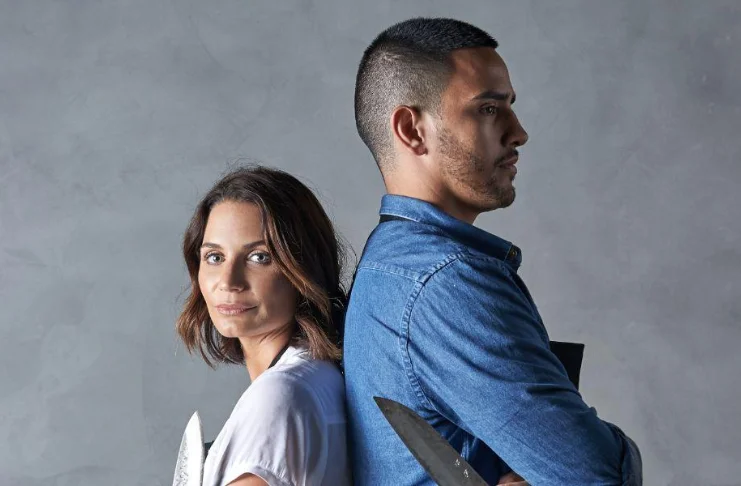
The story of the origins of LOWE is almost like fate, coupled with good timing. Kate Christou, who was born and brought up in Australia, trained initially as an environmental journalist in London. She moved to Berlin, where she could not work as a journalist without speaking the language. She ended up in the kitchen instead. She worked at a Michelin-starred restaurant. She moved back to Melbourne and joined what she called her “dream restaurant.” It was there that she met her soon-to-be husband, Jesse Blake, who was also a chef.
In 2017, Mohammed bin Zaal, an Emirati entrepreneur, made contact. He was developing Koa Canvas, a creative living community located adjacent to Al Barari in Dubai. He had a very specific idea in mind. As quoted in the Khaleej Times, “We were given free rein. We were told to open a concept that would change the food scene in Dubai.” Kate and Jesse agreed. Two years later, in 2019, LOWE was born.
The name itself is not an accident. Low intervention. Low waste. Low ego. Let the food speak for itself. The phrase “let the food speak for itself,” as quoted in The National at the time of the restaurant’s launch, is the founding premise, and it has never wavered.
The Room, the Fire, the Philosophy
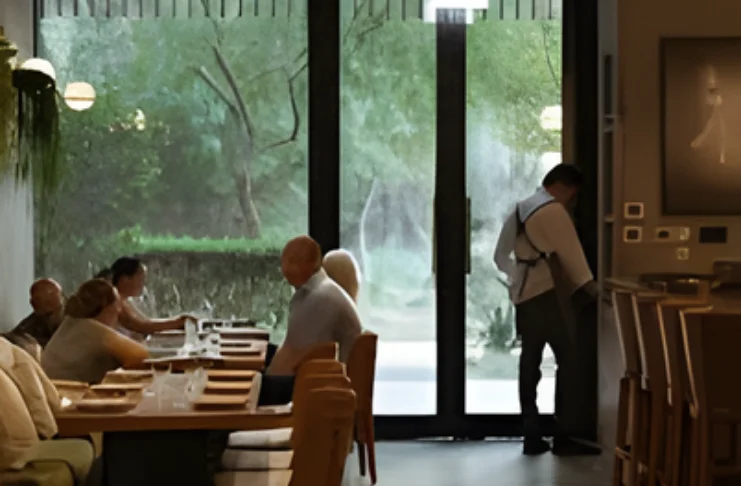
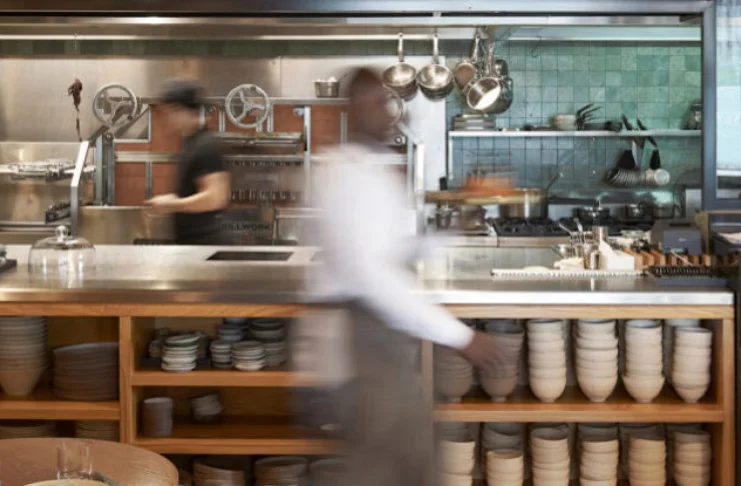
Step into LOWE, and you immediately know what they’re about. Wood, concrete, clean lines. An open kitchen where a wood-fired oven, a grill, and a rotisserie sit front and center. No chandeliers to compete for your attention, no tableside performances to ensure you video them. Theatrics here come in one form, and one form only: fire.
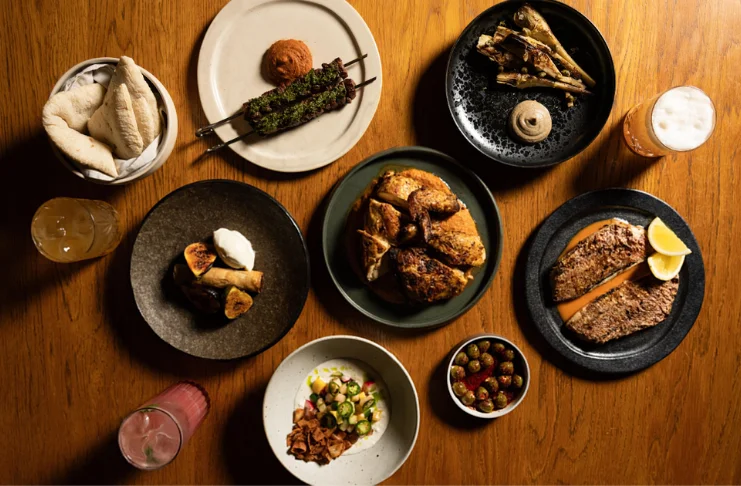
Their menu comes from everywhere and nowhere, a true global palate based on what’s locally in season, swimming, or grazing. Their lobster Benedict with kale hollandaise, salsa fresca, and espelette pepper has become a breakfast phenomenon. Their smoked organic beef tartare with artichoke crisps and soured onion makes you feel smart for ordering it. Their whole roasted local sole with curry leaves and caper butter vinaigrette? A must, according to the Michelin Guide. The menu here is always changing, tied to what’s in season and what the chefs can come up with. But it’s not this, however, that LOWE is most about.
The Green Star: A Distinction That Actually Means Something
In 2022, when the Michelin Guide awarded LOWE the Green Star, this was especially the case. The Green Star is not awarded for a beautiful dish, nor is it awarded for a beautiful room. It is awarded for a verified and uncompromising commitment to sustainability. LOWE was the first restaurant in the UAE to be awarded this honor and has continued to hold the award in 2023.
The restaurant closes on Mondays and Tuesdays in the interest of saving energy. Any food that is left over and cannot be used in another dish goes directly into the compost pile, which becomes fertilizer for the LOWE garden. Nose-to-tail cooking and the creative use of vegetable off-cuts have become part of the way the LOWE kitchen thinks.
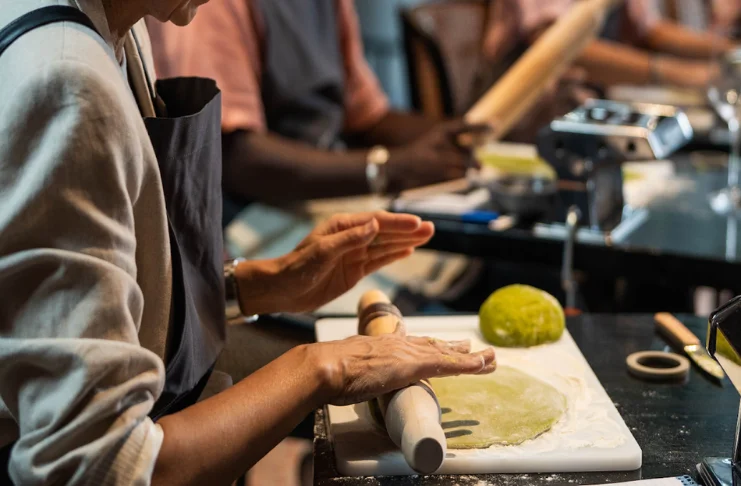
The “Waste NOT” dinners are perhaps LOWE’s most radical act. Eight to ten courses built entirely from ingredients that would otherwise have been discarded over the previous month. Potato peelings become ice cream. Fruit rinds find a second life. The bones go to the garden. Practically nothing leaves the building as rubbish.
The Chef at the Pass Now
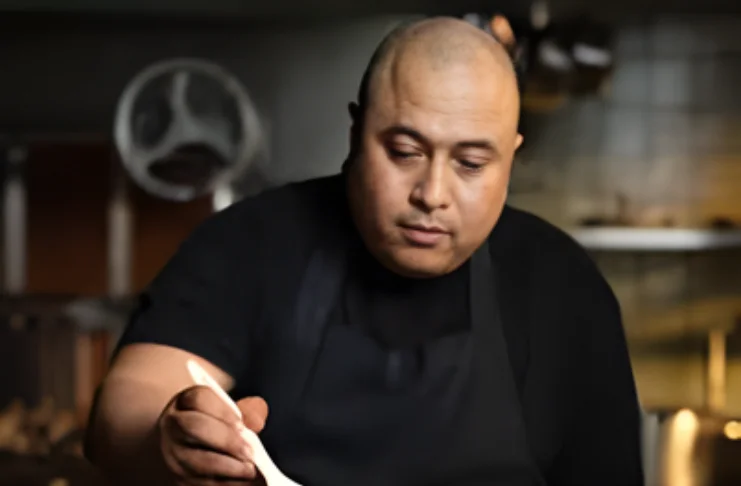
Jesse and Kate were the founders, but the kitchen now belongs to Chef Ali Shiddique Samsi, a Singaporean-born chef who came to LOWE after helping launch 11 Woodfire, which made its MENA 50 Best debut in 2023. At LOWE, Ali combines his culinary passion with the restaurant’s deeply ingrained sustainability philosophy that earned it the inaugural Sustainable Restaurant Award in 2022.
Ali was born in Singapore to a humble background, knew from a very young age that he wanted to cook, and has a kitchen philosophy that perfectly complements the LOWE philosophy. His food is all about the hyper-local: the Gulf’s rich seafood, UAE-grown produce, and the rich traditions of spices from the region, all coming together in a menu that is both cosmopolitan and local. As restaurant manager Zachary Roy has described LOWE’s kitchen approach to Gulf News: “We don’t like to waste anything. We took the peelings from the potatoes for our French fries, and our chef turned them into a potato ice cream. We recycle everything we have. We make sure that our footprint is as little as possible.”
Community is yet another language that Ali is fluent in. They have had an open call to home cooks in the neighbourhood to submit their recipes that could potentially feature on the menu, an approach that is at once generous but also rather unusual for a restaurant of this calibre.
What LOWE Proves
LOWE did not arrive to instant fanfare. A new concept, in an unfamiliar location, in a city accustomed to grandeur, took time to find its audience. And then, just as it did, the world shut down.
Kate described the moment in Khaleej Times: “We were devastated. It was such a difficult time for us. I remember crying, thinking that all our hard work was just gone.” With the Al Barari location making delivery impractical, the team waited. When Dubai began to reopen, they returned, serving just two days a week before gradually building back up. “I think the pandemic was a great time for us to learn and re-evaluate ourselves,” she said.
What came out of that period, if anything, was a clearer and more confident expression of the original concept. The kitchen garden developed. The composting process was codified. The “Waste NOT” dinners commenced. The recognition from the Michelin guide materialized. MENA’s 50 Best Restaurants listed LOWE at number 35 in 2024. It recognized LOWE as the best breakfast destination in the city, serious at lunch, and serious at dinner.
There is a LOWE that could have been co-opted. Sustainability as a branding tool. Fire cooking is a form of entertainment. Neighborhood location as a marketing ploy. What makes the restaurant remarkable is that you don’t see any of this. You see a belief.
The World’s 50 Best Discovery put it plainly: “Lowe stands out from the crowd with its commitment to sustainability: a kitchen garden, nose-to-tail cooking and creative use of vegetable off-cuts make each meal here an unforgettable experience.”
In a dining city that still measures its ambition in spectacle, LOWE is making a quieter, more durable argument. The most interesting food comes from restraint. That waste is a creative problem, not just an ethical one, that a restaurant can be excellent and responsible in the same breath, without sacrificing either.
It is located 30 minutes from Downtown Dubai. The drive, everyone agrees, is worth it.