
Every technology leader knows the drill. You’ve identified the perfect solution. It solves a real problem. The vendor checks out. Your team is ready. Then you walk into the CFO’s office, and the question comes: “What’s the ROI?”
If you’re lucky, they ask about ROI. If you’re not, they just say “no budget,” and the conversation ends there.
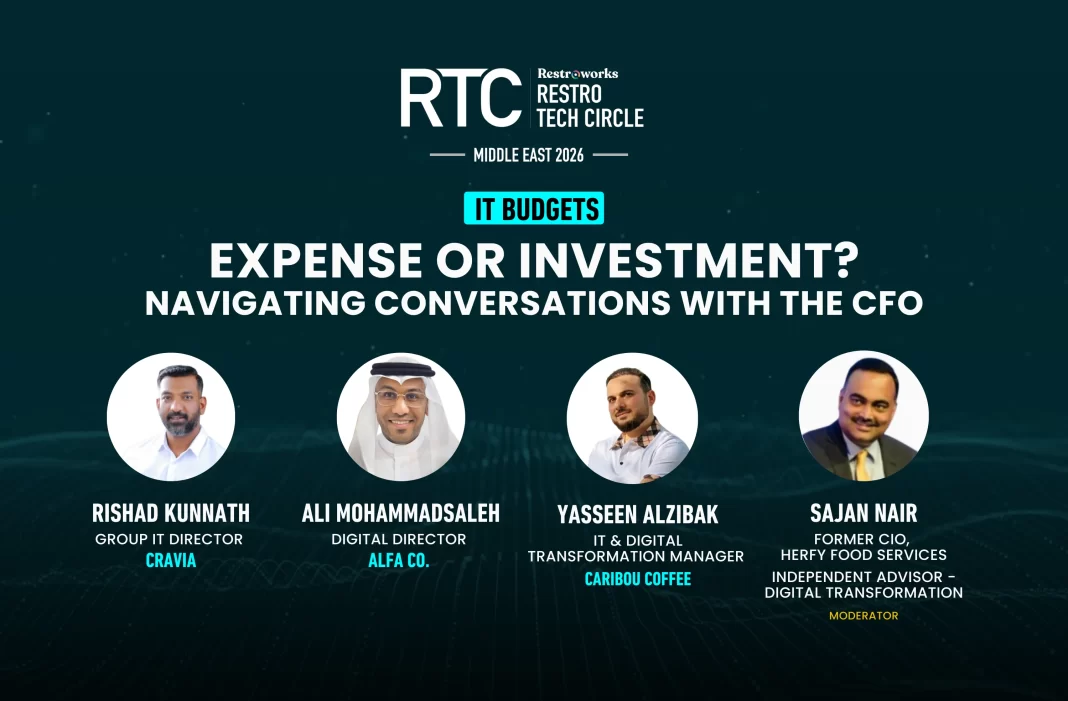
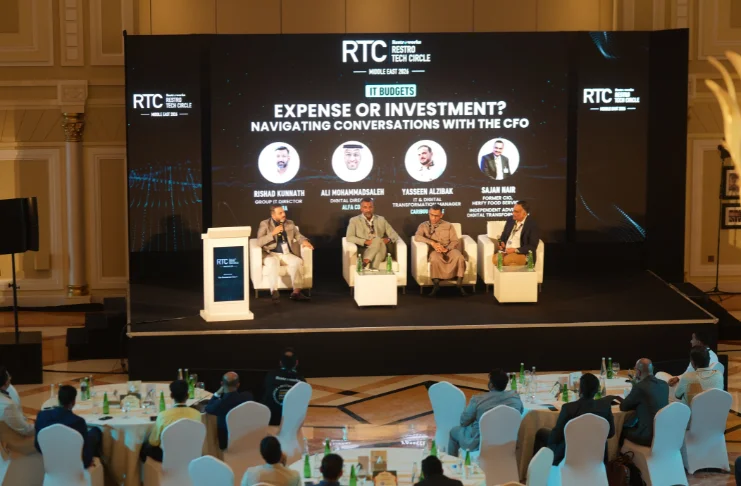
At the RestroTech Circle Middle East 2026 vernissage on “Different ways that IT Leaders can make technology investment a value driver,” the opening panel discussion addressed the age-old challenge of how IT leaders shift their worldview of technology spending from a cost center to a value driver.
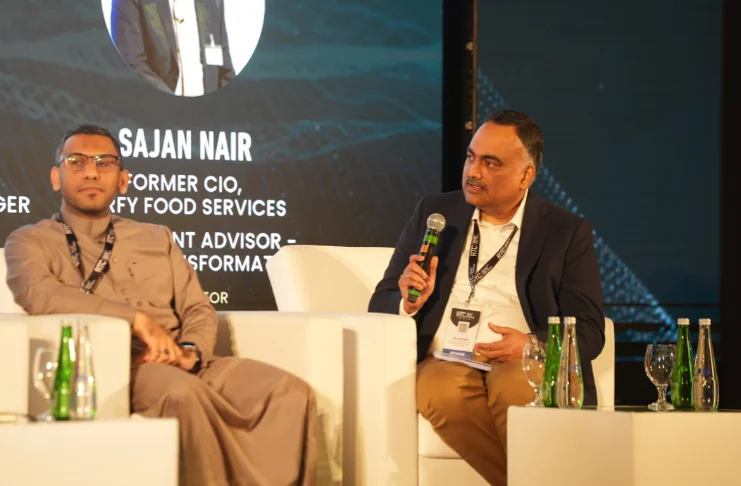
Panel moderator Sajan Nair, former CIO at Herfy Food Services, was joined by Rishad Kunnath from Cravia, Ali Mohammad Saleh from Alfa Co., and Yasseen Alzibak from Caribou Coffee (UAE).
What emerged wasn’t a playbook for easy approvals—because those don’t exist—but a set of hard-won strategies from leaders who’ve had to justify every riyal, every project, every line item in boardrooms where finance holds the power.
The Free Software That Costs You Everything
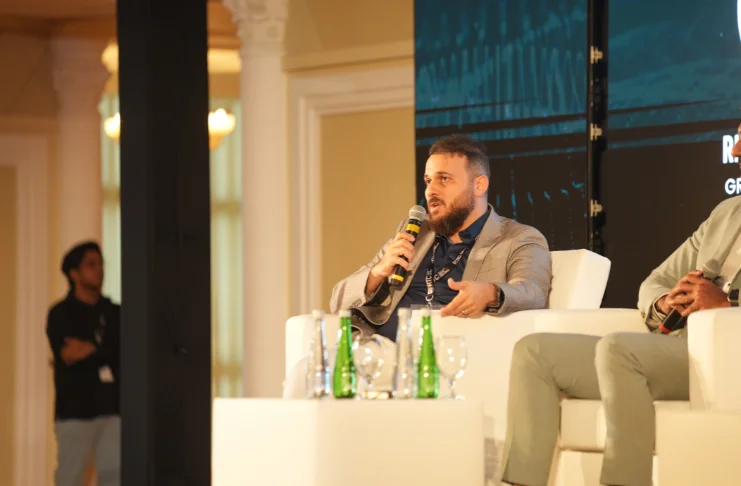
Yasseen opened with a story that resonates across the industry. His team was running outdated software, not free, but fully depreciated and no longer supported. On paper, it costs nothing. In reality, it was a ticking time bomb.
“The parent company of that system has already closed,” Yasseen explained. “How would you get support? It’s just a time bomb that will blow in your face. Imagine yourself five days without a system, what will happen?”
This is the hidden cost that finance teams often miss. Depreciated software looks like a gift in budget reviews. But when it fails during peak hours, New Year’s Eve, a major holiday, a critical rush, the cost isn’t just downtime. It’s lost sales, frustrated customers, staff working manually, and potential theft when systems are down.
Yasseen’s approach: quantify the risk. “You have to build your own business case. You’ll get a system, but if you don’t use it, what justified your investment? You have to prove the system is working continuously.”
The key insight: free software isn’t free if it puts your operation at risk. The question isn’t what the software costs, it’s what system failure will cost when (not if) it happens.
The Europe vs. Middle East Budget Reality
Rishad brought a unique perspective, having worked in both European and Middle Eastern markets. The difference isn’t just procedural, it’s cultural.
“In Europe, very well-structured planning happens ahead of time, starting from Q4 itself,” he explained. “You work on ‘working backward documents’, you clearly say to management what issues you’re solving, what improvements you’re bringing, what customer-centric value you’re adding.”
The European model is data-driven and documentation-heavy. If you can articulate the value clearly, with supporting data, budget approval follows a relatively predictable path.
The Middle East operates differently. “There’s not a clear planning process for the whole year or budget level,” Rishad noted. “It’s harder to convince CFOs. However, if you come with data, management will say okay to the project.”
The critical difference: management isn’t against technology or innovation. “They’re more worried about the success factor, the adoption rate,” Rishad emphasized. “Most IT projects fail because they’re poorly planned with minimal change management.”
He cited a McKinsey study from 2008-2009 showing that half of technology projects fail due to poor planning. That’s the legacy IT leaders are fighting against. CFOs aren’t being difficult; they’re being realistic about historical failure rates.
The solution isn’t better sales pitches. It’s a better execution and proof of competence.
When Customers Drive the Budget
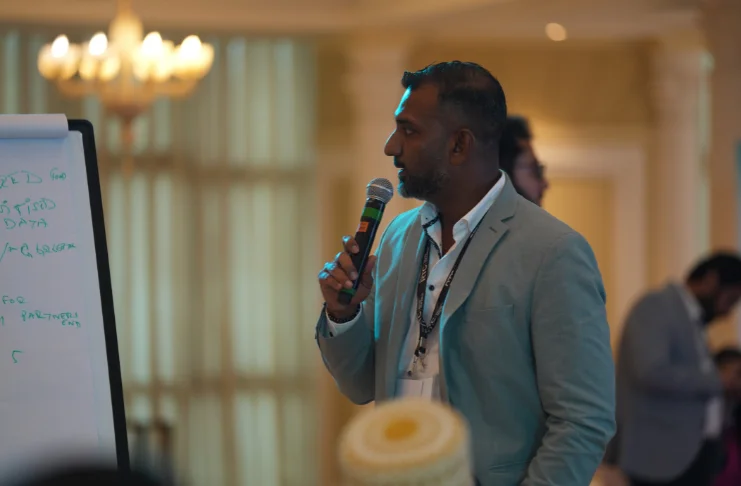
Ali reframed the entire conversation by pointing out an uncomfortable truth: in B2C restaurants, customers are making technology decisions whether you’re ready or not.
“Customers are demanding features,” he explained. “If you don’t deliver loyalty engines, kiosks, and new ways of online ordering, you’ll lack attraction to customers. Customers are asking for features, which makes management believe we need to add new digital applications.”
This shifts the budget conversation from IT expense to competitive necessity. When customers expect certain capabilities—mobile ordering, personalized experiences, seamless payment—the question isn’t whether to invest. It’s whether you can afford not to.
Ali described how this reality shapes annual planning at Alfa Co: “The annual operating plan will always have what IT will deliver to the company in the new year. This is aligned at the management level; it will deliver new features to customers, which will bring growth to the business.”
But here’s the challenge: not every project delivers obvious ROI. Ali gave the example of greeting robots deployed in some restaurants. “The robot is not easy to give ROI for—it’s just a greeting robot. But many customers come to take photos with that robot. You grab customers by having that experience.”
This is where creative budgeting comes in. If you save $70,000 by developing a music streaming solution in-house instead of paying a vendor, you can redirect those savings to customer-facing innovations that drive traffic, even if the direct ROI is unclear.
The principle: find savings in operational technology to fund investments in customer experience.
The Pilot That Proved Itself
One of the most effective strategies discussed was using free pilots to demonstrate value before requesting a budget.
Ali shared a case study: “A startup in Saudi Arabia came to us last year offering digital checklists and knowledge resource platforms. They said, ‘We’re a startup, you have many brands, we’ll give you the software free for the first year and additional discounts for the next three years.’ We said okay, we won’t lose anything. We tried it, and it worked very well. Now management is convinced—we’ll pay this year.”
This approach de-risks technology adoption in multiple ways. First, it eliminates the upfront cost barrier. Second, it provides proof of value before commitment. Third, it builds confidence in finance that the solution actually works in your environment.
Ali also described implementing RPA (robotic process automation) in the finance department, specifically to convince the CFO: “We took the finance reconciliation process. It costs 50,000 riyals for four processes. Finance didn’t initially accept that cost, but they realized after running it that they saved hundreds of hours.”
The strategic choice to start in finance was deliberate. “We will not do it in any other department; we need to convince them first.” When the CFO sees direct benefit to their own team, approval for broader technology initiatives becomes significantly easier.
The Support Factor
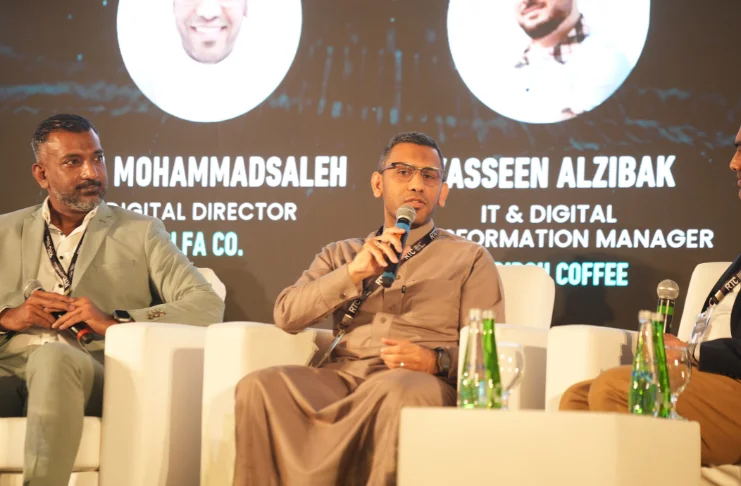
When discussing vendor selection, Yasseen was emphatic about what matters most: “It’s always about support. The decisive factors are support, service speed, and the release schedule. Support is the backbone of the system. If there is no support, the system will fall.”
This often gets overlooked in procurement processes that focus on feature comparisons and pricing. Yet every technology leader has war stories about vendors who disappeared after the sale or couldn’t provide support when systems failed during critical periods.
Yasseen described his evaluation process: “You have to check all the products in the market, sit with actual clients of these system providers, understand what they enjoy, what their pain points are.”
The Middle East context makes support even more critical. When you’re running operations across multiple countries and time zones, waiting for business hours in another continent isn’t an option. You need responsive, knowledgeable support available when problems happen—which is usually during your busiest periods.
Beyond support, Yasseen emphasized the importance of stakeholder buy-in: “You are not working alone. You are a team providing service to the company. Always have someone to back you up with your project, whether finance, supply chain, or marketing.”
Technology projects fail when they’re seen as IT initiatives rather than business initiatives. The solution isn’t better technology, it’s better alignment with the people who will use it and benefit from it.
The Phased Investment Strategy
An audience question raised an approach gaining traction: phased investments and staged approvals rather than requesting full project budgets upfront.
Rishad acknowledged the merit: “There are certain products where minimal liabilities make sense, no long-term commitments that we can’t exit from. For services where you’re not sure how they’ll work in your organization, I recommend minimal commitment.”
However, he drew a distinction: “Core products like Microsoft or Google, we can do an evaluation for the longer run. But certain elements where you’re uncertain, we can go for minimal liabilities.”
The strategic principle: differentiate between foundational infrastructure that requires long-term commitment and experimental initiatives that require flexibility to course-correct or exit.
This also addresses the geopolitical uncertainties that can affect Middle East operations. Rishad referenced evacuation planning scenarios in Europe where the ability to rapidly scale down became critical. “Certain times it’s always good to go for phased approaches or minimal liabilities, even in the IT structure itself.”
The Projects You Can’t Quantify
Perhaps the most difficult challenge: justifying investments that don’t deliver obvious ROI but are necessary for operational stability or compliance.
An audience member asked directly: “Part of your budget is IT-driven projects where there’s no direct business benefit, or you cannot justify ROI. How do you justify those to business?”
Yasseen’s response cut to the practical reality: “It depends on your type. If you cannot measure ROI, what type of service are you providing? One approach is to reevaluate your existing services, your outdated services, present cost savings, or reinvest from cheaper solutions you develop internally.”
But he also acknowledged some projects can’t be cost-justified: “You have to find the stakeholder who requested that service. Is it you or someone else?”
For truly IT-driven infrastructure projects, he suggested two approaches: demonstrate that competitors or industry standards require it, or categorize it as research and development with acknowledged uncertainty about returns.
The underlying message: every project should have a business sponsor. If IT is the only stakeholder, that’s a red flag that either the project isn’t necessary, or you haven’t articulated the value correctly.
Building Credibility Through Execution
Rishad emphasized a crucial but often overlooked factor: credibility.
“We create steering committees where the CFO or CEO is the funder for projects. There are clear metrics and a clear roadmap to drive the projects,” he explained. “Clear definition of each department’s requirements, weekly catch-ups, which make sure projects go in the right direction.”
This disciplined approach isn’t just about project management. It’s about building trust. When you consistently deliver projects on time, within budget, and with measurable results, future budget requests get easier.
Conversely, failed projects make every subsequent request harder. This is why Rishad stressed success rates: “Touch wood, the last nine months I’ve been driving several projects with a success rate of 95%.”
That track record becomes currency in budget conversations. When you can point to consistent execution, CFOs start viewing technology investments as reliable rather than risky.
The Evaluation Framework That Actually Works
Rishad outlined a structured vendor evaluation approach used at Cravia: “Half the weightage goes to business, what are the use cases? Then, if it’s IT-related, we play a key role. Then commercial factors. We evaluate based on each section: 50 for business cases, 25 for technology, 25 for commercials, plus non-negotiable factors from cross-functional departments.”
This multi-dimensional framework prevents the common trap of choosing vendors based purely on features or price. By forcing explicit consideration of business impact, technical fit, and commercial terms, you surface trade-offs before they become problems.
Ali added an important perspective on architecture: “Simplicity of structure matters. I have a middle layer between POS and delivery aggregators, but if a solution can do direct integration, that’s better. It reduces dependencies on other partners.”
Every additional integration point, every middleware layer, every custom connector is a potential failure point. Simpler architectures aren’t just easier to manage; they’re more reliable and typically cheaper to operate over time.
What Finance Really Wants to Hear
The live survey during the panel asked: “What convinces a CFO the fastest to approve IT spend?”
The top answers: higher revenue, faster payback, and lower risk.
These aren’t surprising, but they reveal an important truth: CFOs aren’t anti-technology. They’re pro-value and anti-waste. They want to invest in initiatives that grow the business, pay for themselves quickly, or reduce exposure to operational risk.
The challenge for IT leaders is translating technical benefits into these business outcomes. Cloud migration might enable scalability, but what CFOs hear is “higher revenue potential from new locations.” Better POS integration might reduce manual reconciliation, but what CFOs care about is “faster month-end close and reduced risk of financial errors.”
As Ali summarized in his key learning: “Have direct alignment with finance. Finance has to always be aligned with IT. No money, no solution. Be friends with the CFO.”
That friendship isn’t built on charm. It’s built on speaking the language of business outcomes and consistently delivering results.
The Insight You Can’t Skip
Yasseen provided perhaps the most important takeaway: “Always present your case with the rest of your departments. You are not working alone. You are a team providing service to the company. Always have someone to back you up, whether in finance, supply chain, or marketing. There is always some merit in any service you’re investing in.”
Technology projects succeed or fail based on organizational readiness, not technical capability. The best solution in the world will fail if the people who need to use it aren’t prepared, trained, and committed.
This is why pilots matter. This is why stakeholder buy-in matters. This is why support matters. Technology isn’t the product you buy; it’s the change you implement across your organization.
The Budget Reality
No attendees left the panel believing that boardroom approvals for technology budgets would suddenly be easy to obtain. However, patterns that were brought out during the discussions on the panel included:
- Focus on data: Quantify the benefits of investing in technology and the costs of not investing in it.
- Use pilot projects to demonstrate Return on Investment (ROI) while reducing exposure to the organization.
- Grow credibility through consistent delivery of technology products.
- Align with the business unit that receives a benefit from that technology;
- Select your technology vendor based on their level of service and architectural ability to integrate with your existing technology, and not only based on their individual features; and
- Frame the investment in technology as enhancements in revenues, reductions in costs, and mitigation of risks.
- Understand that technology budgets are not awarded in boardrooms but will continue to be awarded based on the above considerations. They’re won through daily execution that demonstrates IT’s value to the business.
As Rishad noted, learning never stops in IT. “Every day there is a learning opportunity. If you structure it so every learning becomes an outcome of a growth phase, you will learn something every day.”
The IT leaders who get budgets approved aren’t necessarily the ones with the best presentations. They’re the ones who’ve proven, project after project, that they can translate technology investments into business results.
In a region scaling as fast as the Middle East, that credibility is the only currency that matters.