



The world has always believed women belong in the kitchen, just not at the top of it. This International Women’s Day, we dig into the contradiction, celebrate the trailblazers, and ask: what will it take for the industry to actually change?
Let’s start with a question (that technically shouldn’t even be an issue in the first place): If women are traditionally regarded as the ones who cook (be it the home cooks, the nurturers, the ones who keep families fed), why is it that when cooking becomes a profession, suddenly men seem to take over?
Even the numbers are hard to argue with.
Women represent about 25% of chefs globally. That alone should give you pause. But here’s more:
- Only 6% of Michelin-starred restaurants worldwide are led by female chefs.
- 65% of culinary school graduates are women, yet they hold only about 15% of head chef roles.
- 79% of chefs and head cooks globally are male, while women represent only about 19%.
“I’m actually surprised it’s so high. I would have said it’s lower.” – Chef Ana Roš, Hiša Franko.
Ana Roš, whose two-Michelin-starred restaurant Hiša Franko has helped put Slovenia on the global culinary map, was in fact surprised that the number wasn’t worse.
How Did We Get Here?
The story of women and professional kitchens is, at its core, a story about who gets to be taken seriously.
For centuries, cooking at home was considered women’s work, i.e., invisible, uncompensated, and expected. But as soon as cooking became a profession with wages, status, and acclaim attached, the dynamic flipped. Professional kitchens became male domains. The brigade system, modelled on military hierarchy, didn’t exactly roll out the welcome mat. The hours were punishing. The culture was often bruising.
And for a long time, society’s expectation that women would be the primary caregivers at home collided head-on with the demands of a professional kitchen.
Chef Heidi Bjerkan, one of only two female chefs running a Michelin-starred restaurant in all of Scandinavia, says:
“Fine dining requires a lot of time and dedication, and it is hard to combine with family life.”
The result? Across the broader hospitality industry, women make up 54% of the workforce but hold only about 31.7% of leadership positions, with a mere 7% of CEO roles, and 27% board seats. For every 16 male CEOs in hospitality, there is one female CEO.
Signs of Change And Why They’re Not Enough Yet
To be fair, things are changing for the better, albeit slowly.
More Women Are Entering Professional Kitchens
In the UK, the number of female chefs has grown by about a third since 2016, and women now make up roughly a quarter of the culinary workforce. Culinary institutes around the world are reporting 40–45% female student enrollment. That’s nearly half.
The Industry is Starting to Take DEI Seriously
Research shows that 85% of restaurant managers now believe diversity initiatives improve team performance. Participation in culinary DEI initiatives rose by 45% between 2020 and 2023. Inclusion-focused hiring practices have led to a 25% increase in employee retention in some hospitality businesses.
Companies are now starting to understand what researchers have been saying for years: diverse leadership teams are more profitable, more innovative, and better at anticipating where the market is going.
As Rachel Humphrey, Founder of the Women in Hospitality Leadership Alliance, has noted, companies with high female leadership are 25% more likely to achieve above-average profitability, and diverse teams make better decisions 87% of the time.
But Structural Change Has Not Caught Up

Women in hospitality continue to face a gender pay gap. A 2023 report by WiHTL and PwC UK found the gap had widened from 4.2% to 5.2% in a single year. Women in tourism earn on average 14.7% less than men, largely because men disproportionately hold the higher-paying senior roles.
The networking problem is real, too. Traditional networks (the golf course, the exclusive retreat, the male-dominated conference) still shape who gets the call when a new opportunity opens up.
Anna Blue, advisor to the Women in Hospitality Leadership Alliance, puts: success in hospitality isn’t just about skill. It’s about who knows you and who advocates for you.
10 Women Who Are Rewriting the System
Across the world, female chefs, restaurateurs, and leaders are succeeding on their own terms, in a system that wasn’t designed for them, and making it easier for the women coming behind them. Here are ten whose stories deserve to be told.
1. Dominique Crenn
Dominique Crenn was the first female chef in the United States to earn three Michelin stars, for her restaurant Atelier Crenn in San Francisco.
A cancer survivor, activist, author, and speaker, she has spent years using her platform to advocate for gender equity, climate consciousness, and systemic change in the restaurant industry.
Fun Fact: Atelier Crenn is also the first three-Michelin-star restaurant in the U.S. to serve a fully pescatarian menu.
2. Sherry Pocknett
What does it mean to cook as an act of resistance? Ask Sherry Pocknett.
As a member of the Mashpee Wampanoag Tribe, she opened Sly Fox Den Too to bring back the food, ingredients, knowledge, and memories that colonization had tried to erase.
In 2023, the culinary world caught up to this revolution, and Pocknett became the first Indigenous woman to win the James Beard Award for Best Chef in the Northeast. Historic, yes. Overdue, absolutely.
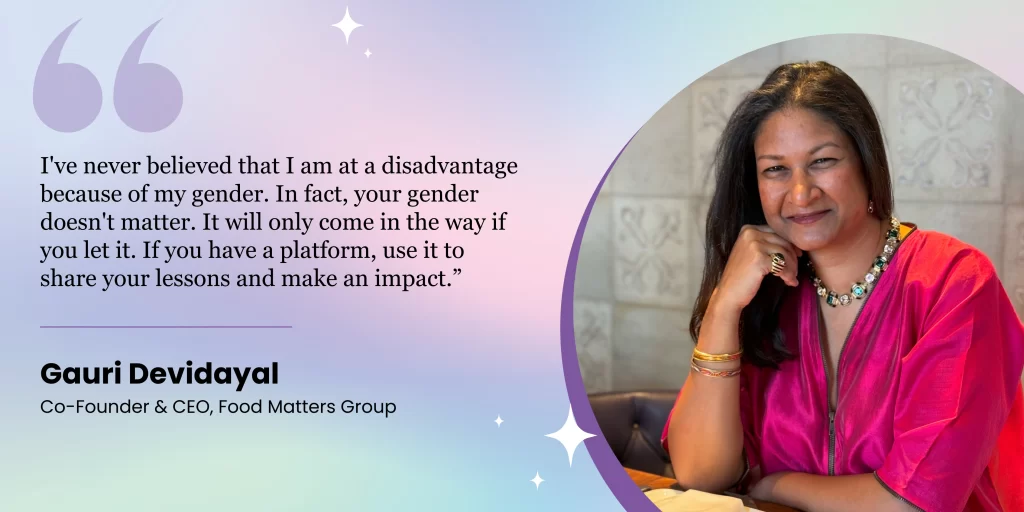
3. Gauri Devidayal
A chartered accountant by profession, Gauri Devidayal is set to redefine what dining out could mean in India.
As co-founder of the Food Matters Group (the team behind The Table, Iktara, and a string of other beloved restaurants), she brought ingredient-driven, globally informed cooking to Mumbai.
Her aim? Build restaurants people genuinely love, give them time to grow, and believe in what you’re creating. And claim your contribution. As she puts it:
6. Ana Ros
Ana Roš never went to cooking school. She studied diplomacy. She was a competitive alpine skier. Still, somehow, almost by accident, she took over a remote family restaurant in Slovenia and turned it into one of the most celebrated dining destinations in the world.
In fact, she’s also one of the industry’s most outspoken critics of its own culture.
When we quoted her earlier, saying she was surprised the number of female Michelin-starred chefs wasn’t lower, she wasn’t being dismissive. She was being honest about the fact that the problem isn’t only about gender.
“Many young male and female chefs are struggling. The whole system needs to change.” – Chef Ana Roš, Hiša Franko.
5. Natsuko Shoji
Shoji is ‘the Chanel of fine dining.’ And it’s not even an exaggeration.
She trained in pastry, then tried her hand at savory, and somewhere in between, she developed a signature style that blends Japanese seasonality with couture-level technique.
Crowned Asia’s Best Female Chef in 2022, she’s built one of Tokyo’s most talked-about restaurants around an idea that food can be as beautiful, as intentional, and as emotionally resonant as great fashion. The comparison flatters both.
6. Yasmina Hayek
Yasmina Hayek grew up learning the ways of Lebanese hospitality – the kind that’s warm, generous, and absolutely uncompromising about flavour.
At the Em Sherif group, she’s taken that heritage and stretched it into one that works for a global dining room without losing any of its soul.
She is the first woman in the Middle East to win the Michelin Young Chef Award, and was named MENA’s Best Female Chef in 2025.
In a region where female representation in professional kitchens has been historically limited, those firsts carry weight.
Every young woman watching from the sidelines who sees Hayek’s name on a list like this is seeing, perhaps for the first time, that this is a space she could occupy too.
7. Ruchira Hoon
As the chef behind Dakshin, Ruchira Hoon introduced generations of diners to the depth and range of India’s southern kitchens. However, her journey here was never easy.
Time and again, she’s spoken openly about the ugliness that can show up in professional food spaces:

This is Ruchira – bold & unapologetically her.
8. Marlene Vieira & Rita Magro
Portugal’s food scene had a long-overdue moment. And Marlene Vieira and Rita Magro are part of the reason why.
Vieira has spent years mastering and re-mastering Portuguese ingredients and culinary traditions with a thoroughly modern voice. Magro, on the other hand, is one of the country’s most celebrated pastry chefs.
Together, they are the first female Portuguese chefs to earn Michelin stars in three decades.
You heard it – Three decades. In a country with one of the world’s great food cultures, it took 30 years for a woman to be recognised at the top level.
9. Garima Arora
Garima Arora first started out as a journalist. Then she went to culinary school. Then she worked at Noma.
Her career never followed a script, which is perhaps why her cooking doesn’t either.
At Gaa in Bangkok, she earned two Michelin stars, making her the only Indian woman to helm a two-star restaurant. Her menus delve into India’s culinary history through fermentation, indigenous ingredients, and deep research into techniques long-forgotten.
In 2024, she returned to India with Baang – first in Gurgaon, then Mumbai, with Goa to follow.
If the question was ever whether her cooking would translate to a home audience, Baang is the answer: it absolutely does.
10. Alice Waters
Before ‘farm-to-table’ became a thing, Alice Waters was already doing it.
She opened Chez Panisse in Berkeley in 1971 because she genuinely believed that how food is grown matters, that seasons should dictate the menu, and that a cook’s relationship with a farmer is as important as a cook’s relationship with a stove.
That philosophy changed American food culture. It changed how chefs think, how diners eat, how schools approach food, and how agriculture and gastronomy interact.
Waters was the first woman to win the James Beard Award for Outstanding Chef, and she remains, more than fifty years after opening Chez Panisse, one of the most consequential figures in the American food world.
On the High Note
The fallacy embedded in how we think about women and professional cooking is that, though women are good cooks, men make better chefs.
The names we listed above (and many more who deserve to be here) didn’t just fight for the seat, they found their ways around it, through it, and by challenging the very system inside out. The only problem here is – They shouldn’t have had to.
Any kitchen is better when it reflects people who cook, eat, and care about food.
This International Women’s Day, let’s celebrate the women who’ve made it, hold up a mirror to an industry that still has real work to do, and ask it, with some urgency, to get on with it.
Happy International Women’s Day


