

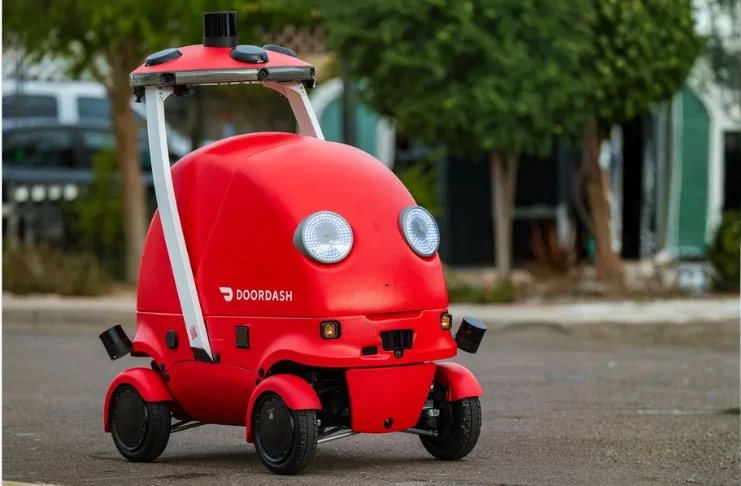

DoorDash is making a bold leap from marketplace to mixed model: the company has unveiled its own fleet of delivery robots, a smart hardware system, and a new “Autonomous Delivery Platform,” signaling that it intends to internalize more of the logistics layer it once outsourced.
- Dot is the robot centerpiece, an in-house autonomous vehicle built to navigate bike lanes, sidewalks, roads, and driveways. It can move at up to 20 mph, and is already being tested in the Phoenix, Arizona metro area.
- DoorDash also introduced SmartScale, a predictive scale designed for merchants to weigh delivery bags pre-dispatch. The goal: reduce “missing-item” claims by matching actual bag weight to expected item weight.
- These innovations are integrated into the Autonomous Delivery Platform, a decision engine that can pick whether a delivery should go via human Dasher, robot (Dot), or even drone in the future, based on cost, distance, and context.
Tony Xu, cofounder and CEO of DoorDash, described, as noted by NRN, the shift by saying the company has grown from a “single restaurant delivery marketplace” into a multi-product, multi-category local commerce platform.
For restaurants, this is more than a robot announcement, it’s a possible shift in cost, commission models, and delivery reliability. By owning the hardware and delivery “last mile” decision tools, DoorDash gains control over margins, service levels, and the data flowing between merchant and consumer.
The risk is high: robotics and autonomous systems have been notoriously difficult in real-world deployment (navigation challenges, vandalism, complex urban environments). But DoorDash may believe its scale, data, and merchant base give it an edge others lacked.
For other delivery platforms and cloud kitchens, this move intensifies pressure to either partner with robotics firms or develop their own tech stack. The competitive frontier is shifting from “fast and cheap delivery” to “smart, reliable, autonomous delivery.”


