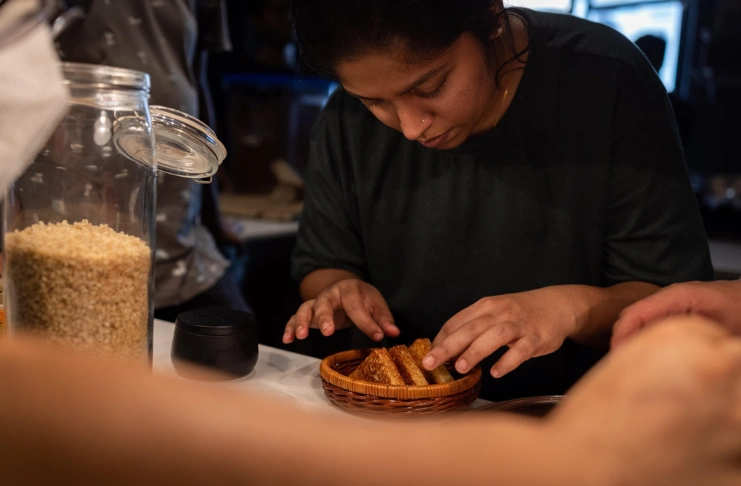
There’s a dish at Ekaa that looks like French toast. It tastes like French toast. But it’s made entirely from potatoes.
This kind of deception (the good kind, the kind that makes you lean back in your chair and laugh at the cleverness of it all) is what happens when a chef stops asking “what should this be” and starts asking “what could this be.”
At 27, Niyati Rao leads that question. As head chef and co-founder of Ekaa, she runs one of Mumbai’s most acclaimed ingredient-first kitchens inside the century-old Kitab Mahal building in Fort.
And that’s not even it. Ekaa is doing something many fine dining restaurants struggle to get right: making you feel like you belong there, even if you’ve never heard of half the ingredients on the plate.
The Superpower Niyati Wanted
Rao has a learning disability. School in ’90s India was brutal for a kid who wasn’t academically strong. Math and science felt impossible. Bullying was constant. But in her family’s kitchen, watching her mother (a food-loving scientist who left her career to raise her kids) cook, she discovered something that didn’t require her to be anyone other than who she was.
She saw that food could end bad days. That it could make people happy. “It felt like a superpower,” she shared with Man’s World. “And I guess I kind of wanted that.”
So she went after it. She trained at the Taj Group of Hotels. Worked at The Zodiac Grill at 20, handling caviar when most people her age were still figuring out how to make rent.
She learned ‘how to respect ingredients’ at Wasabi by Morimoto, where fresh fish arrived from Japan within 24 hours. She learned to experiment wildly and fail publicly at A Reverie in Goa.
And then she got into Noma in Copenhagen (the place every chef dreams of) and learned how to make a kitchen so systematized that everyone moves on autopilot.
The India Nobody’s Tasting
When COVID hit, Rao was unemployed and back in India. “Forget jobs, people were being laid off,” she told Elle Gourmet. Then came a Facebook message from Sagar Neve, a restaurateur she’d worked with before. They kept talking through lockdown, brainstorming about the same thing: India has infinite ingredients, and nobody’s really celebrating them. Not in the way they could be.
So they spent a year and a half in research and development. They sourced Indian sea urchin from a small fishing village in the south, where locals were using the shells to make lanterns. They worked with Kashmiri fishermen for a full year to source rainbow trout eggs, teaching them when to harvest the roe. They foraged naga pepper, one of the rarest ingredients in the world. They introduced Indian durian to the Indian market.
The menu at Ekaa doesn’t tell you what cuisine you’re eating. It tells you what ingredient you’re about to experience. Eggplant comes with fermented chili marinade, pomegranate salsa, and lime. Needle fish (the last thing to sell in a Koli fisherman’s basket) gets fried and served in a steamed bao. A dish called “Tomato, Tomato!” is a direct callback to the tomato soup served on the Rajdhani train in the ’90s.
“If I have cauliflower, what can I do with it?” Rao explains. “Let’s research. Maybe we can come up with something absolutely new. Maybe 30 years from now, somebody will mix and match and come up with their own version of it. But creating that baseline, creating that blueprint is extremely important to me.”
Rao always thought she’d open her first restaurant when she was 32. She told her mother this all the time. Then Ekaa opened when she was 27. Life, as she says, works in mysterious ways.
Memory Is the Secret Ingredient
Nostalgia drives everything at Ekaa. One course is called Chuski, which is similar to those Pepsi or cola ice pops you’d buy after school. Guests receive a 10-paisa coin at the beginning of the meal. The staff playfully tries to steal it. Then they exchange it for a Chuski made with black raspberries from Mahabaleshwar, basil, and black salt. The joy on people’s faces, Rao says, is priceless.
Another course references Tinkle comics. Sweet Morning (that faux toast made from potato) is about childhood on a crystal plate. When older guests explain these references to younger ones at the table, conversations happen. Connections form. Food becomes more than what’s on the plate.
“Food is memories for me,” Rao shares at Elle. “From a very young age, I’ve seen my family’s lives revolve around food. It was the source of celebrating happiness. I understood that food has an unimaginable impact on situations, feelings, and moods. It can end wars, make people feel things, and remember things they had forgotten.”
She remembers going to the fish market with her father, carrying two large buckets to pick out the best crabs for her mother’s curry. She remembers picking wild mushrooms and berries during monsoons in Mahabaleshwar. Those memories show up in her food now. They’re the reason her 80-year-old Gujarati vegetarian grandmother came to Ekaa and finished a 20-course meal.
Fine Dining That Doesn’t Make You Feel Small
Rao thought about her grandmother when she was curating the menu. If her grandmother could enjoy this food without feeling confused or intimidated, then she would have succeeded. “Fine dining shouldn’t make you feel small,” she says. “It should make you feel happier.”
This matters in India, where the palate is already complex. “We’re not used to monochromatic dishes,” Rao points out. “We don’t boil a single potato and eat it with cream and dill. We know what to eat, when. We like different textures and flavors. We like to tickle our taste buds. Hence, the thali, a type of bento box. We like more things on our plate, we like condiments, we like our pickles.”
The world thinks Indians are fussy eaters, she says. They want their own food, their own spice. “But what they’re doing is breaking monotony on the plate. We can’t eat one large plate of pasta without getting bored after four bites. We need contrast. We need excitement. That’s not fussiness, it’s instinct.”
So Ekaa offers three different menus. The Tapas and bar menu for after-work unwinding. The à la carte menu for people who want to understand what ingredient-first really means. And the tasting menu (currently at 20 courses in its 6.0 iteration called “Awakening”) for people ready to trust Rao completely.
The restaurant is always sold out for tastings. Ekaa was featured on the extended list of Asia’s 50 Best Restaurants at just 14 months old. It secured a spot on the World’s 50 Best list. When Pharrell Williams was in Mumbai recently, Ekaa was where he had dinner. Rao and Neve were included in Forbes’ 30 Under 30.
The Failures That Make the Magic
Not everything works. Rao tells the story of seaweed from Visakhapatnam that worked well in sauce, butter, and stock. Then they tried making seaweed chutney. “We had to wait three days to get that smell out of the kitchen,” she laughs.
But that’s the point. Every dish on the tasting menu spent two years being perfected in R&D. The sea urchin that now sits as decor on a shelf? It’s planned for the Christmas menu, available for just one day, as it comes in limited quantities. “But it’s absolutely brilliant,” Rao told GQ India.
What Comes Next
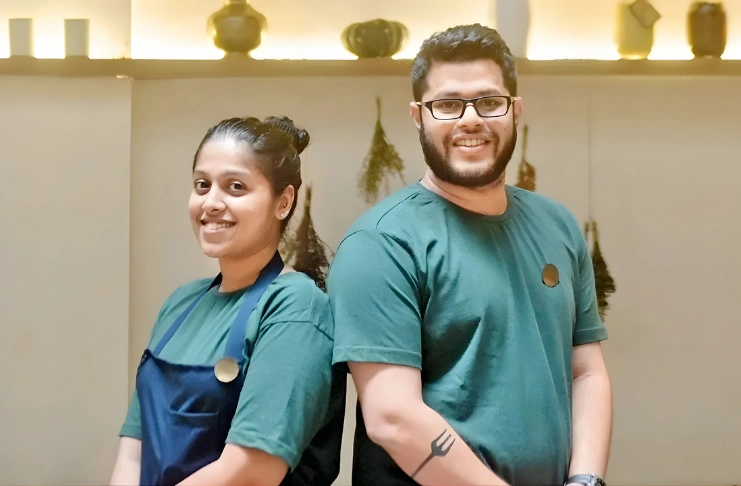
Rao’s focus isn’t just on Ekaa anymore. She and Neve now run three restaurants: Ekaa, KMC Bar & Bistro (with locations in Fort and Vikhroli), and Bombay Daak.
If Ekaa is a temple of taste, Bombay Daak is pure rebellion. “People say, ‘Oh, you own a cocktail bar.’ No, I own a daru chakna bar!” Rao says. For her, it’s about reclaiming pride. “In Spain, you go to tapas bars, and in Japan, izakayas. But in India, people looked down upon daru and chakna. I thought, Why not respect it? Why not study it?”
Research for Bombay Daak took over a year, talking to nonagenarians about what their parents ate and drank during parties, unearthing a forgotten culinary branch: India’s drinking food culture. “It was emotional. It blew us away how smart Indians were about drinking and eating together. We don’t need to understand wine; we already have our own systems.”
Bombay Daak just celebrated its first anniversary. In a city where restaurants open and shut in the blink of an eye, that’s no small thing.
KMC was born of different aspirations. “We always loved the gymkhana vibe, those bars that feel like someone’s elegant drawing room. But they were exclusive, membership-only, legacy-driven. We wanted to democratise that vibe,” Rao explains.
She recently represented India at Tasmania’s Dark Mofo Winter Feast, the first Indian guest chef invited to headline the iconic event. “So many Indian immigrants in Hobart told me they came because my name reminded them of home. They felt proud. And even though they’d never met me, I felt a connection.”
But it wasn’t just the diaspora. Locals also showed up with curiosity. “We were more excited than anyone else. We’d never seen a wallaby before. We’d only heard of certain native berries and spices from the Aboriginal landscapes. That kind of cultural exchange, where you listen to people’s stories and cook with their ingredients, that’s invaluable.”
Back home, there’s more brewing. A boulangerie-viennoiserie project is coming soon. “Guests tell us we make very good bread,” she hints. There’s also a small but meaningful project in northeast India, one of the reasons she’s constantly travelling these days.
Creating Tomorrow’s Classics
“Decades ago, someone came up with the idea of frying little puris and filling them with spicy water. That’s how we got pani puri. I don’t want to give the world a new version of pani puri. I want to create something that a century from now could be perceived in the same way.” (Source: Hindustan Times)
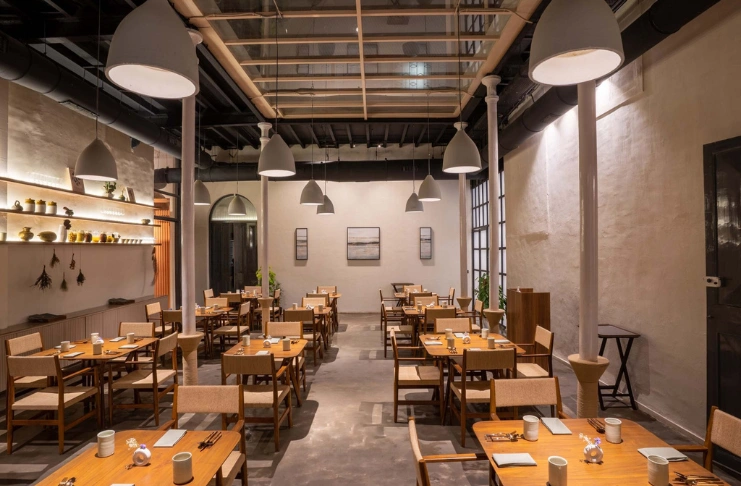
Inside Kitab Mahal, under that glass sunroof, with an open kitchen where guests can watch Rao and her team work, something is happening that feels bigger than one restaurant. It feels like the beginning of a conversation about what Indian food can be when you stop trying to categorize it and start celebrating it.
“When you create something new today,” she says, “it has the power to trickle down, into smaller establishments, into the streets, into people’s homes. That’s how cuisines evolve.”