
When five-star hotels consigned their Indian restaurants to the basement—deemed too “smelly” for polite company—one woman decided to flip the script entirely. In 1990, tucked into the gardens of Taj Gateway Hotel in Bengaluru, Karavalli opened its doors not as an apology for Indian cuisine but as a manifesto for it. What emerged was far more than a restaurant. It was an act of culinary archaeology, a rebellion against mediocrity, and ultimately, an institution that would reshape how India eats and how the world perceives regional Indian food.
The Vision Behind the Creation
Karavalli was created by Camellia Panjabi, then an executive director of the Taj Group of hotels. This wasn’t a casual venture. Camellia pushed the Taj to explore the cooking of India’s west coast: Goa, Mangalore, and Kerala, and set up the Karavalli restaurant at the Taj Gateway Hotel in Bangalore. But her ambition didn’t stop at a single menu. Taj chefs were dispatched to private homes in the Karai Kudi district of Tamil Nadu to learn how to cook the best dishes and to learn ancient family recipes. This was research conducted like detective work, conducted over months in strangers’ kitchens, learning from the hands that had perfected recipes across generations.
Panjabi’s career embodied this philosophy long before Karavalli. She opened the Bombay Brasserie in London in 1982, introducing regional Indian cooking to the UK for the first time and changing the way Indian cuisine is perceived in Britain. For her, food was about revealing truths that had been hidden in plain sight.
The Man Who Built the Legend
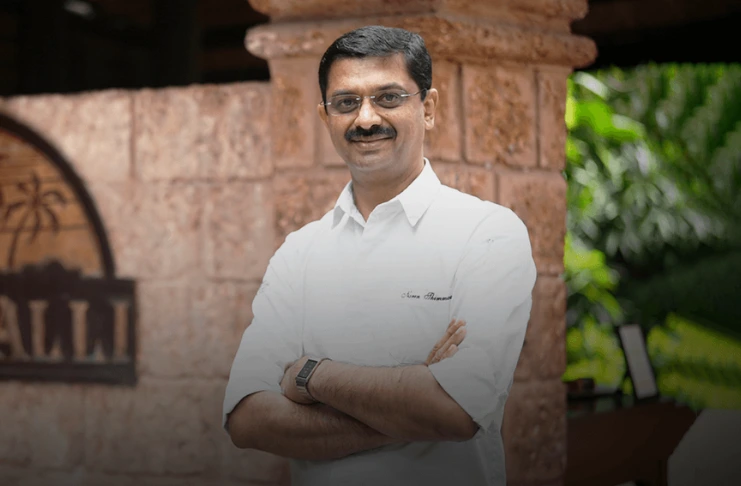
Enter Naren Thimmaiah. Fresh out of catering college, Thimmaiah joined Karavalli barely a year after it opened. Unlike executive chefs who oversee for a few years before moving on, Thimmaiah stayed. He remains the restaurant’s backbone after more than three decades, having worked under the guidance of Panjabi herself when she came to Mangalore to teach him old recipes from families willing to invest time in transmission. When Thimmaiah joined Karavalli 24 years ago, Camellia Panjabi sent him to Mangalore to master old recipes from families that were willing to invest time in teaching him.
In February 2009, at the Government of India, National Tourism Awards held at New Delhi, Naren Thimmaiah was adjudged as the BEST CHEF OF INDIA in his category. He holds the distinction of participating in the World Gourmet Summit held in Singapore in 2005. In its history from inception, Naren Thimmaiah holds the distinction of being the fourth to attend this prestigious event representing India. More recently, Chef Naren Thimmaiah features amongst the Economic Times’ list of India’s Top Ten Chefs.
What’s remarkable is Thimmaiah’s restraint. While recognition piled up—national awards, international summits, profiles in prestigious publications—he remained focused on one thing: consistency. “In the first 10 to 15 years, there was barely any change in the menu. Those years were dedicated to learning,” says Chef Naren Thimmaiah with disarming simplicity and confidence.
The Culinary Universe
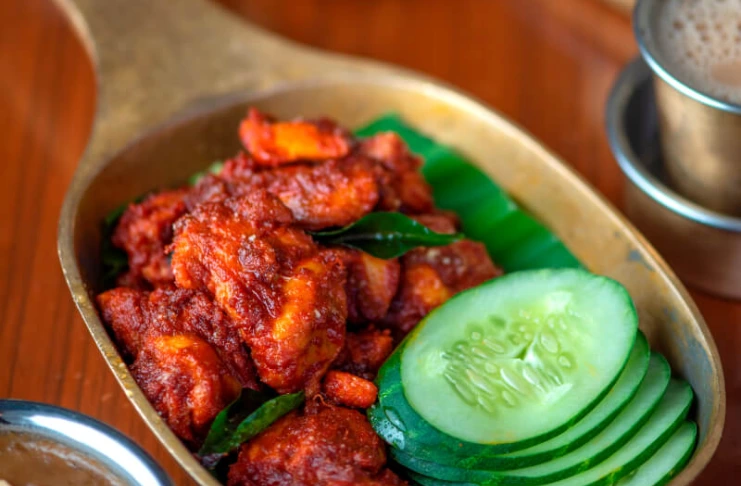
Karavalli doesn’t serve “South Indian food.” That reductive label misses entirely what happens inside its walls. The menu pays homage to the cuisines of Goa, Kerala, Karnataka, and the diverse communities that have shaped the southwestern coast, including Syrian Christians, Konkanis, Havyaka Brahmins, Moplahs of Malabar, and the Portuguese-influenced Goan traditions. Each dish carries genealogy.
The kitchen operates with a philosophy of sourcing and restraint. Naren Thimmaiah attributes Karavalli’s success to the authenticity of the ingredients, 75 per cent of which he says are sourced from the region, and the long years of experience of the chefs. There are no improvised flourishes. Even the garnish is restricted to fried curry leaves or some chopped coriander.
Signature dishes read like poetry written in spice: Alleppey Fish Curry with its tart coconut sauce and tender Seer fish; Meen Pollichathu, black pomfret steamed in banana leaves with an 18-spice blend; Chevod Balchao, fresh lobster steeped in Goan vinegar and pickling spices. The Ramasseri Idli—steamed on a leaf-lined lattice of ropes tied across the rims of mud pots—has become almost mythical, a dish few homemakers still prepare anywhere outside of Palakkad.
The Team: Specialists, Not Credentials
One detail separates Karavalli from almost every five-star restaurant in India: of the nine chefs at Karavalli, only two have degrees in hotel management. Thimmaiah recruited differently. Some came from small hotels in coastal towns. Others, like Padmini Chandran and Latha Prakash, came from kitchens that mattered most, their own homes. They were former homemakers who understood that mastery of a single dish, perfected over a lifetime, often matters more than a degree.
This hiring philosophy isn’t quaint nostalgia; it’s survival. These cooks carried recipes encoded not in textbooks but in muscle memory and family pride.
Recognition That Followed
As the years accumulated, so did the accolades. Karavalli has appeared twice on the S.Pellegrino 50 Best Restaurants in Asia list; recently on Condé Nast Traveller’s India’s 50 Best Restaurants; NatGeo Traveller Magazine’s Top 10 best Restaurants in India, and Jenny Linford’s ‘1001 Restaurants You Must Experience Before You Die’.
The Hindustan Times describes Karavalli as “the most famous South Indian restaurant in the world”.
Yet awards feel almost incidental here. Karavalli was the one-stop that Gaggan Anand, the best-known Indian chef in the world, did not miss on a fleeting visit to Bengaluru. International travelers, Indian celebrities, food pilgrims, and families, three generations of regular diners, move through Karavalli’s garden as if stepping into a preserved memory of home.
A Place That Breaks the Rules
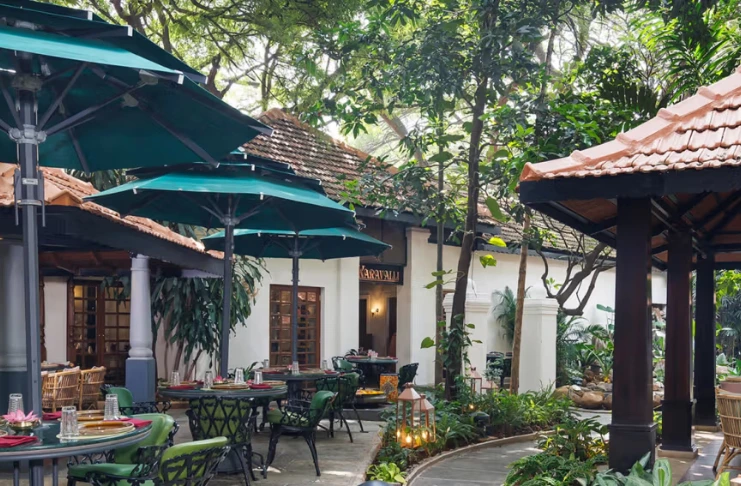
Karavalli opened when five-star Indian restaurants were an afterthought. It was not before 1989-90, with Dakshin at the Park Sheraton opening a year before Karavalli, that Indian restaurants finally got their pride of place in five-star hotels. The Gateway location itself—a converted Mangalorean-style bungalow surrounded by tamarind and palm trees, a lotus pond reflecting an older India—was unorthodox for its era.
Every choice reflected conviction. The menu barely changed for 15 years. Staff were recruited from small-town kitchens, not culinary school waitlists. The food stayed slow-cooked, wood-fired, and hand-ground. In an industry chasing novelty, Karavalli chose depth.