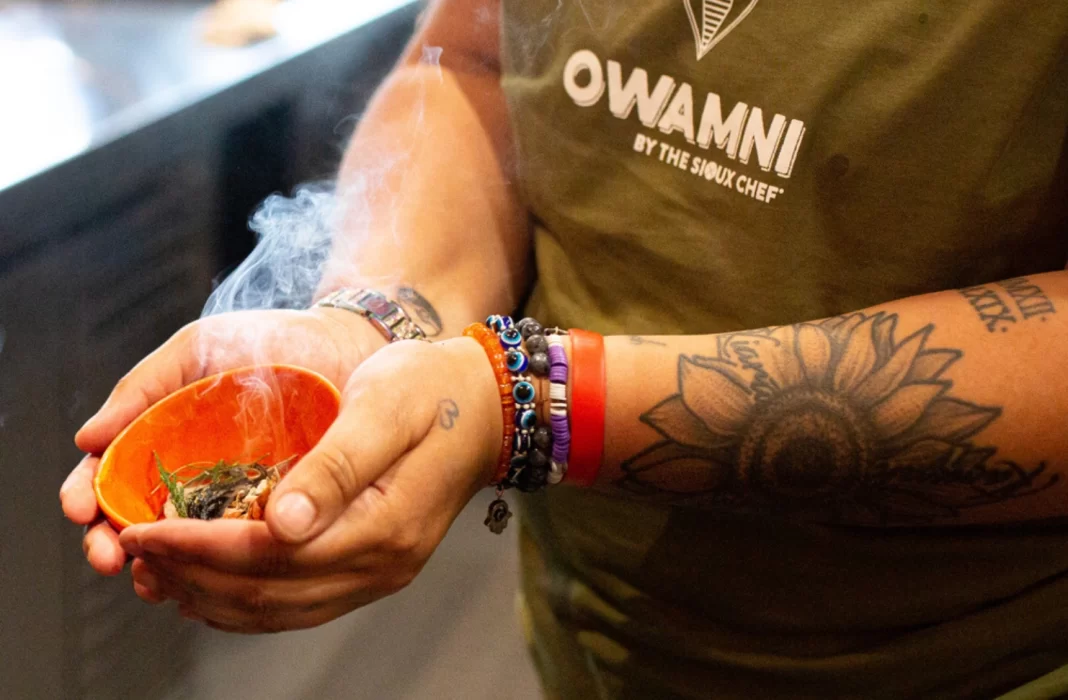

There’s a moment at Owamni when guests stop mid-bite and start crying. It happens weekly. Sometimes daily. Dana Thompson and Sean Sherman, the restaurant’s co-owners, have stopped being surprised by it.
Thompson says people cry because they understand something has been taken from them. That this food (true wild rice harvested by hand, bison raised on native grasses, berries foraged from Minnesota soil) was systematically erased from the American table. That eating it now, in this place, along these sacred waters, means something bigger than dinner.
And now, that powerful experience is about to reach even more people.
This spring, Owamni will move from its home at Water Works Pavilion to the main floor of the Guthrie Theater, doubling its space and cementing its place as one of the most important restaurants in America. The move keeps Owamni close to St. Anthony Falls—Owámniyomni in Dakota, meaning “falling water”—the sacred gathering place that gave the restaurant its name and its soul.
Sherman, an Oglala Lakota chef from Pine Ridge, South Dakota, calls the expansion a chance to put Indigenous cuisine on a bigger stage. Literally. The Guthrie’s Artistic Director Joseph Haj said welcoming Owamni reflects the theater’s commitment to honoring the Mississippi riverfront and the Indigenous peoples who first called this land home.
But this move means more than square footage. It’s proof that what Sherman and Thompson started in 2014 with a food truck called Tatanka has become something undeniable. Something that can’t be ignored anymore.
A Platform for Stories No One Wanted to Hear
Sherman opened The Sioux Chef, his catering company, in the Twin Cities back when nobody was talking about pre-colonial foodways. He launched the Tatanka Truck a year later, serving bison tamales and smoked turkey wild rice bowls to curious Minnesotans.
He, however, shuttered the truck to focus on opening a full-service restaurant instead. The goal was to prove Indigenous cuisine deserved the same reverence Americans gave to French or Italian food.
Thompson, a descendant of the Wahpeton-Sisseton and Mdewakanton Dakota tribes, joined him as co-owner. Her grandfather, Clem Felix, was born in 1892 on the Santee Reservation in Nebraska. He spent his life preserving the Indigenous names of waterways around St. Anthony Falls, working with writer Paul Durand to document them in a book published in 1994. That map hangs in Owamni now, a reminder that this knowledge almost disappeared.
Together, Sherman and Thompson built a restaurant with zero dairy, wheat flour, cane sugar, beef, chicken, or pork. Nothing that arrived with European colonizers. Only foods that existed on this land before everything changed.
They named it Owamni, after the base of the falls where water swirls and gathers. They opened in summer 2021 to reviews that bordered on reverent. And in 2022, at the James Beard Awards in Chicago, they made history.
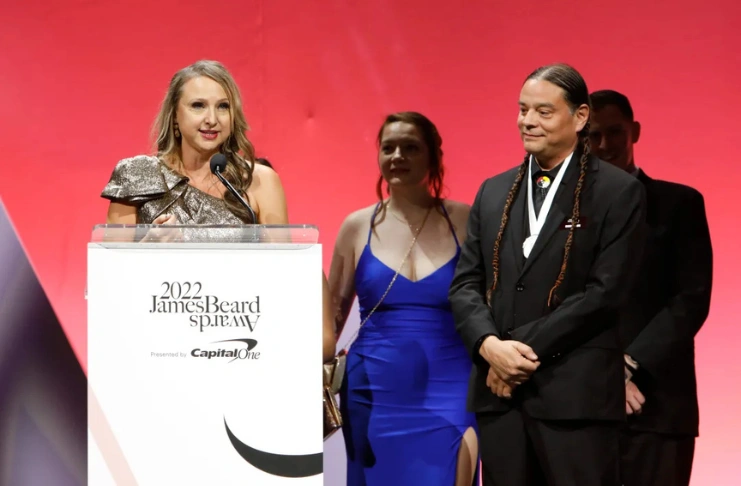
“People of color everywhere have been affected by colonialism, and we just went through centuries of racist bullshit,” Sherman said during his acceptance speech at Chicago. “This [James Beard Award] is showing that we can get through that. We’re still here. Our people are here, our ancestors are proud tonight.”
He told the room he hoped to see Native American restaurants in every city. Thompson thanked her grandfather and the ancestors who were there with them, in the theater and in the restaurant every single day.
Food That Knows Where It Belongs
Walk into Owamni, and you smell burning sage before anything else. The staff burns it before every shift, setting intentions and creating sacred space. Fire pits glow outside the weathered white stone building. Warm light spills across the Mississippi, constant and beautiful through the windows.
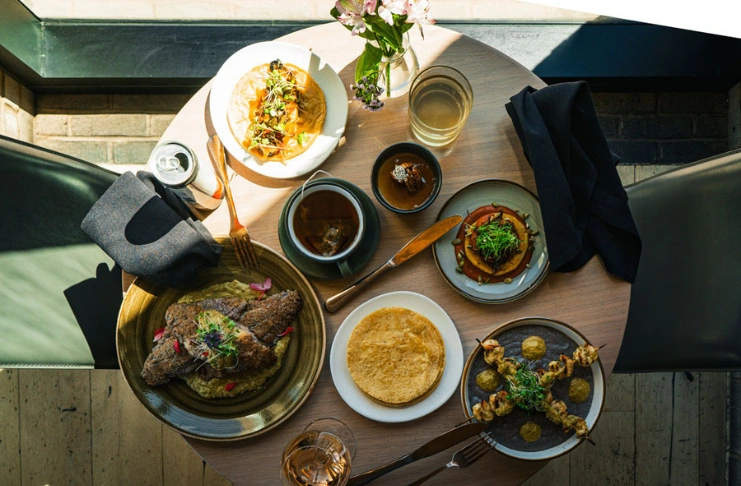
The menu reads like a love letter to this specific piece of earth. Cheyenne River bison tartare with duck egg aioli. Grilled forest mushroom tacos on heirloom corn tortillas. Wild rice sorbet. Preserved rabbit with fermented blueberry and cedar. Each dish carries centuries of knowledge about this land, the kind passed down through generations before anyone thought to write cookbooks.
Sherman gelatinizes wild rice to create breads and tarts without wheat or refined sugar. The blue cornbread takes three hours to cool after baking. The wild rice porridge gets its creaminess from wild rice milk, a revelation most diners will never experience anywhere else because true wild rice is too expensive and scarce.
One food writer described eating a bowl of wild rice at Owamni and fighting back tears. Not because of elaborate presentation or complex technique, but because tasting truly Indigenous wild rice brought up memories of loss. Of a food future stolen. Of what could have been.
Thomas Draskovic, lead singer of Minneapolis band The Pretendians, put it simply after eating there: “My body knows this is what I’m supposed to be eating.”
Bigger Than a Restaurant
Owamni operates under NATIFS, the nonprofit Sherman and Thompson founded to address economic and health crises in Native communities by reestablishing Native foodways. They run the Indigenous Food Lab in Minneapolis’s Midtown Global Market, where elders teach traditional techniques to younger generations. They sell bulk Indigenous ingredients (teas, hominy, tepary beans) to anyone who wants to cook this way at home.
The Tatanka Truck is back on the streets. Sherman won a James Beard Award for his cookbook in 2018 and another for leadership in 2019. But the restaurant award in 2022 felt different. It proved that Indigenous cuisine could stand alongside anything else at the highest level.
The new space at the Guthrie doubles Owamni’s capacity. Sherman admits they outgrew the Water Works Pavilion almost immediately after opening. Now they can serve more people, hire more staff, and tell more stories.
The Guthrie chose its riverfront location over twenty years ago because of the Mississippi’s cultural significance. This partnership deepens that connection as the theater prepares to celebrate two decades in its building next year. Together, they’re creating what Haj calls “a one-of-a-kind destination that honors the significance of this setting.”
Sherman and Thompson say the expansion lets them do more of what matters: reconnect people with traditional Indigenous food practices, support Native cultural revitalization, and prove that plant-forward cuisine deserves celebration when it comes with centuries of wisdom baked in.
What Reclamation Tastes Like
There’s something happening at Owamni that goes beyond excellent food, though the food is excellent. Diners who would never enter a vegan restaurant line up for reservations because they want to taste Indigenous cuisine, and they leave understanding that most of what they ate came from plants. That the stuffed poblanos with wild rice and mushroom picadillo would kill at any high-end vegan restaurant, but here they carry a different weight.
Sherman says he hopes people open their eyes to the land and its mysteries, which are barely touched by Western diets. Thompson says reclaiming this food is profound, and the tears prove it.
When Owamni moves to the Guthrie in spring 2026, it will remain close to the falls, the river, and the sacred gathering place that gave it a name. The water will keep falling. The stories will keep being told. And somewhere in that doubled space, someone will take a bite of wild rice and understand what was stolen, what survived, and what’s being built back.
Sherman told the Beard Awards audience that their ancestors were proud that night. He said they were doing something different, putting health and culture, and stories on the table.
Four years later, they’re building a bigger table. The ancestors are still watching.