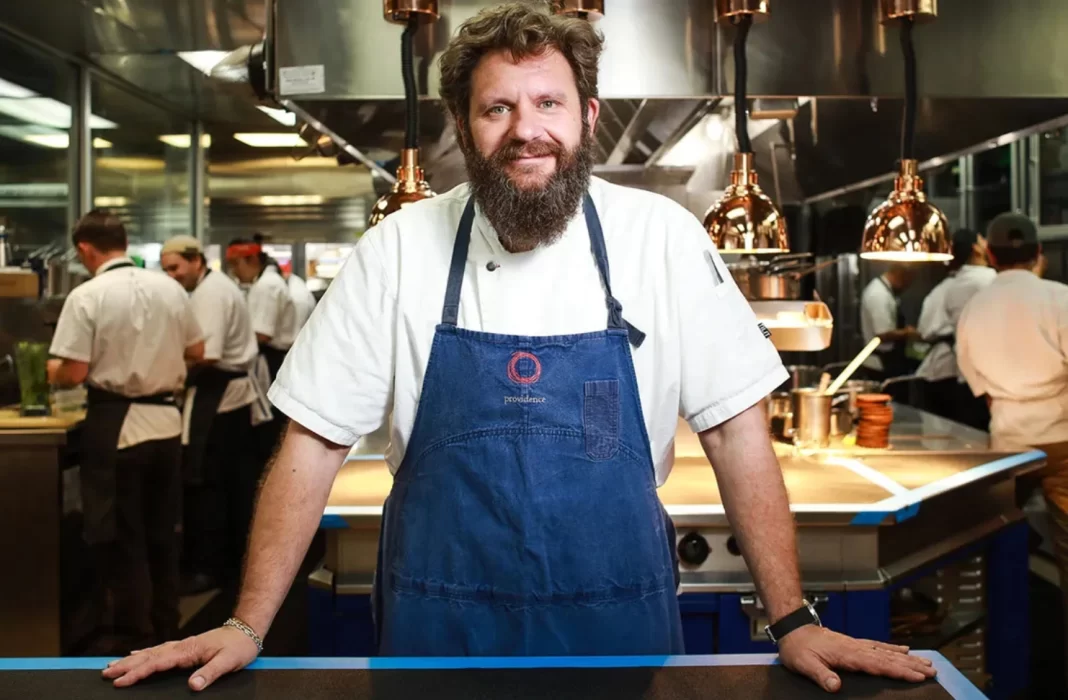

Seconds matter with seafood.
That’s the entire philosophy behind Providence, the restaurant Michael Cimarusti has run on Melrose Avenue for twenty years now. While other chefs built empires and reworked their menus over and over, Cimarusti was keen on that particular instant when heat and flesh reach an agreement so delicate that a breath too long could ruin a dish.
“The goal is to find that moment, deliver it to the dining room, and surround the fish or shellfish with just enough to make it sing,” he says. “Always with restraint.”
For twenty years, that restraint has kept people coming back to this dining room in Hollywood, even as the city’s restaurant scene churned through multiple trends and the entertainment industry that once filled Providence for lunch and dinner slowed after strikes and fires. Even as fine dining fell out of fashion, then back in, and got complicated by a pandemic.
Providence stood because Cimarusti never chased anything except that fleeting second. And now, two decades in, he’s still chasing it.
The Education of Restraint
Cimarusti didn’t start out believing less is more. That took time.
He grew up in rural New Jersey, in an Italian-American family, where Sunday dinner started at noon with charcuterie and didn’t end until nine at night. His grandmother would lay out charcuterie, then come salad, pasta, roast, fruit, and nuts. The table would be cleared for poker. The whole day revolved around that table.
At thirteen, he borrowed a sports coat to eat at a white-tablecloth restaurant in Princeton. They brought out Oysters Rockefeller served on rock salt, and he thought it was the fanciest thing he’d ever seen. Years later, he’d work at The Forager House in Bucks County, the same restaurant his parents took him to as a kid.
Later, he went to the Culinary Institute of America, then worked at An American Place with Larry Forgione. He cooked at Le Cirque in New York alongside Paul Bocuse and Roger Vergé. He spent time in France at La Marée and Arpège. He put in six years as executive chef at Water Grill, building a reputation for seafood that tasted more of the ocean than of the chef’s resume.
By 2005, when he opened Providence with partner Donato Poto, Cimarusti thought he had it figured out. He launched with three menus and multiple tasting options. But it was too much, and he knew it almost immediately.
So they pared down. Two menus became one tasting menu. During the pandemic, they stripped it even further to a single prix fixe that changes daily, plus a vegetarian option. That decision to focus everything on one menu made Providence better. It made the restaurant more itself.
“When I was younger and less informed, in my mind, people were just coming for the food,” Cimarusti says. “What I’ve learned over time is how incredibly important a team is.”
“When I was younger and less informed, in my mind, people were just coming for the food,” Cimarusti admits. “What I’ve learned over time is how incredibly important a team is.” (Source: The Fine Dining Lovers)
The Team That Makes It Work
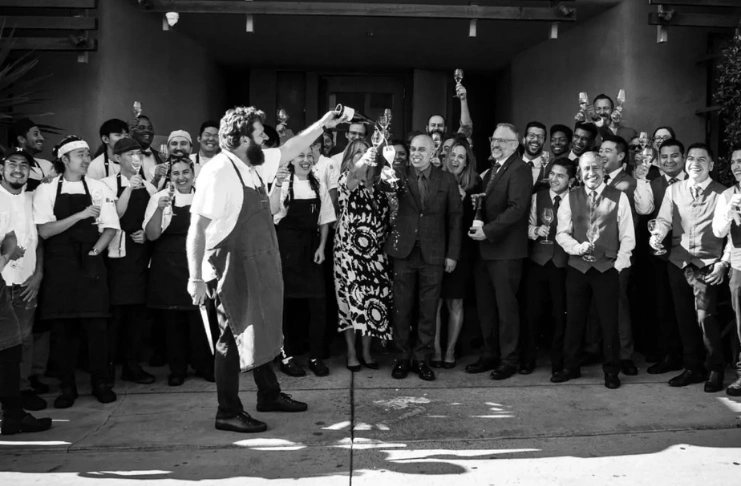
Providence’s kitchen now runs on the talent of people Cimarusti has trained and trusted over the years. Chef de cuisine Tristan Aitchison is a musician and visual artist whose creativity shines through every dish. Danielle Peterson runs the fermentation program, turning what other kitchens would compost into koji, garums, and fish sauce. Regina Spiritu brings her perspective to creating new dishes.
Then there’s Mac Daniel Dimla, the 28-year-old pastry chef who runs what Cimarusti believes is the only true bean-to-bar chocolate program in any U.S. restaurant. Every gram of chocolate served at Providence, Dimla makes himself.
This is what twenty years of building look like when you care more about succession than legacy. Cimarusti is 55 now, and he thinks about the future differently than he did at 35. “In another 10 or 15 years, I won’t be doing this anymore,” he says without sentimentality. “So now it’s about succession planning and figuring out what happens next within these four walls.”
He and his partners, his wife Cristina and Donato Poto, bought the building a decade ago. Several team members have been there since opening day. The question isn’t whether Providence continues. The question is how it evolves when Cimarusti eventually steps back.
But for now, there’s still fish to cook.
What Restraint Actually Looks Like
Santa Barbara spot prawns arrive at Providence during their season, which, if you’re lucky, runs nine or ten months out of the year. Cimarusti calls them “one of the most delicious things I’ve ever come across.” He’s eaten at Noma twice, spent time in Japan, France, Hong Kong, and London. He wants to spend a month in Kyoto just wandering and eating. But those local spot prawns still rank at the top.
They get roasted in salt and presented tableside with rosemary and lemon. That’s it. The cooking happens at that exact moment Cimarusti has spent two decades learning to recognize. Any longer and the texture turns wrong. Any shorter and you lose the sweetness that makes them worth eating in the first place.
“Sometimes I think the food’s too simple,” he admits. “But when I taste the fish at that exact right moment, I realize you don’t need to do a lot. Anything more and you lose what the ingredient has to say.”
The halibut swims in clam bouillon so clean it tastes like the ocean. Swordfish gets lipstick peppers and charred vegetable jus, both from the rooftop garden where 5,000 honeybees make honey, and every herb that touches a plate grows thirty feet above the dining room. Sashimi arrives crowned with basil from that same garden. The rooftop is now a Certified Wildlife Habitat, complete with two beehives. Every leaf and flower used on the menu comes from up there.
Providence earned a Green Michelin Star for these sustainability practices. The restaurant doesn’t serve farm-raised fish, only wild. No bluefin tuna. Plenty of zero-input shellfish like mussels, clams, and oysters. When Cimarusti can’t find what he wants from sustainable fisheries, he moves on to something else.
“That’s becoming more and more difficult,” he says. Climate change complicates everything. “Seventeen years ago, when we first started this, climate change was a concern. But now we’re starting to see the real-time effects and how they affect fisheries and our oceans.” (Source: Tasting Table)
So the menu adapts. Rockfish when king salmon isn’t in season. Black cod from California. Whatever’s sustainable, abundant, and treated right from water to plate. The commitment never wavers, even when it makes things harder.
The Room That Finally Matched the Food
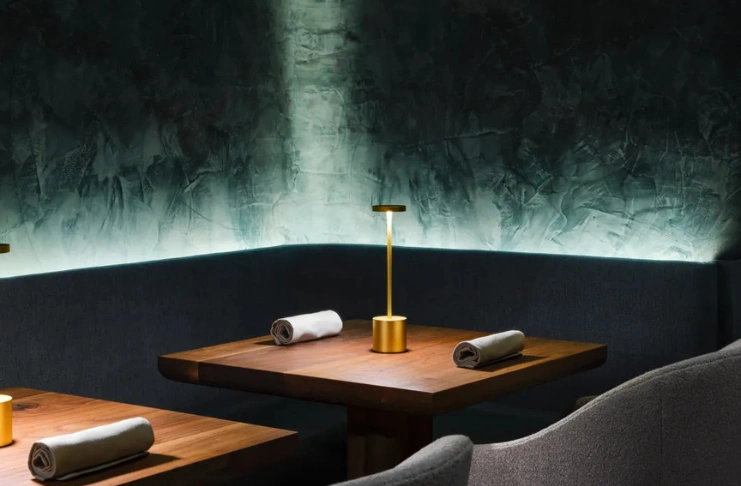
In 2023, Providence closed for five weeks. When it reopened, guests walked in and stopped in their tracks. The dining room had been completely redesigned by creative agency Bells + Whistles, and it finally looked like what was happening on the plates.
Parisian glass artist Jeremy Maxwell Wintrebert created biomorphic light fixtures that seem to breathe. The walls got hand-finished Venetian plaster in blues and greens that evoke the ocean without hitting you over the head with the theme. The space feels organic, imperfect in the way nature is imperfect, which is exactly what Cimarusti wanted.
“For me, in the kitchen, I’m always trying to find the beauty in natural forms,” he explains. “Whether it’s the shape of a green almond before it hardens into a nut or the beauty of a porcini mushroom. The organic nature of what we do in the kitchen ties directly into the organic nature of the work that went into creating the redesign.”
People came in after the renovation, and their jaws dropped, not because the space demanded attention but because everything finally felt cohesive. The room matched the food. The food matched the philosophy. The philosophy had always been there, and now you could see it in the walls.
What Fine Dining Actually Means
Ask Cimarusti to define fine dining, and he won’t talk about Michelin stars. He won’t mention that Providence has held two stars since 2009, or three as of 2025. He won’t bring up the James Beard award he won in 2019 for Best Chef: West.
“To me, fine dining is about the level of service and the overall experience,” he says. “It doesn’t necessarily have to mean white tablecloths anymore. But it does mean fine china, silver, stemware, and very hospitable service. It should be all about creature comfort. It should really be an escape. You should leave feeling pampered and like you were the only table in the room.”
Providence has always focused on the guest experience first. “In many ways, that means cost be damned,” Cimarusti says plainly. “It’s just our way.” That approach kept the restaurant alive through circumstances like the 2008 economic crash, a pandemic, the 2023 Writers Guild strike that paralyzed Hollywood just blocks away, and the 2025 wildfires that devastated the city.
“Back then in 2005, you still had executives at Paramount Studios, which is right up the street, coming in for lunch and dinner,” Cimarusti remembers. That world has changed. The entertainment industry that once filled the dining room has slowed considerably. But Providence adapted the way it always has, by staying true to what it does best.
The Simplicity of Going Home
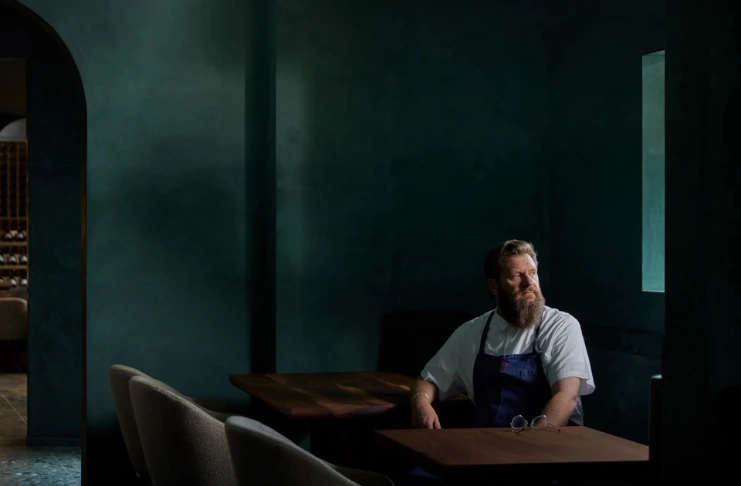
After service, when Cimarusti goes home tired and hungry, he makes pasta. Sometimes it’s aglio e olio, just garlic, oil, and pasta. Other times, he’ll spend a whole Sunday making Marcella Hazan’s Bolognese, babying it along for hours, finding something meditative in the repetition.
“Pasta,” he says when asked about comfort food. “If I don’t feel 100%, or if I’m cooking for myself, that’s what I make.”
There’s something fitting about that. The chef who built his reputation on restraint finds comfort in the simplest preparations. The man who can coax layers of flavor from uni and spot prawns also understands that sometimes the best meal is cold leftover pasta eaten alone on a Sunday night.
This is the duality that defines Providence. It’s a restaurant that serves eight-course tasting menus starting at $295, where every detail receives meticulous attention, where the beef course features matsutake mushrooms, fermented habanada peppers from the garden, and Musquee de Provence pumpkin.
But it’s also a place built by someone who remembers his grandmother’s kitchen, who wore a borrowed sport coat at thirteen and fell in love with oysters.
What Twenty Years Actually Built
Providence is now the longest-standing fine dining establishment in Los Angeles. It has outlasted restaurants with more press, more hype, and more celebrity attached. It survived longer than places that seemed more fashionable, more of-the-moment, more likely to define the city’s dining scene.
It’s still here because Cimarusti never tried to be anything other than what Providence is: a restaurant that cares about the fish. A place where restraint is the highest form of respect. Where the rooftop garden supplies every leaf and flower. Where 5,000 honeybees make honey, where a team of chefs ferments peppers and makes chocolate from scratch, and sources rockfish from California waters, they know by name.
Where, every single night, Michael Cimarusti finds that perfect second when seafood reaches its apex. And then he gets out of the way.
“Hit that mark every time,” he says. “Do enough, then step back and let the ingredients do the work.”
Twenty years of hitting that mark. Twenty years of stepping back. Twenty years of proving that the best restaurants aren’t built on spectacle or reinvention or whatever’s next. They’re built on knowing exactly when to stop. And in a city that never stops moving, that kind of conviction is rare enough to be revolutionary.