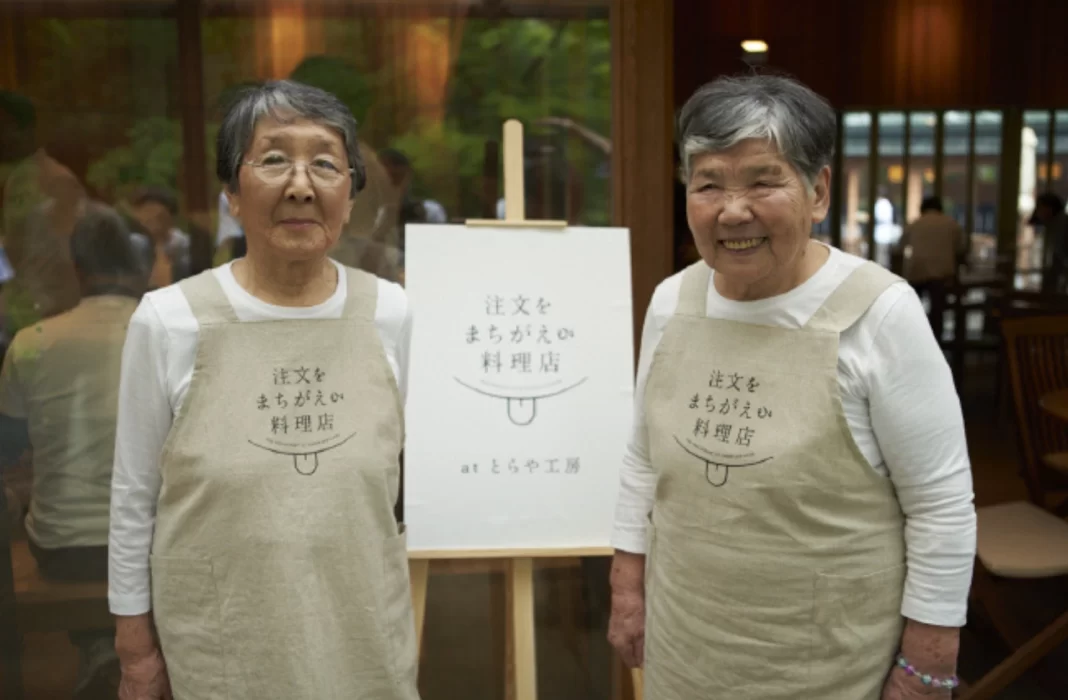

Imagine arriving at a restaurant, placing your order, and half expecting it not to match. Then you receive a dish you did not ask for, but instead of annoyance, you laugh. That’s exactly what happens at Tokyo’s Restaurant of Mistaken Orders.
Here, every server lives with dementia. Orders may go astray, but the purpose is never lost. The restaurant exists to challenge perception and celebrate ability.
You may receive the exact food you ordered. You may not. Either way, the meal is “delicious and one of a kind”, as the restaurant promises.
The Origin
The idea belongs to Shiro Oguni, a television director who visited a group home for people with dementia and noticed something shift when he was served the wrong dish. A hamburger order turned into gyoza. He did not protest. Instead, he realised that society’s view of dementia limited what people believe those living with it can do.
Around the table, everyone ate with such pleasure that for a moment he wondered if he was the one who’d gotten confused. Then clarity came with not the impulse to correct the mistake, but with a question: What if the mistake isn’t the problem? What if my need for it to be right is?
He took a bite of the gyoza. It was good. Really good. And suddenly the wrongness of it stopped mattering entirely.
“Why raise our eyebrows at the difference between sizzling steak and gyoza?” he thought later.
“If one wrong order could create this much warmth, what would happen if you built an entire restaurant around that feeling?”
Then, in June 2017, a pre-opening event doubled as training. Someone tweeted about it. The tweet went viral. By September 2017, crowdfunding had raised enough to launch officially at RANDY, a pop-up restaurant in Tokyo’s Roppongi district.
The Model
Rather than hide errors, the restaurant makes them visible. The name itself warns: “may or may not get your order right”. The website doesn’t soften the pitch: “You may think it’s crazy. A restaurant that can’t even get your order right.”
Then comes the promise that makes it work: “Even if your order is mistaken, everything on our menu is delicious and one of a kind. This, we guarantee.”
At one event, about 37% of orders were mistaken. Yet 99% of customers said they were happy.
Servers wear colour-coded aprons, and order sheets make use of simple visuals, supporting memory and ease. One man, 85 years old, forgot his clipboard but still greeted guests, delivered dessert, and laughed along when things went sideways.
Behind every wrong order is extraordinary planning. Support staff are positioned everywhere, ready to step in without taking over. The restaurant is built to help people with dementia succeed, even when success produces results that look nothing like traditional service.
What Happens Inside
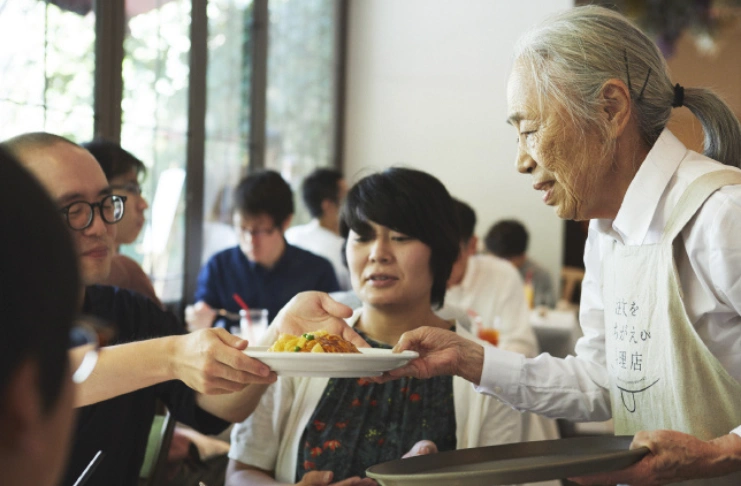
You sit at a small-scale pop-up. Servers living with dementia guide you to a table. You order coffee or cake. Perhaps your coffee comes with a straw. Or your cake arrives elsewhere. Mistakes are baked into the menu. Everyone around realizes it is part of the experience.
An older woman shows you to your table, then sits down next to you like you’re old friends. Another server wrestles with a pepper mill, concentrating hard, not entirely sure where the pepper will land. You reach over to help. Other diners help. Someone shouts, “We did it!” when the pepper finally falls. Everyone laughs, not at anyone, but with the shared absurdity of how much effort a simple thing can take.
Instead of frustration, the vulnerability opens space for connection. A guest described seeing the server smile after a “thank you” and said it reminded her of her grandfather’s last months.
“I’m still capable,” the servers say after their shifts. “This has given me confidence.” They’re not grateful for pity. They’re proud of real work. They wanted to contribute and feel useful to their community, but society kept telling them no. The Restaurant of Mistaken Orders told them yes, but rewrote the terms of what yes could mean.
Why It Matters
Japan faces a demographic shift: by the end of 2025, about one in five people will live with dementia. Currently, 4.6 million Japanese people live with it, representing the highest rate in the developed world at 2.3% of the population. Two-thirds of them stay home, isolated, carrying the quiet understanding that society has decided they’re finished contributing.
Rather than isolate older adults with cognitive decline, the Restaurant of Mistaken Orders offers agency, visibility, and community. It flips the script: rather than viewing dementia as a deficit, it becomes a lens on shared humility, humour, and humanity.
Founder Oguni frames it this way: “Dementia is not what a person is, but just part of who they are. People are people. The change will not come from them. It must come from society.” (Source: WanderOn)
Yui Iwata, who helps manage the restaurant, explains the philosophy in practical terms: “If people better understood dementia, it would make it easier for those with the condition to go out into the world.”
Awards and Spread
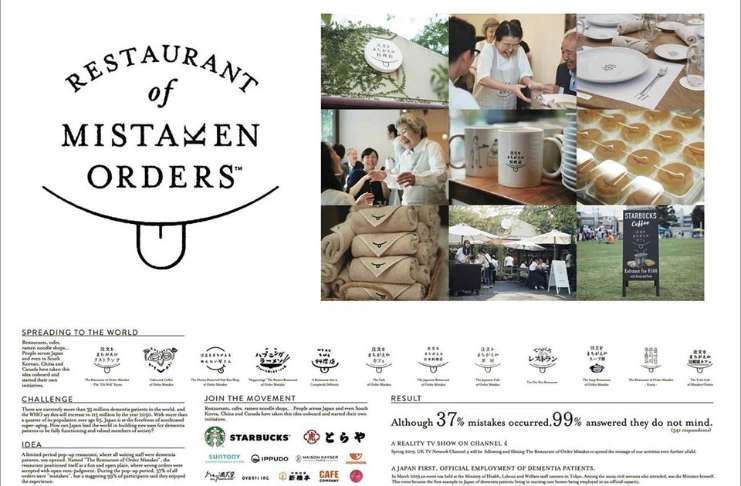
The project did not go unnoticed. It picked up a Silver at Cannes Lions 2019 in the Design Lions category and multiple Golds and Silvers across Spikes Asia for live events, healthcare PR, CSR, and experience design. AD STARS awarded it Gold. London International Awards granted Silver. The ACC Tokyo Creativity Awards presented the Grand Prix, the highest honor.
Beyond Tokyo, variants of the concept have appeared in Machida city in September 2017 and at Toraya Confectioners in Shizuoka in May 2018, where local dementia patients worked the floor for a single day. Even the Ministry of Health, Labor, and Welfare hosted an event in March 2019, where bureaucrats sat down to understand what policy looks like when it meets actual human beings.
The awards were never the goal, though. What mattered was what they represented: global recognition that this was more than a clever concept. This was a working model for how society could function differently.
Books were published documenting the journey. Media coverage went international. The Restaurant of Mistaken Orders became a reference point for what Oguni calls “Warm Japan,” a counterbalance to the country’s global reputation for efficiency and precision.
This is the Japan of kintsugi, the ancient art of repairing broken pottery with gold, turning the fractures into the most beautiful part of the object instead of trying to hide them.
A Visit That Changes You
Go as a diner, expecting the unexpected. The wrong plate. The delayed drink. The mix-up. Then you smile because you are allowed to. Because the staff is allowed to be more than their diagnosis. You feel something shift. You see value beyond service. You leave with a story.
One visitor on X wrote: “That’s a unique and thoughtful concept. The Restaurant of Mistaken Orders not only provides a dining experience but also raises awareness about dementia by simulating the unpredictability people with dementia may face in their daily lives.”
Here’s what the Restaurant of Mistaken Orders actually sells, and it’s not food. It’s permission. Permission to be imperfect in a culture that worships precision. Permission to laugh when things go sideways. Permission to value people for something beyond their ability to execute tasks flawlessly.
You walk in knowing your order will probably be wrong. You’re theoretically fine with that. Then the wrong plate actually arrives, and you feel the full weight of conditioning kick in. The impulse to correct, to fix, to make it right. That moment is when you choose what kind of person you’re going to be.
Most people choose flexibility. They taste what came instead of what they ordered. It turns out to be delicious. The tension that seemed so important thirty seconds ago just evaporates. What’s left is simpler: people eating together, laughing about how much energy we waste caring about getting exactly what we asked for.
Challenges and Reflections
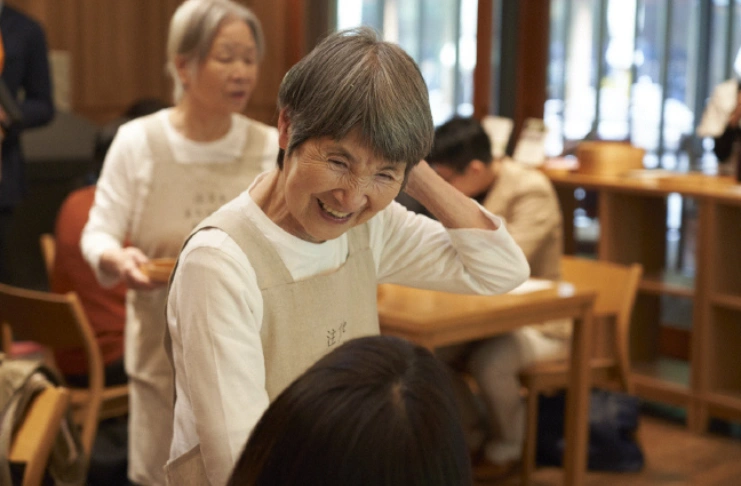
The restaurant is indeed not perfect. There are practical concerns. Ensuring meals are safe for food allergies has been raised online. The restaurant’s team works hard to make the space supportive, never exploitative. Behind the bill of wrong orders lies careful design, training, and volunteer support.
Oguni worried before the first event. He braced for backlash, for accusations of exploitation, for people claiming he was turning dementia into entertainment. The criticism never materialized.
Instead, guests watched the servers smile with genuine pleasure. They saw real pride in the work. Some visitors felt inspired. Others cried from recognition.
Why This Story Matters for Hospitality
This restaurant reframes the business of dining from speed and precision to connection and acceptance. It shows that a hospitality concept can carry a purpose, a mission. Kitchens deliver thoughtful food. Service invites participation in empathy. Mistakes become meaningful.
For restaurateurs, the takeaway is clear: humans flounder, recover, and learn. Create frameworks where imperfect service becomes an invitation rather than a failure.
Final Words
If you ever find yourself in Tokyo, step into the Restaurant of Mistaken Orders. Order dessert. Perhaps the wrong dessert arrives. You laugh. They smile. And you both walk out changed.
Because here, mistakes are welcomed and dignity is seen.
Oguni just asked a simple question at that lunch years ago: “Why raise our eyebrows at the difference between sizzling steak and gyoza?” The Restaurant of Mistaken Orders is his answer, built out of twelve seats and servers who forget orders and guests who learn to stop caring.
Maybe it’s time the rest of us stopped caring, too. About the tyranny of perfection. About the idea that people only have value when they can execute tasks exactly as specified. About the belief that mistakes are catastrophes instead of things that happen when humans do human things.
“By cultivating tolerance, almost anything can be solved,” Oguni shares. “I want to promote a Japan that cultivates a warm, comfortable environment, so people will return home with smiles and a glow in their hearts.”
The restaurant keeps running. Events get announced on the website. The model expands to new cities, venues, and contexts. Because once you see it work, you can’t unsee the implications:
The wrongness was never the actual problem. Our collective inability to tolerate it was the thing breaking everything.