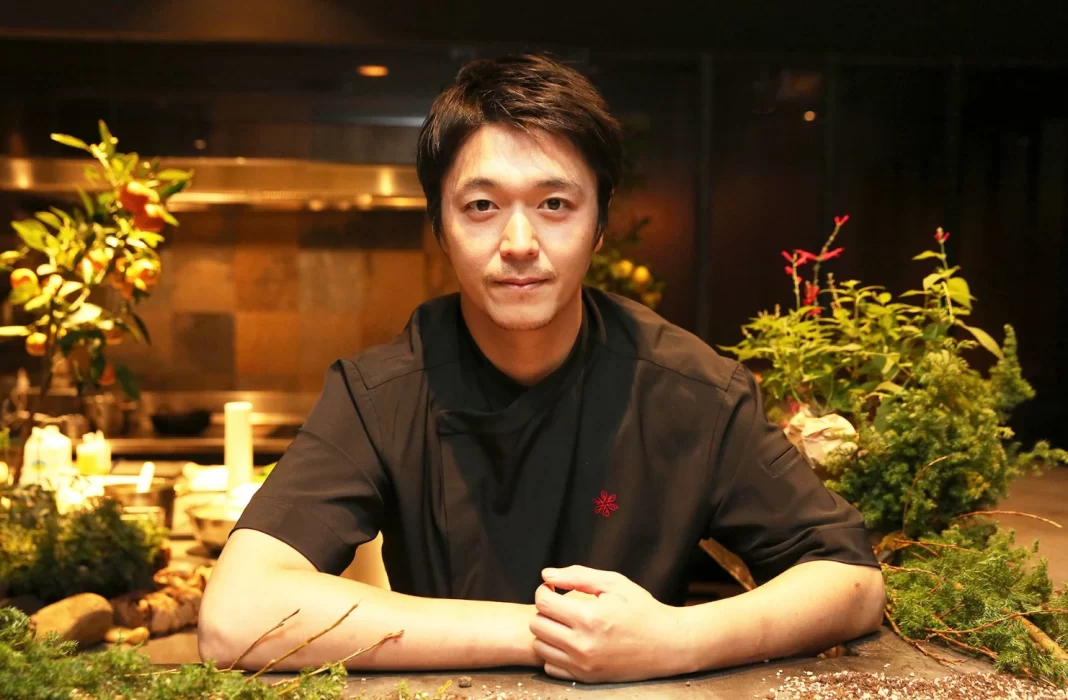

The knife slices through silence before it touches the beef. At Florilège, every cut is theater, every plate a statement. But this isn’t your grandfather’s French restaurant, and Chef Hiroyasu Kawate isn’t playing by anyone’s rules but his own.
While Parisian kitchens cling to century-old traditions, Kawate is busy dismantling them from his open kitchen in Tokyo’s Azabudai Hills. The audacity is breathtaking. The results are revolutionary.
The Kitchen That Broke Every Rule
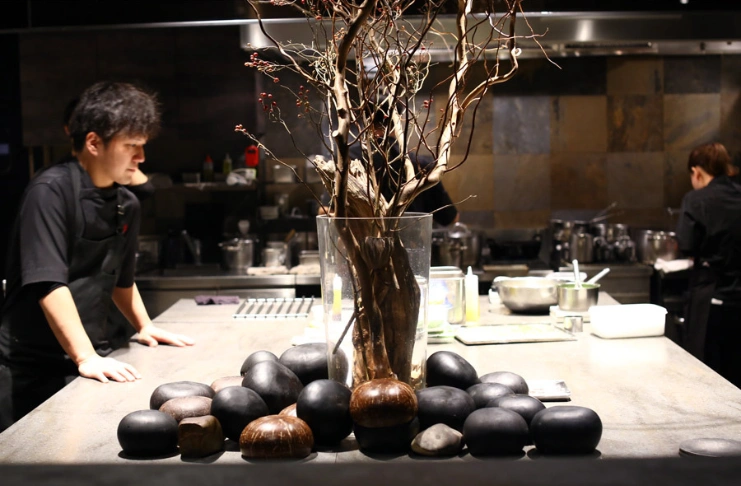
Walk into Florilège and forget everything you know about French fine dining. The massive open kitchen dominates the space like a culinary amphitheater, with plush counter seating wrapping around three sides. Guests don’t just eat here; they witness creation in real time.
“Originally, I didn’t have this open concept arrangement in mind,” Kawate reveals in a rare interview. “But, it materialized in this way before the renovation, during the planning stage when we were integrating my ideas.” (Source: JAPANTWO interview with Chef Kawate)
The decision wasn’t just architectural. It was philosophical warfare against French culinary convention. Where traditional French kitchens hide behind closed doors, maintaining mystique through separation, Kawate throws open every process. The chefs don’t just cook; they serve, they explain, they connect. It’s dining stripped of pretense and rebuilt with purpose.
Turning Waste Into Wonder
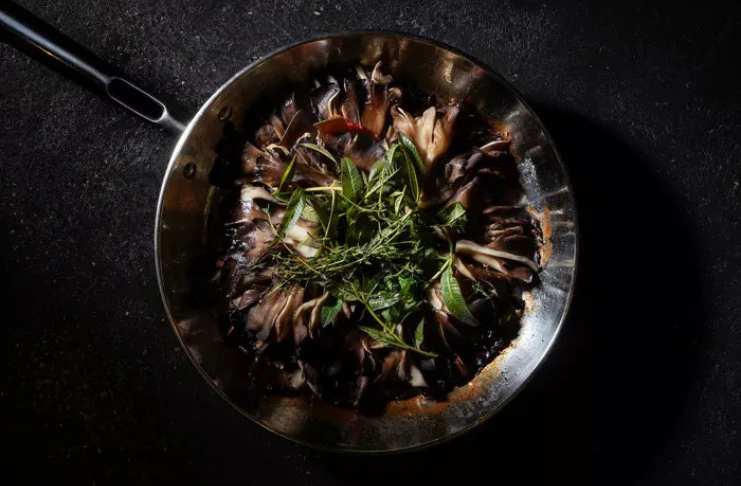
The most shocking thing about Florilège isn’t the two Michelin stars or the Asia’s 50 Best ranking. It’s the beef carpaccio made from a 13-year-old breeding cow that other restaurants wouldn’t touch.
“There was an urge to create French cuisine that utilizes Japanese produce, without depending on Foie gras or caviar,” Kawate explains. “I truly believe that Japanese produce goes well with Japanese customers.”
That cherry-red carpaccio, impossibly tender despite coming from what the industry calls “spent” cattle, represents everything Florilège stands for. While other chefs chase perfect ingredients, Kawate transforms the imperfect into something extraordinary.
The restaurant’s approach to food waste borders on the militant. Vegetable scraps become soups. Shrimp shells transform into consommé. Every carrot leaf, every turnip top, every piece that would typically hit the trash becomes part of the symphony.
“People are not aware of how much food is wasted in Japan: in fact, Japan is the number one wasteful country in the world in terms of food,” Kawate states bluntly. “I was half-raised by my grandparents, and they distilled this mentality of not squandering any food into my consciousness.” (Source: Tatler Asia)
The Philosophy That’s Shaking French Foundations
Traditional French cuisine builds flavor through addition. More butter, more cream, more complexity layered upon complexity. Kawate strips it all away.
“Classic French food is having lots of ingredients packed together in a very concentrated manner,” he explains. “My approach to the influence of Japanese cooking is much more about how to use each ingredient specifically. I will focus on the main ingredient as much as possible and refrain from adding unnecessary things.”
This isn’t fusion cuisine. This is revolution. Kawate isn’t borrowing from Japanese cooking; he’s using it to expose the excesses of French tradition. Every dish becomes an argument for restraint over indulgence, for precision over abundance.
The menu changes every two months, not because of seasonal trends, but because Kawate refuses to let any dish become comfortable. Comfort breeds complacency, and complacency is the enemy of progress.
Building a Team That Breaks Barriers
In the hierarchical world of French kitchens, communication flows one way: down. Kawate demolished that structure along with every other convention.
“I expect many things from them, but I’d like them to be a team that can fully offer our customers the cuisine that draws its tastes from the cultivation stage of the produce,” he shares. “I don’t want them to be hesitant because I’m the chef, but I want them to inquire about many things because I’m the chef.”
The team includes cooks from across Asia, including Zhao Bohan from Harbin, China, who spent seven years mastering Japanese techniques before joining Florilège.
When guests ask questions about dishes in Chinese, he answers fluently, creating moments of connection that transcend cultural boundaries.
The Mission Beyond the Plate
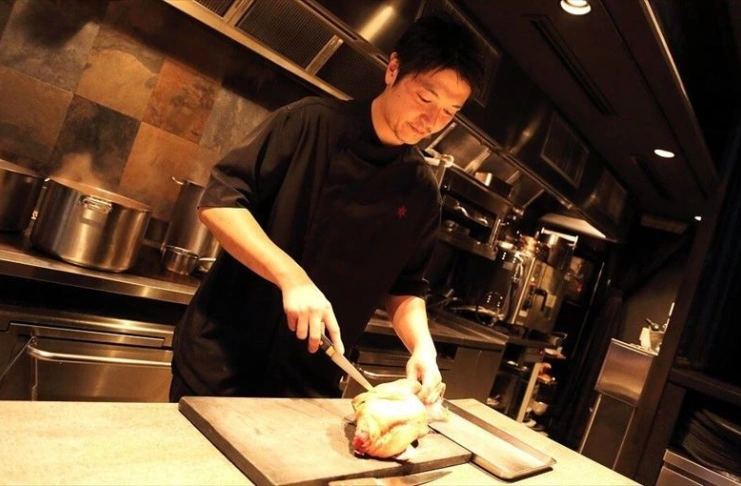
Kawate’s ambitions extend far beyond Tokyo. He’s building a movement that challenges Asia’s position in global gastronomy.
“Compared to North or South America or Europe, Asia doesn’t have power when it comes to giving opinions,” he observes. “Currently, no matter how many Asian restaurants are ranked top 10 in the ‘World’s 50 Best Restaurants’, Asia is still weak in its power.” (Source: Fun! Japan)
His solution? Radical collaboration. Florilège actively welcomes international trainees, particularly from across Asia. The knowledge flows both ways, creating a network of chefs who share Kawate’s vision of Asian culinary independence.
The restaurant’s joint venture with Den’s Zaiyu Hasegawa, Den Kushi Flori, has expanded to Bangkok. Former pastry chef Miho Horio launched Azuki to Kouri, revolutionizing traditional Japanese shaved ice. Every offshoot carries Florilège’s DNA of innovation and sustainability.
The Economics of Revolution
Here’s what makes Florilège truly radical: the prices. Lunch courses start around ¥7,000, dinner at ¥13,000. In a world where fine dining increasingly targets only the wealthy, Kawate maintains accessibility without compromising quality.
“You may wonder how the restaurant can sustain the business at such prices,” notes food critic Jocelyn Chen. “Perhaps the use of all parts of ingredients is one of the cost-cutting strategies, but it also costs a lot of time and effort to present a single ingredient in so many different ways.”
This isn’t charity. It’s a strategy. By keeping prices reasonable, Kawate ensures his message of sustainability and innovation reaches beyond the elite. Revolutionary ideas need revolutionary distribution.
The Future of French Cuisine
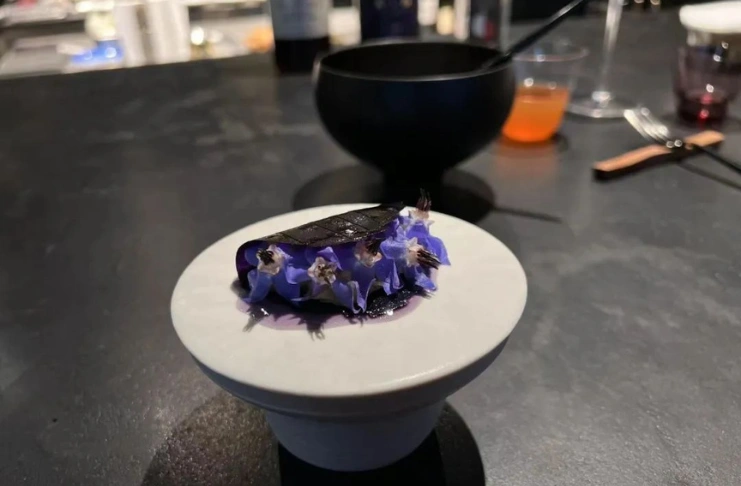
Florilège’s influence extends far beyond Tokyo. Young chefs worldwide are abandoning butter-heavy traditions for ingredient-focused approaches. Sustainability isn’t a trend anymore; it’s becoming standard practice.
The restaurant’s relocation to Azabudai Hills, Tokyo’s tallest building, signals something significant. This isn’t just about better real estate. It’s about claiming space at the top of a city that’s increasingly becoming the world’s most important culinary destination.
Kawate’s vision for French cuisine is all about preserving tradition for tradition’s sake. It’s about evolution, about what French technique can become when freed from French limitations.
“Like the way the concept of what we commonly call ‘French cuisine’ solidified, I wondered why can’t there be a French cuisine of my own,” he reflects. “There are no boundaries to cooking, and everyone is free to choose how they cook.”
The Revolution Continues
Every service at Florilège is both performance and protest. Against waste, against hierarchy, against the idea that fine dining must be exclusionary. The restaurant operates like a culinary think tank, constantly experimenting, constantly pushing boundaries.
The drinks program, led by sommelier Haruki Hirota, abandons traditional wine pairings for cocktail innovations that incorporate elements like katsuobushi (dried bonito flakes) mixed with coffee and wine. Even the beverage program refuses conventional wisdom.
This is what revolution looks like in the 21st century. Not violent overthrow, but patient, persistent reimagining of fundamental assumptions. Kawate isn’t destroying French cuisine; he’s liberating it from its own limitations.
At Florilège, the future of fine dining isn’t French or Japanese. It’s honest, sustainable, and unapologetically innovative. It’s what happens when tradition meets courage, when convention encounters imagination.
The revolution will be delicious.