
"When people are unsure about the future, luxury is the first thing they postpone, not groceries."

- Chef Gregoire Berger, founder of Kraken (former Executive Chef, Atlantis The Palm's Ossiano) (AGBI)
“The greatest global energy security challenge in history.” – That’s how the International Energy Agency described February 28, 2026.
On that day, the United States and Israel launched coordinated airstrikes on Iran under a military operation codenamed “Operation Epic Fury.” But what was planned as a short, sharp attempt to dismantle Iran’s government quickly escalated into a conflict that engulfed much of the Middle East.
Iran’s response was to shut down the Strait of Hormuz, a narrow passage through which roughly 25% of the world’s seaborne oil and 20% of its LNG had flowed every day.
For the hospitality industry (which relies on energy, tourism, food supply chains, and consumer confidence), the effects were compounded.
The war, in a sense, disrupted the entire chain from fuel prices to the very sentiment that makes people willing to spend on eating out.
| Latest [17 April, 2026] A 10-day ceasefire between Israel and Lebanon took effect at midnight on April 16, brokered by the US. Trump described the conflict as “going along swimmingly” and suggested it could end soon. Iran’s ambassador said Tehran was “cautiously optimistic” about further negotiations. France and Britain are chairing a 40-country meeting on restoring freedom of navigation in the Strait of Hormuz. The situation remains fragile but is showing its first real signs of diplomatic movement. (Source: Times Now) |
How We Got Here: The Energy Domino Effect
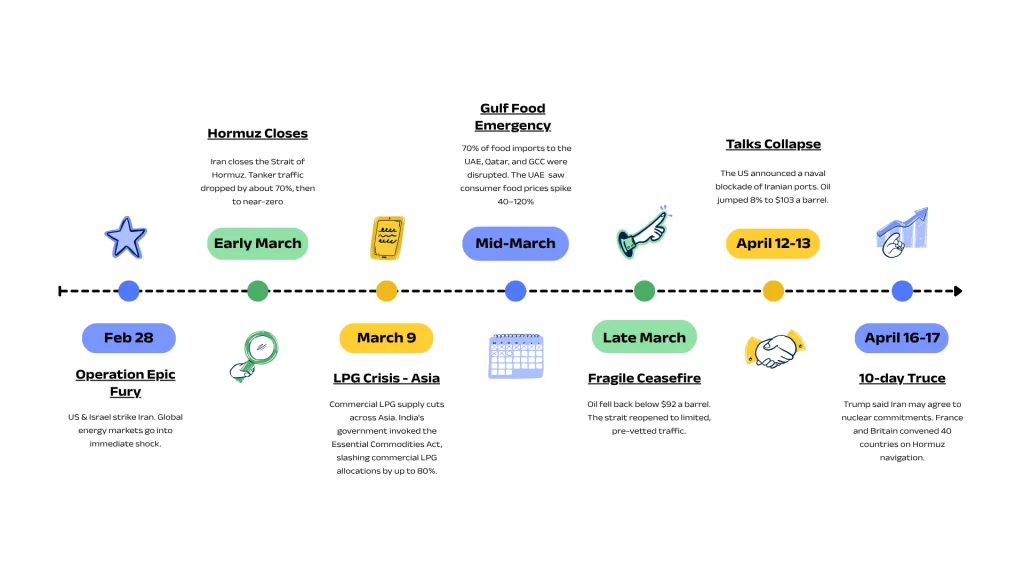
| FEBRUARY 28, 2026 | US and Israel launch Operation Epic Fury. Coordinated strikes on Iran begin. Global energy markets go into immediate shock. Brent crude was at roughly $70 a barrel. |
| EARLY MARCH 2026 | Iran closes the Strait of Hormuz. Tanker traffic dropped by about 70%, then to near-zero. Brent crude crossed $100 for the first time in four years on March 8 and peaked above $120 by mid-March (up 39% from pre-conflict levels). Dutch TTF natural gas futures rose 59%. Middle East urea futures rose 34%. |
| MARCH 9, 2026 | Commercial LPG supply cuts across Asia. India’s government invoked the Essential Commodities Act, slashing commercial LPG allocations by up to 80%. Restaurant kitchens across the country began running dry. The NRAI (representing 500,000 restaurants and 8 million workers) warned of mass closures. Similar pressure hit fuel-dependent markets across Southeast Asia. |
| MID-MARCH 2026 | Gulf states face a grocery emergency. 70% of food imports to the UAE, Qatar, and GCC were disrupted. The UAE — which imports 90% of what it eats — saw consumer food prices spike 40–120%. Retailers like Lulu airlifted staples. Hotels and restaurants faced delivery blackouts. Tourism collapsed. |
| LATE MARCH 2026 | A fragile two-week ceasefire was agreed. Oil fell back below $92 a barrel. The strait reopened to limited, pre-vetted traffic. Markets paused. The Bloomberg Commodity Index remained 9% above pre-war levels. |
| APRIL 12–13, 2026 | Ceasefire talks in Pakistan collapse. US Vice President JD Vance returned to Washington without a deal. The US announced a naval blockade of Iranian ports. Oil jumped 8% to $103 a barrel. Asian stock markets opened lower. S&P 500 futures fell 0.8%. |
| APRIL 16–17, 2026 | A 10-day truce began at midnight. Trump said Iran may agree to nuclear commitments. France and Britain convened 40 countries on Hormuz navigation. Cautious optimism is emerging, but the strait remains largely closed, and the blockade remains in force. |
One Strait & Mostly Every Restaurant on Earth Felt It
The Strait of Hormuz is 33 kilometers wide at its narrowest point. Before the war, roughly 130 ships transited it every day. When Iran closed it, that number fell to near-zero. By April 12, just 17 vessels crossed in a single day. As of early April, 1,541 ships were stuck on either side, including 18 carrying grain and 19 carrying fertilizer raw materials.
Now the point is: The hospitality industry’s dependence on this strait runs much deeper than most operators had ever considered. How?
- Cooking fuel: Countries across Asia and the Gulf source the bulk of their LPG and natural gas from the Gulf. When the Strait closed, commercial gas supplies were either slashed or cut off. In some markets, operators queued for days for black-market cylinders at three times the official price.
- Fertilizer: 30–33% of globally traded fertilizer passes through Hormuz. Urea futures rose 34% in the first weeks. J.P. Morgan said nitrogen fertilizer benchmarks rose 25–50% from the end of February, and that impacts would show “with a considerable lag.” The FAO warned global fertilizer prices could average 15–20% higher in the first half of 2026.
- Packaging: Iran’s South Pars petrochemical complex (which accounts for 85% of its output) was hit early in the conflict. Saudi Arabia’s largest petrochemical complex in Jubail was struck in retaliation, removing 20% of global methanol, urea, and polymer production. Soon, analysts warned of a global supply “cardiac arrest.”
- Jet fuel and tourism: Fuel prices rose sharply across markets, triggering airline surcharges and cancellations. In South Africa, jet fuel rose 70% in a single week. Roughly 1,000 Thailand-bound flights were canceled. Tourism flows — a primary revenue driver for hotel and restaurant sectors across Asia, the Middle East, and Africa — were severely disrupted.
- Consumer confidence: The University of Michigan’s consumer sentiment index fell to 47.6 – its lowest on record, down 10.7% from March alone. When people feel economically uncertain, they stop eating out.
"Food prices are being squeezed from both sides: by climate extremes disrupting production, and by a food system still hooked on fossil fuels and exposed to spikes in gas, fertilizer, transport, and packaging costs."

- Chris Jaccarini, Senior Analyst, Energy and Climate Intelligence Unit (CNBC)
The Impact of US-Iran War on Global Hospitality – Region By Region
The war’s effects on the hospitality sector played out differently depending on where you were, but no major region was untouched.
The Gulf
The Gulf states were hit the hardest. The UAE imports about 90% of what it eats. Cargoes of Indian rice, Australian meat, and Indonesian coffee were snarled or diverted. Supermarket shelves held for a while (Gulf governments had invested in strategic grain reserves covering 4–6 months), but restaurant and hotel operations felt the pain immediately as deliveries stopped arriving.
A Japanese restaurant inside a five-star Dubai hotel reported its most important weekly delivery had stopped with no sense of when it would resume. UAE businesses raised prices at the fastest pace in more than 11 years in March, according to S&P Global. Business confidence fell to a 61-month low. Tourism, which accounted for nearly 13% of UAE GDP in 2025 and supported some 925,000 jobs, came to a near standstill.
"Not a lot of self-funded restaurants would have the bandwidth to sustain for six months without cash flow. There will be a significantly higher number of restaurants that will probably close down by summer this year."

- Panchali Mahendra, CEO, Atelier House Hospitality, Dubai (AGBI)
Asia & South Africa
| India Commercial LPG was slashed by up to 80%. In Indore alone, daily cylinder supply fell from 3,200 to 600–700. A third of restaurants were significantly affected. Menus were cut by 50%, iconic institutions warned of closure, and black-market prices ran more than 3x the official rate. Induction stove sales on Amazon India increased more than thirtyfold. | Thailand Trekking tour inquiries in Chiang Mai fell from 30/day to 3 per day. Around 1,000 flights were canceled. The tourism ministry estimated losses of 41 billion baht if the airspace were closed for 8 weeks. Walking streets that buzzed until 10 pm went quiet almost overnight. |
Japan Japan imports 90% of its oil from the Middle East. Strategic reserves were released. Snack maker Yamayoshi halted production of its “Wasabeef” crisp line — citing an inability to secure heavy oil — prompting the product to trend on Japanese X as a symbol of how far the disruption reached. | Bangladesh Bus fares doubled ahead of Eid. Fuel was rationed. Troops were deployed to depots to prevent hoarding. Universities closed early. The government’s political credibility was tested by a price spike at the worst possible moment — one of the country’s most important travel periods. |
| Sri Lanka Fuel prices rose 35%, and the QR-based rationing system from the 2022 economic crisis was reintroduced. Tour firms reported a 30% drop in business. The country negotiated a temporary easing of its IMF bailout terms just to stay solvent. | South Africa Jet fuel at coastal airports rose 70% in one week. Airlines Fly Safair introduced a dynamic fuel surcharge. Petrol was predicted to rise 25% and diesel by up to 44% on April 1. The central bank abandoned its existing economic projections entirely. |
The United States
American consumers did not face shortages or blackouts, but they felt the conflict in their wallets. The Consumer Price Index rose 3.3% year over year in March — up from 2.4% in February — the first CPI report since the war began.
Gas averaged $4.12 per gallon, the first time it crossed $4 since Russia’s invasion of Ukraine in 2022. Fertilizer supply fell to 75% of normal in mid-March, right at the start of corn planting season in the Midwest.
Amazon imposed a 3.5% surcharge on fuel and logistics. UPS and FedEx raised fuel surcharges as well.
"The food market is quite interconnected, so even if the United States does not directly import food that transits through the Strait of Hormuz, the prices and the shortages will still have a ripple effect on the US market."

- Yan Liang, Kramer Chair of Economics, Willamette University
The Early Signs of Downtrading
Across markets, one could notice the early signs of downtrading, i.e., consumers moving down the food chain in response to price and uncertainty. This pattern is well-documented from previous economic shocks, and the early data from this conflict suggest it is already underway.
Fine dining → Casual dining → Street food → Home cooking
The irony is that street food and casual dining — normally the beneficiaries of downtrading — were also the segments most exposed to LPG shortages and least equipped to absorb rising input costs. The crisis hit both ends of the market simultaneously, leaving mid-market operators temporarily better insulated but under pressure from both sides.
"More than half the 300 respondents in our latest UAE survey were concerned about food inflation. Just over three-quarters said grocery costs had increased in recent weeks."

- Abhishek Rajput, Consultant, Redseer Middle East (AGBI)
The Industry Response
The response from the global hospitality sector was largely one of improvisation, i.e., operators making the best of bad options, often without guidance, often within days of supply lines going dark.
Radically Cutting Menus
Slow-cooked dishes, biryanis, gravies, and dosas (anything that needed a sustained flame) came off first. Many restaurants cut offerings by 40–50%. Some replaced full menus with single-page versions featuring only fast-cooking items.
Shortened Operating Hours
Most restaurants opened only for dinner, skipping breakfast and lunch, or going evenings-only to ration remaining fuel. Events and catering bookings were canceled outright across markets.
Switching to Alternative Fuel Sources
Electric fryers, induction cooktops, charcoal tandoors, and wood fire were all tried. Each helped partially – none was a full substitute for a gas-powered kitchen, particularly for high-flame or slow-cook cuisine. Some governments temporarily permitted biomass.
Airlift and Reroute Logistics
In the Gulf, hotel groups and retailers used pandemic-era networks to airlift perishables and reroute cargo. The UAE government published daily prices across 627+ outlets to curb profiteering. Dubai launched a $272 million business support package. The UAE Central Bank loosened liquidity rules.
Pivoted to Pre-cooked and Simplified Formats
Most operators had leaner menus ready. They switched to cold dishes, pre-prepared plates, or simplified formats to keep kitchens running.
Engaged Industry Bodies and Governments
NRAI in India wrote to the petroleum minister. Hotel associations issued advisories. Spain announced a €5 billion support package and froze rents.
“We sometimes forget that food systems and energy systems are deeply interconnected. A disruption in one of these can quickly affect other parts of the system. We're seeing this unfold in real time right now."

- Marcho, Food Systems Researcher (Grist)
In all, the gap between large operators and small ones widened dramatically.
Bigger chains had cash reserves, backup equipment, and supply diversification. Street vendors, small dhabas, family-run restaurants, and independent cafés had none of these buffers.
They were the first to close and will be the last to recover.
What Comes Next: Cautiously Hopeful But Structurally Changed
As of April 17, the situation is showing its first genuine signs of de-escalation. But the structural damage to food and hospitality supply chains will not unwind at the same pace as the conflict.
On April 16, Trump said Iran had agreed not to pursue nuclear weapons. Iran’s ambassador said Tehran entered negotiations “in good faith” and remained “cautiously optimistic,” despite deep mistrust of the United States. France and Britain are leading a 40-country meeting to plan the restoration of navigation through Hormuz. Pakistan played a praised diplomatic role throughout.
But even if the Strait fully reopens in the coming weeks, a return to pre-war normalcy will not be immediate. Freight disruptions take 10–14 days to show up at ports, and their effects on store and restaurant prices come 2–5 weeks later. Fertilizer impacts will lag by a full agricultural season. Packaging supply chains will need months to normalize.
| STILL UNRESOLVED AS OF APRIL 17 The US naval blockade of Iranian ports, announced on April 13, remains in force. Iran’s IRGC warned any military vessel approaching the strait would be “dealt with severely.” Israel said its military was preparing for a possible resumption of conflict with Iran. Netanyahu confirmed Israeli troops would remain in an expanded security zone in southern Lebanon during the ceasefire. (Source: Times Now) |
Two scenarios to plan for
Scenario A: War ends within weeks
Commodity prices will pull back steadily. Supply chains will begin normalizing by June. Tourism will recover in H2 2026 as routes reopen. Food inflation will remain elevated but predictable.
Overall, recovery in hospitality will become visible within two to three quarters.
Scenario B: Conflict drags beyond a quarter
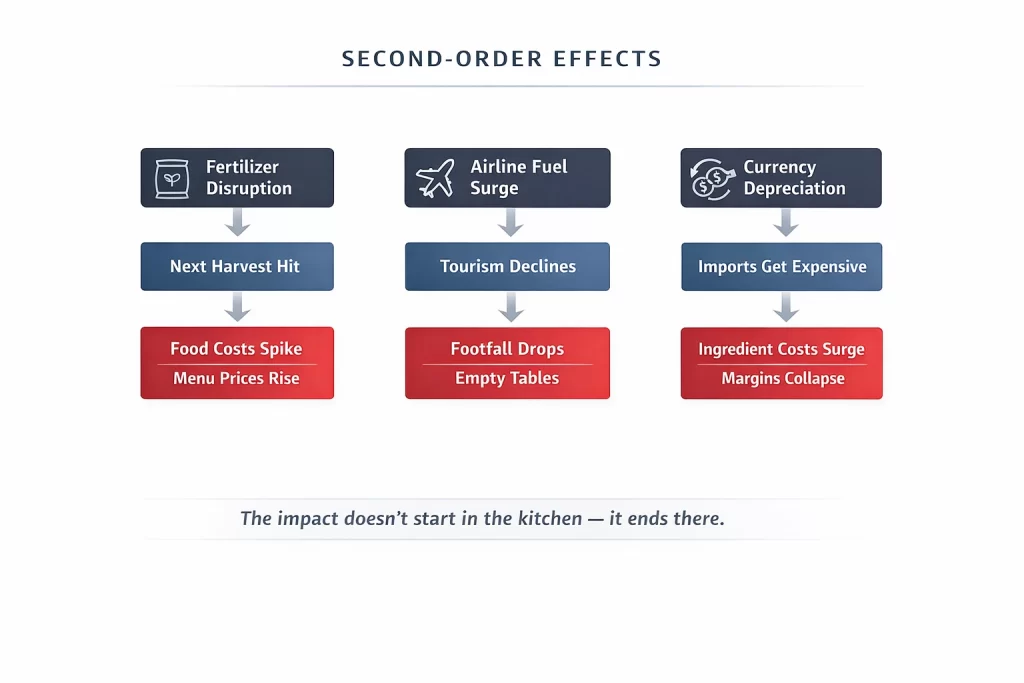
If this happens, there will be widespread permanent closures among small operators. Food inflation will become structural, driven by fertilizer shortages hitting the next harvest. Tourism will stay suppressed. Currency weakness will compound ingredient costs.
The gap between large chains and independents will widen permanently.
"We are just putting shock after shock, and that's what is pretty bad."

- David Laborde, Director of Agrifood Economics, Food and Agriculture Organization