

Michael Turner says, “A satisfied customer is the best business strategy of all,” and we can’t agree more.
According to the 2026 Phygital Index Report, 45% of diners say they’ve switched their favorite restaurant in the past year, up sharply from 33% in 2025. For anyone running a restaurant, this fact is as clear as day that habitual loyalty is fading, and restaurant customer retention now depends on relevance, convenience, and all-around customer experience. And yet most operators continue spending the majority of their marketing budget “attracting” new customers rather than retaining the ones they already have.
Research from Harvard Business Review has long established that a mere 5% increase in customer retention can boost profits by 25% to 95%. Moreover, acquiring a new customer costs five to twenty-five times more than retaining an existing one, and repeat customers spend 67% more per order than first-time visitors.
In the competitive restaurant industry, your most valuable marketing asset is the relationship you’ve already built with your existing customer base. How do you do that? This guide walks you through six proven customer retention strategies for restaurants you can act on right away.
What You’ll Learn
- Proven strategies to increase repeat business, restaurant customer loyalty, long-term success potential, and gain a competitive advantage.
- How to measure, improve, and sustain your restaurant’s customer retention rate using loyalty programs, personalization, customer feedback, and exceptional service?
Why Does Restaurant Customer Retention Rate Matter So Much?
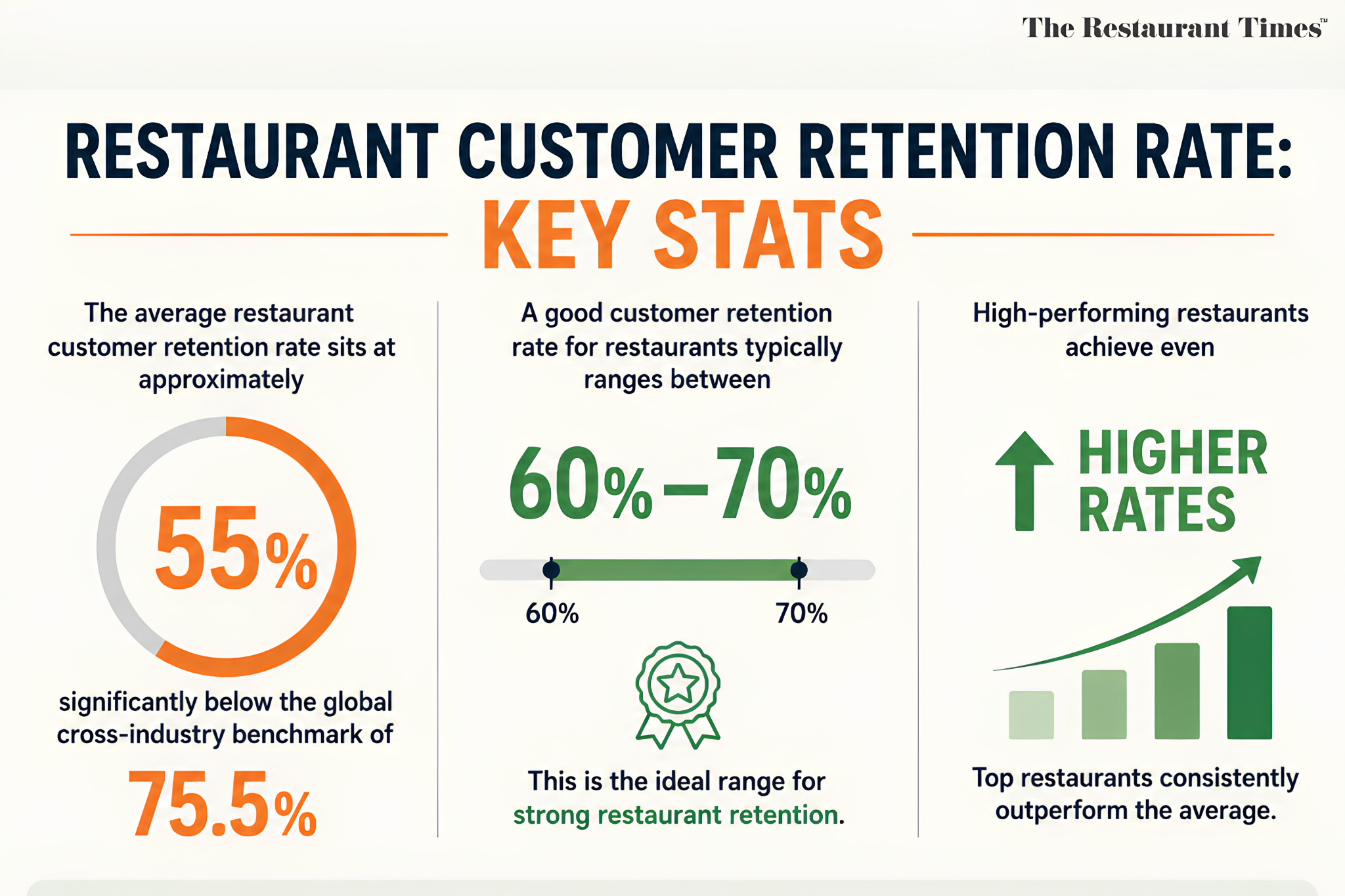
The average restaurant customer retention rate sits at approximately 55%, significantly below the global cross-industry benchmark of 75.5%. In fact, a good customer retention rate for restaurants typically ranges between 60% and 70%, with high-performing restaurants achieving even higher rates.
Why does that matter? Because every customer who doesn’t “return” to your restaurant represents lost revenue. Repeat customers visit more frequently, spend more over time, and are more likely to recommend your restaurant to others.
Plus, retaining customers can significantly reduce marketing costs, since acquiring a new customer can cost five times more than retaining an existing one, emphasizing the cost-effectiveness of loyalty.
Like, look at this case:
An independent restaurant in the United States partnered with AffZip to improve both customer acquisition and retention. They built a multi-channel strategy that combined Google Ads, Meta Ads, CRM integration, email marketing, marketing automation, and retargeting campaigns.
Within 90 days, the restaurant recorded a 65% increase in customer visits. Throughout every guest interaction was tracked, followed up, and nurtured through personalized campaigns that encouraged repeat visits.
Of course, not every restaurant needs a complex marketing stack to improve retention. The underlying principle is to give customers a reason to come back, make every visit consistent, and stay connected between visits.
The six strategies below show you how to do exactly that.
| But before that, you must know how to calculate your customer retention rate, because you can’t improve something you can’t measure in the first place. So, here’s the formula:((E-N)/S) * 100 Here, E is the number of customers at the end of the period, N is the number of new customers acquired during the period, and S is the number of customers at the start of the period. |
Strategy 1: Build a Loyalty Program That Rewards Customer Lifetime Value
Today, Loyalty programs have evolved from simple punch cards to sophisticated behavioral engines that drive measurable revenue growth, with 52% of consumers participating in restaurant loyalty programs, leading to more frequent visits and higher spending per visit compared to non-members.
Data has it that creating a loyalty program can increase customer visit frequency by 35%, making it a powerful tool for enhancing customer retention.
Despite this (and this is a big “despite”), dissatisfaction with fast-food and fast-casual loyalty programs has nearly doubled to 28%, up from 15% in 2025, which tells you that just having a program is not enough, but the design of it matters as much.
The most effective restaurant loyalty programs share several characteristics, including frictionless enrollment, immediate value upon joining, and clear progression paths that motivate continued engagement.
When members have to go an extra mile just to redeem their points, there comes friction that undermines loyalty. Among diners using self-service kiosks, 23% cite the inability to redeem loyalty points as a major frustration.
What should you do instead?
- Offer visual progress tracking so customers always know how close they are to the next reward, using a digital punch card format.
- Non-purchase bonuses: sign-up bonuses, referral rewards, and birthday perks that give people a reason to engage even between visits.
- An omnichannel QR code or short code that works at the in-store POS, kiosk, and in the app.
- Tiered structures (Bronze, Silver, Gold) to sustain long-term engagement through what behavioral economists call the goal gradient effect, i.e., the closer customers get to a reward, the more frequently they return.
Mobile integration has become essential for loyalty program success, with 60% of current loyalty program users preferring smartphone apps over physical cards, enabling advanced personalization features and higher customer engagement.
Always remember this one saying by David Thompson, “People will forget what you said, forget what you did, but they will never forget how you made them feel.”
Strategy 2: Segment Your New Customers and Personalize Their Experience
Natalie King says that “Every guest has a story; your job is to understand it,” and what’s worse, you may end up doing here is to treat every guest “identically.”
You must understand that behavioral segmentation based on actual purchase patterns delivers higher marketing ROI than demographic assumptions by enabling precise, relevant messaging for each customer group. And the best part is that the data you’ll need to do this is already there in your POS system, your app, and your ordering history. A customer data platform (CDP) connects these sources so you can act on them.
INDUSTRY INSIGHT
| Gen Z diners are the least loyal generation when it comes to restaurants, with 51% saying their favorite chain changed over the past year. Only 13% are highly satisfied with current loyalty programs. For this group (52%), food quality is the biggest factor influencing where they eat, while 45% plan to reduce their use of third-party delivery apps over the next 12 months. Contrary to assumptions, 64% of all diners report that social media does not really influence their dining choices. Millennials, on the other hand, (at least 49% of them) prioritize convenience as a top dining factor, 37% rank speed of service as a primary decision driver, and 29% say they use loyalty programs more often now specifically to offset rising costs. |
When you have to handle such diverse needs every single day, personalization is a powerful tool that can significantly enhance customer retention by tailoring services and marketing efforts to meet the unique needs and preferences of each customer.
You could automate personalized email campaigns for birthday rewards and anniversary perks to enhance customer engagement.
Strategy 3: Deliver Exceptional Service with Measurable Consistency
Exceptional service is the most cited reason customers return to a restaurant, and poor service is the most cited reason they don’t come back. In fact, 89% of customers say excellent customer service influences their decision to return.
As Sarah Bennett said, “Consistency in service builds the trust that turns visitors into loyal guests.” It means if you’re consistent with your food quality, service, and atmosphere, you can expect 82% of your consumers to be loyal.
Again, we are double-focusing on the word “consistency,” because one exceptional meal followed by a mediocre one creates doubt. Customers return to places they trust to deliver the same great experience every time, which means the kitchen, the floor staff, and the POS system all need to be operating from the same standards 24*7*365.
How can you ensure this? Run a quick audit of your operations:
- Does every cook prepare each dish using the same recipe, portion, and plating standard?
- What is the average ticket time during peak hours, and how does it compare to off-peak?
- Are customers greeted within 30 seconds of entering?
- When a mistake happens, how does the team respond? Are they quick enough and take ownership?
Train your servers to make genuine recommendations, upsell specials naturally, and handle complaints.
Strategy 4: Use Data to Catch Inefficiency Before the Customer Does
Most restaurants respond to losing a customer after the customer is already gone. Smarter ones use zero-touch dynamic segmentation and behavioral signals to identify and prevent such situations from happening well in advance.
A customer data platform, for example, can build dynamic lists like “customers who haven’t ordered in 30 days” and trigger campaigns automatically. The system continuously evaluates behavior in real-time, meaning users automatically enter or exit these segments without manual updates, triggering immediate churn-prevention offers.
You may use one or more of these tactics:
- Automated bounce-backs: Here, the system triggers a medium-value coupon 7 days after app registration to drive the first mobile order, and a follow-up offer at 30 days to drive the second.
- AOV-targeted minimum spends: When a high-value guest doesn’t show up for long, you send them an offer with a minimum spend requirement calibrated to their historical average order value. This protects the margin while re-engaging the guest, and has been proven to make customers spend 21% to 58% more than their historical average.
- Gamified frequency challenges: Here, you segment users into low-, mid-, and high-frequency tiers and send personalized, time-sensitive order goals based on their habits.
Plus, email and SMS marketing remain the highest-ROI channels for restaurant retention marketing, with SMS achieving open rates of 90% to 98% compared to email’s 20% to 40%.
Strategy 5: Collect Customer Feedback & Act on It to Improve Customer Acquisition & Your Marketing Strategies
Customer feedback is the earliest signal you have that something is going wrong, and most restaurants are not collecting it deliberately enough to catch problems early. Like, trust is, if your burgers have been coming out overcooked for six weeks, a few customers out there are going to bring it up when writing their reviews online.
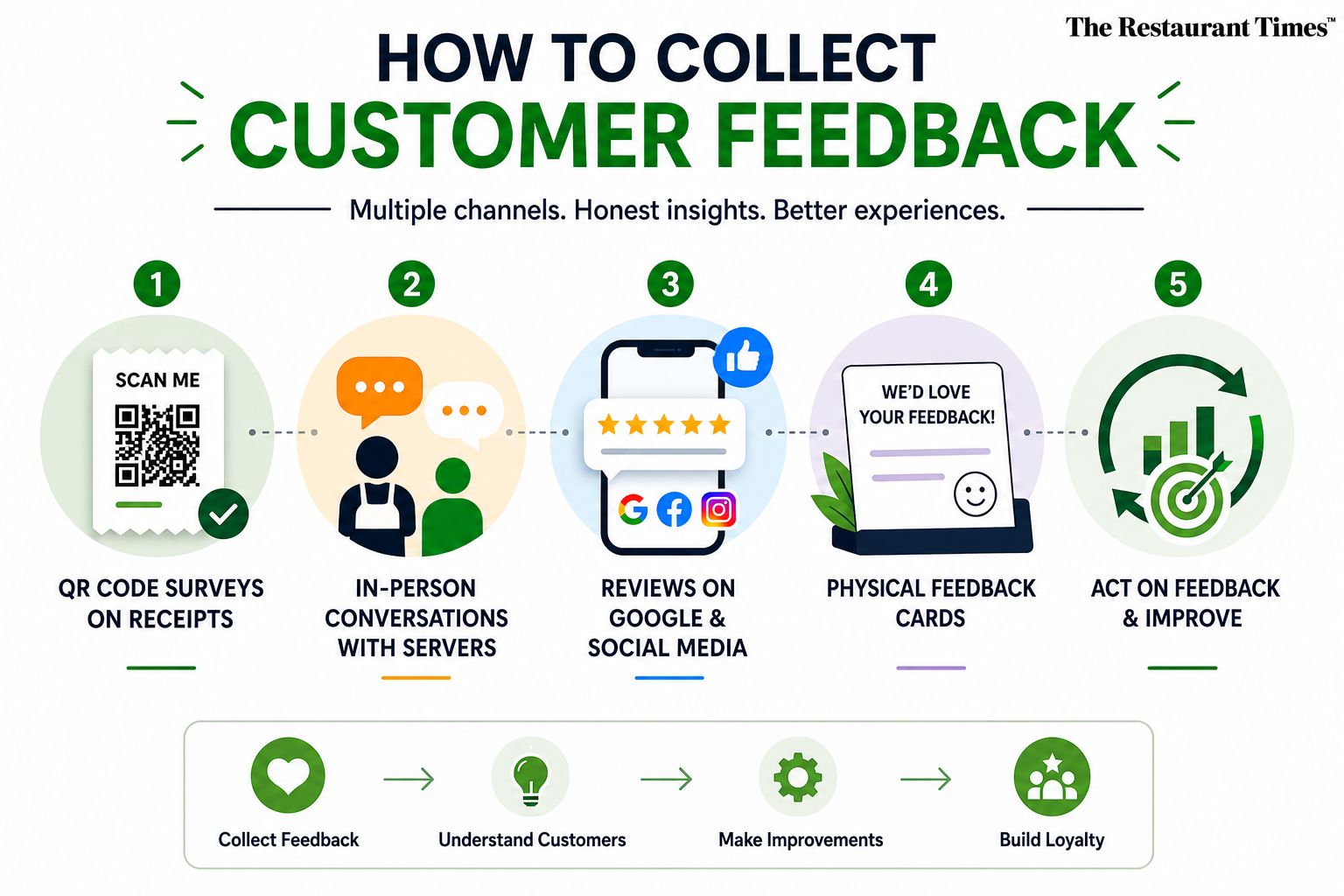
That’s why you should actively monitor Google, Yelp, and social media. Beyond that, the channels that yield the most honest, useful feedback are the short QR code surveys linked from receipts (two questions maximum, with a small discount incentive for completion), in-person conversations with servers, and physical feedback cards near the exit for guests who won’t bother with digital.
Most important: Respond to all the positive reviews and the negative ones. When prospective customers see you acknowledge a problem and explain what changed, that response does more for customer satisfaction and trust than a five-star review. It signals that you take the relationship seriously enough to be accountable.
Strategy 6: Engage & Retain Customers Through Social Media and Events
Your relationship with a customer shouldn’t begin and end at the table. To retain customers in 2026, you have to be present where they spend their time, which is, largely, their phones.
You can use social media to stay in the mental shortlist when someone asks, “Where should we eat tonight?” Staying active means sharing menu updates, seasonal specials, behind-the-scenes moments, and responding to comments. User-Generated Content (UGC), where loyal customers post photos of your food, is free marketing that carries more weight than any paid campaign.
Events are also one of the most underused customer retention efforts in the industry. A wine tasting event, a themed dinner night, a fundraiser tied to a local cause, etc., create experiences that give existing customers a specific reason to return. They also attract new customers through word-of-mouth at a lower cost than most marketing campaigns, since happy customers who attend events are far more likely to bring friends.
For online-only customers, personalized email follow-ups after an order, exclusive promotions for loyalty program members, and early access to new menu items all keep digital customers “happy.” These customers are particularly valuable because they require no table, no staff time to seat them, and can place repeat purchases with almost no friction if your ordering experience is well-built.
Remember what Michael Turner says, “Hospitality is about creating a space where guests feel at home.” Don’t compromise on that.
KEY TAKEAWAYS
| – Effective customer retention strategies in restaurants focus on building relationships through personalized loyalty programs and proactive engagement. – To maximize customer retention, focus on building long-term guest relationships rather than transactional sales. – The 30/30/30 Rule allocates 30% of revenue to food costs, 30% to labor, and 30% to overhead as a common budgeting framework in the restaurant industry. – Limited-time offers (LTOs) can create a sense of urgency that encourages customers to return. – Data-Driven Marketing using Customer Relationship Management (CRM) software can track guest behavior for targeted offers. – Creating a loyalty program that rewards repeat visits and referrals can foster customer engagement, encouraging customers to keep coming back and bring their friends and family along. – Hosting themed nights and special occasions can attract diners and keep them coming back, providing a unique dining experience that differentiates a restaurant from competitors. – Encouraging User-Generated Content (UGC) is a powerful strategy to build community and engage customers, as it taps into authentic content that resonates with potential customers. – Standardized kitchen operations involve enforcing precise recipes, portion controls, and plating guidelines for consistency in food quality. – Using customer data to send personalized offers, such as birthday discounts or recommendations based on past orders, can strengthen emotional connections to the brand and encourage repeat visits. |
Frequently Asked Questions
1. What is the 30/30/30 rule for restaurants?
The 30/30/30 rule suggests allocating roughly 30% of revenue each to food costs, labor, and overhead. While it doesn’t apply as is to every restaurant, it helps restaurant owners control costs and improve their restaurant’s profitability, creating more room to invest in a strong retention strategy.
2. What are the most cost-effective customer retention strategies for restaurants?
The most cost-effective strategies for restaurants include prioritizing customer retention through a rewards program, personalized marketing, and exceptional customer service. These approaches help encourage repeat business, boost customer loyalty, and foster loyalty without constantly having to bear high costs to attract customers.
3. What are the 8 C’s of customer retention?
The 8 C’s commonly include consistency, communication, convenience, customization, commitment, credibility, care, and community. Together, they help restaurants enhance customer satisfaction, meet evolving customer expectations, and build a loyal customer base.
4. What is the 80/20 rule in customer retention?
The 80/20 rule suggests that around 80% of revenue often comes from 20% of customers. That’s why you should prioritize retention because keeping your most loyal guests engaged has a greater impact on maintaining customer loyalty and increasing customer retention rates than focusing only on acquiring new customers.
5. How do restaurants identify their top 20% of customers?
Restaurants analyze purchase history, visit frequency, average spend, and customer behavior using POS systems, CRMs, and loyalty platforms. These valuable insights reveal how many customers drive the most revenue, helping restaurants personalize offers, answer customer inquiries more effectively, understand customer preferences, and encourage customers to return through successful loyalty programs where customers earn points and stay engaged.