

Recently opened a restaurant or are about to, or maybe you are planning to scale soon? “It’s fine to celebrate success, but it is more important to heed the lessons of failure,” and since we’re going to address soon how 82% of business failures are caused by inadequate cash flow management, we thought it would be better to start this blog with one of Bill Gates’ quotes.
After all, undercapitalization is one of the top reasons restaurants close within five years (which, btw, is the case for 50% of restaurants out there).
Since the industry already runs on average pre-tax margins of 5–10%, it’s very important you know the available restaurant funding options and why you should choose the right one at the right time.
But before we get there, first, understand that restaurant cash flow management is different from profit, as it includes all outgoing cash transactions, such as paying bills and purchasing new equipment, as well as incoming cash from revenue and funding sources. This means even a “profitable restaurant” (on paper) can still have a cash flow crisis. How do you deal with that? This article lists funding options that can help you start, sustain, and grow your restaurant business.
What You’ll Learn
- Which restaurant funding option best fits your business needs and stage of growth?
- How to compare financing options, avoid common borrowing mistakes, and manage cash flow after securing funding.
Why Do Restaurant Owners Need Funding in the First Place?
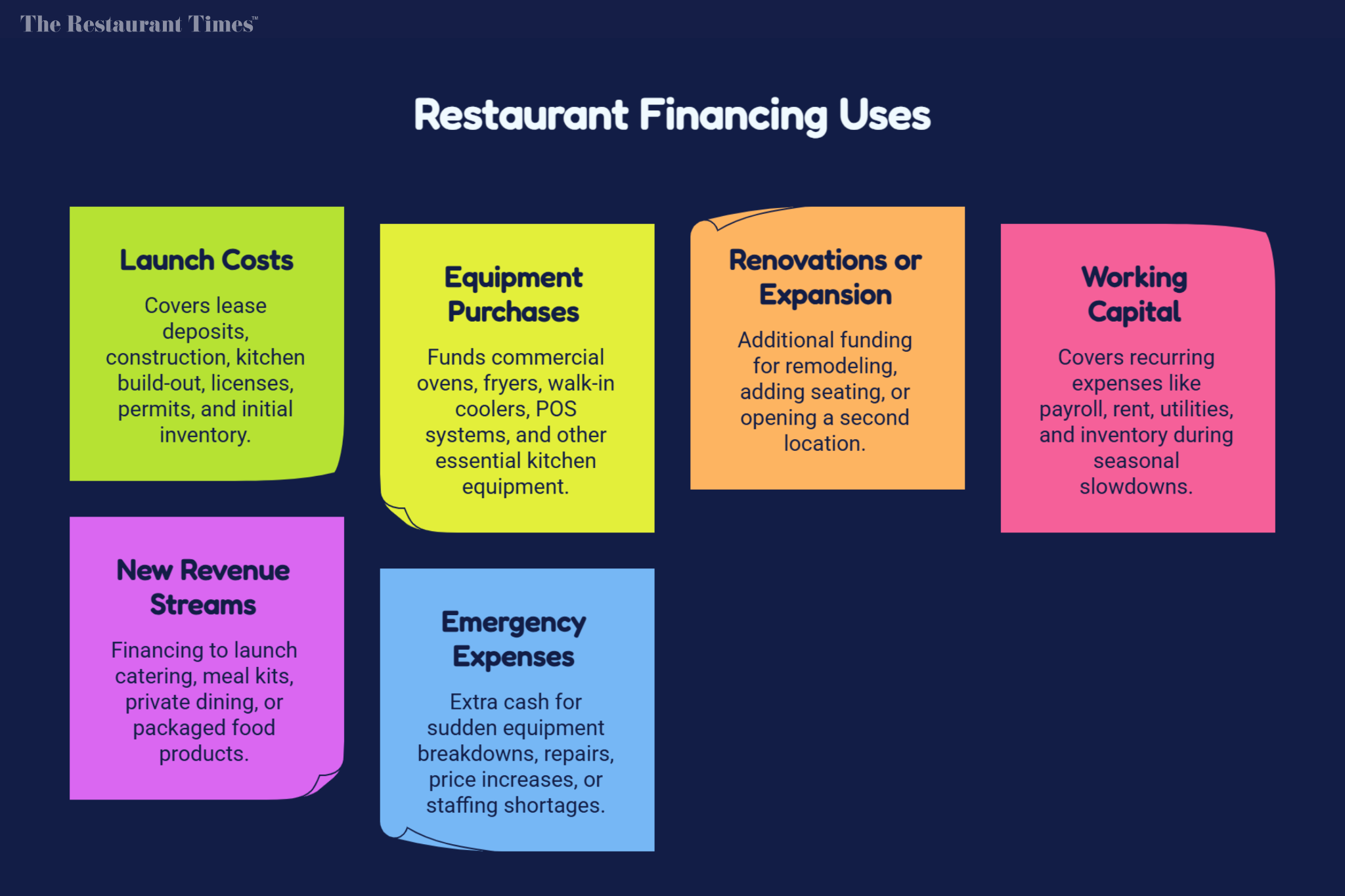
Okay, so some of the most common reasons restaurant owners seek funding are:
- To get the business off the ground [Launch costs]: This one covers lease deposits, construction, kitchen build-out, licenses, permits, and your initial inventory.
- For equipment purchases: Like, you may want to buy commercial ovens, fryers, walk-in coolers, POS systems, or other essential equipment that keeps your kitchen running.
- Renovations or expansion goals: You may need additional funding if you’re planning to remodel your existing restaurant, add more seating, or open a second location.
- To keep day-to-day operations running smoothly [Working capital]: Almost every restaurant experiences seasonal slowdowns, and this is when funding can help them cover recurring expenses like payroll, rent, utilities, and inventory until cash flow stabilizes yet again.
- To create new revenue streams: Many restaurants use financing to launch catering services, meal kits, private dining experiences, or packaged food products (CPG) as a way to make a double income.
- As emergency expenses: Nobody can predict when you may need some extra cash due to sudden equipment breakdowns, emergency repairs, supplier price increases, or staffing shortages. Having access to funding can help you get through those situations with ease.
Remember: “Every part of your restaurant depends on consistent cash flow. That’s why knowing how to finance a restaurant, and which option fits your exact needs, is key to staying competitive in a fast-paced industry” – Ryan Rosett, Founder, Credibly.
What Are the Best Restaurant Funding Options Available?
Below are nine restaurant funding options that you may choose from:
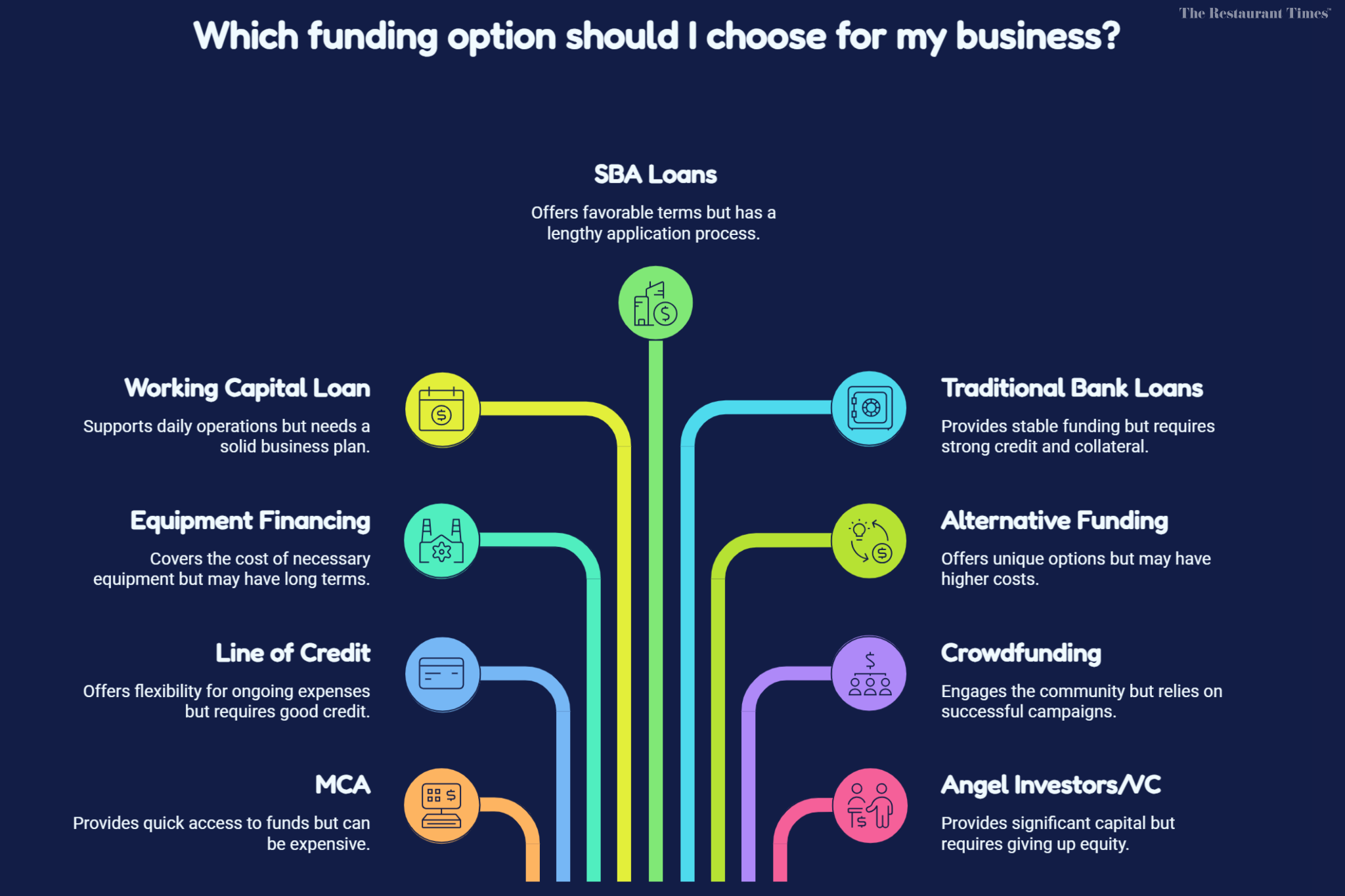
1. Merchant Cash Advance (MCA)
💡Best for: High-volume card-based restaurants (i.e., restaurants that process a lot of credit and debit card payments on a daily basis) that need cash immediately.
Merchant cash advances (MCAs) provide a lump sum of cash upfront in exchange for a portion of future sales, typically through daily or weekly withdrawals from a bank account. The tradeoff here is that MCAs use a factor rate instead of fixed interest rates (it can exceed 30-40%), which often means you’ll have to bear a much higher borrowing cost.
The good point is that MCAs are one of the fastest funding options available, and you can get funded within 24 to 72 hours.
Mind that MCAs aren’t technically loans, which means they don’t follow the same transparency standards as other financing. So, you’d better use this option carefully, and only when other faster, cheaper alternatives aren’t available.
| Factor | MCA |
| Speed | 24–72 hours |
| Cost | Very high (factor rates) |
| Repayment | Percentage of daily credit card sales |
| Best for | Card-heavy restaurants, genuine emergencies |
2. Business Line of Credit
💡When should you take it? If you’re struggling with seasonal fluctuations and short-term cash flow gaps.
A business line of credit allows restaurant owners to draw from a set amount of credit as needed, paying interest only on the amount used, making it a flexible option for managing short-term expenses.
This is one of the most flexible restaurant financing options, and it’s genuinely useful when you have to stock up before a busy season, cover payroll through slow periods, or handle unexpected repairs. You can choose between a secured line backed by business assets or an unsecured line with no collateral required, though unsecured lines usually carry higher interest rates. Over time, responsible use of a line of credit also builds your credit history, which opens doors to better loan programs later.
3. Equipment Financing
💡This one goes as the name suggests. Take it when you’re purchasing high-end restaurant equipment or upgrading your existing ones.
Equipment financing is specifically designed for purchasing or leasing restaurant equipment, where the equipment itself serves as collateral, often resulting in favorable repayment terms. Because lenders can recover the equipment if you default, their risk is lower, which is why approval rates for equipment financing top 78% industry-wide.
Now, depending on your needs, you can either choose to finance or lease the equipment. The difference here is:
| Aspect | Equipment Financing | Equipment Leasing |
| Ownership | You own the equipment after paying off the loan. | You return the equipment or buy it at the end of the lease. |
| Best for | Equipment you’ll use for many years, such as ovens, grills, or refrigeration units. | Equipment that becomes outdated quickly, such as POS systems or other technology. |
| Tax treatment | May qualify for Section 179 deductions.* | Different tax rules apply. |
* Section 179 may allow businesses to deduct the full cost of qualifying equipment in the year it’s purchased, even if it’s financed. Check with your accountant to understand what applies to your business.
4. Working Capital Loan
💡The best case to opt for this one is when you need short-term funding to cover day-to-day operational expenses.
Working capital loans are intended to help restaurants bridge cash flow gaps and cover day-to-day operational expenses, providing short-term financial support. Unlike equipment financing, this is general-purpose cash, so you can use it for payroll, inventory, rent, or whatever is most urgent.
The keyword here is short-term, which means you should not use working capital loans to fund long-term assets like renovations or new location build-outs because these loans usually come with much shorter repayment terms.
5. SBA Loans
💡Best for: Restaurant owners with decent credit and those who can afford to “wait” on approval.
SBA loans are backed by the U.S. Small Business Administration, which reduces risk for lenders and makes funding more accessible for small businesses. The benefit you get here as a borrower is lower interest rates, longer repayment terms, and smaller down payments than you’d get from traditional bank loans.
The most popular option is the SBA 7(a) loan, which can be used for working capital, equipment purchases, and renovations. In fiscal year 2025, the SBA approved over 77,000 loans through the 7(a) program, averaging more than 1,600 per week.
SBA microloans can provide up to $50,000 for smaller needs, making them accessible to newer restaurants for initial inventory or equipment.
What SBA loans require:
- For-profit business registered in the U.S.
- Personal and business tax returns (2–3 years)
- Detailed business plan with financial projections
- Proof you’ve explored other financing options first
The only tradeoff here is that SBA loans typically require a lengthy application process, which can take from one to three months, and involve submitting extensive documentation such as tax returns and business plans.
6. Traditional Bank Loans
💡Best for: Established restaurants with strong financials and no urgency.
Traditional bank loans offer the lowest interest rates and largest loan amounts of any option on this list, but they’re also the hardest to qualify for. Most banks want a credit score of 680 or higher, at least two years of operating history, and collateral that often exceeds the loan amount itself.
According to the Federal Reserve’s Small Business Credit Survey, only 52% of small business loan applicants received the full amount requested, and restaurants tend to fare worse than that average. Denial due to existing debt has nearly doubled over a three-year period among applicants.
Here’s what lenders require from you before they can approve your loan request:
- Strong personal credit (680+ minimum, 720+ for favorable rates)
- Personal guarantees tied to personal assets
- Financial statements covering P&L, income statements, and balance sheets
- Business tax returns and credit reports
If you’re an existing restaurant owner with consistent cash flow and time on your side, this is your lowest-cost path. If you’re newer or recovering from a rough year, look elsewhere first.
7. Alternative Funding Options/Restaurant Loan
💡Best for: Newer restaurants or those with limited credit history.
Alternative loans, which include options like revenue-based financing and community development financial institutions (CDFIs), offer more flexible terms and quicker access to capital compared to traditional bank loans.
CDFIs are mission-driven lenders focused on underserved communities. They frequently work with restaurant concepts that traditional banks reject outright. If you’re a minority-owned restaurant or operating in an underserved area, CDFIs deserve serious consideration.
Revenue-based financing advances capital based on your projected sales and then collects a percentage of revenue until repaid.
Approval is fast, and there’s no fixed monthly payment, but effective interest rates can run high (in fact, much closer to what MCA charges), so you’d better calculate the true total cost before committing.
8. Crowdfunding
💡Best for: Restaurant concepts with a strong community story or an existing following.
Crowdfunding allows restaurant owners to pitch their concept to the public, offering perks or experiences in exchange for financial support. It raises money and builds your customer base simultaneously, which is genuinely valuable.
Successful crowdfunding campaigns require a compelling story that resonates with potential backers and a well-structured campaign to stand out. It works best for restaurants that already have a following or community support, because crowdfunding leverages existing relationships to generate funding. If your community shows up to support your concept, they’ll likely buy into making it happen.
Platform fees typically run 5-12% of total funds raised, so factor that into your target number.
One caveat we would say here is that crowdfunding is not a reliable primary funding source for most restaurants. You can employ rather than a supplement to other financing. It is absolutely good for early buzz and community buy-in, but not something to build your entire financial plan around.
9. Angel Investors and Venture Capital
💡Any restaurant business that’s planning to expand to multiple locations or grow can seek investors.
Angel investors can provide capital in exchange for equity in the restaurant, often bringing valuable experience and connections to the business. Unlike a loan, here you don’t repay the money in monthly installments. Instead, investors earn a return if your business grows in value.
Venture capital firms usually invest even larger amounts, but they specifically look for restaurant concepts that can scale fast across multiple locations or through a franchise model. Yes, they invest more money than angel investors, but they also expect more control and faster returns.
To attract either, you’ll need a sharp business plan, detailed financial projections, and a pitch that demonstrates both your passion and a credible path to profit.
The trade-off is that you’re required to give up ownership (or at least a part of it), and decision-making gets shared. Only go this route if you’re genuinely building something designed to scale.
How Do You Compare Restaurant Financing Options Before Deciding?
Each financing option that we’ve discussed above serves a different purpose. Some are better for short-term cash flow, while others are designed for long-term investments. So, how do you decide which one is actually right for you? Here’s a quick comparison to help you narrow down your choices.
| Situation | Best Option | Why |
| If you need cash in days | MCA, alternative lenders | Fast approval, minimal paperwork |
| If you’re buying equipment | Equipment financing | Equipment as collateral, tax benefits |
| To fill seasonal cash gaps | Business line of credit | Draw only what you need |
| If you’re expanding to new locations | SBA 7(a), bank loan | Largest amounts, lowest rates |
| If you’re a new restaurant with limited credit history | Equipment financing, CDFIs | Lower eligibility requirements |
| If you’ve got a strong community following | Crowdfunding plus another source | Capital and customer acquisition together |
| If you’re pitching a high-growth concept | Angel investors, VC | Large capital, mentorship |
| To cover day-to-day expenses | Working capital loan | Short-term, general-purpose |
Before you make your final financing decision, ask yourself these three questions:
- How much do I actually need? Don’t borrow the maximum you qualify for. Borrow what you need with a reasonable buffer for surprises.
- What can I handle in repayment? Run the numbers against your cash flow forecast. Loan payments are a fixed outflow, and they don’t pause during slow periods.
- What am I giving up? Debt costs interest. Equity costs ownership. MCAs cost future sales. You’d better know your trade-off before you sign.
INDUSTRY INSIGHT
| The U.S. restaurant industry has been on a strong growth trajectory, crossing the $1 trillion mark in annual sales and continuing to expand year after year. At the same time, competition is increasing, operating costs remain high, and more restaurant owners are investing in technology, new locations, and better guest experiences to stay ahead. As Michelle Korsmo, President and CEO of the National Restaurant Association, puts it, “The fundamentals of the restaurant industry are strong, and operators are optimistic about the year ahead.”The opportunity is indeed big, but so are the risks. Effective funding for a restaurant requires matching the right type of capital to specific needs, whether that’s equipment, renovations, or working capital. There’s no universally best option. There’s only the right option for your stage, your needs, and your ability to repay. Start with clarity on what the money is actually for, only then pick the tool that fits. |
How Do You Manage Cash Flow After Securing Restaurant Funding?
So, you’ve got your money, finally. The next obvious step is to keep your restaurant financially healthy from here on. Here’s how you do that:
First, build a cash flow forecast. A cash flow forecast for a restaurant should indicate projected sales volume, seasonal sales trends, and cash outflows like loan payments, utility payments, inventory costs, and payroll. Do this before you borrow and update it monthly.
Next, focus on building and following these four habits:
#1: Track every dollar, be it your incoming sales, outgoing vendor payments, payroll, or supplies.
#2: Review your P&L monthly. A monthly review catches overspending before it eats into your reserves.
#3: Budget by quarter. Start with 90-day goals, let’s say. They are specific enough to act on and yet flexible enough to adjust.
#4: Keep a cash reserve. Successful restaurants maintain cash flow through careful budgeting and planning based on cash flow forecasting, which predicts future cash flow based on past performance. You should ideally have a reserve covering at least 1-3 months of your operating expenses.
How Can Business Owners Prepare for Restaurant Business Financing?
Preparation for securing funding often includes presenting a solid business plan, tax returns, and a strong personal credit score to lenders. Having everything ready before you apply speeds up the process and signals to lenders that you run a tight operation.
Here’s the application checklist to make the process a bit easier for you:
- Business plan with detailed financial projections (minimum three years)
- Personal and business tax returns (2–3 years)
- Bank statements from the last 3–6 months
- P&L statement and balance sheet (for existing restaurants)
- Credit reports, both personal and business
- List of existing debts and obligations
- Equipment quotes or invoices if applying for equipment financing
On credit scores, most banks prefer 680 or above. Equipment financing providers sometimes work with scores as low as 500–600. If your score needs work, spend a few months paying down debt and correcting errors on your credit reports before applying. Your credit history directly affects the interest rates and eligibility requirements you’ll face, and a few months of cleanup can save you thousands.
One thing we would advocate restaurant owners to do before “talking” to any lender is to know their numbers by heart. If you can’t walk the lender/investor through your monthly cash flow in five minutes, no matter how good your business plan is, it won’t compensate on your behalf.
KEY TAKEAWAYS
| – Merchant cash advances (MCAs) provide a lump sum of cash upfront in exchange for a portion of future sales, making them suitable for restaurants with high card transaction volumes. – A business line of credit allows restaurant owners to draw funds as needed, paying interest only on the amount used, which can help manage short-term expenses and cash flow. – Equipment financing allows restaurants to purchase or lease equipment, with the equipment itself serving as collateral, often resulting in favorable repayment terms. – Personal savings can be a straightforward funding option for restaurant owners, allowing them to invest directly in their business without incurring debt. – SBA loans are designed to make funding more accessible for small businesses, including restaurants, by offering lower rates, longer terms, and smaller down payments compared to traditional loans. – Crowdfunding can be particularly effective for restaurants that already have a following or community support, as it leverages existing relationships to generate funding. |
Frequently Asked Questions
1. How do I get funding for my restaurant?
To secure business funding, start by estimating your upfront capital needs and preparing your financial documentation, including a business plan, tax returns, and cash flow projections. Lenders typically evaluate your credit, while investors typically focus on your growth potential. Depending on your situation, you can explore bank loans, SBA loans, crowdfunding platforms, or alternative funding opportunities, even if you have bad credit.
2. What is the 30-30-30 rule for restaurants?
The 30-30-30 rule is a budgeting guideline suggesting that restaurants aim to keep food costs, labor costs, and occupancy costs at roughly 30% each of revenue. While not every restaurant can meet these targets, the rule provides a useful benchmark for maintaining healthy margins while still generating enough cash flow to pay interest, purchase equipment, and support long-term growth.
3. How much is the monthly payment on a $50,000 business loan?
Monthly payments on a $50,000 business loan depend on the interest rate and repayment term. For example, a five-year loan at 10% interest costs about $1,062 per month, while lower rates reduce the payment. Since lenders typically offer different terms based on your credit profile and business history, you should compare multiple financing options before borrowing.
4. How much funding do I need to open a restaurant?
The amount of upfront capital you need depends on your concept, physical location, size, and equipment requirements. Small restaurants may require $100,000 to $300,000, while full-service concepts often need significantly more.
Your budget should cover build-out costs, inventory, permits, staffing, and enough working capital for the first few months. Some eligible restaurants also combine loans with crowdfunding platforms to generate buzz before opening or launching consumer packaged goods as an additional revenue stream.