

Opening a restaurant is one of the most exciting and financially complex decisions an entrepreneur can make. Most first-time restaurant owners significantly underestimate what it actually takes to get through the doors and stay open long enough to become profitable.
The cost of a business license for a restaurant can range from $75 to $7,000 or more, depending on local requirements. A food-handling service license typically costs between $100 and $1,000, while liquor licenses can range from $300 to $14,000, depending on state regulations. Common permits required to open a restaurant include a business license, food service permit, certificate of occupancy, and signage permit. The licensing process can take 60 to 90 days or longer, making it essential to start early to avoid delays in opening. Liquor licenses can cost anywhere from $50,000 to $300,000, depending on state and local quotas. And so much more is a part of the initial process.
What You Will Learn
- Complete startup costs range by restaurant type and format
- Every major upfront cost category with realistic ranges
- Ongoing monthly operating expenses and how to benchmark them
- How to reduce startup costs without compromising your concept
Average Restaurant Startup Costs: Quick Overview
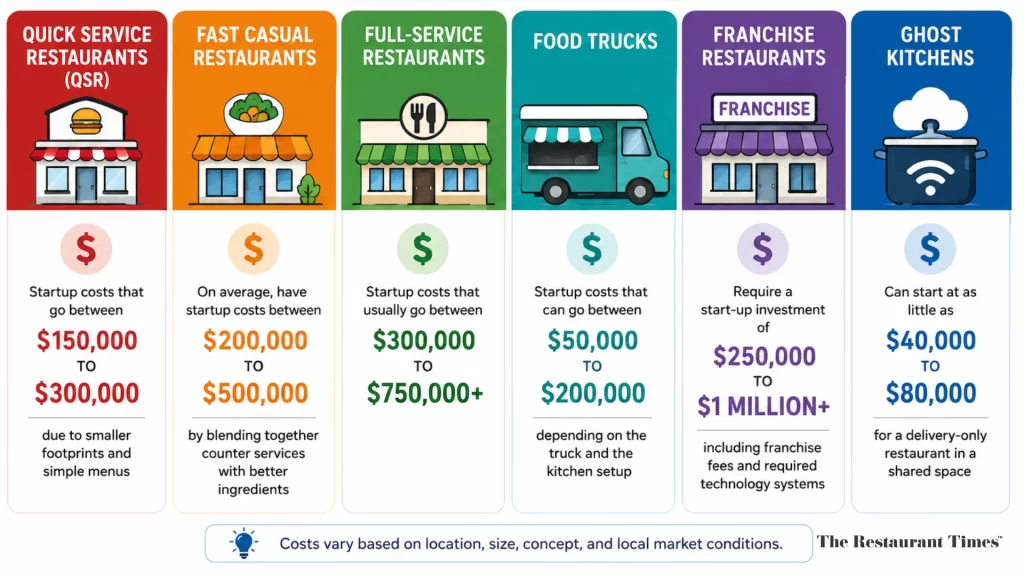
Prior to diving into the line-by-line analysis, below is where each format stands regarding startup costs. Here is a restaurant startup costs checklist:
- Quick Service Restaurants (QSR): Startup costs that go between $150,000 to $300,000 due to smaller footprints and simple menus
- Fast Casual Restaurants: On average, have startup costs between $200,000 to $500,000 by blending together counter services with better ingredients
- Full-Service Restaurants: Startup costs that usually go between $300,000 to more than $750,000
- Food Trucks: Startup costs that can go between $50,000 to $200,000, depending on the truck and the kitchen setup
- Franchise Restaurants: Require a start-up investment of $250,000 to more than $1 million, including franchise fees and required technology systems
- Ghost Kitchens: Can start at as little as $40,000 to $80,000 for a delivery-only restaurant in a shared space
INDUSTRY INSIGHT
| Food service industry sales are projected to reach $1.55 trillion in 2026, with real (inflation-adjusted) gains of 1.3% expected nationwide. |
The average total cost to open a restaurant typically ranges from $175,000 to over $2 million, depending on factors such as location, size, and concept. Use these ranges as a starting orientation, not a budget. Your actual number depends on decisions you have not made yet, and those decisions matter more than any national average.
One-Time Startup Cost to Open Restaurant: A Breakdown
The average monthly rent for a restaurant can range from $2,000 to $12,000, depending on the location and size of the establishment. High-cost cities like San Francisco or New York often exceed $2 million in total startup costs due to higher rents. Startup costs for quick-service restaurants can range from $150,000 to $300,000, while full-service restaurants may require $300,000 to $750,000 or more. Food trucks offer a lower-cost entry point into the restaurant industry, with startup costs ranging from $50,000 to $200,000, depending on the vehicle and kitchen equipment. Let’s see in detail:
Lease Deposits and Build-Out Costs
Real estate is always the most costly item on your first budget. The location of a restaurant affects rental fees, insurance expenses, and expenditures. The average rent price for a restaurant may be in the range of $2,000 to $12,000 per month, and it is contingent on the restaurant location and the size of the facility. San Francisco or New York locations usually start from more than $2 million due to high rental prices.
- The following expenses related to build-out will significantly affect the cost of real estate:
- Renovation and build-out expenses range from $24 to $143 per square foot
- Costs of constructing and remodeling a restaurant may vary widely depending on the condition of the property and necessary customizations, from $50 to $300 per square foot.
- Commercial code compliance expenses on plumbing, electricity, and HVAC alterations usually cost from $50 to $250 per square foot
Savings tip: Choosing a pre-existing commercial building that was already constructed for the purpose of food service will help to reduce building expenses by $50,000 to $150,000.
Kitchen Equipment and Appliances
Restaurant equipment costs and furniture needed for the commercial kitchen may vary from $100,000 to $300,000. Such a variety takes into account the difference between purchasing used/reconditioned equipment and buying a completely new one with all custom configurations. In the case of many new restaurant owners, the use of used/reconditioned equipment is the most reasonable option. Thus, you may save about 30-50% of your money when purchasing a used commercial range, a reconditioned mixer, and an open-box refrigeration unit.
- Main expenditures for kitchen equipment:
- Cooking equipment (ranges, ovens, fryers, grills): $15,000-$80,000
- Refrigeration units and coolers: $5,000-$40,000
- Preparation tables and other small kitchen equipment: $5,000-$20,000
- Dish washing equipment: $3,000-$20,000
Saving tip: Equipment financing and leasing equipment options convert high upfront costs into manageable monthly payments, preserving working capital for the operating phase when you need it most.
Dining Room Furniture, Construction Costs, and Fixtures
Your dining room represents your brand in its tangible form. The cost of furniture, tables, chairs, booths, lighting, and decorations for the dining room of a mid-sized restaurant is usually $20,000-$80,000, but this range differs greatly depending on the service style of the restaurant.
- A full-service restaurant with table service needs to have more expensive seats and décor
- Fast-casual counter service restaurants can decorate their dining rooms with a budget of $15,000-$30,000
- High-end fine dining restaurants can spend up to $100,000 on interior decorating and furniture
- Quick-service restaurants may not need to invest much in the dining room area at all
Where budgets blow up here: Vanity investments in décor that customers rarely notice are a common trap for first-time operators. Prioritize seating comfort and durability over aesthetic flourishes that add cost without enhancing the guest experience.
Licenses, Permits, and Legal Fees
Regulatory costs are among the most underestimated categories in the overall restaurant startup cost picture. The licensing process can take 60 to 90 days or longer, making it essential to start early to avoid delays in opening.
Here is what you are looking at across the major permit categories:
- The cost of a business license for a restaurant can range from $75 to $7,000 or more, depending on local requirements
- A food-handling service license typically costs between $100 and $1,000, while liquor licenses can range from $300 to $14,000, depending on state regulations
- Liquor licenses can cost anywhere from $50,000 to $300,000, depending on state and local quotas
- Common permits required to open a restaurant include a business license, food service permit, certificate of occupancy, and signage permit
- Food handler certifications for your staff add cost and time before your team can legally operate
The liquor license issue deserves specific attention. In quota states, you are not applying for a license; you are buying one from an existing holder at market rates.
Technology and POS Systems
Implementing a robust POS system can optimize inventory tracking, providing real-time data on stock levels, waste reduction, and order patterns, which is essential for managing costs effectively.
Technology costs to budget for at opening:
- POS hardware and software: $1,200 to $5,000 upfront
- Online ordering integration: $129 to $299 per month, ongoing
- Reservation systems for full-service restaurants: $200 to $400 per month
- Inventory management software: $150 to $300 per month
- Scheduling software: $100 to $200 per month
What most articles miss: Your POS system’s upfront cost is just the beginning. The ongoing SaaS layer adds $600 to $1,200 per month in year one, turning a $3,000 capital expense into a $12,000 to $17,000 first-year true cost when all integrations are included.
Initial Inventory, Food Costs, and Supplies
Initial food inventory costs can range from $5,000 to $25,000. This covers your first food orders, beverages, cleaning supplies, and the smallwares—utensils, storage containers, serving vessels—that are easy to forget until opening week arrives.
- Initial dry goods and shelf-stable inventory: $3,000 to $10,000
- Fresh and perishable food inventory for opening week: $2,000 to $8,000
- Cleaning supplies and chemicals: $500 to $2,000
- Smallwares (utensils, containers, serving equipment): $3,000 to $10,000
Food costs generally represent 28% to 35% of a restaurant’s ongoing expenses, but can vary significantly depending on the cuisine and menu offerings. Getting your initial inventory right, not too much to waste, not too little to serve your first week, requires careful planning before opening day.
Licenses, Permits, and Pre-Opening Payroll
Pre-opening payroll is one of the most consistently underestimated costs in a restaurant budget. You need to hire, onboard, and train your staff before you open, which means paying them before you have generated a dollar of revenue.
- Staff training period: typically 2 to 4 weeks before opening
- Pre-opening payroll for a small restaurant: $15,000 to $40,000
- Soft opening costs: additional food and beverage expense without full revenue
Payroll costs typically account for 28 to 35% of restaurant startup costs, making them one of the largest expense categories for new restaurants. Budget for the full training period, not just the week before opening.
Marketing and Pre-Opening Expenses
Restaurants should allocate around 3 to 6% of their sales to marketing, especially during the initial years when building brand awareness and customer loyalty. For a pre-opening budget, the major marketing costs include:
- Signage and exterior branding: $3,000 to $15,000
- Website design and development: $2,000 to $8,000
- Social media setup and content creation: $1,000 to $5,000
- Grand opening promotion and events: $3,000 to $10,000
- Local PR and press outreach: varies widely depending on whether you use a PR agency or manage it yourself
Choosing a location with high foot traffic can reduce the need for extensive marketing, as it naturally attracts more customers to the restaurant. That is not an excuse to skip marketing, but it does mean your location decision has a direct impact on your marketing costs budget.
Ongoing Monthly Operating Costs
Restaurants also have ongoing monthly operating costs. Let’s explore those:
Rent and Utilities
Monthly utility costs for restaurants can range from $1,000 to $1,200 for an existing commercial space of 4,000 to 4,500 square feet, and can account for approximately 3% to 5% of overall operating costs. Add these to your monthly rent, and you have a fixed overhead floor that every dollar of revenue must cover before reaching profitability.
Labor and Payroll Expenses
Labor expense usually constitutes 25% to 35% of the restaurant’s revenue, depending on the restaurant’s service and staffing system. The full-service restaurant with a table service system bears the maximum labor expenses among all. Quick-service restaurants have a more economical service system based on counter service. Monitoring labor cost against revenue per week is a must.
Food Service and Beverage Costs
Food cost usually accounts for 28% to 35% of restaurant expenses, though it varies widely depending on the type of food served. The industry standard for ideal food cost ranges from 28% to 35%, with the current industry average at 32.4%. Food costs beyond 35% calls for immediate action.
Insurance Premiums
Insurance is mandatory and consistently underbudgeted. Your required coverage typically includes:
- General liability insurance: $2,500 to $4,500 per year for $1 million in coverage
- Workers’ compensation insurance: averaging $8,000 to $20,000 annually for a small restaurant
- Property insurance: $1,500 to $3,500 per year
- Liquor liability if applicable: $3,000 to $8,000 per year
- Many landlords require $2 million umbrella policies, adding another $1,200 to $2,000 annually
Cost Factors by Restaurant Type
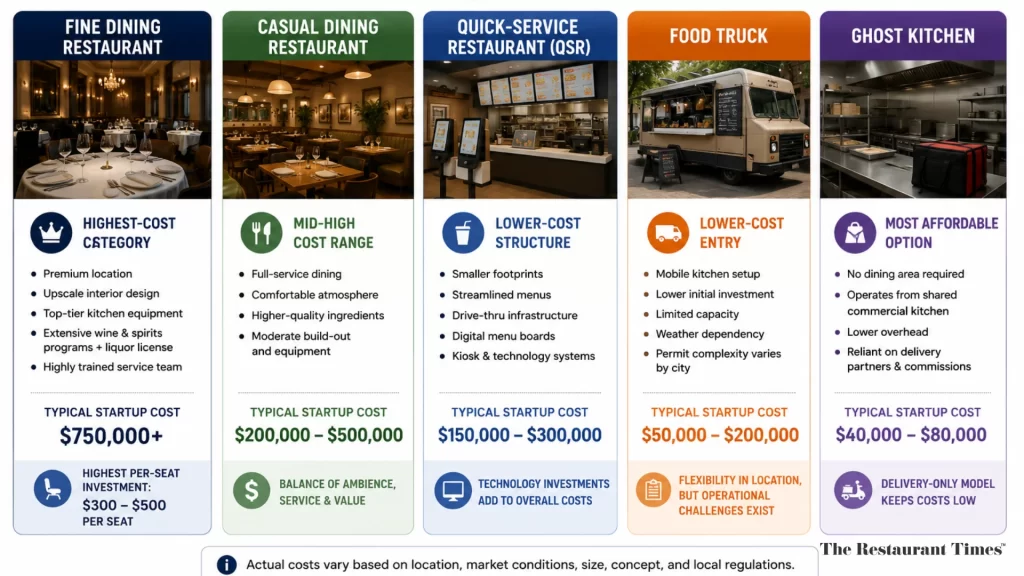
Have you wondered how costs change in different types of restaurants? Let’s now find out:
Fine Dining & Full Service Restaurants Costs
Fine dining is the highest-cost category in the restaurant industry. Premium location, upscale restaurant interior design, top-tier kitchen equipment, extensive wine and spirits programs with associated staff liquor license requirements, and a highly trained service team all combine to push total startup costs well above the $750,000 median. Fine dining also carries the highest per-seat investment, often $300 to $500 per seat in furniture and fixtures alone.
Casual Dining Restaurant Costs
Fast casual restaurants, which combine counter service with higher-quality ingredients, generally have startup costs between $200,000 and $500,000.
Quick-Service Restaurant Costs
Quick-service restaurants (QSRs) typically have lower startup costs ranging from $150,000 to $300,000 due to smaller footprints and streamlined menus. That said, drive-thru infrastructure, digital menu boards, and kiosk systems add technology costs that table-service formats do not carry.
Food Truck Costs
Food trucks represent a lower-cost entry into the restaurant industry, with startup costs ranging from $50,000 to $200,000, depending on the vehicle and kitchen installation. The lower upfront costs are offset by limited capacity, weather dependency, and permit complexity that varies significantly by city.
Ghost Kitchen Costs
The ghost kitchen provides the most affordable startup cost structure in the hospitality industry through the absence of a dining area. A delivery-only service operated from a shared commercial kitchen could be started for a price range between $40,000-$80,000, including kitchen equipment, first inventory, technology implementation, licensing, and working capital. However, the consequence will be total reliance on third-party delivery services and their commissions.
How to Finance Your Restaurant: A Business Plan
It is rare that most restaurant owners launch their businesses with just money. Sources of financing will include:
- SBA 7(a) loans: The most popular form, available in amounts up to $5 million and with good terms
- SBA 504 loans: Great for financing real estate and major equipment acquisitions
- Leasing/equipment financing: Lease your equipment or finance a particular acquisition, so that your money is available for other needs
- Equity financing: Financing through investors/partnerships, whereby a business plan and financial forecasts are needed to get a percentage of ownership of the business
- Self-financing using personal savings and home equity: The most common form of self-financing that restaurant owners undertake to launch the concept, before leases.
Effective budgeting is vital in ensuring that your restaurant business survives during and after its launch, and involves preparing a proper business plan that covers all costs. Plan your business plan and cash flow projections before you have the need for money, not after.
Ways to Reduce Restaurant Startup Costs
Restaurants can lower the costs related to opening a new establishment through smarter concept-related decisions prior to any contract signings, as opposed to using low-quality raw materials.
- Purchase second-hand equipment: Can save between 30% and 50% on kitchen equipment without sacrificing the cooking ability
- Choose a second-generation building: Second-generation premises save money on renovations and up to ten thousand dollars in buildout expenses
- Negotiate tenant improvements allowance: In competitive markets, landlords offer a TI allowance of between $50 and $150 per square foot. This is negotiable prior to contract signing
- Launch with a limited menu: A concentrated menu requires less equipment, less starting stock, and less complicated kitchen processes, thus lowering initial and ongoing food waste
- Postpone unnecessary technologies: POS is essential for the first day, while analytics and scheduling AI technologies are added later
Hidden Costs That Blow Restaurant Budgets
The expenses that ruin restaurant budgets are seldom the expenses found in your original budget. They are the expenses no one warns you about:
- Utility deposits: Landlords and utility companies frequently ask for a deposit of between 2 and 3 months’ worth of expected utility usage before allowing you any utilities
- Change orders from contractors: Any change to the original scope of work triggers a change order. Plan for an extra $15,000-$30,000 for these, no matter how thorough your contractor contract appears at the outset
- Longer-than-anticipated permitting processes: Permitting periods of 60-90 days or more can affect your launch schedule. Weeks of permitting delay mean weeks of rent, utility, and payroll costs without any revenue stream
- POS system integration costs: Your technology budget may end up being 2-3 times higher than the original budget due to unexpected costs of integrations, hardware accessories, and set-up
- Over-budget pre-opening payroll: Most operators plan for one week of training and find themselves requiring three or four weeks
Having a healthy cash reserve is highly recommended for the first few months of restaurant operations. Allocate between 10 to 20% of your total budget towards building a contingency fund.
EXPERT INSIGHT
| “You need to have a lot of passion, a lot of money. Because F&B does not make money in the first year. You need to have, you need to be very patient. Because F&B is not a business that you open and you make money, no. You open, and you wait until you start to know people and to understand the business, to understand your trade zone. Then it could pass maybe two or three years.” — Khaled Naga, Multi-Brand Restaurant Operator |
Working Capital: The Budget Line Most Operators Get Wrong
Working Capital is the amount of money needed from opening day until sales begin to cover the monthly costs. Plan 3 to 6 months’ worth of reserves and calculate it for your business specifically:
- Step 1: Calculate your monthly fixed costs, rent, insurance, utilities, loan repayments, and minimal staffing
- Step 2: Forecast your revenue curve; most restaurants operate at 40% to 60% of capacity during the first 3 months
- Step 3: Subtract your monthly fixed costs from the monthly revenue forecast
- Step 4: Multiply the number by 4 to 6 months and add 20% safety margin
A healthy cash reserve fund is highly recommended for the first few months of your restaurant’s operation. Most restaurant business owners plan on spending from $10,000 to $15,000 on working capital, but run out of money by month 3.
KEY TAKEAWAYS
| – The median cost to launch a new independent restaurant across the country is $375,500, although your true figure will vary depending on the concepts, location, and formats you decide on before signing a lease – Hidden costs like utility deposits, permit delays, contractor change orders, and start-up payroll expenses will account for most budget overrun surprises – Start-up working capital for the ramp-up period is the most critical component in your launch budget, with underfunding the biggest single reason restaurants fail in their first year – Budget savings come from concept choices made before you launch, rather than negotiating lower prices for products or equipment |
Frequently Asked Questions
1. Is owning a restaurant good money?
Owning a restaurant could be profitable for you; however, it is important to set realistic timeframes and financial expectations. There are more than one million restaurants operating in the US, almost half of which earn between $500,000 and $1 million per year.
2. Is $20,000 enough to open a restaurant?
No, $20,000 is not enough money to launch a restaurant business. Even the most affordable fast-food restaurants require an initial investment of $150,000. But $20,000 could be sufficient to start testing a restaurant idea by opening up a food truck or stand.
3. What is the 30/30/30 rule for restaurants?
The 30/30/30 rule is a standard used by restaurant owners to calculate expenses; according to this rule, food costs, labor expenses, and overheads are expected to take around 30% of the revenue each, leaving 10% of the margin.