
The food industry is at an inflection point. On one side, you have the traditional brick-and-mortar establishment, the dine-in restaurant that has defined the restaurant industry for centuries. On the other hand, you have the cloud kitchen: a delivery-only model that has rewritten the rules of how food businesses launch, operate, and scale.
Cloud kitchens rely heavily on technology and third-party delivery apps to receive orders and manage customer interactions. Cloud kitchens prioritize online visibility and data-driven optimization, leveraging third-party delivery platforms to enhance their marketing strategies. Traditional restaurants often thrive on local marketing initiatives, building relationships with local businesses and participating in community events to generate brand awareness. Cloud kitchens can operate in lower-cost, often industrial areas instead of prime high-traffic locations required for traditional restaurants. Traditional restaurants typically require a significant investment in physical space and staffing, while cloud kitchens operate with lower overhead costs and can be launched in as little as 30 to 60 days. There is so much more to these two models than just this.
This guide gives you a clear, honest comparison of the cloud kitchen vs. dine-in restaurant models, covering startup costs, profit margins, customer experience, operations, and long-term business considerations, so you can make the decision that actually fits your goals, your capital, and your market.
What You Will Learn
- What cloud kitchens and dine-in restaurants are, and how each model fundamentally works
- How do startup costs, profit margins, and unit economics compare between the two models
- Where each model wins and loses on customer experience and brand loyalty
- Which business model fits your goals, capital, and growth stage
What Is a Cloud Kitchen? (The Cloud Kitchen Business Model)
A cloud kitchen is a delivery-only food business operating from a commercial kitchen with no physical storefront or dine-in space. There is no dining area, no front-of-house staff, and no walk-in customers. Cloud kitchens primarily focus on digital delivery, eliminating front-of-house, storefronts, and serving staff. Orders come in through food delivery apps and third-party delivery platforms. Preparing food is part of the process, and it goes straight out the door with a delivery driver.
EXPERT INSIGHT
| “Operating a virtual kitchen has a lot of advantages over operating a traditional restaurant: lower operational cost, lower risks, more efficiency, and more…” — Wilson K. Lee, CEO and Founder, Profitable Restaurant Owner Academy |
These efficiencies are tangible and documented. However, these efficiencies are only one aspect of a sustainable food business. While the cloud kitchen concept excels in efficiency, it sacrifices ownership of relationships with its customers and brand equity. It is the knowledge of these aspects of the trade-off that sets food entrepreneurs apart from the rest.
What Is a Dine-In Restaurant? (Dine-in Space Explained)
A dine-in restaurant is a traditional brick-and-mortar establishment that relies on a dining room, front-of-house staff, and walk-in customers. The physical dining space is not just infrastructure; it is part of the product. Traditional restaurants offer a multifaceted experience that goes beyond the food, including ambiance, service, and social interaction, fostering customer loyalty. Every element of the in-person environment contributes to whether a guest returns.
Traditional restaurants often thrive on local marketing initiatives, building relationships with local businesses and participating in community events to generate brand awareness. The physical location creates organic discovery, foot traffic, signage, and neighborhood word-of-mouth that cloud kitchens cannot replicate. That visibility is both a marketing asset and a built-in customer acquisition channel that incurs no per-order commission.
Exceptional customer service delivered consistently is what converts a first-time visitor into a loyal customer with genuine brand loyalty. That direct customer interaction is the dine-in restaurant’s most durable competitive advantage.
Cloud Kitchen vs Dine-In Restaurant: Side-by-Side Comparison
The cloud kitchen vs. restaurant decision ultimately comes down to how you want to spend your capital, how you want to acquire customers, and what kind of business you want to own. Before diving into each dimension in depth, here is where the two models stand at a glance.
Cloud kitchens launch in 30 to 60 days; dine-in restaurants take 12 to 18 months. Cloud kitchen startup costs range from $20,000 to $100,000; dine-in build-outs run $200,000 to $500,000 or more. Cloud kitchens see headline profit margins of 15 to 25%; dine-in restaurants typically operate between 5 to 15%. Cloud kitchens save 30 to 40% on labor by eliminating front-of-house staff entirely. Dine-in restaurants own the customer relationship; cloud kitchens rent access to customers through platforms. Every one of these comparisons carries a “but” that the numbers alone do not capture, and those nuances are what the rest of this guide unpacks.
Startup Costs Breakdown: What You Will Actually Pay
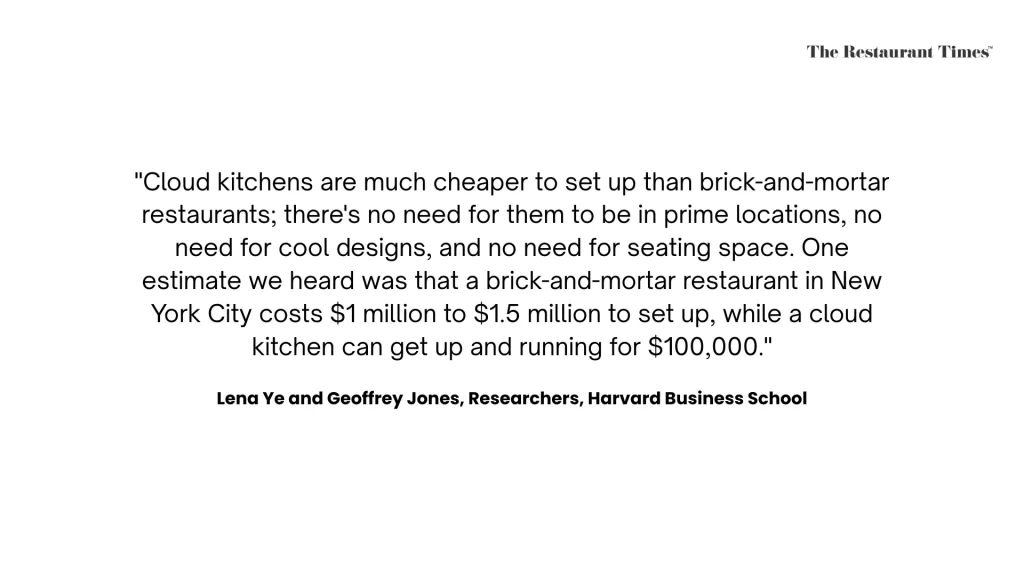
That cost differential is real, but the framing requires context. The initial investment for a traditional restaurant can range from $200,000 to $500,000 or more, while a cloud kitchen can be started for as little as $20,000 to $100,000. However, cloud kitchens externalize a significant portion of customer acquisition costs as ongoing variable expenses—aggregator commissions and paid digital marketing spend—rather than capitalizing them as upfront build-out costs.
A dine-in restaurant’s build-out buys a physical location that generates walk-in traffic for years. A cloud kitchen’s lower setup cost requires continuous marketing spend to remain discoverable on delivery platforms. The cloud kitchen business model allows for rapid market entry, with the ability to launch in as little as 30 to 60 days, compared to traditional restaurants, which can take 12 to 18 months to open, but a faster launch does not mean faster profitability.
Profit Margins and Unit Economics: The Real Numbers
Cloud kitchens typically see profit margins of 15 to 25% and can break even in 6 to 12 months, whereas traditional restaurants have profit margins of 5 to 15% and longer break-even periods of 18 to 36 months. Looking at the unit economics of a restaurant, the business should run between 78 and 93 percent in combined costs, allowing for a profit margin of between 7 and 22 percent.
The cost of labor can be reduced by 30 to 40% in cloud kitchens, compared to traditional restaurants, owing to efficient working and the lack of any front-end personnel. The cloud kitchen workforce is reduced in number as it requires only chefs and preparation staff members, unlike the traditional restaurant, which requires more staff. This difference in the labor cost is real and significant.
However, the margin numbers quoted for cloud kitchens do not account for the commission aggregators charge per order (15-30%), packaging costs, and digital marketing expenses. For instance, a cloud kitchen receiving orders averaging $30, taking a 25% commission per order, and incurring production costs of 30% has little left to cover its rent and labor costs. Traditional dine-in restaurants have higher fixed costs but do not incur per-order commissions.
The Commission Problem: How Delivery Platforms’ Fees Eat Into Cloud Kitchen Profits
It is by far the most overlooked cost when comparing cloud kitchens with restaurants. Commissions charged by third-party delivery platforms are between 15-30%. In the case of a $30 sale, it is about $4.5-$9 per sale to the platform before any costs associated with food purchase, packaging, or labor. Operators of cloud kitchens state that they require significant amounts of money to invest in digital marketing every month in order to remain visible.
When a consumer searches for restaurants in a certain area, aggregators use their own algorithms to determine which restaurants or particular dishes will be shown to the consumer. You are not guaranteed visibility – you have to earn it through ratings, reviews, promotional spending, and algorithm favorability. The main marketing strategy used by cloud kitchens includes optimizing online visibility and being dependent on third-party delivery platforms.
For dine-in restaurants, food delivery services may be a supplementary source of income, but not a major one. In case your restaurant receives 20% of sales via third-party delivery services, then you pay commission only for part of your income, while for the cloud kitchen, it would be a commission on every sale made.
Customer Engagement, Customer Experience, and Brand Loyalty Building
The customer experience at a cloud kitchen is determined by packaging quality, food temperature, and delivery speed instead of atmosphere and services, and needs to maintain consistent service quality. In this case, the product of a cloud kitchen is convenience, whereas the product of a restaurant is an experience that consists of atmosphere and interaction with a person. These are two valid products for two different types of consumers.
It is possible to use analytics data to learn more about customers’ tastes and ordering behavior. However, this data goes through the delivery platforms and not the cloud kitchen itself. Thus, creating a brand in the space where customers associate themselves with an app rather than a restaurant is one of the key challenges for this model.
40% of customers prefer ordering food from restaurant websites, whereas 55% prefer calling the restaurant when they have questions. Despite the fact that people use online ordering, direct communication is still important for them. This direct communication and building a relationship with customers is what the dine-in restaurants manage to do.
INDUSTRY INSIGHT
| The demand for cloud kitchens in the USA is projected to grow from USD 29.4 million in 2025 to USD 89.4 million by 2035, at a CAGR of 11.8%. That sustained growth reflects genuine structural demand for delivery-optimized food businesses, but it also reflects an increasingly crowded marketplace. As more cloud kitchen operators enter the space, competition for visibility on delivery platforms intensifies, customer acquisition costs rise, and the margin advantage that early movers enjoyed narrows. Entering this market in 2026 means entering a maturing model, and your unit economics need to reflect that reality from day one. |
Why a Cloud Kitchen Business Fails: Survival Rates and Common Pitfalls
Overall, cloud kitchens suit newcomers more as they require less startup capital and a shorter time to reach breakeven – 6-12 months, under the assumption that unit economics are positive from the beginning. Structural problems, rather than cooking-related ones, are among the key areas of vulnerability.
The main threat is the dependence on the platform. If all clients get from your restaurant through delivery apps, a drop in ratings, a change in algorithms, or increased competition on the platform can drastically reduce order numbers. The timing of cash flow makes the matter even worse. While aggregators normally pay out only 7-14 days after order processing, food expenses and salaries should be paid immediately. The working capital shortage problem affects the third to fifth months when order volumes are still low.
One more underestimated difficulty associated with cloud kitchens is brand switching behavior on delivery platforms. Without having a fixed restaurant, cloud kitchens compete in the environment when clients choose cuisines and prices without remembering the restaurant brand. Providing high-quality meals for delivery over long distances, building loyalty, and retaining the clients requires investment into packaging, marketing, and owned digital channels.
Why Dine-In Restaurants Fail: Where Traditional Models Break Down
Dine-in establishments go out of business for several reasons. First of all, it can be an improper ratio of the price of the location and the number of customers who visit the place. A dine-in restaurant, located in an expensive place, but which cannot receive enough cover numbers to cover its rental payments, is doomed.
The second important factor influencing the success of a dine-in restaurant is labor costs. One little restaurant in Little Rock pays $13 per hour to their dishwashers, and $16 to the experienced kitchen workers in 2022. In case of increasing salaries and growing competition in the market of qualified kitchen staff, there are not many options to cope with it except for a price increase.
Another issue for a dine-in establishment is the difficulty of delivering consistently high-quality service across all shifts and managing the variability of walk-in customers. The management process of such a restaurant is much more complicated than the cloud kitchen management, and first-time entrepreneurs do not realize this fact.
Cloud Kitchen vs Restaurant: The Hybrid Model
Hybrid business models represent the strategic combination of dine-in establishments and efficiency gains of cloud kitchens, allowing restaurants to reach a larger pool of customers through various means: dining in, takeaway, and deliveries. Hybrid business models are gaining traction as consumer tastes and preferences shift, enabling restaurants to capitalize on multiple revenue streams.
A successful hybrid model leverages existing restaurant resources and adds a delivery operation, giving the restaurant a competitive advantage in a constantly changing environment. The keyword here is “existing.” The hybrid model works great for restaurants that already have a dine-in operation, have kitchen capacity, trained personnel, and a supply chain network. Adding delivery to this is what allows restaurants to make use of their assets in creating multiple revenue streams. Building a hybrid from scratch will mean building up two cost centers simultaneously.
Menu Design Constraints: What Works for Delivery vs. Dine-In
Not every food concept is viable for delivery, and this is one of the most critical and least discussed differences between the two models. Food quality during transit is a genuine operational challenge. Items that are crispy, delicate, temperature-sensitive, or structurally complex degrade significantly in a 20 to 30-minute delivery window. Consistent food quality in a cloud kitchen requires menu engineering focused on what travels well, not just what tastes best in the kitchen.
The cloud kitchens fit cuisines like bowls, wraps, sandwiches, pizza, burgers, and comfort food, which can be transported without compromising on the food quality. It becomes very hard to deliver cuisines that require freshness, perfect temperature, and/or immediacy in terms of food plating because they are fine dining, sushi, delicate frying, or complex breakfast menus. The cloud kitchens put a lot of emphasis on efficiency and speed of delivery by allocating more resources to optimize the process in the kitchen than with the customers. Your menu needs to be optimized according to this condition.
The dine-in restaurant is not restricted by any of the above constraints in providing its primary service. The food is prepared just a few steps away from where it will be served, and the time between the kitchen and the customer is just a matter of minutes. The menu design for dine-in is not required to take into account how the food would perform in the delivery bag, but rather concentrate on the taste and presentation.
Licensing, Permits, and Regulatory Requirements Compared
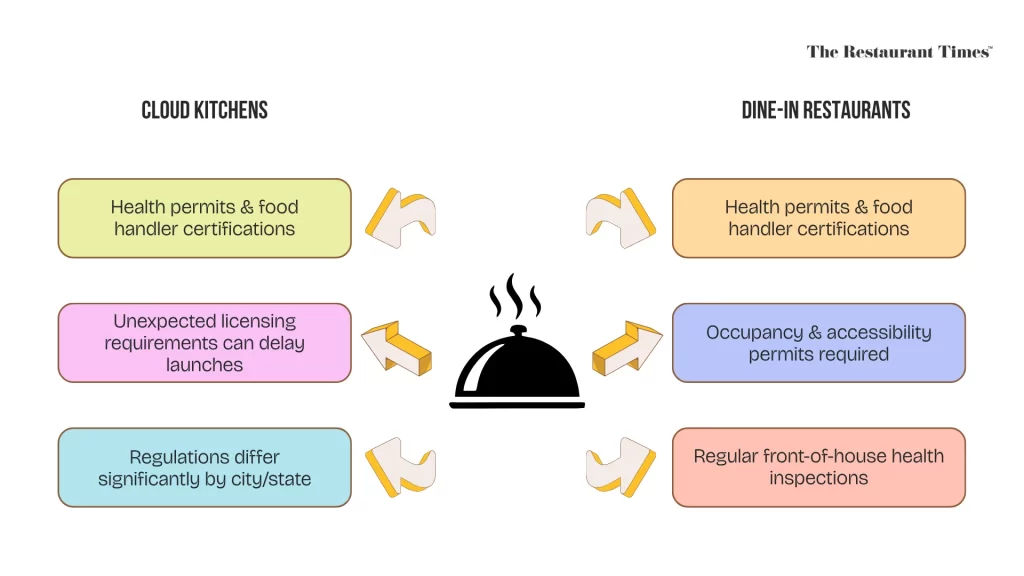
They both need health licenses, food handler certificates, and compliance with local fire and safety codes. However, differences start to arise when cloud kitchens try to run several virtual brands with just one license. There is a great variation in the regulations from place to place. Some places will allow several virtual brands under one health license, whereas other places will need a separate registration for every brand. Cloud kitchen business operators learn about this requirement only after securing a lease for a facility.
Restaurant dining establishments also have their own regulatory regime of occupancy permits, accessibility requirements, alcohol licenses if necessary, and health inspections customized for front-of-the-house operations. These regulatory requirements are familiar and well-understood, thus making the compliance process somewhat more certain despite its greater breadth. Prior to making any decision regarding each of these options, it would be best to consult a restaurant lawyer or expert in the local area of intended operations. What works in one jurisdiction does not necessarily work in another.
Geographic and Demographic Considerations
Geography is not a secondary factor when deciding between the cloud kitchen vs. dine-in business models; it is a primary factor. Cloud kitchens require a high density of delivery areas to be able to generate enough orders to make unit economics possible. If a cloud kitchen operates in a market with fewer than 50 thousand people within a 3-mile radius, it will have difficulty generating orders per day, which will be required to maintain a commercial kitchen. Food delivery platforms require density as the driver of the model.
Dine-in restaurants require corridors of foot traffic or destinations. A full-service restaurant operating in a suburban area without any anchor traffic will face a similar dilemma to the cloud kitchen operating in a low-density delivery area. Your market analysis should prove the viability of your particular demand model prior to committing to space or signing a lease. Preferences of the consumers also vary greatly based on demographics. Urban markets tend to show a stronger preference for food delivery apps and online food delivery orders, whereas in suburban and rural areas,s the preference tends to go to dine-in options and traditional ordering methods.
Which Model Should You Choose? Decision Framework
Go with cloud kitchens if you have a food concept designed to be delivered, $50,000 to $75,000 working capital for the first 6 months, real digital marketing capabilities, and are comfortable with an algorithmic marketplace where a net margin of 10 to 15% after all expenses is an acceptable victory.
Go with the dine-in restaurant if you are creating a brand that customers will seek by name, your food concept depends on ambiance or experience, you have $250,000 to $500,000 in build-out funds with 12 to 18 months of runway, and you can find a location that already has foot traffic or destination appeal. The dine-in concept gives you ownership of customer relations—customer data, customer loyalty, customer behavior—that is inherently impossible to achieve through the cloud kitchen business model.
Pass on both concepts if you don’t have at least $40,000 in liquid assets or access to more than $75,000 of credit.
Long-Term Considerations: Exit Strategy and Resale Value
Most food entrepreneurs tend to think of starting a food business while rarely contemplating the exit strategy. Both concepts differ significantly regarding exit value and investor attraction. A profitable dine-in restaurant located in a good location is an asset worth considering because it is tangible and comprises equipment, leasehold goodwill, brand identity, and customer loyalty. All these factors make it appealing for buyers, and a sale multiple of 2 to 3 times the annual revenue becomes possible for well-placed dine-in businesses with a customer base and repeat customers.
Exit value for a cloud kitchen relies exclusively on intangibles such as a brand with real social following, restaurant owners have ownership of customer data, proprietary recipe, or a playbook for running multiple virtual brands. The physical assets of a cloud kitchen are not much and can be easily replicated by any potential buyer elsewhere. Without the creation of true intellectual property or a brand with an owned audience, the exit value for a cloud kitchen will become considerably lower compared to a dine-in business. If creating long-term wealth via a sellable asset becomes your objective, then the restaurant business model will be better suited for you.
KEY TAKEAWAYS
| – Cloud kitchens have less expensive start-up investments and quicker time to market, although aggregators’ cut and digital marketing costs will make up most of the margin benefits, and are now adopted by multiple brands.- Dine-in restaurants have more initial investment but have the advantages of customer relationships, location targeting, and long-term asset value- The hybrid model would be more successful as a supplement to the dine-in business rather than the other way around- The density of deliveries, foot traffic trends, and consumption behaviors in your market become just as important as the food business itself when making this choice |
Frequently Asked Questions
1. What is the difference between a cloud kitchen and dine-in?
Cloud kitchen is a food business operating without a physical storefront and dine-in space, through only the delivery model from a commercial kitchen. A dine-in restaurant is a typical brick-and-mortar restaurant requiring a dining room and front-of-house staff service.
2. What are the disadvantages of cloud kitchens?
The major downsides involve high commissions charged by aggregators, reaching 15 to 30% per each order.
3. What is the average monthly cost for a cloud kitchen?
The monthly price depends on the market and volume of the operations. The price to rent a kitchen facility usually ranges between $3,000 and $6,500 per month.
4. What is the 30/30/30 rule for restaurants?
The 30/30/30 rule is an indicator of the effective cost control of the restaurant business. According to this rule, food costs need to be 30% of the total income, labor costs – 30%, and overhead costs – also 30%.