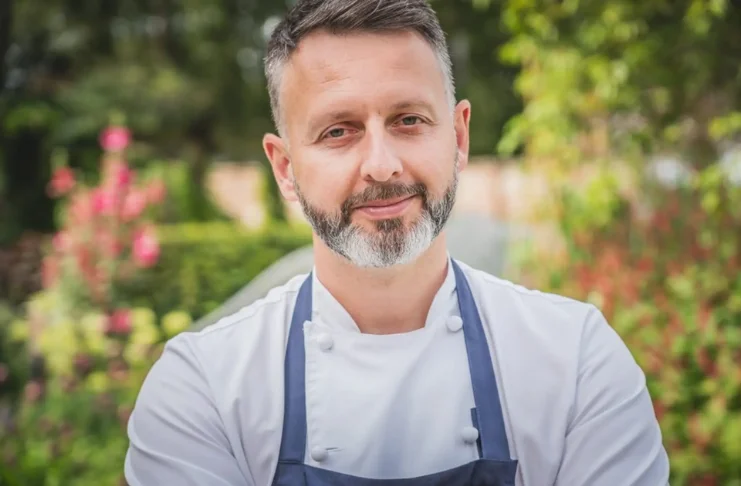

In the gently undulating landscape of West Lancashire, where ancient market towns give way to secluded estates, stands Moor Hall. Not in London, as one might expect of a restaurant holding three Michelin stars, but in Aughton, a village whose name most outside the region would struggle to place. Yet here, amid five acres of thriving gardens and clustered around a glistening lake, Chef Patron Mark Birchall has created something extraordinary: a restaurant so deeply rooted in its surroundings that the line between field and plate has all but dissolved.
Centuries in the Making: From 1282 to Today
The story begins in 1282, though the origins likely stretch further back, perhaps even before the Norman Conquest. This Grade II listed building has passed through the hands of Lancashire gentry families for centuries, from the de Bickerstaths to the Stanleys, a family so powerful they were virtual kings of the region during the Tudor period. In 1566, Peter Stanley modernized the timber-framed structure, cladding it in stone and brick. The plaque above the main door, bearing that date and Stanley’s initials, remains today, a quiet testament to continuity.
Fast forward to 2015, when Andy and Tracey Bell acquired the property with a vision: to regenerate this historic estate and create a world-class restaurant in partnership with Mark Birchall. The two-year renovation was guided by reverence for what came before. Sandstone from the building was transformed into crockery by local ceramic artist Sarah Jerath, who sets materials from the surroundings into clay, hand-finishing each piece so no two are identical. Sixteenth-century oak beams from the original barn were repurposed for the garden’s pergola and to clad corridors, even becoming tableside wooden pegs for the meat blade during service.
The Man Behind the Vision: Mark Birchall
When Moor Hall opened its doors in 2017, recognition came swiftly. Within six months, a Michelin star. By 2018, two stars. In 2025, the ultimate accolade: three Michelin stars, joining an elite group of restaurants in the UK. Along the way came five AA Rosettes, the title of Best Restaurant in England at the Estrella Damm National Restaurant Awards (claimed three times), and a Michelin Green Star recognizing sustainability efforts. Mark Birchall himself was named Chef of the Year at the National Restaurant Awards 2025 and Best Chef in the UK at the AA Hospitality Awards.
Yet for all the accolades, what sets Moor Hall apart is not ambition for its own sake but a philosophy elegantly captured in Birchall’s own words: “We want to bring together the very best, beautiful surroundings with an unrivalled dining experience that pushes boundaries.” Born in Chorley, Lancashire, Birchall knew from age 14 that he wanted to be a chef. His journey took him through prestigious kitchens, including L’Enclume as Executive Chef and a stage at El Celler de Can Roca in Girona, twice voted the world’s best restaurant. He won a Roux Scholarship in 2011. But it’s here, in Lancashire soil, that his vision has fully bloomed.
Five Acres of Abundance: The Garden as Kitchen
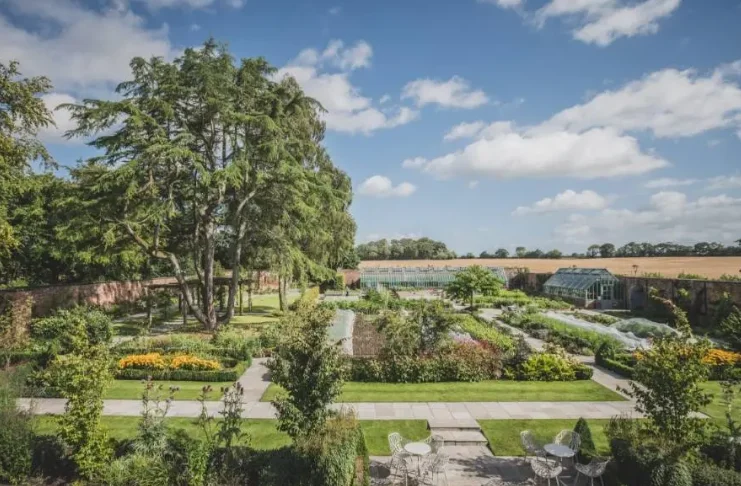
The restaurant’s ethos is encapsulated in one word: provenance. From the Latin provenire (to come forth), it speaks to origin, to the journey from field to plate. Walk through Moor Hall’s gardens and you’ll find beetroot and turnips, step-over apple trees, and an astonishing diversity of crops. The estate is completely self-sufficient in micro herbs and baby vegetables, growing around ten varieties at any time, depending on the season: celery, anise hyssop, fennel, and baby carrots. All edible flowers are grown on-site too: cornflowers, violas, primulas, calendula, marigolds, borage, alongside garnishes like oxalis, wood sorrel, buckler sorrel, and nasturtium.
During summer, the gardens produce an impressive bounty: peas, broad beans, French beans, runner beans, courgettes, cucumbers, beetroot, turnip, carrot, fennel, agretti, crosnes, wild strawberries, raspberries, heritage apples and pears, peaches, plums, medlar, quince, artichokes, cabbages, kales, leeks, New Zealand spinach, and baby red onions. The estate even produces its own charcuterie, curing meats in-house, and operates a dairy where cheese, butter, and yogurt are made from raw milk sourced from a small, local herd of Holstein Friesian.
This commitment to growing extends to sustainability practices that earned Moor Hall its Michelin Green Star. The team employs organic farming methods exclusively, based on a ‘no dig’ approach that improves soil health and protects the micro-organisms, fungi, and worms essential to plant life. No chemicals touch the crops; instead, biological controls like ladybird and lacewing larvae combat greenfly, while netting protects carrots and brassicas. Wildlife is encouraged: hedgehogs help manage slugs, four beehives support pollination, and wildflower meadows are being expanded for bee conservation.
Kitchen and garden waste is funneled back into homegrown compost, yielding around two tonnes every six to ten weeks, season dependent. What can’t be composted on-site goes to ReFood, the UK’s only fully integrated food chain recycler. Nothing is wasted. Produce life is extended through techniques like drying flowers or fermenting green tomatoes. Even ingredients purchased externally are maximized: lobster tails might be used at Moor Hall, the claws at The Barn, Moor Hall’s Michelin-starred sister restaurant.
Partners in Purpose: Suppliers Who Share the Vision
The philosophy extends to suppliers. Wild Farmed provides flour, using regenerative practices that by 2030 will sequester as much CO2 as a 100-year-old rainforest the size of Greater London. Flowers for decoration come from homegrown sources or Petal & Twig, a sustainable florist in Tarleton and a member of Flowers from the Farm. Bathroom products are by Pure Lakes, handmade with natural ingredients and minimal, environmentally friendly packaging. All meat is reared in the North West; all fish is sustainable, sourced from day boats with full traceability.
The Dining Experience: Where Seasons Meet Skill
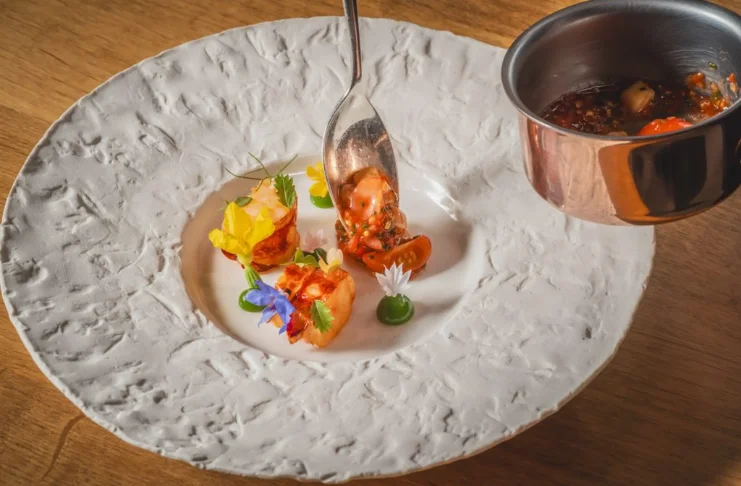
At lunch, guests choose between a four-course menu or the signature Provenance Menu, available all day Sundays and at earlier reservations on Fridays and Saturdays. Dishes speak to the landscape: Paris Market Carrots with Doddington, chrysanthemum, and sea buckthorn; Ruby Red Devon with celeriac, mustard, and shallot; Honey Roast Sladesdown Duck with beetroot, elderberry, and forest mushroom ragout and whey; Ormskirk Gingerbread with roots and pine; Garden Apples and Gooseberry with woodruff, birch sap, and marigold. The wine list, awarded Best in England at the AA Awards 2024, offers Prestige and Rarity pairings alongside an alcohol-free option featuring single-vintage teas from tea gardens worldwide, treated with the same reverence as wine.
Beyond Dining: Experiences That Linger
For those seeking intimacy, Atelier Hearth, the private dining room for up to 12 guests, offers a space where culinary artistry meets personalized service. On Sundays, lunch extends from 11:30 am to 4:15 pm, beautifully unhurried. Guests staying on-site, in rooms recently awarded Two Michelin Keys, receive complimentary Champagne to begin the afternoon and, as evening settles, a late supper of pie, cheese, and cake with a half bottle of port served in their room.
Beyond the kitchen, Moor Hall supports Sandy Park Café, a not-for-profit social enterprise helping students with special needs and disabilities gain work experience. Nationally, only 6% of such students gain paid employment. To date, Moor Hall has raised over £8,000 for the charity, hosts educational visits, and supports menu development.
The Secret Garden That Keeps Blooming
As Mark Birchall reflects, the stars and rosettes are proud achievements, but the ultimate focus is guest comfort and enjoyment. “It’s about making people want to come back. We want them to feel like they don’t want to leave, and that, when they reluctantly do, they are already planning their return visit.”
In an age of culinary globalization, Moor Hall offers something increasingly rare: a restaurant so intimately connected to its place that every dish tells the story of this particular soil, this particular season, this particular moment. It’s a vision Frances Hodgson Burnett might have recognized, writing in The Secret Garden: “It is the sun shining on the rain and the rain falling on sunshine, and things pushing up and working under the earth.” At Moor Hall, the secret garden has bloomed indeed, revealing new miracles with every service.