

Some dishes are frozen in time. This one grows with it.
At Pujol in Mexico City, a pot of mole has been simmering and resting for more than ten years. Every two days, it gets blended into a fresh preparation. The result tastes like memory and anticipation at once.
Chef Enrique Olvera calls it the mole madre. Mother mole. It has outlasted three Mexican presidencies, survived a pandemic, and watched as Pujol became one of the most recognized restaurants in the world. This year, it even earned two Michelin stars. But the mole was already famous long before that.
“I think it’s a little bit like what happened to Juan Gabriel when they asked him to sing ‘Querida,'” Olvera said, referencing the Mexican pop star and his signature song. “As long as people continue to like it, we will continue to do it.”
The dish is plated simply. A circle of rust-red mole, made fresh that morning, sits in the center of a pool of the mole madre. Three tortillas accompany it. One pressed with a hoja santa leaf. One made with colored corn. One with indigenous criollo corn. Different flavor that speaks in layers.
Olvera’s mouth waters when he describes it. His eyes light up when he tastes it. After more than a decade of serving this dish, he still reacts as if he were encountering it for the first time.
That says something.
How It All Started
The story begins at a party. In 2013, Pujol’s sister restaurant Quintonil was celebrating its first anniversary down the street in Polanco. Olvera and his team prepared a mole negro using chilhuacle peppers they had recently purchased in bulk from farmers in Oaxaca. The pepper was nearly extinct. Buying it was part of an effort to save it.
The mole was served spooned over lightly fried tortillas, a dish called an enmolada. Sesame seeds were sprinkled on top. Olvera remembers it as a metaphor for the mole as a celestial body.
Leftovers went back to the Pujol kitchen. They were reheated and served each day until the supply ran low.
However, in the process, Olvera noticed something. The mole got smoother with each trip back to the flame. He had learned the technique from chef Ricardo Muñoz Zurita, a renowned researcher of Mexican gastronomy.
So instead of starting over, they extended the original batch with a new one. Then they did it again. And again. For over a year, the team kept notes in a logbook, tracking how the flavors changed.
When the mole veered into ashy and earthy tones, they introduced fruit into the recipe. They also designed the elegant plating that remains today.
The Continuous Science Behind a Living Mole
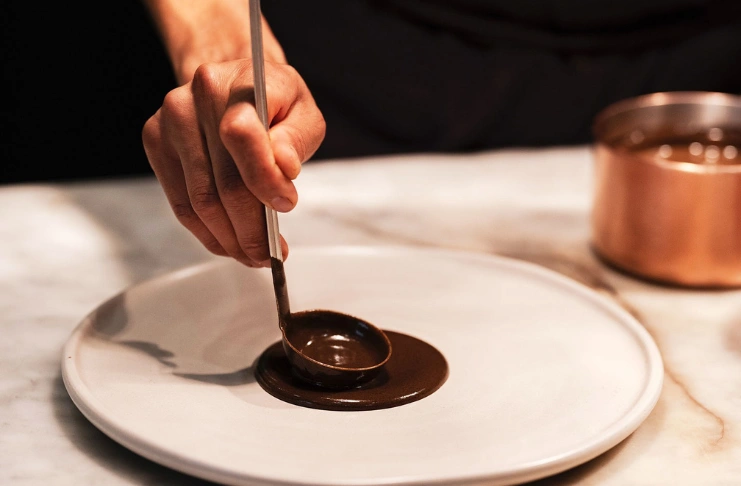
Dozens of ingredients go into the black mole, which is folded in every two days: onions, garlic, tomato, cinnamon, almonds, pecans, peanuts, and more.
Taste and seasonality guide the adjustments. If the spice level drops, they augment the chilhuacle with ancho peppers. When fruits are at their peak, they get added.
“The path that the mole’s flavor follows over time is more like a spiral than a line,” Olvera noted. “When it’s apple season, we put in apple, when it’s banana season, we put in banana, and the following year, you go back to banana, and you go back to the apple.”
This summer, the mole was in one of its finest states. Tomatoes and bananas were at their ripest. The flavors hit their peaks and depths accordingly.
Olvera describes the flavor profile as cyclical. “It’s chili, then acidity, then spices come out, and then it begins again,” he said. “It makes a loop: back to chili, acidity, spices. I think that’s something very beautiful.”
The Dish That Nearly Didn’t Make It
At first, the mole madre wasn’t even on the menu at Pujol’s adjunct taco bar. Diners complained. It had become too synonymous with the restaurant to leave out.
Now, as Pujol approaches its 25th anniversary, Olvera is opening the door to change. Several kitchen experiments have already been tossed. (a swirling multicoloured plating, for example). What comes next?
Olvera shows no anxiety about it. “Mole is both new and old, which is something I like a lot,” he said. “Like the tortilla, mole belongs to the past, the present, and the future. When you manage to understand food in that way, I think there’s no anxiety about creativity. I feel that creativity is something that happens over time.”
The Philosophy Driving Pujol
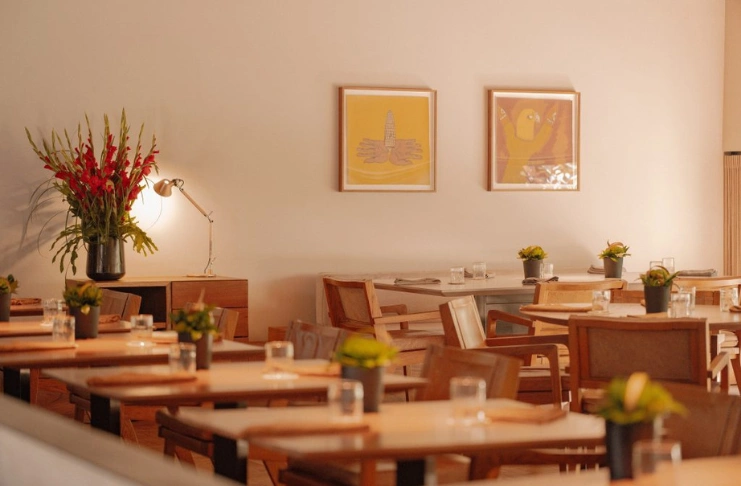
Pujol is not about spectacle. There are no fog machines or edible balloons. The dining room is calm. Skylights filter natural light. Mid-century modern furniture lines the space. Neutral tones dominate.
The restaurant moved to its current Polanco location in 2017. Before that, it was smaller. Just 13 tables complementing black walls and white tablecloths. Olvera discovered he preferred more casual settings after opening Cosme in New York City in 2014. The redesign reflected that.
Now diners can choose between two seven-course tasting menus or sit at the bar for a taco omakase experience. Either way, the food remains rooted in Mexican tradition.
Olvera sources ingredients with exacting precision. During the pandemic, he rebuilt the supply chain from the ground up. Every product became fully traceable to the individual who grows or raises it. Pujol now pays farmers in advance, often committing to entire annual harvests.
The restaurant earned B Corporation Certification, which defines it as a business that balances profit with purpose. During the pandemic shutdown, all staff received full salaries and grocery vouchers to compensate for lost tips.
In 2020, Pujol won the Flor de Caná Sustainable Restaurant Award as part of Latin America’s 50 Best Restaurants. “Our aim is not to become the best restaurant in the world, but to be the best restaurant for the world,” Olvera said.
Why It Matters
Mexican cuisine has always been rich, complex, and layered with history. Yet for decades, fine-dining circles dismissed it. Olvera shifted that center of gravity. He showed that indigenous ingredients and time-worn techniques could stand their own beside French sauces and Japanese precision.
The mole madre is the most evident proof. It honors the past while moving forward. It relies on repetition and patience. It grows richer with time.
One diner (in their review) wrote that the mole had “a strong, slightly spicy flavor” and was served under a palm-sized circle on a thin tortilla. Another visitor, years later, described it as tasting like history itself.
Both are right.
What Comes Next

Olvera hasn’t revealed what the mole will become in the reimagined Pujol. But he seems confident that whatever form it takes, the spirit will remain.
“What you look for when reheating a mole is for the ingredients to meld and for there to be a better integration of the ingredients into the whole,” he shared.
The mole madre is now over 3,500 days old. It has seen the restaurant grow from an upstart in Polanco to an international icon. It has survived closures, renovations, and reinventions.
And it keeps getting better.
That is what makes Pujol a reminder that the best things cannot be rushed. That tradition and innovation are not opposites. That time, when treated with respect, becomes an ingredient all its own.