
The gobi parantha at Gaa in Bangkok is the (Indian’s usual) flatbread stuffed with spiced cauliflower, and served with butter. That’s it, and yet this one dish has a separate fanbase that not only orders but returns for it specifically.
Sounds simple? But there’s a story behind it. For the record, the butter recipe comes from her paternal grandmother’s kitchen in Delhi. Arora remembers a cupboard with a lattice door where thick cream would ferment into butter. She could watch it for hours. Similarly, the cauliflower filling comes from her maternal grandmother. When guests eat this dish, they taste what Arora calls an umbilical link to her roots.
This is what Gaa does. It takes Indian cooking techniques and applies them to Thai ingredients.
The result is a restaurant that earned its first Michelin star in 2018, making Arora the first Indian woman to achieve this. In 2023, Gaa earned its second star. Today, Arora remains the only Indian female chef with two Michelin stars.
Trading Pen for a Knife
Arora didn’t start out as a chef. She studied mass media at Jai Hind College in Mumbai and worked as a pharmaceutical journalist. But at 21, she left for Le Cordon Bleu in Paris.
“Paris opened my world of food and cooking,” she said in an interview with Global Indian. “For someone who wants to start a career as a chef, this is the right place to be.”
After Paris, she worked at Verre by Gordon Ramsay in Dubai, then spent three years at Noma in Copenhagen under René Redzepi. At Noma, she learned to think about food differently. “I learnt to think cerebrally about food,” she said. “It made me realise that food was also an intellectual exercise rather than just a blue-collar job.”
Her journalism background stayed with her, though. “I have to know the five Ws and one H of food,” she explained to The Better India. “Whenever I cook a dish, my goal is to make sure the ingredients answer these questions.”
Why Bangkok, Not India
Arora had planned to return to India from Copenhagen. Instead, she stopped in Bangkok to work as sous chef at Gaggan under Gaggan Anand. She stayed.
“Thailand chose me,” she said. “The more I explored this link, the more I realised that Bangkok would be the perfect backdrop for us to start a restaurant.”
The connection between Thai and Indian cuisine made sense to her. Both cultures use spices heavily. Both have regional variations. “Thailand and India have a lot of similarities as far as food is concerned,” she said. “Gaa is an expression of that connection.”
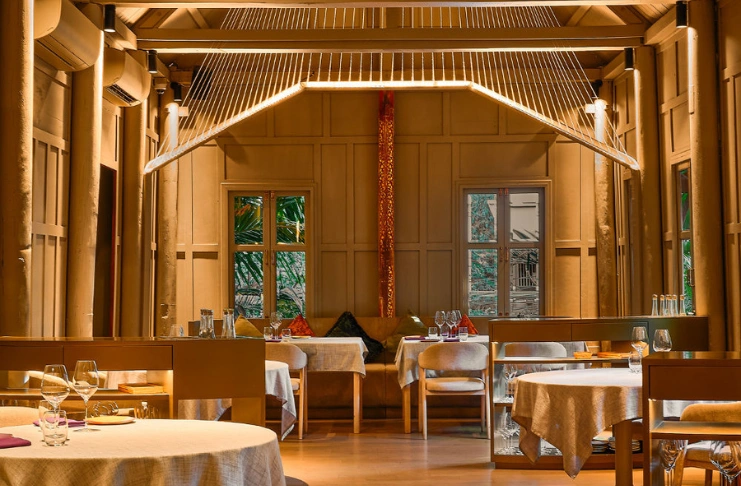
In April 2017, at 31, Arora opened Gaa in a 60-year-old traditional Thai house in Bangkok’s Wattana area. The building had been transported piece by piece from Ayutthaya, 80 kilometers north of Bangkok, and reassembled in the city’s Thonglor neighborhood.
“The home’s exteriors are traditional, but as soon as you step in, you’ll see modern finishes,” she told The Better India. “There is a minimalist approach to everything, just as in the food we serve.”
The Servings
Gaa’s menu changes with seasons and availability, although the core idea remains the same: Indian techniques applied to Thai produce.
Take the Summer Curry. It’s blue swimmer crab served with coconut milk spiked with grilled banana leaves. Or the Tandoori Story, which uses durian as the primary ingredient. Durian is controversial. People either love it or hate it. But grilled and served with kadhi, spicy chutneys, and tandoori rotis, it works. “The most memorable aspect of this experience, for me, was transforming what seemed like a challenging dish into a crowd favourite,” she told LLM.
The pumpkin kebabs demonstrate how Indian cuisine adapts without native ingredients. They’re made with Thai garam masala, cashew, and smoked tofu. “It’s a testament to how strong our techniques are, and how deep-rooted our culinary history is,” she shared.
The restaurant also draws heavily from Malvan, a coastal region in India. “The region is home to the Brahmin community. Brahmins are normally vegetarians, but since they live next to the coast, they’re pescatarians,” Arora explained. “They eat a lot of seafood, and they share the same biodiversity as coastal Thailand.”
Breaking Down Indian Cuisine
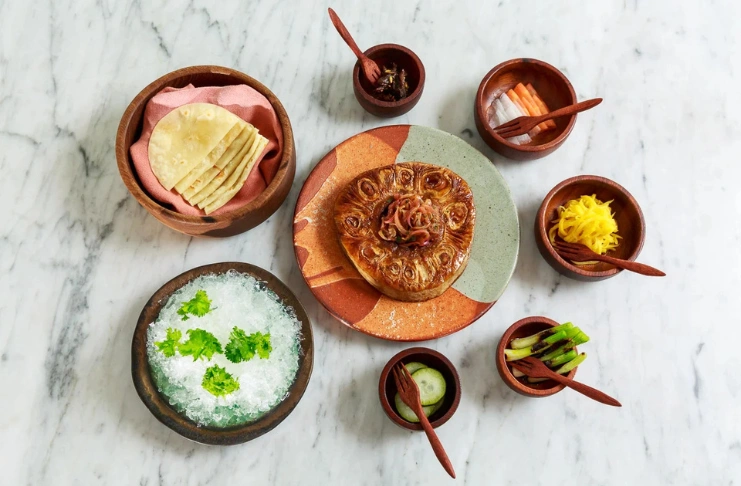
For years, Arora has worked to change how people see Indian food. “The idea with Here is to show the world that Indian food is way beyond curry and naan,” she said. “We don’t eat curry for breakfast. We don’t eat it for lunch, and we definitely don’t eat it for dinner.”
Gaa offers a 10-course or 14-course tasting menu. Every dish tells a story. The restaurant has its own fermentation room. Soy sauce, fish sauce, butter, and cheese are all made in-house.
One of Gaa’s vegetarian main courses uses tandoori durian. “At Gaa, our main course has always been vegetarian, and we are very proud of how Indian techniques are capable of drawing so much umami from vegetables in a way that you don’t miss meat,” she told Global Indian.
The approach works. In 2019, Arora was named Asia’s Best Female Chef by The World’s 50 Best Restaurants. Gaa debuted at number 16 on the list and earned the Highest New Entry award.
Running a Kitchen and Raising a Child
In 2023, Gaa earned its second Michelin star. A few months earlier, Arora had given birth to her son, Aham. She was also judging MasterChef India, the first female judge in the show’s history.
“This transition that I’ve been able to make from being a business owner and chef to now also a mom, I wouldn’t be able to do it so seamlessly without my stellar team,” she shared. “I can’t take all the credit. It all belongs to my team.”
But she’s clear about the challenges. “This is not a 9-5 job; it is very demanding,” she told Travel+Leisure India. “In your 20s, you can’t have both; you can’t be working in a high-end kitchen and have a family. And it’s a big sacrifice to ask any woman to make.”
Her advice to young women in the industry is: “One thing I always tell them is to be financially independent. Financial independence is the best tool we can give our girls.”
What Comes Next
Arora opened her first restaurant in India, Banng, in Gurugram. It’s the reverse of Gaa. Where Gaa brings Indian techniques to Thailand, Banng brings Thai flavors to India.
She’s also part of Food Forward India, a nonprofit that documents regional Indian cuisines. “It’s a mammoth project.” The goal is to travel to India, record local cuisines, and create a resource for future chefs.
For Arora, the work is personal. “You have all the men in the kitchens professionally, but at home, it’s always the women,” she said. “And this is where our cuisine is evolving, this is where our cuisine has always been: in home kitchens.”
She learned her basics not just from her mother, but from neighborhood women. One taught her to make khandvis, khakhras, and theplas. “There are so many other women who must have so many other little tricks up their sleeves that they know, but only they know,” she said. “And it’d be nice to share that knowledge with everybody.”
At Gaa, that knowledge lives in every dish. The 60-year-old house holds a kitchen that looks forward while honoring what came before. The gobi parantha still has its fans. And Arora keeps cooking.