
The question that Sushama Nagarkar could not help but ask herself again and again was neither a complex nor intricate one. It was a question that was merely a matter of candor.
If her autistic daughter Aarti was unable to secure any decent and respectable work within a nation of 1.4 billion people, what did that say of the country? But more importantly, what was she going to do about it?
Sushama returned to India in 2014 after living abroad in America and founded the Yash Charitable Trust in Mumbai. Her trust was based on three basic terms – acceptance, inclusion, and empowerment. Not as catchphrases, but as a philosophy. As real standards of conduct.
Before the Cafe, There Was the Dabba
The trust was not founded because of a cafe. It was founded because of a dabba service.
In 2015, the Yash Charitable Trust created a business venture in which individuals with intellectual and developmental disabilities, including autism, dyslexia, ADHD, and others, worked, delivering lunchboxes to customers. The dabba service was successful. There were repeat customers. This group of neurodivergents grew and learned to prove what the traditional job market had refused to believe all these years: that these individuals were capable of running a business.
This became the basis of the Cafe Arpan.
The Cafe Opens
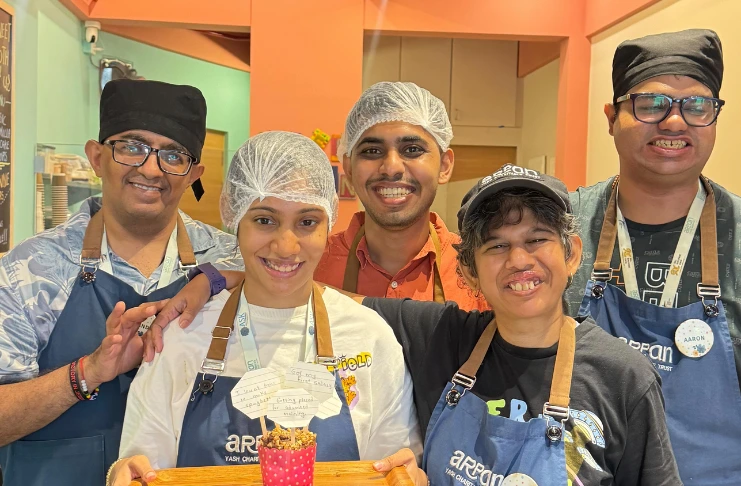
Cafe Arpan opened its doors in 2018 in Juhu, Mumbai, and had a whole crew consisting of people with intellectual/developmental disabilities. The idea was not to confine them to the back rooms but to make them work at receiving orders, serving customers, cooking, and delivering.
This café was founded by Ashaita Mahajan, the niece of Nagarkar. She is the co-founder of this café that she established in 2017 after resigning from her job in the cultural sector, because of seeing the problems of her cousin Aarti in such an environment. “People with autism and other developmental disorders have a lot to offer,” Mahajan has said, “if their strengths and talents are channeled correctly.”
The cafe employs training programs and visual guides to enable its employees to deal with difficult kitchen activities. Instead of employing neurodivergent people behind the scenes, the cafe makes an effort to place them in front-office activities intentionally, as visibility is one of their goals. As stated by a spokesperson for Cafe Arpan to The Tribune in 2026, “by putting neurodivergent people in front-office roles, the cafe aims to challenge social stigma and highlight the contribution of an often-neglected demographic towards the economy.”
The Menu and the Room
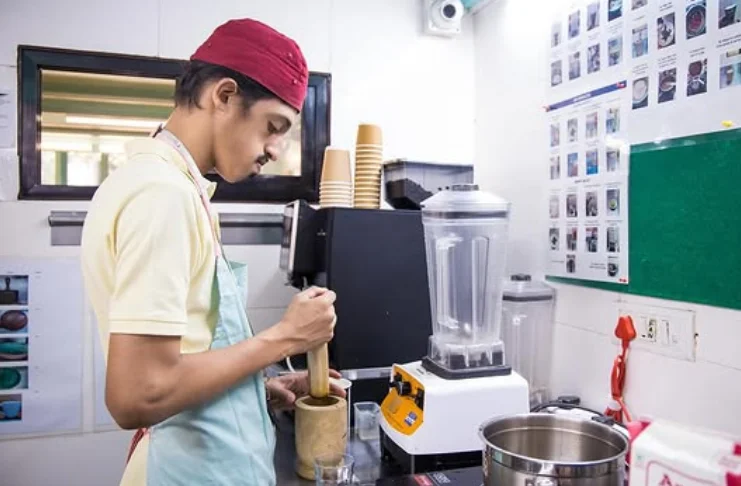
The meals served at Cafe Arpan are homely, comforting, and well-prepared. Cha, coffee, sandwiches, vada pav, snacks, and comforting dishes made in careful detail. This is the kind of menu that makes you want to order one more cup of it and makes you stay there for longer hours.
However, what makes them return is not included on their menu card. What keeps them returning again and again is the ambiance of the place. The degree of attentiveness that surrounds you. The kind of dedication with which the workers look at their job as not merely a way of earning bread, but an important responsibility. As per them, it is their smiling faces that raised them up to the sky.
“It’s fun working here,” said Anand, one of the cafe’s staff members, in an early interview after the launch. He was not performing gratitude. He meant it.
A Move That Proved the Point
Recently, Cafe Arpan moved from its original base in Juhu to Vile Parle East, a denser area. This could easily have been viewed as a drawback. But for the cafe’s management, it was proof of something else.
“Moving a business is a challenge for any professional,” Nagarkar told The Tribune, “but for our team, it was a moment to prove that their skills are not just site-specific but truly transferable.”
The mission, she has made clear, was never to build a charity wearing a cafe’s clothes. “This is not about making a profit, but bringing neurodivergent adults into the workforce and demonstrating to the community what they can do.”
Why It Matters Beyond Mumbai
Cafe Arpan may not be the only inclusive employment program operating in India, but the way it works is unique in its clarity of purpose. From its conception, the founders of the Yash Charitable Trust knew that the issue wasn’t the individuals themselves. The issue was the lack of a structure that recognizes their abilities. The dabba service established the structure. The cafe enhanced it. The relocation validated it.
At each step of the way, it has become clear that if the right structure and support are provided for neurodivergent adults, then yes, they can do this job. Not in spite of, but because of who they are.
One cup of chai at a time, Cafe Arpan is proving this point to the citizens of Mumbai, and they have begun to listen.