In the industrial heartland of Makati, Manila, where the cacophony of commerce drowns out subtlety, lies one of Asia’s best restaurants: Toyo Eatery. It’s a space that unites cultural maximalism with contemplative calm, a third-wave aesthetic that reflects both precision and soul.
At its helm, Chef Jordy Navarra and his wife May have created a living archive of Filipino cultural memory where heritage isn’t preserved in amber but breathes with contemporary relevance.
Since 2016, this modest establishment has redefined what it means to honor indigenous foodways in the age of global gastronomy. With each plate, Toyo makes a case that Filipino cuisine requires no validation from the Western culinary establishment. It simply invites you to listen more closely to what it has always been saying.
The Ethos: A Taste of the Unsaid

Toyo in Filipino means soy sauce, but that’s only scratching the surface. It also evokes umami—depth, darkness, and complexity. These ideas permeate every corner of the restaurant, from the bare concrete walls to the simplicity of its name. Navarra, who cut his teeth at The Fat Duck in the UK and Bo Innovation in Hong Kong, chose to return home and build something rooted in memory. Not nostalgia, but remembrance. There is a difference.
“We’re not trying to modernize Filipino food,” he’s said in an interview. “We’re trying to understand it better.”
This is a restaurant that doesn’t serve food to impress but to remember. Not your childhood, necessarily, but someone’s. Somewhere in Luzon. Somewhere in Mindanao. Somewhere in the collective DNA of the archipelago.
A Restaurant That Never Wanted to Be a Restaurant
Toyo Eatery wasn’t born out of competition or a desire to outdo others. As Navarra explains, “It was more of an expression of what we have and our ideas.” And that authenticity has paid off.
Since winning the One to Watch Award in 2018 from Asia’s 50 Best Restaurants, Toyo has consistently ranked as the Best Restaurant in the Philippines and most recently clinched the Gin Mare Art of Hospitality Award in 2023, becoming the first Philippine restaurant to do so.
These accolades, however, sit lightly on the shoulders of Jordy and May. “It’s still shocking for us,” she says, laughing. “To be part of the list is already huge. But to get the Art of Hospitality Award is just insane.”
The Menu as Memory Archive
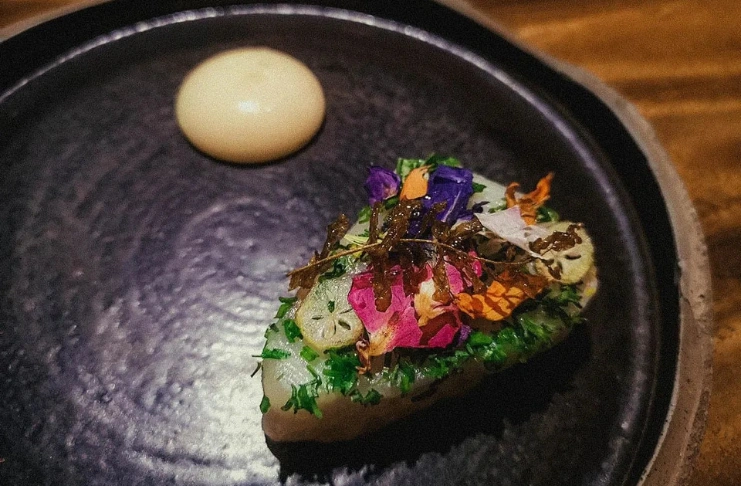
There’s no set script here. The tasting menu evolves constantly, shaped by seasonal produce, ancestral traditions, and the restaurant’s deepening relationship with local farmers, foragers, and artisans.
A standout dish, often described by first-time diners as both humorous and profound, is the “Bahag-hari ng Gulay” (literally, “Rainbow of Vegetables”), a plate of 18 native vegetables cooked using different Filipino techniques, inspired by a folk children’s song called “Bahay Kubo.” It’s delicate, poetic, and deeply political in its subtext: a reverence for biodiversity, forgotten crops, and the rural economy that sustains Filipino life.
Then there’s Toyo’s grilled prawns in aligue butter, where crustacean richness meets the sharpness of calamansi, served over rice fried in garlic. Or their take on lugaw, a humble rice porridge elevated with aged local vinegar, crab fat, and fine dining restraint. Even the bread, a pan de sal inspired sourdough served with burnt coconut vinegar butter, is a study in heritage and technique.
Dishes like kinilaw, their take on Filipino-style ceviche, punch with acid, salt, and clarity. Barbecue skewers show up unassumingly but leave a deep imprint.
And yes, there’s an à la carte menu. But it’s the kamayan spread that steals hearts, not just for how it tastes but also for what it evokes: beach trips, birthday parties, family reunions, meals without hierarchy.
“We can’t really recreate that setting,” Navarra explains. “But getting the same energy or the same level of comfort from a meal was something we really wanted to explore.”
The point is not luxury. The point is fluency. Toyo Eatery speaks the language of Filipino food, not as a dialect of Western fine dining but as a literary form in its own right.
The Space: Industrial Warmth

The interiors, designed by May Navarra herself, mirror the restaurant’s approach to cuisine: grounded, respectful, unpretentious. Bare concrete, recycled wood, handwoven accents, and the glow of warm pendant lighting create a space that feels more like an artist’s studio than a restaurant.
“Our approach to our food is similar; we want to be clean. It’s very minimalist, but at the same time very natural and very raw,” Jordy explains.
The dining room invites communal salo-salo conversations, while the kamayan menu, centered around food served on banana leaves and eaten by hand, grounds diners in something primal, celebratory, and Filipino.
“It makes your hands busy,” Jordy quips, “so no ultra-posed Instagram shots. We want to remind people this is really about just having fun.”
Guests don’t come here for Instagram moments. They come here to be fed in every sense of the word.
Farmers, Foragers, and Fermenters
Unlike many high-end restaurants that merely source locally as a talking point, Toyo Eatery builds with the land. Its relationships with producers are deep, even political. Whether it’s fermented fish paste from small-scale producers in the Visayas, rice from heirloom growers in the Cordilleras, or shellfish farmed in Batangas, every ingredient is a collaboration.
Navarra once described their menu development process as “research through relationships.” It’s not enough to know where something came from. You need to know who harvested it, how they live, and what that ingredient means to them. This relationship-first approach is what separates Toyo from trend-chasing kitchens.
They’ve also invested in their own bakery and fermentation lab, creating a closed loop of creativity where even their condiments and breads are made from scratch, often using indigenous yeasts and grains.
Toyo’s mission has evolved into something larger than the restaurant itself. In 2022, they eliminated beef from the menu to reduce their carbon footprint. They buy sustainable seafood from Meliomar and spotlight hyperlocal produce, often from remote communities that had never before sold their crops commercially.
And the next step? A Toyo farm. “Going deeper into the ingredients we use and growing our own… that would be a nice next thing,” says Jordy.
A Filipino Identity Without Apology
What’s most extraordinary about Toyo Eatery is that it doesn’t try to “fix” Filipino food to fit a global palate. There’s no toning down the vinegar. No excessive foam.
Toyo’s approach is informed but not intimidated by the world’s culinary capitals. In fact, it quietly resists the pressure to perform a Westernized idea of refinement. Instead, it asserts that Filipino food, just as it is, can sit at the same table as any fine-dining tradition.
A Partnership Rooted in Trust
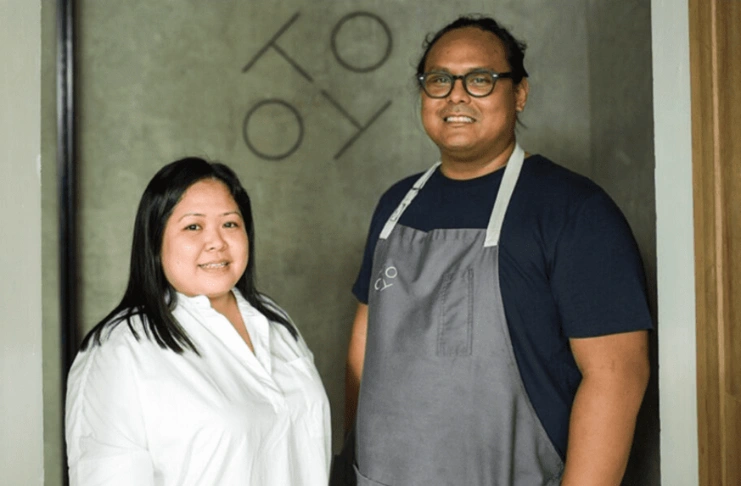
Behind every plate is a partnership that works because it’s balanced. “I don’t know how to cook,” May confesses. “So I never really mess around in the kitchen.”
Jordy, on the other hand, says, “I don’t know anything about money.”
It’s clear this dynamic has helped Toyo grow with both vision and clarity, and more importantly, peace.
The Future of Filipino Cuisine, Now
In an age where culinary storytelling often defaults to spectacle, Toyo Eatery offers something radically different: sincerity. And in doing so, it has become one of the most compelling restaurants in Asia, not for what it promises, but for what it remembers.
The food is not loud, but it lingers. The flavors don’t explode; they unfold. You don’t leave with a reel; you leave with a reckoning.
And if you ask the Navarras where Toyo Eatery is headed, they’ll probably point not to the next award or concept but to a new farmer they’ve met. A crop they’re experimenting with. A memory they’re trying to cook into being.
Because here, success isn’t measured in stars. It’s measured in roots.
In Manila, there are many places to eat. But Toyo Eatery maybe the only one that feeds the Filipino soul with such discipline, grace, and quiet revolution.