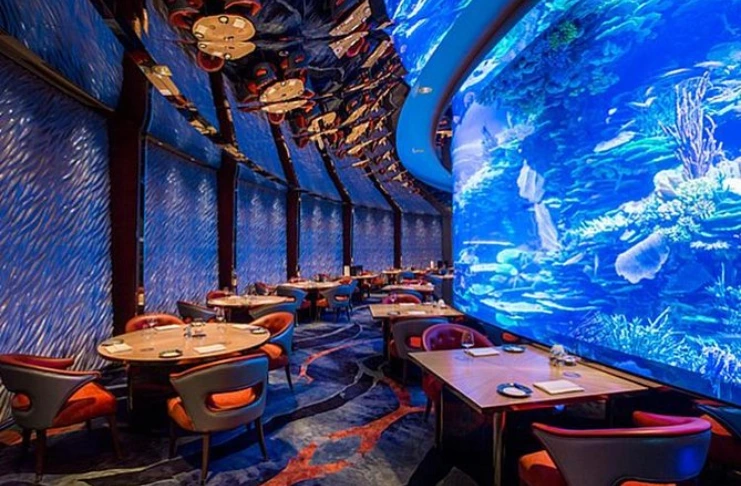

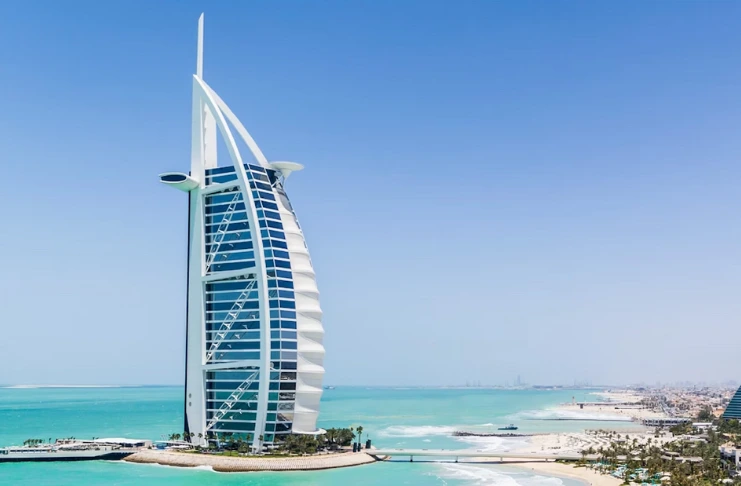
In the heart of Dubai’s most iconic architectural landmark, beneath the soaring atrium of the Burj Al Arab, lies a dining destination that exists between dream and reality. Al Mahara, translating to “oyster” in Arabic, has redefined luxury seafood dining since the hotel’s opening in December 1999, offering guests not merely a meal but an immersive voyage into an underwater realm.
A Vision Realized
The restaurant is accessed via a simulated submarine voyage, immediately transporting diners from the gilded corridors of the Burj Al Arab into an altogether different world. This theatrical entry sequence sets the tone for what follows: a restaurant built in a circle around a massive seawater aquarium holding roughly 990,000 liters of water. The aquarium wall, constructed from acrylic glass approximately 18 centimeters thick to withstand water pressure, creates an ever-changing backdrop of marine life gliding past dining tables.
The original vision for Al Mahara was part of architect Tom Wright’s broader concept for the Burj Al Arab, where every element would push boundaries. The interior designs were led by Khuan Chew and John Carolan of KCA International, who understood that the restaurant needed to balance spectacle with intimacy, creating spaces where the drama of the setting never overwhelmed the culinary experience.
Evolution Through Design
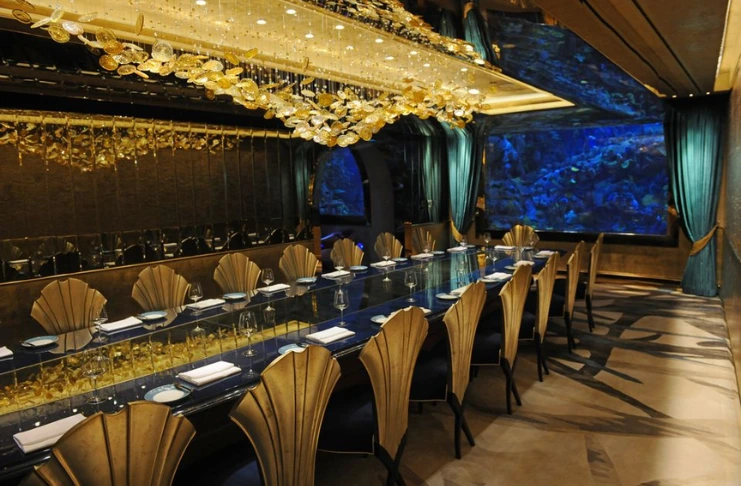
In October 2016, Al Mahara underwent a transformative redesign by Dubai-based Kristina Zanic Design Consultants. The renovation introduced a sophisticated new aesthetic while respecting the restaurant’s aquatic essence. The redesign included a new bar extension featuring a sea life-inspired chandelier, mother-of-pearl bar tops, and scalloped blue veneer panels. The entry was reimagined with a gold shell hostess stand, while private dining spaces were carved out and dressed with mother-of-pearl wall coverings and Australian rock crystal pendants.
Designer Kristina Zanic created bespoke lighting installations inspired by the deep ocean, collaborating with Czech crystal manufacturer Preciosa. The most striking is an octopus-inspired chandelier in the bar area, weighing 400 kilograms and spanning three meters in diameter, composed of hand-blown clear and blue Bohemian crystal inset with bubbles. These design elements speak to a philosophy where every detail reinforces the underwater narrative without descending into theme park theatricality.
A Culinary Journey
Al Mahara’s culinary identity has evolved through collaborations with some of the world’s most distinguished chefs. The restaurant gained international acclaim under British chef Nathan Outlaw, whose seafood expertise aligned perfectly with Al Mahara’s oceanic setting. Following Outlaw’s tenure, the restaurant has continued to attract culinary luminaries who understand that cooking at Al Mahara requires both technical mastery and theatrical sensibility.
In 2019, Chef Kasper Kurdahl joined as Executive Chef of Al Mahara, bringing over 25 years of Michelin-starred experience from Europe. The Danish chef had worked alongside culinary legends like Roger Souvereyns and served as Executive Chef at the famed Le Chalet de la Fôret in Brussels, Belgium. His international experience spanning New York, Italy, Spain, Japan, France, and Germany positioned him to lead Al Mahara into a new era with a focus on treating ingredients with respect and serving them in refined ways.
Currently, the restaurant hosts Ristorante L’Olivo at Al Mahara, a rendition of Capri’s two Michelin-starred restaurant by Chef Andrea Migliaccio. What began as a winter pop-up in 2022 became a permanent installation, with Migliaccio splitting his time between Dubai and the original L’Olivo at Capri Palace Jumeirah. His menu reinterprets Mediterranean traditions with elegant Italian sensibilities, offering dishes like lemon-scented tagliolini with red prawn and blue lobster with saffron and raspberries. The transition to Italian cuisine represents Al Mahara’s willingness to evolve while maintaining its core identity as a destination for exceptional seafood.
The Philosophy of Place
Al Mahara operates within a unique context. It exists not simply as a restaurant but as an integral component of the Burj Al Arab experience, a hotel that opened in 1999 and has been referred to as the world’s only “seven-star” hotel, though hotel management has never officially used this designation. The restaurant must therefore balance multiple identities: serious culinary destination, architectural attraction, and symbol of Dubai’s ambition.
This balancing act extends to every operational detail. The dress code is smart and elegant, with an age policy of 8 years and above, ensuring an atmosphere conducive to both romance and culinary appreciation. Service standards reflect the broader Burj Al Arab philosophy, where excellence is non-negotiable, with staff trained to anticipate needs while remaining unobtrusive.
The wine program, overseen by Samuel Lacroix (Gault & Millau UAE Sommelier of the Year in 2023 and 2024), has matured into one of Dubai’s most comprehensive collections, with particular strength in Italian varietals that complement Migliaccio’s cuisine. The pastry program, led by Tom Coll (Gault & Millau UAE Pastry Chef of the Year in 2023), ensures that the final course matches the sophistication of what preceded it.
Positioning and Recognition
Al Mahara occupies a distinctive position in Dubai’s competitive dining landscape. It is simultaneously a tourist destination and a restaurant taken seriously by gastronomes, a difficult duality to maintain. The restaurant has received recognition from Gault & Millau UAE, with Ristorante L’Olivo at Al Mahara earning three toques (a rating of 15) in 2023. It has also been acknowledged by the MICHELIN Guide Dubai, though specific distinctions vary as the guide’s presence in the region evolves.
The restaurant’s location within the Burj Al Arab provides both advantages and challenges. Access requires either hotel residency or a dining reservation, creating exclusivity while potentially limiting spontaneous visits. This controlled access reinforces Al Mahara’s positioning as a special occasion destination, somewhere reserved for celebrations and significant moments.
The Al Mahara Experience Today
Contemporary Al Mahara represents the synthesis of 25 years of refinement. Guests begin their journey with the submarine simulator, a piece of theater that remains effective despite its longevity. Upon arrival, they enter a space where navy velvet accents meet soft white and gold hues, where the aquarium’s residents glide through coral as diners settle into their evening.
The menu reflects Mediterranean sensibilities filtered through Italian technique, with daily-made pasta, pristine seafood, and generous portions that acknowledge the occasion such dining represents. Dishes might include blue crab tortelli, milk-fed veal with chicory and saffron, or the signature tagliolini al limone with red prawn. An optional tasting menu allows guests to experience the kitchen’s full range.
What distinguishes Al Mahara from competitors is its refusal to rely solely on spectacle. The aquarium provides an unforgettable backdrop, but it is the precision in the kitchen, the knowledge of the service team, and the attention to detail in every element that justifies the restaurant’s reputation and pricing. This is dining as a total experience, where environment, service, and cuisine converge.
Looking Forward
As Dubai’s restaurant scene continues to expand and diversify, Al Mahara faces the perpetual challenge of remaining relevant without losing its essential character. The decision to bring in Andrea Migliaccio and transition to Italian cuisine demonstrates management’s understanding that evolution is necessary, but it must be thoughtful evolution that respects the restaurant’s DNA.
Al Mahara’s future likely involves continued partnerships with celebrated international chefs, each bringing their perspective while honoring the unique setting. The restaurant may experiment with menu formats, service styles, and wine programs, but the fundamentals will likely remain constant: an underwater setting that captivates, cuisine that satisfies serious diners, and service that reflects the Burj Al Arab’s uncompromising standards.
In a city defined by constant reinvention, Al Mahara represents something increasingly rare: institutional dining that has earned its status through sustained excellence rather than novelty alone. It is a restaurant that understands its role in Dubai’s hospitality ecosystem and executes that role with consistent professionalism. For those seeking not just a meal but a memory, Al Mahara continues to deliver on the promise suggested by its name: a pearl of rare quality, formed through time and pressure into something luminous.