
Every restaurant operator knows the feeling. You’ve invested in a new POS system, integrated with delivery aggregators, installed digital menu boards, and implemented a kitchen display system. On paper, your tech stack looks impressive. In reality? It’s a fragmented mess that’s costing you time, money, and sanity.
Welcome to the state of restaurant technology in 2025, where the gap between technology’s promise and its reality has never been wider. While 76% of operators say technology gives them a competitive edge, only 13% believe they’re on the leading edge compared to their peers. The rest? They’re struggling with fragmented systems that don’t talk to each other, drowning in data they don’t know how to use, and watching their teams spend more time managing technology than serving customers.
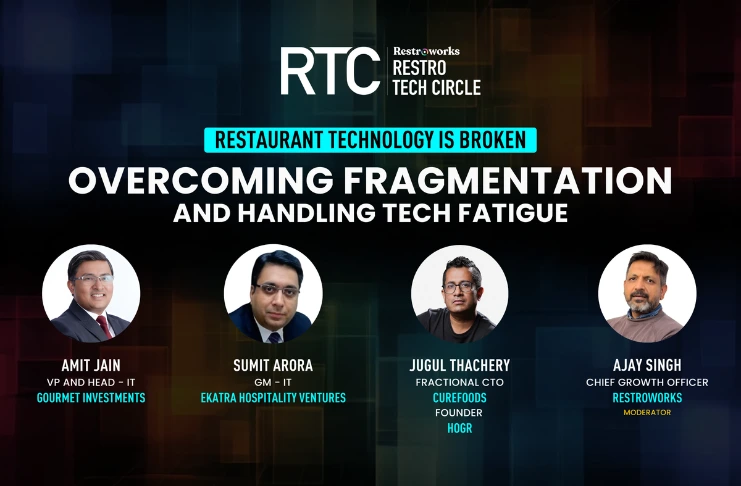
This September, in the serene coastal setting of Goa, RestroTech Circle 2025 brought together the minds tasked with solving these challenges: CTOs and technology leaders from India’s leading restaurant chains. In an intimate, closed-door conversation under Chatham House rules, what emerged wasn’t a celebration of innovation; it was an unflinching examination of an industry struggling to make its technology work.
The Real Problem: Your Foundation Is Cracked
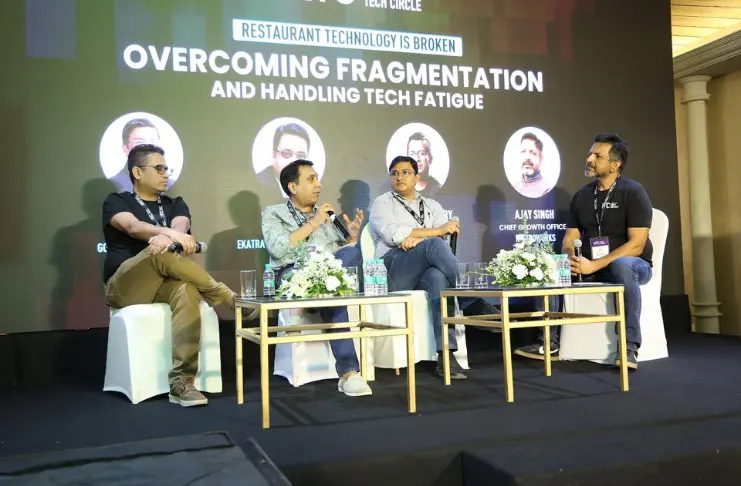
Moderator AJ Singh opened with a story. Over ten years in Gurgaon, he’d bought multiple cars to navigate the city’s infamous floods: SUVs, Volvos, even a Thar designed specifically for waterlogged terrain. All went underwater eventually.
“The problem is these solutions are not the ones that are broken,” he observed. “Actually, the foundation is broken.”
Restaurant technology faces the same issue. The solutions aren’t necessarily bad. They’re just not built to work together.
Amit Jain laid it bare: “We don’t have what I call a unified or integrated ecosystem for applications. If I talk about my front of house, my customers, billing, I need to integrate with Zomato, Swiggy, all my third-party partners, Thrive system. Then there’s table reservations from Zomato, Swiggy, Easy Diner. We need to integrate all these things together.”
His list exposed the complexity: feedback systems scattered across social media and internal platforms, CRM and loyalty programs operating independently, inventory management disconnected from kitchen displays. “Right now we would be working with six, seven different systems. Are they totally integrated with each other? No. So that remains a challenge, a big challenge for all of us.”
But the technical mess is just part of it. There’s something more urgent: “There is one more element which we typically miss in the restaurant industry, which is very, very important: compliance. We can kill people if we do not take care of what we are serving. Pest issues, expiry issues, temperature issues. The compliance piece is equally critical.”
Sumit Arora echoed this from the fine dining world: “We all want a unified platform wherein everything from the start to the end experience of the customer should be seamless. Starting from ordering to KDS, speed of services, menu management, not only POS, maybe QR code ordering, aggregators. The entire thing has to be unified or controlled from one control panel.”
His current reality? Separate vendors for kiosks with their own databases, POS systems controlling only aggregators and menus, and digital menu boards managed completely separately. “Once it gets integrated and one platform is provided, that will simplify the life of all the tech team members, be less time consuming, and the same manpower can be utilized elsewhere in upgrading the solution.”
This fragmentation isn’t just annoying. It’s expensive. As Ashish Tulsian, Co-founder and CEO of Restroworks, noted: “We know many well-intentioned IT leaders who appreciate our product struggle to take a call because it requires significant migration effort.”
The numbers tell the story: 76% of restaurant operators see technology as a competitive advantage, but only 13% are satisfied with their current setup. When your POS, purchasing, inventory, and accounting systems deliver conflicting numbers, your teams resort to Excel for manual reconciliation. You know, precisely the inefficiency that technology was supposed to eliminate.
Swimming in Data, Starving for Insights
Here’s the most startling revelation from the panel: restaurants are collecting more data than ever before, yet fewer than ever know what to do with it.
Jugul Thachery framed the core problem: “There are different touchpoints and finally there is some data flowing in. If all the data can provide some actionable insights, the problem is solved. Who really consumes that data is the most important point. Waiters want that data at their fingertips to give that personal experience. The kitchen team needs to know what needs to be produced.”
His verdict? “We get tons of data on a daily basis, but whether we are using that data for data-driven decision making? Absolutely no.”
Drawing from his gaming industry background, Thachery highlighted what restaurants lack: “I come from a gaming background. Most tech industries, gaming industries, have a separate analytics team which will churn the data and give you tidbits of how to use this data. But the restaurant industry can’t at this point afford to have a different data team.”
Amit Jain, who previously specialized in data warehousing and business intelligence in banking, admitted the gap: “Very, very honestly, transparently, we’re very basic. We’ve been doing SSSG analysis, SSTG analysis, new customer acquisitions, lapses, wastage analysis. But beyond that, the kind of tools that could be coming, AI that can give us indicators like ‘this September is lower 10% compared to last September, and last month you did this promotion that lifted your sale by 15%, but this year the promotion is not working,’ we kind of overlook this. Predictive analytics running on AI models is still evolving for us.”
Then came Sumit Arora’s bombshell: “Currently, if I say we are only 10%.”
When pressed to clarify: “90% is what we need. We have been getting data from all sources, but to be honest, the team doesn’t know what is to be done with that particular data, how it is to be churned out, what exactly should be the output, where to use that. Currently, we are all focused on the sales, not the overall experience from the guest perspective.”
His conclusion hit hard: “Collecting data is not the goal. Utilizing it in the right way is what we should be working towards, and that’s where we are actually failing in tech right now. We are having the data but don’t know what to do with it, to be honest.”
Jugul expanded on the operational reality at Cure Foods: “We pull all the data and democratize it, data should be accessible to everyone. We had predefined queries in Metabase where people just click a button and pull basic reports. But people don’t know how to read data. Data can be the most dangerous thing if you don’t know how to analyze it.”
He illustrated with a scenario: “We know there is 10% wastage, 20% wastage. Why? Because Durga Puja was during that time. When you have 300 locations across the country or running 10 to 15 brands, there could be an outage in Swiggy that day. Data without knowing the underlying reason… we run like a tech company, we’re all techies who started a food business, and even we find it very challenging. Data points are out there, but the margins are also so thin that we can’t have a huge data team sitting and churning data.”
The Context Problem
Sumit Arora explained why basic sales data isn’t enough: “Historical data, if I talk about Gurgaon being submerged during monsoons, obviously all business in the entire food industry will not do well during that period. Aggregators will have challenges in delivering food. Those particular data points, if I talk to you about next year, you will not even remember what the scenario was the previous year.”
He pointed to a critical gap: “All the CRM partners approaching us will take data points from your POS for sales, but they are not considering the 360-degree view of the overall scenario of the market at that particular time. They will only analyze data available on POS. That will be basically sales data, not the actual on-ground reality.”
This isn’t a minor inconvenience. Without context, data becomes dangerous. Teams make decisions based on incomplete pictures, leading to misallocated inventory, poorly timed promotions, and wasted marketing spend.
Video Analytics: When AI Actually Works
While data paralysis dominates one end of the spectrum, video analytics has emerged as a surprisingly effective solution for addressing both compliance and operational efficiency.
The discussion revealed how leaders are approaching video analytics not as a surveillance tool, but as an operational enabler. Kripadyuti Sarkar, Group CIO at Ambuja Neotia, shared a compelling story from Zamana, a Bollywood-themed street food restaurant in Kolkata. His team implemented facial recognition AI without formal management approval.
“I never shared anything with the management. I just installed CCTV cameras and started video analytics on face reading AI,” Sarkar explained. “The system identifies when customers last visited and immediately suggests, ‘Last time you ordered Bombay vada pav, are you repeating that or something new?’ That creates the wow factor.”
This guerrilla approach delivered measurable results without disrupting operations. When management visited and experienced the personalized service firsthand, the project received an 18 lakh rupees budget for chain-wide implementation.
Amit Jain shared a similar success story around workflow automation for compliance: “One of the recent successes we’ve had is a workflow system we onboarded from the back-of-house perspective. I mentioned our food can kill. Some simple things like ops checklist, shift checklist, the shift manager, morning store open, these are 20, 30, 40 things he has to do.”
The old way was inadequate: “Typically, if I have to do this, I’ll do a tick mark.”
The new approach uses technology to enforce accountability: “Through your mobile app, you mention and tell me the temperature of this equipment should be between minus 4 to minus 10. Show me a photo, upload a photograph, and you cannot upload anything from gallery. The solution has to use your phone’s camera. You have to upload it, and using tech, it reads the value and can possibly show some differences. Everything is online.”
This system extends beyond compliance: “This can help you manage the learning aspect for your team members, your onboarding. Obviously, TMTO, team member turnover or attrition in our industry, is very high, 80%, 100%. How do you ensure learning happens? How do you ensure your QA audits, everything from the backend perspective is taken care of?”
Jugul Thachery discussed implementation at Cure Foods: “For the kitchen audit perspective, we implemented some AI cameras and it started working a lot because manually processing that data is not going to happen. AI cameras help in knowing whether people are cleaning properly, how is the look, and all those things because we have so many outlets. We’ve seen early successes in that.”
The broader industry trend supports this. Video analytics systems now provide capabilities extending beyond security to theft prevention (reducing losses by up to 30%), food safety monitoring, and customer behavior analysis. They’re dual-purpose investments addressing both security concerns and customer experience.
Self-Ordering Kiosks: Great for Customers, Hell for IT
Self-ordering kiosks represent one of restaurant technology’s clearest success stories from a consumer standpoint, and one of its biggest operational headaches from an integration perspective.
The market data is compelling: self-ordering kiosks in India generated $1.62 billion in 2024 and are on track to reach $3 billion by 2030 at an 11.1% CAGR. Globally, implementation has shown dramatic results. McDonald’s reported a 30% rise in average order value after introducing kiosks, while self-service kiosks in quick-service restaurants reduce total order time by nearly 40%.
Consumer adoption is accelerating. According to industry data, 66% of U.S. consumers prefer using self-service kiosks over interacting with staff, citing speed and reduced stress as primary reasons. For labor-strapped operators, the financial case is clear: specific case studies show a three-location ramen restaurant saved approximately $1,050 per week per location after implementing kiosks.
But as Amit Jain explained, deployment isn’t simple: “If I tell the board we want to get into QSR, self-ordering and self-ordering kiosks have to be the best in the world. If I tell them we can do it but it will probably take a few months, they ask ‘Why a few months?’ I’ll need to onboard a new system, and it’s not like a digital menu board which can run on its own. Self-order immediately has to go to your POS system, into your KDS immediately, and that integration needs to happen. All of us understand this is painful to manage.”
Sumit Arora pointed to lessons from hospitality systems: “In hospitality, we were using Micros, which has a very nice functionality wherein we can define a particular time and date wherein a specific menu will be activated and will get deactivated after that time period. Those functionalities can be incorporated in POS solutions.”
He envisioned the future: “Analytics can be provided based on the sale on those particular menus. All those things can get automated. No human intervention would be required in a longer run.”
The kiosk story illustrates a broader tension: consumer-facing innovations get headlines, but backend integration determines whether they actually work. Without seamless connections between kiosks, POS, KDS, and inventory systems, you end up with expensive hardware that creates more problems than it solves.
AI That Actually Makes Decisions
Beyond reactive systems, the panel touched on agentic AI, technology that can analyze, decide, and act autonomously. This represents a fundamental shift from systems that respond to inputs to systems that anticipate needs.
From the broader RTC discussions, the concept of agentic AI emerged as both promise and challenge. Unlike traditional AI that follows preset rules, agentic AI systems analyze data from multiple sources and determine optimal courses of action before executing them. The panelists discussed how this technology is transforming operations: automating portions of the online ordering process, with AI agents capable of browsing options and ordering on a customer’s behalf.
Jugul Thachery offered a glimpse into what’s possible: “A lot of things we do manually now are not needed. We spend a lot of time creating menus on a weekly basis. Why would you do that? That menu should be dynamically created based on data, customer preferences, and time of day. All these things come in and a menu will get automatically created, and the kitchen preparation schedule should create all those things. It’s only a matter of time before it becomes seamless.”
More importantly for restaurant operators, agentic AI helps managers make informed decisions faster by turning data into action, optimizing labor, and easing operational stress while keeping human hospitality at the center.
But as Kripadyuti Sarkar noted when discussing board presentations: “Independent directors understand customer experience, risk coverage, compliance, and business insights. They do not understand CRM or agentic AI.”
The challenge is translating its value into business outcomes that leadership can understand and support.
The Invisible Time Drain: Kitchen Display Systems
While customer-facing technology attracts attention, backend systems often deliver the most immediate operational value and cause the most hidden pain.
Amit Jain highlighted an often-overlooked constraint: “The pain point of the QSR segment is the operations team. From 11 p.m. to 1 a.m., they spend two hours getting everything sorted out. Otherwise, they must ensure everything is completed before 5 a.m. when data needs to travel.”
This overnight reconciliation window, invisible to customers but critical to operations, means technology must prioritize time efficiency alongside cost savings. As Kunal Kumar, IT Head at Taco Bell India, shared: “When I joined, within one month, everyone was saying the cost-cutting person is coming to the meeting room. Every time I go to the boardroom, they ask how much cost I will save this time.” His approach combines savings with time efficiency, recognizing that in QSR operations, systems that save staff two hours during critical windows deliver value far exceeding their cost.
Sumit Arora described how backend struggles ripple through organizations: “The front end is not getting impacted because they’re just taking orders and servicing the customer. The business is to serve the customer. The food has to be perfect and served in the right manner. The major challenge is only in the back office, backend processes. They are struggling with updating menus on multiple platforms, and that’s consuming their major time. Data analysis, the marketing team, data analytics team, finance, they are all struggling to get data for the board’s consumption and management to make decisions for the future.”
This backend reality reveals a critical truth: the most valuable technology investments often aren’t visible to customers. They’re the systems that give time back to operators, eliminate manual work, and provide clean data for decision-making.
When Technology Costs You Sales
The most painful discussions centered on what happens when fragmented systems break down during critical moments.
Jugul Thachery explained Cure Foods’ migration away from in-house development: “We used to develop almost all the tech internally, and then only for aggregator order passing we used to depend on third-party service like Urban Piper. There was always a blame game, ‘your tech failed, your tech failed, the handshake failed.’ One of the reasons we moved out was to stop this blame game altogether. We moved everything out of our system and stopped building. You guys take the responsibility so there’s a single source of truth.”
When asked about quantifying losses: “Yes, we do that. When we do menu planning and kitchen preparation for dark kitchens, we know what we predicted for sales based on offers and promos we’re running with aggregators. If it goes down for 10 minutes, we know what it loses, and we go back to the agreements. They always promise 99.9% uptime. Over one year, we might have only lost that much, so there’s no way I can penalize them.”
Amit Jain shared a critical New Year’s Eve crisis: “31st December night, we use Urban Piper for integration with third-party orders. Because of the load, there were downtime issues and we started losing sales. We realized quickly their server from Mumbai is working but Delhi is down. We created a parallel server in half an hour to an hour and kept it up and running throughout the 31st night.”
He also described operational nightmares from poor integration: “While mobile POS is great, if it’s not working with geolocation tagging, if you end up firing somebody who was taking orders because the mobile phone ID is not linked to your outlet ID, and you have multiple systems with different system IDs, you struggle. We implemented these systems very recently, and now we’re taking a step back asking what do we do? We can’t keep running to the board saying ‘I need 3 months, 6 months to implement this thing.'”
According to industry research, 35% of restaurant staff spend more than half their time managing digital orders. Time that should be spent serving customers. This isn’t just an efficiency problem. It’s a fundamental misalignment of technology with business goals.
Build vs. Buy: Why Vision Matters More Than Code
A critical strategic question emerged: should restaurants build technology in-house or rely on specialized vendors? The answer depends less on technical capabilities and more on organizational vision.
Jugul Thachery was blunt: “The vision is not there. Restaurant tech is just evolving as tech. We’ve been calling it only food tech, and food tech is what food delivery companies are. I don’t believe that is food tech. The ecosystem needs to evolve. Business owners need to understand what is happening at ground level and that they need to invest in that.”
He pointed to structural barriers at even tech-savvy companies like Cure Foods: “We have all the data points. We’ve pulled up all the problems stated, like bringing all the data from disjointed systems to a single warehouse. But still, churning that data needs a small data analytics team. And then maybe it takes second fiddle: ‘Let’s do it after the IPO maybe.’ Those things happen.”
His proposed solution: “Maybe the answer is everybody opens up their API to other people and they consume the API. One data analytics company comes in who has plugged into everybody, churns the data, and gives it as a service.”
Sumit Arora addressed investment priorities directly: “The intent is not there to spend money on this first. The business owners need to first understand where the bottlenecks are, and this is one of the major bottlenecks.”
Amit Jain offered a practical framework: “Do we want to be a restaurant tech company within the restaurant company itself? That remains a question. Should we have a large team managing systems compared to hiring more people in operations or marketing roles which directly impact revenue versus IT, which is still typically seen as a backend function?”
His philosophy: “Any industry-standard solution, we have to buy from the market. Anything which is very simple and acts like an add-on over my POS or ERP, that’s something we can do in-house. For example, if my system has four screens to update pricing and involves three or four people, I can develop a couple of screens internally through our internal portal. Beyond that, it has to be external systems. We do not want to get into any development on our own.”
The broader RTC discussions revealed another layer. As Ashish Tulsian framed it: “The central question is, how does one innovate when it requires buy-in from leadership? That buy-in must address two things: one, change. And the other part is failure, the appetite to fail.”
Building credibility before making large requests emerged as a consistent theme. Ashwin Chandrasekhar, CTO of Third Wave Coffee, emphasized starting small: “If you are a new CTO where you lack social capital, one of the first things you should work on is building it. Small wins are critical. When you come on time, when you deliver on time, that creates credibility.”
The build versus buy decision isn’t purely technical. It’s about organizational readiness, leadership vision, and the courage to experiment while accepting that some initiatives will fail.
Omnichannel Operations: More Channels, More Chaos
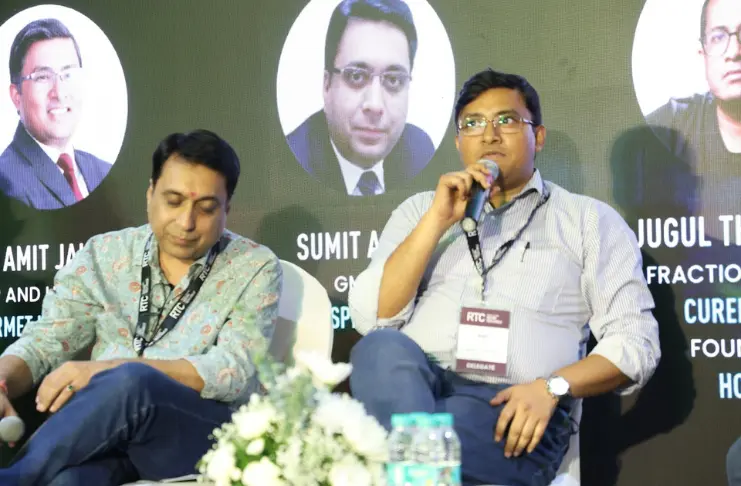
The shift to omnichannel operations, managing dine-in, takeaway, delivery, and dark kitchens simultaneously, has multiplied operational complexity exponentially.
Jugul Thachery explained Cure Foods’ evolution: “We are now an omnichannel player. We have a lot of offline play: almost 100-plus frozen retail outlets, 50-plus Sheriff outlets even in the Middle East. We’re omnichannel, not just online. Any peak days, we always face challenges, one thing or the other. It can be throttle issues at the aggregator.”
Sumit Arora pointed to integration as a bright spot: “Integration with our aggregators, that’s one good thing we started working with Restroworks on, which reduced a lot of work at the backend. Updating things on multiple databases reduced that effort and saved time.”
This omnichannel reality is reshaping the industry. According to industry data, 36% of brands report that online ordering now accounts for over half of total revenue. That’s not a side channel. It’s the primary business for many operators. Yet most restaurant technology stacks weren’t designed for this reality.
The challenge isn’t just technical. It’s operational, strategic, and cultural. When dine-in, delivery, dark kitchens, and retail all require different systems, processes, and data flows, the complexity compounds exponentially. Integration becomes not just desirable but essential for survival.
What 2030 Should Look Like
When asked to envision restaurant technology in 2030, the leaders painted a picture of seamless, intelligent systems that work invisibly in the background. Technology that enables human connection rather than replacing it.
Amit Jain articulated the dream: “The future has to be absolutely automatic and digitized. I created something which I wanted to show to the board: I would want customer 360. His entire journey has to be coming in one single platform. Either I use one single system for that, or if I use 10 different systems behind that, I need to see that. I need to have a store 360. I need to have my entire P&L. I need to have the complete integrated ecosystem that works together, wherein I am able to solve a lot of things for my operators where they spend more time working with their guests but not just filling data in the system.”
Jugul Thachery focused on eliminating manual work: “Menus should be dynamically created based on data, customer preferences, and time of day. The kitchen preparation schedule should be automatic. It’s only a matter of time before it becomes seamless.”
Sumit Arora emphasized automation: “Making things digitalized, we have to get away with manual work. Menu cycles defined in the system that automatically roll out. Analytics provided automatically. No human intervention required in the longer run.”
From the broader RTC discussions, Ashwin Chandrasekhar added perspective: “Expense or investment depends on perspective. Tech is a significant multiplier if you have the appetite for it. When you make a company into an enterprise, you need multipliers. For that world, tech is important. But even in that world, whether you want to go the extra mile for out-of-the-ordinary experiences is an add-on.”
The consensus vision isn’t about technology for technology’s sake. It’s about systems that fade into the background, enabling operators to focus on hospitality while the technology handles operational complexity seamlessly.
The Future Belongs to Those Who Act Now
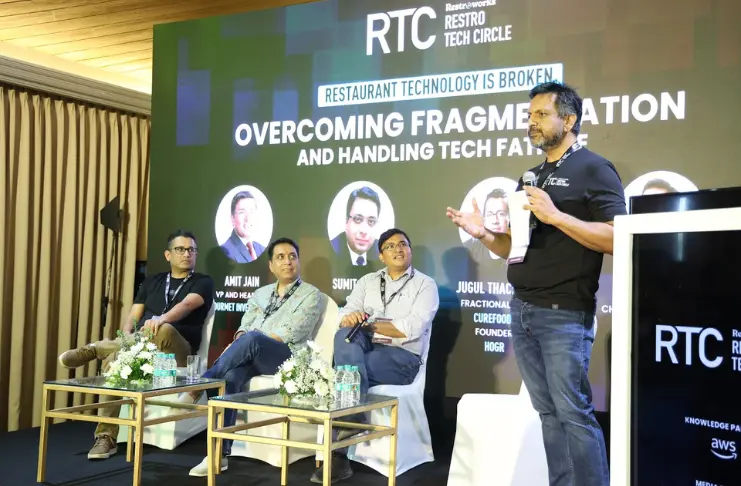
The panel’s candor revealed an industry at an inflection point. With 76% of operators saying technology gives them a competitive edge, yet only 13% believing they’re technology leaders, the gap between aspiration and reality has never been wider.
India’s restaurant landscape is transforming at breakneck speed. The foodservice market is valued at $85.19 billion in 2025 and projected to reach $139.8 billion by 2030, reflecting robust growth at over 10% CAGR. Cloud kitchens alone, valued at approximately $1.1 billion in 2024, are showing 12% to 13% CAGR growth as the delivery-first model gains traction. With QSRs showing a projected 9.16% growth rate in POS adoption from 2025 to 2032, the pressure to make the right technology decisions has never been higher.
But as the RTC discussions revealed, success won’t come from simply spending more on technology. It will come from building cultures of experimentation, earning buy-in through credible execution, and maintaining the discipline to learn continuously from both successes and failures.
As Kripadyuti Sarkar demonstrated with his guerrilla video analytics implementation at Zamana, sometimes the best approach is to prove value first and ask for permission later. Start small, show results, then scale. As Ashwin Chandrasekhar emphasized: “Take a smaller project, execute it like it is the most perfect thing that was ever executed. They gain confidence.”
The leadership lessons from RTC extend beyond technology choices. Sarkar emphasized continuous learning: “Keep learning because you can command boards if you have knowledge of the world. Independent directors are very knowledgeable, very sharp. If you think they do not know agentic AI, they will immediately mention Salesforce’s agent force.”
Chandrasekhar identified three critical leadership attributes: people management, visioning, and execution excellence. “Even as CTO, I love coding. No developer can mislead me because I can go find out what is happening on the ground.”
Kumar emphasized empowering teams: “Learn from me what I am doing. When you are learning, give me solutions, not questions.”
The operators who scale successfully won’t be those with the biggest technology budgets. They’ll be the ones who build unified systems that actually work together, who translate technical capabilities into business outcomes leadership can understand, and who maintain the courage to experiment while accepting that some initiatives will fail.
RestroTech Circle isn’t solving these problems overnight. But by creating a space where India’s sharpest technology minds can speak without filters, share failures without shame, and learn from each other’s scars, it’s building something potentially more valuable: a community that refuses to accept “this is how it’s always been done.”
Because in an industry built on hospitality, technology should enable human connection, not fragment it across six different systems that don’t talk to each other.