


The phone number for Universo Santi no longer works. No one answers when you call to make a reservation. At the entrance gate to El Altillo, the recreational estate in Jerez where the restaurant once operated, there’s no sign warning visitors that lunch and dinner haven’t been served there in more than three years.
In fact, even its social media accounts haven’t been updated since 2022. The last post about reopening in June never materialized.
Maybe this is how ambitious projects die sometimes. What happened at Universo Santi is a complicated tangle of good intentions and structural problems, of political photo opportunities and genuine dreams, of a kitchen shutting piece by piece from Catalonia and robberies that gutted the investment.
So, why are we even covering this story in 2026? Because failures matter just as much as success stories, if not more. And because the project involved real people whose lives changed when the restaurant opened, and changed again when it closed just like that.
The Beginning: October 2017
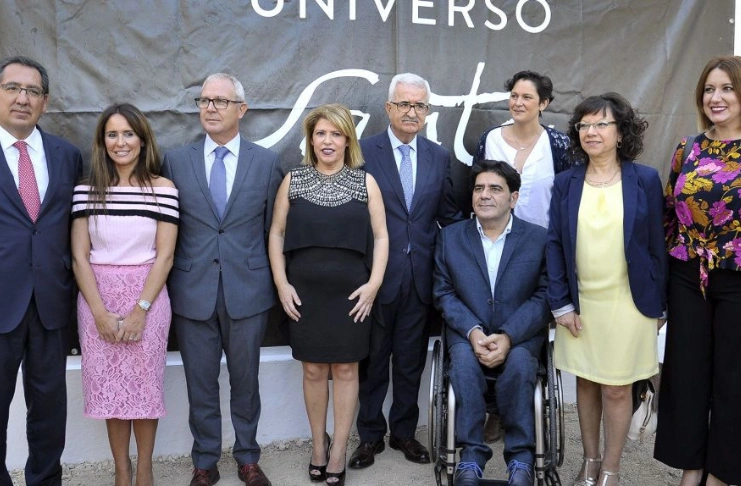
More than 200 guests attended the inauguration of Universo Santi on October 27, 2017. Two stewardesses from Tío Pepe presided over a stage where authorities lined up to praise the initiative.
Juanma Moreno, who would soon become president of the Junta de Andalucía, called it “an exemplary initiative of which we can all be proud.”
Mamen Sánchez, then socialist mayor of Jerez, highlighted how “the joint work and commitment of companies and entities can change things and make people happy, focusing on such an important aspect as training and education in equality.”
The restaurant occupied a stone manor house dating back to the late 1800s, originally acquired by Manuel María González Gordon, founder of González Byass. The estate, with more than 70,000 square meters of gardens and trees gathered from around the world, had passed through the De la Quintana González family before the city of Jerez expropriated it in 1995. For years, the building sat waiting for a new project.
What Antonio Vila and the Accessible Universe Foundation proposed was the first-ever haute cuisine restaurant whose staff would be comprised entirely of people with disabilities. They secured a 30-year concession from the city, brought in the DKV Integralia Foundation as main partner, and attracted support from the Cajasol Foundation, Cruzcampo Foundation, and others. The initial rehabilitation cost was around 120,000 euros. Total investment eventually reached 1.5 million.
But the real coup was convincing the family of Santi Santamaría to lend his name and kitchen to the project. Santamaría, who died suddenly in 2011 at age 53, was one of Spain’s most respected chefs, the first in the country to earn seven Michelin stars across his restaurants. His philosophy centered on honest cooking that let ingredients speak for themselves, always respecting local products and traditional techniques.
The Kitchen That Traveled South
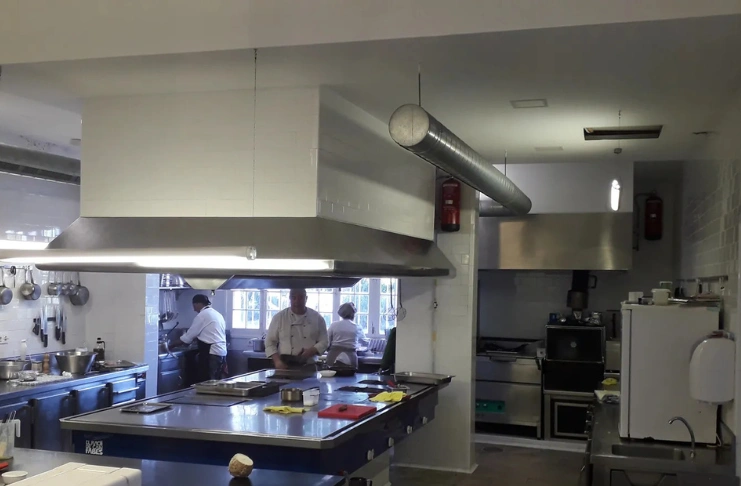
Cocina de Universo Santi, the same one with which Santi Santamaría rose to fame at Can Fabes.
When ‘El Racó de Can Fabes’ closed after Santamaría’s death, his family faced financial issues. Vila and another patron, Josep Santacreu, proposed transferring part of the kitchen from the restaurant in Sant Celoni to Jerez. The family agreed, partly because the project aligned with Santamaría’s spirit of social responsibility, partly because they needed financial help during a difficult period.
The kitchen traveled south, piece by piece, and was installed in the El Altillo manor house. “Part of Santi’s culinary history is recovered, as it will be the only restaurant with the recipes that made Can Fabes famous, as well as a menu with our own stamp,” Abel Valverde, director of the Universo Santi project, explained at the inauguration.
Regina Santamaría, the chef’s daughter, described the restaurant as “the representation of Santi’s work, effort, culture, and ideology. There was no better way to pay tribute to my father than to continue cooking and making foodies enjoy, while working for a society in which we all have a place, whatever our condition.”
Spain’s culinary elite showed up to support the opening. Martín Berasategui, the Roca brothers, Juan Mari Arzak, and the Torres brothers all came to Jerez. Joan Roca called the initiative “fantastic and an extraordinary legacy of Santi.” Berasategui admitted, “It is a nostalgic day for everyone, but with the opening of Universo Santi, it is shown that he is more alive than ever and that he is among us.”
What the Restaurant Aimed For & Achieved
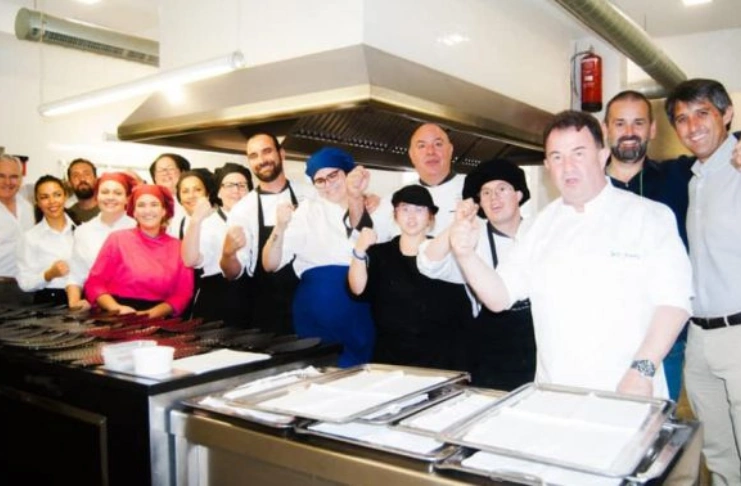
The staff of 20, aged 22 to 62, had to meet specific criteria to work at Universo Santi. For the record, they must be unemployed and have at least 35 percent disability.
Gloria Bazán, who had cerebral palsy, became head of human resources. Alejandro Giménez, 23, who has Down syndrome, worked as a novice chef. “Working here has transformed my life,” he said in an interview. “So many things I used to ask my mother to do, I do myself. I didn’t even know how to take a train by myself because I’d just miss my stop.”
The menu drew from Santamaría’s recipes and philosophy while incorporating local products from Jerez and surrounding areas. Dishes like tomato salad in its own water with fennel and olive, anchovies with cold soup of smoked aubergine, country egg with cauliflower cream and sherry vinaigrette, wild sea bass with spinach essence and beurre blanc of chili and ginger were widely appreciated. Every meal at Universo Santi ended with cinnamon cake infused with coffee and cardamom, served with vanilla ice cream and Pedro Ximénez.
This nine-course tasting menu costs 59 euros, 74 euros with wine pairing featuring selections from local Cádiz producers. The restaurant earned a mention in the Michelin Guide’s quality-cuisine section, which felt like validation that the concept could work and that excellence and social integration weren’t mutually exclusive.
Writer Deborah Cater brought her brother Reuben, who has Down syndrome and had been suffering from deep depression, to eat at Universo Santi in early 2020. “As Reuben tasted the food, I noticed the flavors beginning to work away at him,” she wrote. “Eventually, during the fourth dish, a huge smile engulfed his face, the kind that I hadn’t seen in months. It really did feel like a sort of culinary therapy. The honest food with its delicately measured flavours was awakening senses in Reuben that had lain dormant for a long time.”
The Problems Away From the Limelight
Behind the external success, the Accessible Universe Foundation’s board of trustees was deteriorating. Staff had started leaving one after another. “Many did not see the accounts clearly; the debts had increased a lot,” one former trustee shared anonymously. “I don’t know if there were really more than two people with disabilities hired or if they were only put on an apron for the photo.”
Vila denies this, saying that “if anyone has thought that we, or in this case I, have earned money or benefited from Universo Santi, we will see each other in court because it is completely false; it has been the opposite,” he said. He estimates he personally invested between 200,000 and 300,000 euros to keep the project alive.
The restaurant struggled to attract enough local diners to sustain operations. “Jerez didn’t turn around. It’s true that haute cuisine often has empty tables, but there were days when I would take my family and take them to dinner, paying out of my pocket in order to put some money in the box,” Vila recalled. They relied heavily on marketing to bring celebrities and personalities through the doors. The external image looked strong even as internal management became increasingly difficult.
Then came the pandemic in 2020, forcing closure for 15 months. When they attempted to reopen in June 2021, they launched a new menu called “Tierra” that doubled down on local products and Santamaría’s elementary principles. The menu featured nine dishes, with the option to add two classics from Can Fabes. But the reopening never happened.
The Ensuing Silence
Sometime in late 2021 or early 2022, Universo Santi stopped serving meals without any formal announcement. Vila says he moved to Madrid and “had a shock every 20 days” as problems mounted. Robberies affected approximately 40 percent of the investment. “They took paintings, very expensive lamps, kitchenware, and kitchen utensils,” he said. The alarm systems stopped working. He hired private security and paid monthly expenses for electricity, water, security employees, and two alarms out of his own pocket.
For the Santamaría family, the lack of communication felt like betrayal. “We tried a thousand times, and they didn’t respond. To this day, I have no communication with them, so we feel hurt and deceived because the kitchens are part of my father’s legacy,” Regina Santamaría said from Cairo. “It’s no longer the material value they have.”
The family had signed a contract for kitchen transfer with long payment terms because their intention wasn’t to profit but to have some help during financially difficult times. “I think they only made one payment, for a derisory amount; and then, the communication was delayed until they completely stopped responding to us,” Regina explained.
Vila maintains he recently spoke with the family and “they will be paid and, if necessary, the kitchen will be taken back. They are yours, and we restore them with great effort. We signed a contract to transfer one of Santi Santamaría’s old kitchens, and we agreed to pay a little at a time, which is what we have done. The moment we stopped the activity, we stopped paying.”
What Happened to Its People
Gloria Bazán, the woman with cerebral palsy who became head of human resources and showed the world that someone with her condition could run a restaurant, left Universo Santi. She was employed for a year at the Multiple Sclerosis Association, then jumped into politics. Bruno García recruited her for his list in the 2023 municipal elections. He became mayor of Cádiz, and Bazán is now municipal delegate for Health, Youth and Children, and Crafts in the Cádiz City Council. She declined to comment about her time at the restaurant.
The other staff members scattered when the restaurant closed. Their stories aren’t part of the public record, which is perhaps the saddest part of how this ended. The people whose lives the project was supposed to transform became invisible again when the doors closed without explanation.
The Estate That Now Sits Empty
Almost 11 years have passed since the municipal concession began. The purpose for which El Altillo was granted to the Accessible Universe Foundation hasn’t been fulfilled. Municipal government sources admit they’re not clear about short-term plans for the space but say they’ll ask for explanations. The enormous plot ultimately belongs to the people of Jerez, and its use must be socially and economically profitable for the city’s interests.
“There have been some offers, but nothing firm,” city officials say. Vila mentions various proposals over the years: “They wanted to set up an Asturian restaurant, others wanted to turn it into a space for weddings, baptisms and communions… that was not the initial purpose of the concession, and that is why we have not consented to it.”
He tried to find alternative financing to relaunch the initiative, proposing a solution through a businessman friend in Dubai. Cajasol was supposed to manage the foundation at the local level. After eight months of negotiations, Cajasol declined, leaving them without options.
What It All Means
Vila insists the foundation has no debts and remains split between those who think he should leave and others who support him staying.
When asked if there were any successes worth acknowledging despite how things ended, Vila points to the people who worked there. “There are people who can feel frustrated by that, there is a part of injustice, but surely if you ask the restaurant workers, people like Gloria, they will speak wonders because this offered them an opportunity that they did not have. She went viral because no one wanted to hire her, and now she is a councilor of the Cádiz City Council. We have done something right.”
The meteoric rise of Universo Santi ended with a brutal fall that left uncertainties, internal disputes, and a space where significant money and enthusiasm were invested, now threatened by squatting, vandalism, and looting.
This is the story of a commendable idea with tremendous promise that crashed and left more questions than answers.
What will happen to the space in the short-, medium-, and long-term remains unclear. For now, it’s just another ambitious dream that couldn’t survive the gap between what people hoped it would become and what reality allowed it to be.


