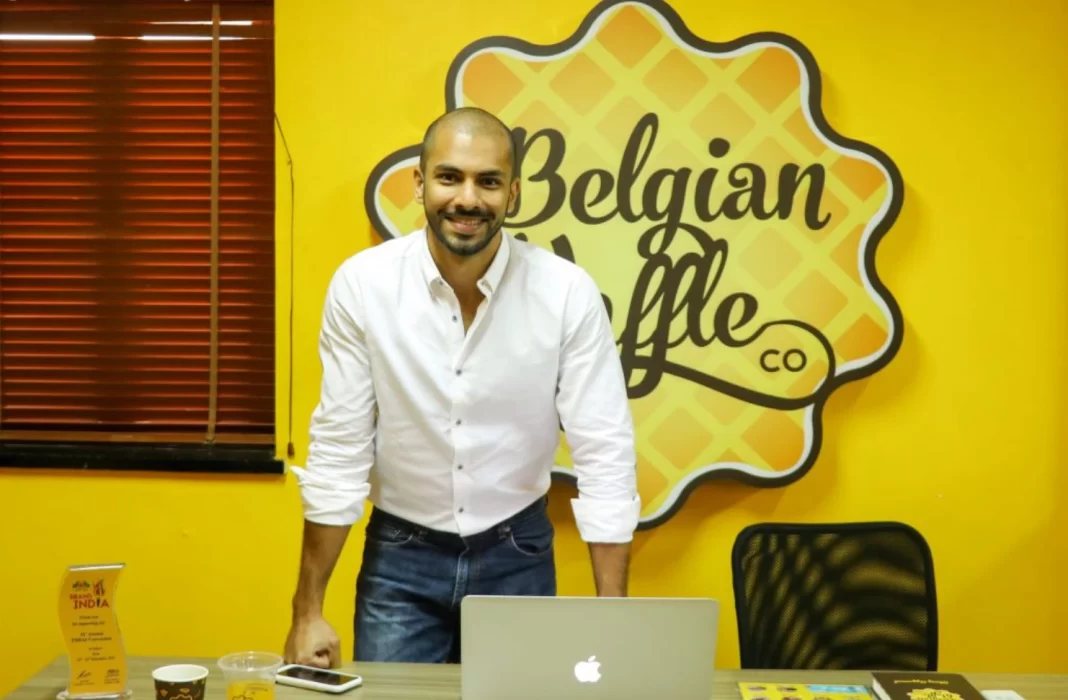

Over 47,500 waffles are sold daily across 700+ outlets in 199+ cities, generating somewhere around Rs 450 crore in revenue.
Ten years ago, The Belgian Waffle Co. started as a single kiosk at INOX Cinemas in Mumbai’s Nariman Point. Today, it’s one of India’s largest waffle chains, a category creator that turned a dessert most Indians never had into a nationwide craving.
In a conversation with The Restaurant Times, Founder Shrey Aggarwal shares insights, challenges, and strategies behind scaling The Belgian Waffle in India’s cutthroat F&B industry.
The Journey of Shrey Aggarwal and How He Started A Waffle Restaurant Chain
Coming from an engineering background, Shrey actively worked on Tech projects for three years. That’s also when, between 2013 and 2015, while working in Manila, he came across waffles.
“I was working abroad, and there I came very close to unveiling various interesting food concepts that were available. Waffle as a concept attracted me,” Shrey recalls. The more he explored, the more he realized India lacked a good dessert alternative besides ice cream, which had dominated the market for years.
And so, Shrey returned to India and co-founded The Belgian Waffle Co. in 2015 alongside his wife, Alisha Shirodkar. Together, they introduced eggless waffles, freshly prepared in front of customers.
To make a relatively unfamiliar product feel trustworthy, the founders leaned heavily on digital-first brand-building. Central to that effort was the waffwich, a term they coined for a folded, handheld waffle loaded with fillings.
Portable, indulgent, and easy to eat on the go, it reframed waffles from café desserts to everyday treats. Online storytelling focused on what worked best in the Indian market: freshness, aroma, customization, and visual appeal.
What Does it Take to Make a Mark in the F&B Industry?

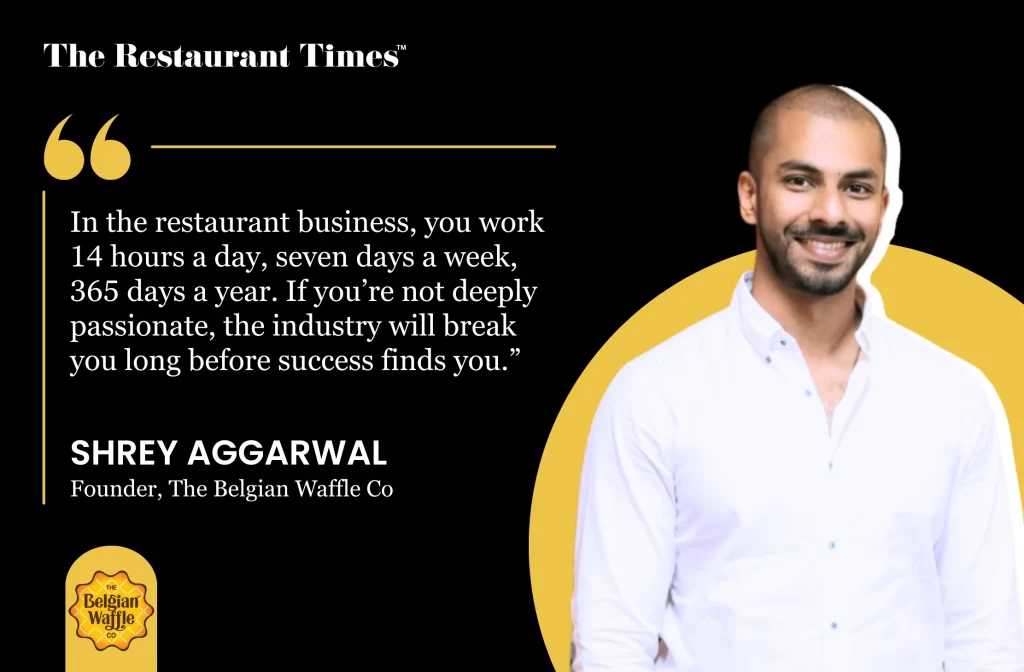
“In the case of the F&B industry, you obviously have to have a passion for it, because it touches people’s experiences and lives. You can only leave a mark on people if you have a proper understanding of the demand and the food itself,” Shrey explains.
Entrepreneurship has always held appeal because creating equity for himself is more important to him than working a job. But passion alone wasn’t enough. Creating a benchmark in the industry demanded focusing on customer experience and building a holistic picture. There are many other angles as well, such as pricing strategy, store aesthetics, and employee service quality, that make any business or brand a living example.
However, one of the greatest challenges Shrey thinks every restaurant owner faces is getting their Accounts Team in place.
“Getting the right personnel is where I work the most. Despite India’s huge population, there are very few people you can rely on with their skills and experience. Hunting those who can help you is a very big challenge.“
That said, the brand’s growth trajectory is no joke. From those initial company-owned outlets in Pune, Ahmedabad, and Surat, there are now over 700 stores across 199 cities. In fact, the company has maintained a steady expansion rate of approximately 140 stores annually over the past eight years, with plans to continue this pace for the next four to five years.
How to Decide the Location and Format Based on the Target Audience
Though the Belgian Waffle attracts all kinds of customers, females aged 16 to 35 make up the primary customer base.
The brand operates across multiple formats: kiosks (50-90 sq. ft., mainly in malls), takeaway stores (100-340 sq. ft. with minimal seating on high streets), and café-style outlets (250-450 sq. ft., mainly on high streets). According to Smartassretailer, the brand’s current footprint is around 80% in the café format, 10-15% in takeaway, and 5-10% in kiosks.
Each format has advantages. Kiosks offer flexibility since they can be moved. Food trucks don’t attract rent and are highly movable, though they face equity issues. The most stable format remains standalone outlets that are on high streets rather than malls.
“Malls often operate on short 11-month leases, with rental hikes if the outlet performs well, something brands have little control over. Also, malls close by 11 PM, limiting late-night footfall, whereas indulgent cravings often peak later in the night,” notes Ankit Patel, Managing Director & CEO at The Belgian Waffle Co.
Shrey listed what goes into good location research for any business. For example, you should know where the markets are and check whether other brands are doing well in the desired location. You must establish a research team to conduct an extensive survey of the local crowd density and whether it matches your targeted audience, their income, and the roads in the surrounding area. You must also know the kind of customers you plan to target, whether corporate, school, or residential.
On Franchising The Belgian Waffle
While talking about franchising, Shrey stated that standalone outlets are more profitable. And still, the Belgian Waffle chose franchising as its scaling strategy. “Scaling yourself in this kind of business is a challenging deal. You need to have a good team behind you,” Shrey explains. “It is necessary to be on the ball, otherwise your quality and attention may slip. Since Belgian Waffle wants to scale across India, I don’t think it’s feasible to do so with my own team. Some people may do it with the right things and people in place, but I think franchising is a much easier way to scale.”
However, reports suggest that in 2021, the brand shifted strategy after the pandemic exposed the drawbacks of franchising, especially brand dilution. To protect brand equity, it began prioritizing company-owned, company-operated (COCO) stores in major cities. Currently, around 340 outlets are company-owned across 40 cities, with the remaining 310 run under the franchise (FOFO) model. The expansion strategy continues franchising in Tier 3 and Tier 4 towns while adopting the COCO model in all major urban markets.
The biggest challenge when doing so? Maintaining consistency and freshness across all outlets. Shrey addressed this through operational simplicity. Products are manufactured and assembled in standardized forms with proper documentation, making things as simple and automated as possible.
The market dynamics support this growth. People now have higher spending power, travel more widely, and show greater awareness and exposure to a wider range of products. This factor drives the sudden upsurge of waffle restaurant chains and standalone outlets. Moreover, the initial investment remains relatively small in terms of footprint, as is true for most QSR formats, making it easier to start a waffle outlet.
“No one really did it right before. I am not aware what the other guys are doing, but I think that a lot of them are trying to follow what Belgian Waffle is doing in terms of providing affordable desserts with the Quick Service option,” says Shrey.
The Waffle Restaurant Trend and the Future Scope of Waffles in India
Despite the waffle trend taking over the food and beverage space, Shrey believes the sudden upsurge will eventually subside because operational challenges in the waffle industry are significant, and people will soon realize them a couple of months into the business. “If the competitors are not able to scale, I don’t think there will be enough meat on the bone.“
Shrey also went on to share the greatest operational challenge a waffle restaurant faces. For example, India does not manufacture waffle machines; hence, you will have to contact a distributor. When it comes to the machine itself, the coating wears off, so you will have to constantly replace it and recoat it. These are not easy things to do. Plus, they are not readily available in the market, so you will have to order and get them made specially.
The Belgian Waffle Co. has expanded well beyond its original nine-SKU waffle menu. As per data, waffle offerings have grown to about 30 SKUs today. In 2019, the brand entered the cake market with waffle cakes. Two years later, it expanded with ice cream sundaes, and most recently launched a cheesecake-inspired waffle range. The brand is expanding its cold beverage range and introducing hot beverages at select stores.
Entering the FMCG Space
Around the time of the pandemic, with stores shut, the company launched its own FMCG range to sustain revenue. It started with pancake and waffle premixes.
Tapping into India’s robust snacking culture, the brand later introduced waffle crisps, followed by chocolate spreads. Its current FMCG portfolio comprises nine SKUs, with plans to steadily expand the range over time.
These products are sold across the brand’s own network of around 700 stalls, as well as in both modern and general trade channels, reaching approximately 1,300 touchpoints. The brand aims to broaden its reach by entering new cities. The company is re-evaluating this vertical, aiming for FMCG to contribute 15-20% of total revenues in the long term.
Growth Metrics and Future Plans
As of today, The Belgian Waffle Co. serves a loyal customer base of 4-5 million people. Over the past eight years, the brand has scaled 20-fold in revenue and 10-12 fold in profitability, closing the last fiscal year with revenue of Rs 450 crore. The company has maintained a steady ~30% year-on-year growth and expects this momentum to continue over the next 2-3 years.
The brand’s revenue split is evenly distributed between online and offline channels, with third-party platforms like Swiggy and Zomato playing a significant role.
Looking ahead, the company is actively evaluating opportunities to launch new product categories under the same brand or create entirely new brands within the company’s umbrella.
International expansion remains on the radar but is still a few years away, with early-stage research underway to understand what localization would be required to succeed globally. With a strong balance sheet, the brand is open to small, strategic acquisitions that reduce time-to-market and align with its brand values.
In a significant development, Anagram Partners reports that Shrey Aggarwal and The Belgian Waffle Co. have entered into definitive agreements with VIXAR (formerly Arpwood Partners) to sell a significant stake in The Belgian Waffle Co.