


The store manager arrives at 7 AM. Before serving a single customer, he’s already logged into seven different systems. One portal for inventory orders. Another for maintenance tickets. A third for leave applications. The IT helpdesk has its own interface. Marketing wants inputs via Excel. Loss prevention prefers WhatsApp. And there’s an operations checklist somewhere in the mix.
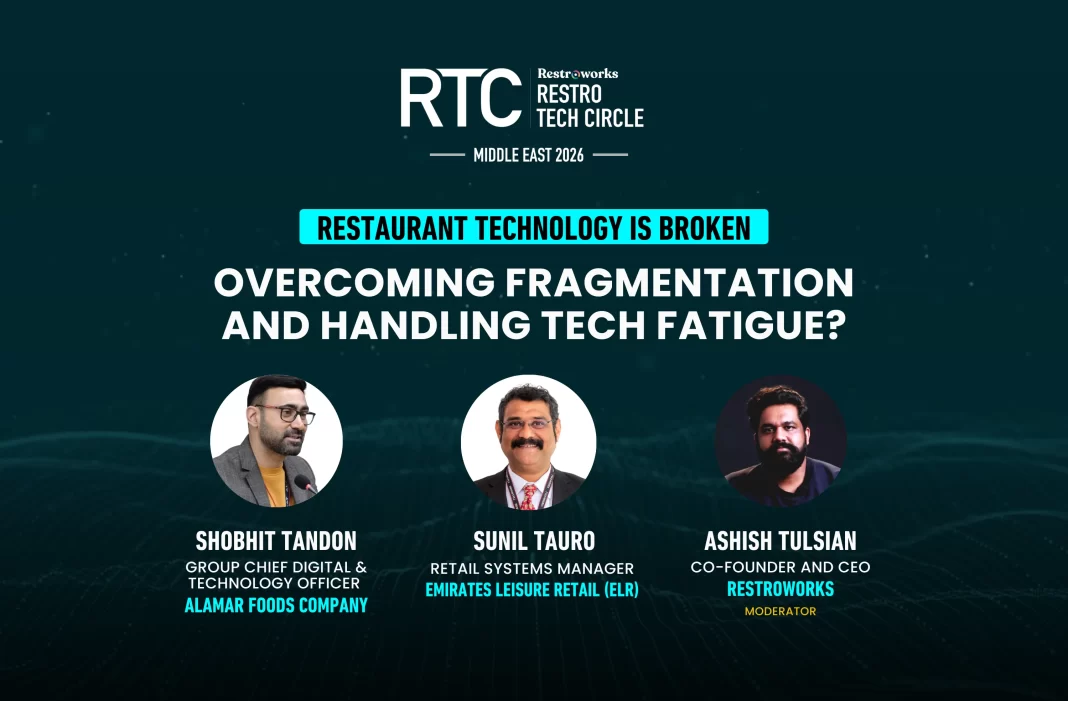
“Do we agree with this or is it just us?” asked Shobhit Tandon, Group Chief Digital and Technology Officer at Alamar Foods, opening the second panel at RestroTech Circle Middle East 2026.
The room’s reaction confirmed what everyone already knew: this is everyone’s reality. The store manager is doing everything except focusing on sales.
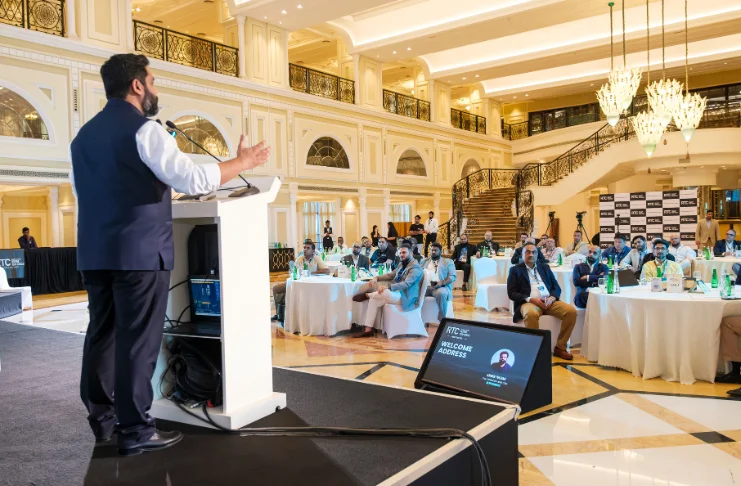
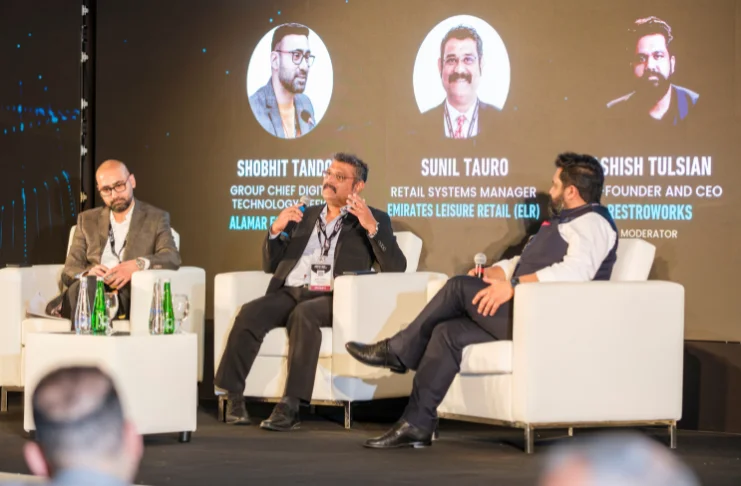
Moderating the discussion was Ashish Tulsian, CEO of Restroworks, joined by Shobhit from Alamar Foods (master franchisee for Domino’s across the Middle East, North Africa, and Pakistan) and Sunil Tauro, Retail Systems Manager at Emirates Leisure Retail (Costa Coffee, Bar & Restaurants UAE and MMI).
What emerged wasn’t just a discussion about fragmented systems. It was an unflinching look at how the pursuit of point solutions has created operational chaos that costs more than anyone wants to admit.
The Store Problem Is Everyone’s Problem
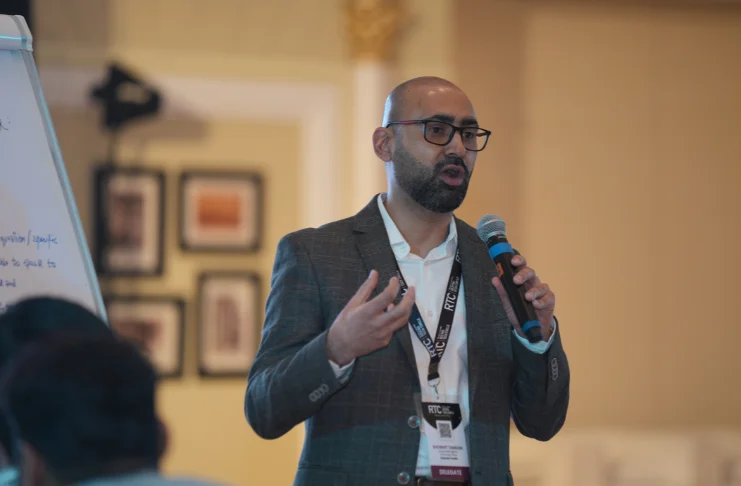
Shobhit didn’t limit the discussion of fragmentation to stores. “It’s not just the store. A few years ago, we had a system for performance management, another for talent acquisition, another for payroll, another for expense management, another for HR—collectively around 10 systems before we could put them all into one.”
This multiplication of systems happens gradually. Each purchase seems logical in isolation. Marketing needs a tool. Operations need a solution. IT needs a helpdesk. Before you know it, you’re managing a zoo of disconnected applications that don’t talk to each other.
Sunil echoed the sentiment from a different angle: “We have five fragmented point systems. Everything is different. Getting everything to work on one single app or system is difficult.”
But the real problem isn’t just the number of systems. It’s the human cost.
“Even today, a small barista, even a driver of Noon or Talabat has a personal mobile phone,” Sunil noted. “We’ve got so many communication channels—Teams, WhatsApp, Slack—and on top of that is email. Managers are spending time looking into these applications, trying to communicate, while the main focus should be selling coffee and giving a customer experience.”
The technology that was supposed to make operations easier has become the operation itself.
The Integration Wall
When Ashish asked Sunil about his pursuit—whether he’s increasing entropy by adding more vendors or consolidating—the answer revealed a fundamental challenge facing operators everywhere.
My biggest challenge is getting multiple systems to seamlessly communicate with each other,” Sunil explained. “While our core platform is reliable for its primary function, it wasn’t designed with modern integrations in mind. As a result, connecting it with newer solutions often requires significant technical effort, custom work, and added cost.”
He continued, “Ideally, we want to work with systems that are integration-ready—where connecting different touchpoints doesn’t demand heavy development, complex configurations, or high investment. With kiosks, inventory, digital menu boards, customer displays, and other channels all needing to stay in sync, a simple price change should automatically reflect everywhere—across point of sale, self-service, displays, and mobile—driven by a centralized source of truth, without unnecessary complexity.”
This isn’t a minor IT inconvenience. When systems can’t talk to each other, every price change, every menu update, every promotional campaign requires manual work across multiple platforms. The margin for error is enormous, and the time cost adds up daily.
Sunil was clear about what he’s looking for: “It’s not about one system having everything and loading so much baggage that the application dies. We need good applications that work perfectly within their ecosystem, with well-written code. The problem starts when we do customizations, when we touch the vanilla product.”
His point cuts to a critical tension: the vanilla product does what it does well. But when you stretch its limits with customizations and new features, things break because those additions aren’t tested at the same level.
Partner Over Product

Shobhit offered a different lens on the consolidation challenge, one that’s proven successful at Alamar Foods: “We prioritize partner over product. This doesn’t mean a partner could have a bad product. What it means is we’re looking at versatility and participation that the partner can do with us over time.”
The strategic question he asks: “Is the partner ready to invest with us? Whatever services the partner provides today, if we require 10 more services on the same platform tomorrow, will they be able to deliver them? Does the product have that flexibility? Does the partner have that willingness to work with us, learn with us, and grow with us?”
This approach delivered results. “We work with one platform for our store operations today. It wasn’t meant for maintenance, marketing, loss prevention, or asset management. It was meant for operational excellence. But today, seven departments use the same platform when they visit stores.”
The same principle applied to AWS: “The engagement initially was limited to Data Lake, but we knew so much more we could do with that partner. Now we’re building AI agents. Both parties are equally invested in building the future together.”
This isn’t just vendor management. It’s a strategic partnership based on a clear-eyed view of where the business is heading and whether the partner can scale with that vision.
The POC That Wastes Everyone’s Time
One of Shobhit’s most provocative points centered on proofs-of-concept, the go-to approach for de-risking technology decisions.
“We’re very, very careful about doing POCs,” he explained. “Unless we have a clear line that if this POC is successful, we can scale it to 700 stores, we will not do it.”
His reasoning: “POC usually works more in favor of the person doing it rather than us. Sometimes people come, and I see in their presentation, ‘Domino’s is our client.’ Where? Middle East? When did we engage with you? ‘No, we did one POC somewhere.'”
But the deeper issue is operational fatigue: “It wastes a lot of energy at the store level. You have to train and retrain your people on how many things. Eventually, they will stop doing it for you.”
This is the hidden cost of experimentation without commitment. Store teams become guinea pigs for technology that may never scale, burning credibility and creating skepticism about the next initiative.
Sunil agreed: “Trying out a new system means a lot of investment, not only from IT but from operations and management. If it’s successful, wonderful. But if not, you’re looking for another solution, and then another, and you lose your credibility.”
The solution isn’t to stop innovating. It’s to be ruthlessly selective about what you test and why, ensuring that POCs have a clear path to production and that all stakeholders are committed.
When Point of Sale Becomes a Dumb Terminal
One of the most striking observations came from Shobhit about how customer behavior is fundamentally changing the role of traditional systems.
“The point of sale for what it used to be is dead. It’s not relevant anymore in the way it used to be,” he stated. “Point of sale at the front end now is a dumb terminal because customers have taken the point of sale in their hands, whether it’s an app, self-ordering kiosk, or whatever.”
This shift has profound implications. If customers are handling ordering through their devices, what’s the purpose of the technology at the counter?
Sunil articulated the ideal: “The best system would be a system which is not visible. I’m at the counter talking to the customer, but I know exactly what I’m doing on the system. If my system talks to me the way I talk to the customer, and without any effort, I actually do my work, and the customer doesn’t even realize he’s ordered, that’s the best system.”
He contrasted this with reality: “There are systems so complicated you go to the start screen, enter the customer’s mobile number, and go through so many different places to finish the order, whereas it could have been two clicks and the order is done.”
As Shobhit summarized: “Humans need to be repurposed for better jobs. Jobs should not be something that can be automated because it’s just inefficient.”
Building for Five Years From Today
Shobhit shared a framework that guided Alamar’s technology decisions: think beyond today’s use case to what you’ll need five years out.
He gave a detailed example around customer wallets: “At one point, we wanted to create wallets for customers to store Domino’s money. When we looked at this requirement, we said today you want to put Domino’s money in the wallet, but tomorrow you might want to put a free pizza, and the day after a buy-one-get-one coupon. So let’s create something that encompasses everything. Eventually, it could build into a loyalty program.”
The second piece was delivery promise and driver tracking. “If the driver tracking is tied to the wallet, and the order is delivered beyond 30 minutes, can the driver tracking system tell the wallet system to give credit to the customer without them asking? If it’s after 40 minutes, send a product. After 50 minutes, money, product, and coupon.”
The result: “Today we don’t have a loyalty program, but we have delivery guarantee, wallet, driver tracking, and CRM. All of it is speaking to each other seamlessly. Tomorrow, if I want to do loyalty, the whole ecosystem is ready.”
This is architecture done right, building with the end state in mind rather than solving only today’s problem.
The Build vs. Buy Decision
An interesting tension emerged around when to build internally versus when to buy from vendors.
Shobhit was emphatic about certain systems: “There are certain systems we internally classify as business critical where we make sure we do not go to a partner to build it, but we build ourselves.”
He gave the example of driver tracking: “When we built it, we had 100% in-house drivers. As the business and regulations evolved, it became almost impossible to have our own drivers. We had to build the system to cater to on-demand drivers rather than in-house drivers. If we had an external system, it would have taken six months. We took less than a month to completely rebuild our code.”
The principle: “You need to ensure which are your business critical products where your requirement will be ever-evolving and you need to move really, really quickly.”
But Sunil offered a counterpoint from his experience: “When we do customizations, when we touch the vanilla product, that’s where the problem starts. The vanilla product is tested and has a whole lot going on. Then a customer says, ‘Can you give me this feature?’ and you say yes. That feature has not been tested.”
His preference: an ecosystem approach where best-of-breed solutions integrate well rather than one system trying to do everything. “If you’re not good at kiosks, give me a system that’s integrated well with a proven kiosk solution.”
The resolution to this tension came from Shobhit’s distinction: “When the foundation is the same—same hierarchy, same integration—then you should build more on top of it. When products are delivering completely two different things, be very careful.”
The Data You Can See But Can’t Use
Sunil raised a problem that haunts restaurant operators: having data but lacking the insights that matter.
“We have data for so many years. We have data on sales, discounts, promotions, voids, returns, and all that you see on the point of sale. What we don’t have is the customer coming to the store, seeing a big queue, and walking away.”
This is the business loss nobody tracks. “Footfall management, there are solutions for this. I don’t expect a point-of-sale system to give you that, but it could be integrated. You see, this is the busiest time of day. Between seven and 10 is the busiest time for coffee. You see, there was a big queue, but the point of sale hadn’t seen that. This is the leakage we’re talking about.”
His vision: “If you can integrate these two systems, AI could show you’ve lost 10 customers, lost that business. You could get better growth.”
The broader point applies across operations. Dark stores and delivery-only concepts are reshaping retail, but the technology to optimize them lags behind. AI cameras can help with compliance and queue management, but only when properly integrated with transaction systems.
What Actually Needs to Change
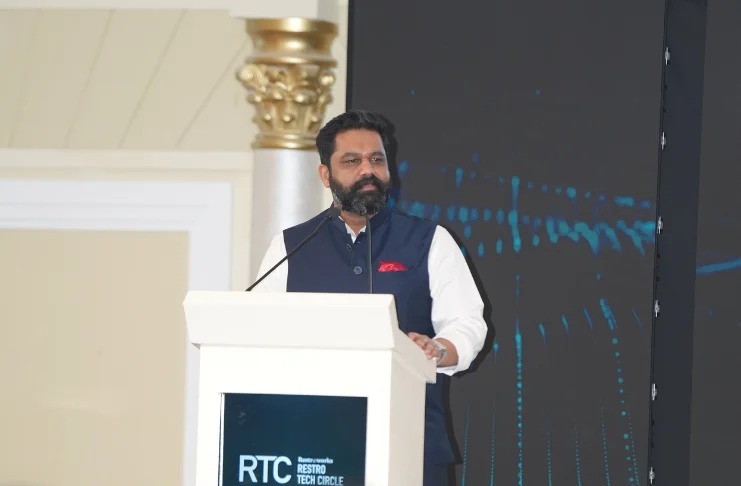
Shobhit’s framework for selecting and implementing technology boils down to two critical filters:
First, understand not just today’s use case but the requirements over the next five years. Technology decisions with a 12-month horizon will require replacement before they deliver full value.
Second, pick the product that serves your actual need, not something stretched beyond its design. As he put it: “When you’re looking at a product like HRIS and expense management, and some company says ‘we’re a complete HR solution, we can do HRIS, performance management, expense management’, be very careful. These are completely two different things. That’s where you should be really careful not to merge everything together.”
Sunil’s bottom line was equally clear: “Make sure whatever you’re doing is scalable and can cater to requirements. You need an RFP that clearly states exactly what you want. And most importantly, when you say POC, it’s live business. We don’t want to hurt our customers at any point.”
The Vendor Fatigue Reality
Ashish pressed on the most exhausting aspect of the current landscape: vendor fatigue. When you’re dealing with 10 applications and 10 more vendors standing outside promising better solutions, how do you maintain sanity?
Both panelists converged on the same answer: extreme selectivity.
“Work with the right partners,” Shobhit emphasized. “Engage in the right solution that has the future.”
Sunil added, “Since we’re managing both F&B and retail verticals, I would love to see a product that will scale in both industries. But we’re talking about live business. Whether it will be successful is there. That’s the challenge.”
The implication: the restaurant technology industry’s obsession with point solutions has created a landscape where operators are overwhelmed by choice but starved for systems that actually work together. The winning vendors won’t be those with the most features. There will be those who understand that integration, scalability, and long-term partnership matter more than feature checklists.
The Invisible Technology Future
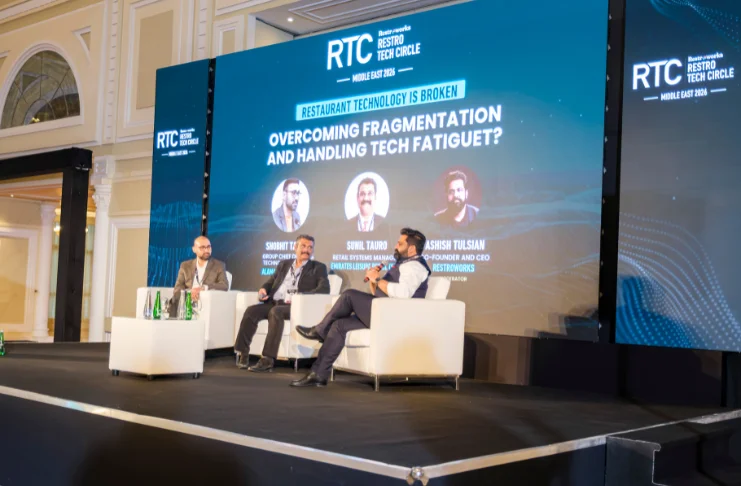
As the discussion wound down, Sunil returned to a theme he’d opened with: “For me, the best system would be a system which is not visible.”
In a Gen Z world where customers don’t want waiters hovering but expect frictionless digital experiences, technology needs to fade into the background. It should enable the human interaction, not complicate it.
“I come from old school technology where people wanted to come to the counter and talk to the cashier,” Sunil reflected. “When you have fine dining, the manager asks what you’d like and gives details of the food. Currently, with Gen Zs, they don’t want somebody to come and ask. ‘I have my mobile. I know what I want.'”
This generational shift accelerated post-COVID. “People have started ordering from restaurants, eating outside quite often. The restaurant business has grown because people want to eat outside and want to try new restaurants. Earlier, it was all home-cooked food.”
The technology needs to match this evolution, seamless, invisible, enabling rather than obstructing.
What No One Wants to Admit
Perhaps the most telling moment came when Ashish asked if anyone had questions, and the room stayed silent.
“I think they found us boring,” Shobhit joked. “Or probably we were echoing everyone’s sentiments.”
Sunil had it right: “It’s just a matter of being here and talking. Everybody knows it’s just a matter of addressing it and saying, yeah, you’re right, but in a different way.”
That’s the real problem with restaurant technology fragmentation. Everyone knows it’s broken. Everyone experiences pain daily. But knowing something is broken and having the bandwidth to fix it are entirely different challenges.
The operators who will win aren’t those who acknowledge the problem. They’re the ones who will make the hard choices, selecting partners over products, saying no to POCs without scale potential, investing in business-critical systems built for five years out, and ruthlessly consolidating where it makes sense while integrating best-of-breed where it doesn’t.
Because in the end, technology should be invisible to the customer and intuitive to the operator. Everything else is just expensive noise.


