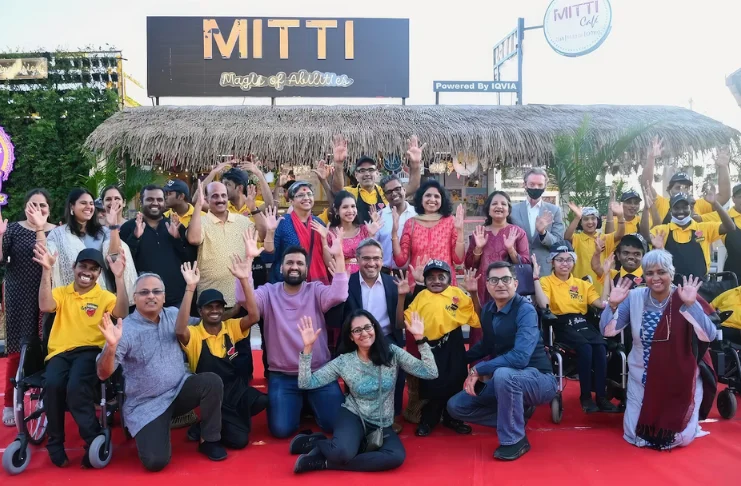

If you go to one of the cafe’s locations, nothing will appear that is out of the ordinary (on the surface, anyway). Yes, there is a counter, some food on the counter, and the normal hum of any cafe doing its business. And then there is the person behind the counter – the person who looks up and smiles at you when you approach the counter. The way this person takes your order, the focus and intensity with which they do this, is like nothing you have experienced before, and at the same time makes the person’s appearance the most well-dressed and professional you have seen in a long time. There is an element of trickery to the way the cafe has accomplished this since they opened in 2017 – they have created an environment that makes inclusion appear effortless. This is what they have done successfully since 2017. The employees in this cafe all have a hearing or visual impairment or an intellectual disability.
The Girl, the Documentary, and the Tin Shed
A psychology graduate, Alina Alam, hails from Kolkata and is pursuing a Master’s in Development Studies at Azim Premji University in Bangalore. At 22 years old, Alina joined the crowd and waited in line for a job offer, just like everyone else; however, she is unlike any other applicant. Alina watched a documentary on Emperor Nero; not specifically about the emperor himself, but the people at his party who saw his acts of cruelty and did nothing to stop them.
“The problem was not Nero,” she said, as noted in Global Indian. “The problem was with the individuals who treated others as inconsequential. If something wrong is happening and you are not taking sides, that means you are on the side of the oppressor.”
She skipped campus placements. In Bengaluru, Alina Alam had visited the Samarthanam Trust for the Disabled. What she saw there had completely rearranged her thinking. They were not disabled, they were dis-enabled. “They have enormous potential but lack opportunities,” she has said. “They just need someone to guide and upskill them. What better way to reach out and connect them to the world than through food?” (Global Indian)
So, Alina Alam started Mitti Cafe when she was 23. She had no capital, no infrastructure, and no experience of running a restaurant. The Deshpande Foundation had provided space on the campus of a college in Hubli, Karnataka. The community had provided 90 percent of the equipment. The name had come from the Hindi word for mud, “mitti.” Alina Alam had chosen it deliberately. “We all come from mud, despite ability, despite disability, despite everything.”
The first outlet had opened in August 2017, housed in a tin shed. It had run on borrowed kitchenware, borrowed conviction.
How It Works, and Why It Works
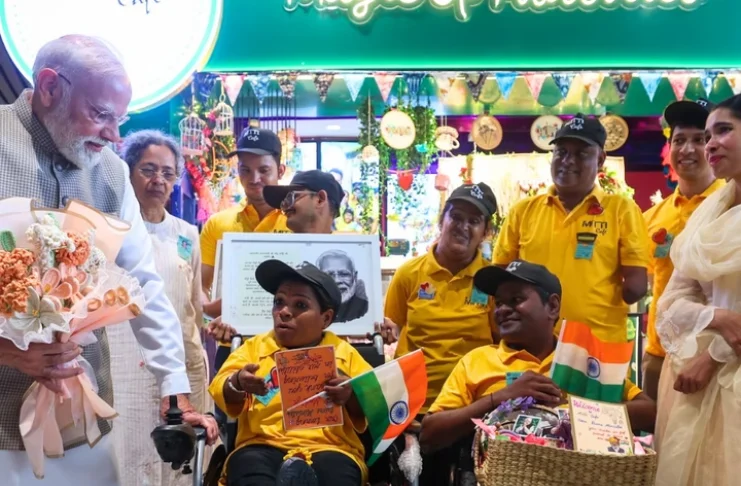
Mitti Cafes is a simple model. The Cafes are located in various institutions: corporate offices, Airports, courts, and universities. Each Cafe has a staff of 6 to 8 people who have physical, intellectual, and psychiatric disabilities. The staff undergoes an extensive training program before serving a single cup of chai. Menu cards at each Cafe are in Braille format, and the Cafe design is accessible to everyone.
Perhaps the most important element of the Mitti Cafe model is financial independence. After receiving the start-up grant, each Cafe becomes totally financially independent. The individuals working at the Cafes earn salaries that range from Rs. 15,000 to Rs. 50,000. Depending on their position in the cafe, employees may experience what financial independence is for the first time. “Those who were once perceived to be in need are helping others in need,” as the organisation itself puts it, a line that sounds like a slogan but is, in practice, a factual description of what happens here every day.
For instance, take the case of Bhairappa, who is three feet tall and has dwarfism. He is also motor disabled and has a mild intellectual disability. Before he joined the team at Mitti Cafe, he had been rejected over 80 times. During his first meeting with the team, he came barefoot. Today, he runs his own team at the Mitti Cafe within the Infosys compound in Bengaluru. His team has served food to Infosys Co-Founder Narayana Murthy and has been endorsed on national television. (Moodie Davitt Report)
The Addresses That Tell the Story
Mitti Cafe locations are deliberate; all locations (outlets) are corporate. There is an outlet inside the Supreme Court of India that Chief Justice D.Y. Chandrachud opened; there are two that were opened by President Droupadi Murmu inside Rashtrapati Bhawan (India’s presidential palace), as well as multiple outlets at India’s international airports in Bengaluru, Mumbai, and Lucknow. They also have cafes located inside corporate offices, including Wipro, Infosys, Accenture, Wells Fargo, Mercedes-Benz Research & Development India, and ANZ Bank. Prime Minister Modi stopped at the Mitti Cafe match at Navi Mumbai International Airport to speak to the team members individually throughout his busy schedule, and German Chancellor Olaf Scholz visited the India Coffee House location in Bengaluru. (Kashmir Observer)
These are not the cafes’ guest appearances at a charity event. These are working cafes, earning money, operating in accordance with professional standards, and located within India’s most important public institutions.
The Pandemic, and What Came After
When COVID-19 hit India and everything shut down in 2020, all Mitti Cafe’s corporate and institutional locations were closed. The revenue was zero.
What happened next is the part of the story that reveals the organisation’s character most clearly. A team member named Hemant approached Alam with a different frame entirely: “Didi, there are people who are hungry, and we know how to cook. If we start cooking, nobody will stay hungry.” (Moodie Davitt Report)
But what followed was perhaps the most indicative of the organisation’s character. The result was the Karuna Meals program, which eventually provided over 8 million nutritious meals to the economically disadvantaged, including the remote areas of the Sundarbans. The people serving were the same people the world was busy categorising as needing support. The organisation raised 1.5 crores in under 15 days to support the program. The trajectory was permanently changed, and when the cafe reopened, the team was there, and so was the model.
The Recognition
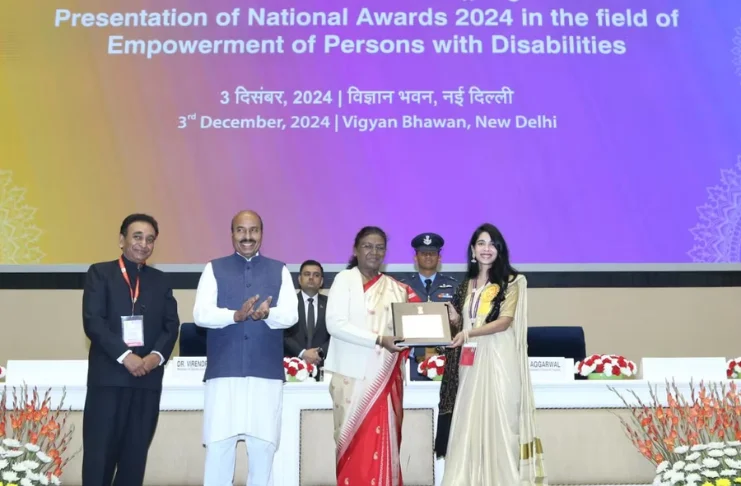
The accolades have been pouring in from all sides, a true reflection of the nature of what exactly the Mitti Cafe is. Alina Alam has been named to the prestigious Forbes 30 Under 30 Asia list. Alina Alam has received the prestigious United Nations Intercultural Innovation Award, supported by the BMW Group. The Commonwealth Youth Award, NITI Aayog Women Transforming India Award, Helen Keller Award, Times of India She Unlimited Award, Rotary Exemplar Award, Tiecon Young Female Entrepreneur of the Year, and many more have followed. The organisation itself received the prestigious Indian President’s Award in the highest category of organisations empowering persons with disabilities. In 2024, the Moodie Davitt Report honoured Alam and Bangalore International Airport Limited with the FAB Humanitarian Award for opening the first airport-based cafe under the brand. The organisation received the prestigious Condé Nast Traveller India Awards for its contribution to the hospitality industry in India. Alam is a four-time TEDx speaker. Alam has spoken at the prestigious World Economic Forum. Alam has had the distinction of meeting the German Chancellor, the Indian Prime Minister, the President, and the Chief Justice, not as a guest, but as the person running the cafe they wanted to visit.
What 22 Million Meals Means
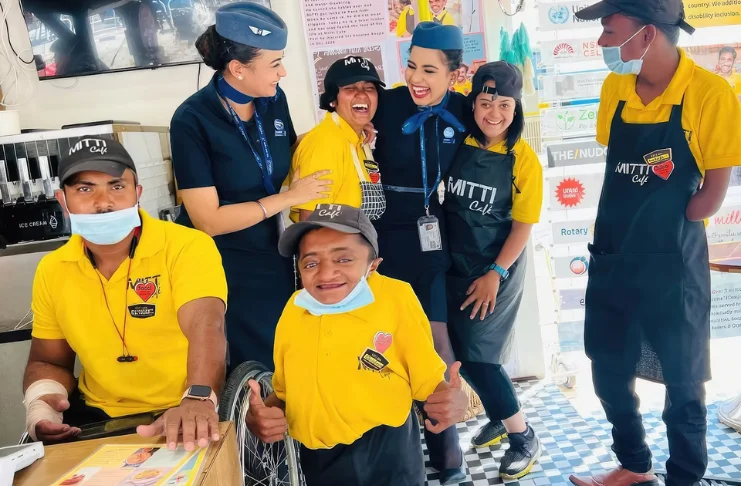
Mitti Café is a chain of cafes with over 70 outlets across India. It is the world’s largest inclusive cafe. Over 6,500 adults with disabilities have been trained and employed through this program. They have served over 22 million meals. And they have all, in a sense, been opportunities to talk about inclusion, not on the basis of logic or argument, but on the basis of service.
Samosas made well, pakoras fried well, sandwiches made well, juices, coffee – food that is plain and simple. Food that does not need a menu to be anything other than what it is. Food that does not need a server to be anything other than what he or she is.
A tin shed in Hubli. A team leader at Infosys. A cafe in the Supreme Court. A visit by the PM to an international airport. A world record in inclusive dining. And all of it was built not in grand style, but one meal, one training, one salary, one opportunity at a time.
Mitti, in a sense, is just mud. The same earth that holds all of us.