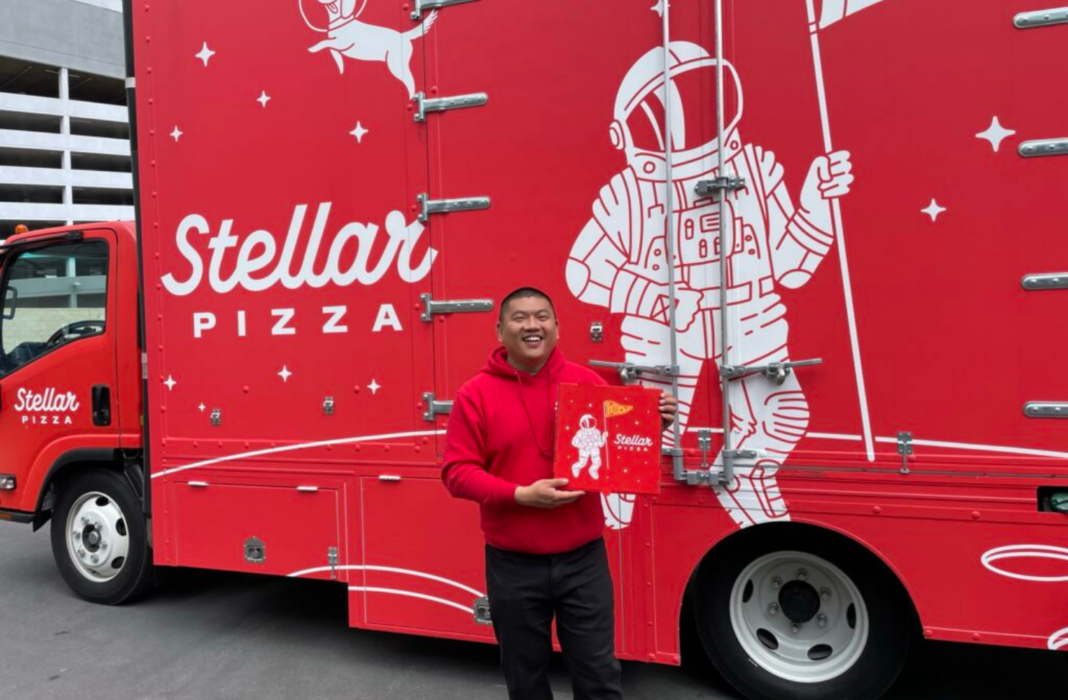

How many people have you seen go from engineering rockets at SpaceX (literally, SpaceX – every techie dreams to work there), one moment to making pizzas the next? That’s Benson Tsai for you, and his story is full of experiences, curiosity, and an urge to question why industries operate the way they do.
In 2019, Benson Tsai teamed up with his fellow former SpaceX engineers, Brian Langone and James Wahawisan, to launch Stellar Pizza, aiming to upend the quick-service food industry with an automated, robotic mobile pizza truck.
Their idea was to create a restaurant that drives directly to the customer, removing the need for expensive real estate while reducing the cost of labor. That idea was so bold that it caught the eye of Hanwha Foodtech, which later acquired Stellar Pizza’s assets in early 2024.
Roots & The Rockets
Benson Tsai grew up in Hacienda Heights, California, watching his parents run a fish-and-chips shop in the United States after immigrating from Taiwan. In a way, one can’t deny that “food has always been central to my life, and it’s been my one real passion,” he told The Spoon.
Tsai earned his B.S. in engineering from Harvey Mudd College in 2006, followed by an M.S. in chemical engineering from the University of Minnesota. He later co-founded Motiv Power Systems, an electric powertrain manufacturer that received Fast Company’s World Changing Ideas Award for transportation in 2019. As an early member of the Lucid Motors team, Tsai spent 2.5 years designing batteries for high-end electric vehicles before job-hopping to SpaceX.
He worked at SpaceX for five straight years. It is also here, while building power systems for Falcon 9, Dragon 2, and Starlink, he learned what it takes to build at the absolute edge of what’s possible.
But amid rockets and spacecraft, Tsai was convinced that “solving problems here on Earth is really important to me,” he told Bloomberg in January 2023, in stark contrast to his former boss, Elon Musk, whose well-publicized vision was to make humanity multi-planetary.
The Machine in the Truck
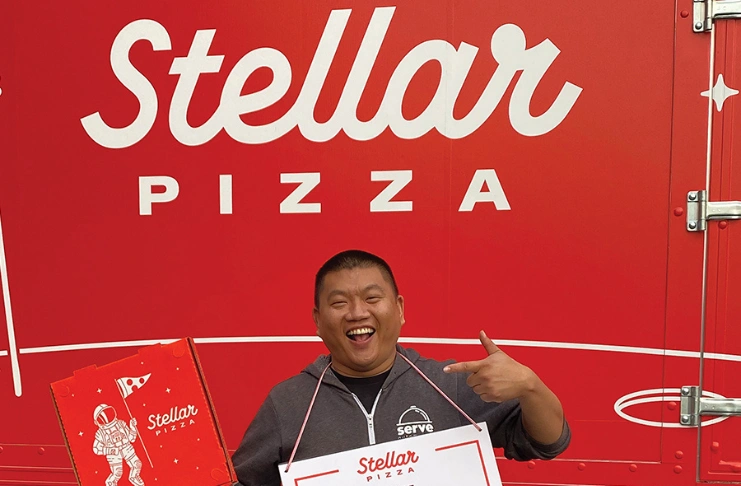
When Benson Tsai finally left SpaceX in 2019, he redirected his engineering principles to building a mobile restaurant that could automate nearly the entire pizza-making process.
At first, it started with “building ovens and smaller bench-top versions of the subsystems in my living room at home. Through much trial and error, the machine evolved into what it is today with the help of the team’s space-grade design process.”
Today, it handles the entire pipeline without a human hand touching it. A customer orders through the app, dough is flattened, the topping line adds sauce, cheese, and whatever the customer chose, then an automated pizza peel launches it into one of the four ovens, and finally, in under five minutes, you get your pizza ready to eat.
“Today, Stellar has over 23 ex-SpaceX employees working for us, along with people from Uber Eats, Sweetgreen, and Fresh Brothers. Our offices, coincidentally, are right near SpaceX. We have lots of our friends from SpaceX serve as our unofficial food tasters! Their feedback has really helped us dial in a great recipe.”
What makes the truck genuinely different is actually the model itself. Stellar never planned to sell the technology to restaurants. Instead, it owns the whole stack. Tsai drew the comparison himself: “If you look at SpaceX, raw metals show up at the door of the factory, and they sell rides to space, not rockets or any of the technology.” (The Spoon) That’s exactly how Stellar controls its product and tightens the system, so as not to end up licensing its best idea to someone else.
On the question of robots displacing workers, Tsai says, “All of the fast food in the world is already made by robots. Like the sausage patty you get in your burger is made by a factory somewhere, so automation in food has already been a part of our lives for decades. We’re just moving the robotics a little closer to the customer.” (The Spoon)
The long-term vision for Stellar Pizza is to move the pizza production closer to the customer by having just one person, a driver, who hands off the pizza to the customer or another delivery driver. This application uses a hub-and-spoke model, with a main truck and a fleet of delivery drivers.
Jay-Z, $16.5 Million, and What Came After
By October 2022, Stellar had raised a $16.5 million investment round led by Jay Z’s venture capital firm, Marcy Venture Partners. Total funding had already crossed $25.5 million across two rounds, which basically confirmed that the concept was resonating well beyond the engineering community.
When asked about who he sees as his competition, Tsai named “Domino’s.”
He argues, “We’re not trying to be the Italian, fresh-out-of-the-oven, Neapolitan pizza.” Domino’s does over $4 billion in annual sales. Tsai believes a mobile pizzeria with fewer staff, zero real estate overhead, and a robot doing the heavy lifting can eat into that.
The Hanwha Acquisition
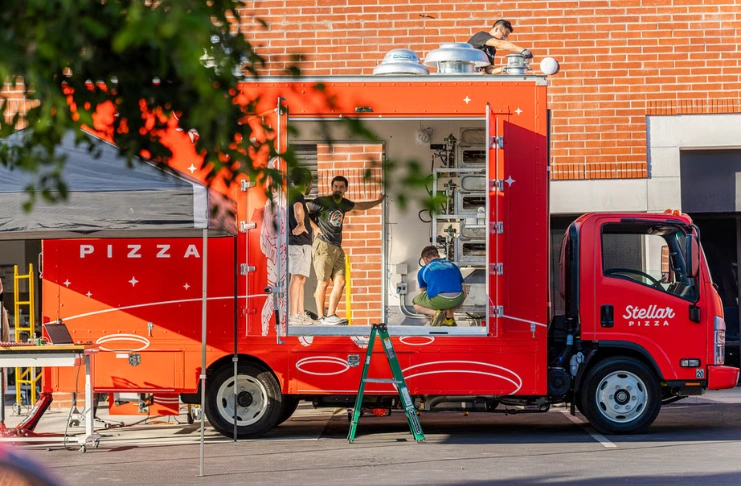
In early 2024, Hanwha Foodtech, a food and beverage subsidiary of South Korea’s Hanwha Group, acquired Stellar Pizza outright. (KED Global, March 2024) The MOU was signed in January, and the asset transfer was finalized on February 29.
What’s notable is who drove it. The acquisition was championed by Kim Dong-seon, the third and youngest son of Hanwha Group Chairman Kim Seung-youn — the same person who brought Five Guys into Korea in 2023. (Korea Herald, March 2024) Tsai stayed on as CEO, along with key technical staff. The technology didn’t get shelved. It became the foundation.
Along with acquiring 100% of the assets, Hanwha Foodtech planned to retain key technicians and management executives, including CEO Benson Tsai. The acquisition initiative was notably driven by a generational bet: it was championed by Kim Dong-seon, the third and youngest son of Hanwha Group Chairman Kim Seung-youn.
The ambitions behind the deal were that “Hanwha Foodtech will introduce a new pizza brand to both the Korean and US markets following the adaptation of Stellar Pizza’s technology and systems,” an official from Hanwha said.
By May 2024, Hanwha Foodtech opened a research and development center in Seongnam, Gyeonggi Province, spanning 1,349 square meters with laboratories, a simulation room, and a foodtech showroom, and confirmed it would be used to prepare for the launch of a new brand utilizing Stellar Pizza’s robotic technology.
The Detour?
If you thought this story was purely a tech narrative, you couldn’t be more wrong. This story is fundamentally about a kid from an immigrant family who watched his parents struggle with the economics of running a small food business, and spent twenty-something years building the tools to fix that problem.
SpaceX wasn’t a detour. In fact, everything he learned there fed directly into a machine that makes pizza in five minutes and parks outside a university campus.
Whether Tsai’s original vision ultimately survives is the question worth watching, though. Big companies absorbing small foodtech ideas and smoothing out all the interesting edges is a well-worn story. But Tsai stayed. The tech stayed. And Hanwha, for whatever it’s worth, seems to understand that the system is the asset.