
Every bakery faces the same challenge: baking goods that are perfect the moment they come out of the oven, but poor quality by the time they reach customers. Shelf life is not merely an issue of food science; it’s a business problem. Short shelf life leads to waste, high costs, and stress on your production process. Extend shelf life the right way, and you can save money, maintain consistency, and increase consumer trust.
In this guide, we’ll explore the science of staling and spoilage, how to extend shelf life for various product types, and food safety, and hope to help your business.
What You Will Learn
- Why baked goods go stale and what drives shelf life differences between product types
- How packaging, storage, and functional ingredients extend freshness without compromising quality
- Food safety thresholds for bakery products, including cream-filled pastries and fresh bread
- Practical waste reduction strategies for retail and wholesale bakery operations
What Is Bakery Shelf Life and Why Does It Matter?
The shelf life of bakery goods is the amount of time a baked good stays fit to be consumed: in terms of quality, flavor, texture, smell, and appearance. The shelf life is not constant. It depends on the nature of the baked goods, ingredients used, how the baked goods were baked, packaging of the baked goods, and how they are stored.
INDUSTRY INSIGHT
| The global bakery products market is projected to grow from $515.89 billion in 2026 to $326.55 billion by 2034, at a CAGR of 3.59%. |
Shelf life is very important in the bakery industry. There are huge financial losses incurred because of food wastage in the bakery industry. Bakery companies can benefit financially and ethically from reducing food wastage. A consumer will not purchase any product that has gone bad.
Why Baked Goods Go Stale Faster Than You Think
Bread lasts 3-5 days at room temperature in a bread box. Most bread lasts 3-6 months in the freezer at 0°F. Airtight containers prevent moisture loss in baked goods. Refrigeration accelerates bread staling within 2-3 days. Understand why baked goods go stale.
It is also important to remember that freshness perception varies: 21 days in North America, 5-10 days in Europe.
Starch Retrogradation: The Core Staling Mechanism
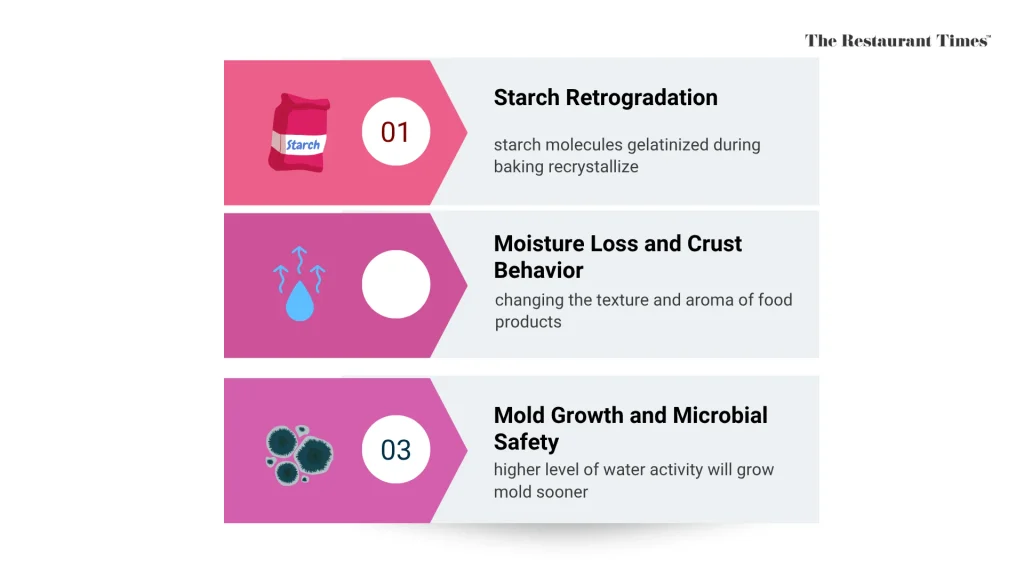
The staling of bread and other grain-based baked products occurs through a process called starch retrogradation, where starch molecules gelatinized during baking recrystallize, resulting in a hard, dry crumb structure. Starch retrogradation starts immediately after baking and progresses quickly at low temperatures, such as in the fridge, which is why bread kept in the refrigerator goes stale faster than bread left at room temperature.
Sourdough bread takes a bit more time to go stale than regular bread since the organic acids formed during the fermentation process retard starch retrogradation and help create a low pH level that discourages mold formation. A good sourdough bread can remain fresh for three to five days at room temperature, which is a lot longer than regular bread.
Dairy fillings in baked goods spoil faster than plain items. Moisture migration can affect the texture of baked goods. Cream-filled baked goods should not be left out for over 2 hours.
Moisture Loss and Crust Behavior
Moisture loss affects more than staleness, changing the texture and aroma of food products. For instance, as bread loses moisture through evaporation, its crust becomes soft while the crumb hardens, contrary to what is expected in fresh bread. Bread left out without wrapping loses moisture quickly, while when wrapped, it retains moisture, but the crust softens as moisture migrates within the package. TREHA® can improve moisture retention in baked goods.
Pastry and cake products react differently. Moisture loss in cakes produces a dry, crumbly product, which is perceived as stale even though the product is safe to eat. DENABAKE™ EXTRA prevents staleness in bread. Doughnuts and muffins become hard after 24 to 48 hours because moisture moves from the crumb to the outside and evaporates.
Mold Growth and Microbial Safety
The third major factor responsible for the limited shelf-life of bakery products is mold growth. Mold needs moisture, heat, and time; products that have a higher level of water activity will grow mold sooner. Fresh bread without preservatives usually develops mold within about three to five days after production. Products that include cream, whipped cream, or fruit, cream-filled cakes, fruit tarts, and fruit cakes will be especially susceptible to mold growth due to the high water activity level and food poisoning risks involved.
EXPERT INSIGHT
| “The most important requirement is that water should be in liquid state and be available to support microbial growth”– Bakery Academy |
Products manufactured in commercial bakeries with preservatives may remain fresh much longer than their homemade counterparts since preservatives will decrease water activity.
How to Extend Shelf Life: Practical Solutions for Bakeries

Cooling baked goods before packaging prevents condensation that leads to mold. Proper sanitation during baking can minimize contamination risks. Learn how to extend shelf life.
Packaging That Protects Freshness
Packaging is the most accessible and affordable shelf-life aid for most bakeries. The trick is choosing a package type that addresses the main factor causing product spoilage. Slimy texture in baked goods suggests spoilage has occurred. A sour smell is a sign that baked goods have gone bad. For bread, tight wrapping or a resealable package reduces evaporation and mold growth, extending shelf life from two to three days to five to seven days at room temperature. For pastries containing cream or fresh fruits, refrigeration is needed in addition to the packaging, not as its replacement.
Bread stored at 35℃ had the shortest quality safety limit period, with a use-by date period of 1.7 to 13.1 days calculated when considering a safety factor of 0.87.
Modified atmosphere packaging, which replaces the air within the package with a nitrogen or CO2 mixture, is used in industrial cakes and packaged breads to increase shelf life by reducing oxygen concentration, which prevents mold development. Modified Atmosphere Packaging (MAP) replaces oxygen with inert gases to inhibit mold growth.
Labeling plays the same important role as packaging itself. Good labeling ensures proper use of the product by indicating dates, storage conditions, and serving advice.
Functional Ingredients That Preserve Freshness
Functional ingredients allow bakeries to extend shelf life without making significant changes to the baking process. Enzymes such as amylase prevent starch retrogradation in bread and help keep the crust soft for longer. Emulsifiers, including lecithin and mono- and diglycerides, interact with starch and proteins to help maintain moisture balance and delay staling.
Natural preservatives such as vinegar, wheat starch, and rosemary extract can extend shelf life compared with products with no preservatives, which some consumers consider to contain no artificial preservatives. In sourdough and fermented bread, the natural acids formed during fermentation act as functional preservatives.
Freezing as a Shelf Life Strategy
One of the best ways to extend the shelf life of bakery products is freezing. Freezing is one of the best-kept secrets bakeries use to make their products last longer. When bread is wrapped properly and put in the freezer within 24 hours after it is made, it will come out very fresh when thawed. In order to prevent freezer burn, it needs to be wrapped up very tightly and thawed at room temperature instead of in the fridge because starch retrogradation would be accelerated in the latter place.
Baked goods such as cakes, muffins, and pastries can be frozen without filling them with cream and fresh fruit, which should be added only after they thaw.
Shelf Life of Bakery Products by Product Type: Quick Reference
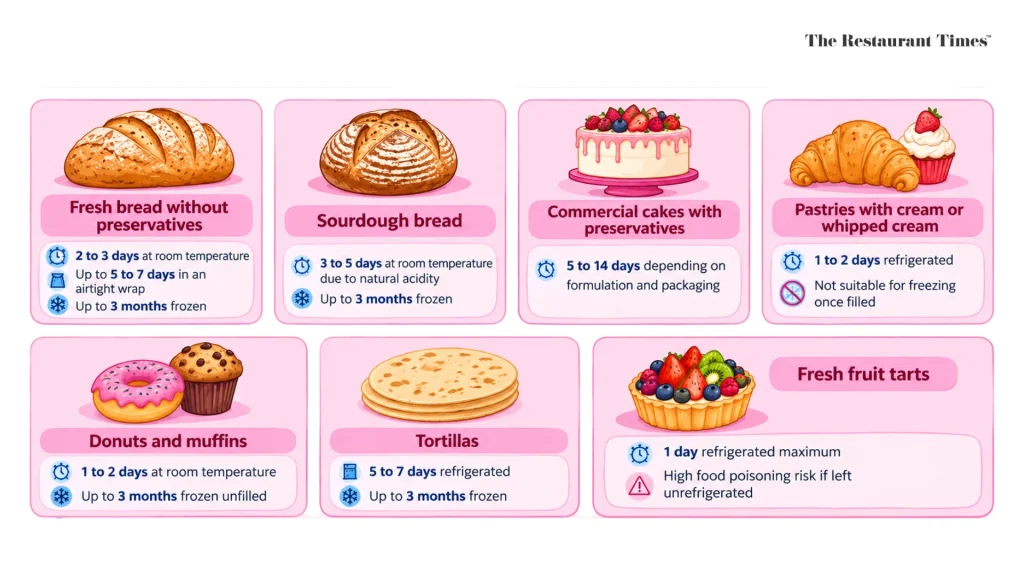
Different bakery products have fundamentally different shelf life profiles.
Fresh bread without preservatives
2 to 3 days at room temperature; up to 5 to 7 days in an airtight wrap; up to 3 months frozen
Sourdough bread
3 to 5 days at room temperature due to natural acidity; up to 3 months frozen
Commercial cakes with preservatives
5 to 14 days depending on formulation and packaging
Pastries with cream or whipped cream
1 to 2 days refrigerated; not suitable for freezing once filled
Donuts and muffins
1 to 2 days at room temperature; up to 3 months frozen unfilled
Tortillas
5 to 7 days refrigerated; up to 3 months frozen
Fresh fruit tarts
1 day refrigerated maximum; high food poisoning risk if left unrefrigerated
Reduce Waste in Your Bakery Operation
Waste prevention is not only an economic practice but an operational one too, and managing shelf life is integral to the former.
Plan your bakery’s production based on actual daily demand, not maximum capacity. The main cause of bakery waste is excess production, and no wrapping or preservation method will help you bake more than you can sell. Review your sales data to see which items tend to run out quickly and which ones often come back unsold.
Recycling products nearing their end of shelf life saves money while retaining the quality; day-old bread becomes croutons, breadcrumbs, or bread pudding; overripe pastries become ingredients in trifles or staff meals.
KEY TAKEAWAYS
| – The shelf life of bakery products depends on starch retrogradation, moisture loss, and fungal growth; knowing which process affects your products most will help you choose the right preservation method. – The most efficient methods for increasing shelf life for bakeries are packaging, functional ingredients, and freezing, and their effectiveness depends largely on the freshness challenges of each product type. – Products filled with cream and containing fresh fruit have the shortest shelf life and the highest risk of food poisoning; refrigeration and labeling are essential. – Waste reduction starts with production planning, not preservation; baking according to actual daily demand always reduces waste. |
Frequently Asked Questions
1. Can I eat cake after 10 days in the fridge?
Shelf life varies by product type. Commercial cakes with preservatives last 5 to 14 days. Cream-filled pastries and products with fresh fruit should be consumed within 1 to 2 days after refrigeration.
2. How long do bakeries keep pastries?
Bakeries can extend freshness by using suitable packaging, functional ingredients, proper storage temperatures, and freezing for products that aren’t needed right away. In clean-label bakeries, sourdough fermentation or cultured wheat starch is used as a natural preservative. Bakery products with cream or fresh fruit require refrigeration to preserve freshness, and this is a must.
3. How long before baked goods go bad?
This would depend on the type of product. Refrigeration prolongs the life of pastries that include cream and fruit, as well as any bakery item with higher water activity, and it is a must for these items. However, refrigeration accelerates staling in bread products because starch retrogradation occurs fastest at these temperatures.