
It has always been a narrow-margin industry within the restaurant business sector. Labor, wastage, missed phone calls, and variations in the demand pattern have been the biggest hurdles for restaurants over the years. Though the AI technology is not offering solutions to all of these problems overnight, it is making changes that are hard to ignore, which your existing tools are not providing.
In 2026, 26 percent of restaurant operators reported using AI tools in their restaurant businesses. Another 25 percent of the restaurants believe they will be adopting AI technologies in their business in the coming year. In 2026, consumer spending in the restaurant industry is forecast to drive sales to approximately $1.55 trillion nationwide, and those who use the right tools can disproportionately benefit from this trend.
What You Will Learn
- What AI for restaurants actually means across front-of-house, back-of-house, and marketing
- Where AI tools deliver measurable results and where human touch remains irreplaceable
- How restaurant operators of any size can start implementing AI without overhauling their entire tech stack
- What to watch for when evaluating AI solutions and vendors
What Is AI for Restaurants?
AI for restaurants refers to the application of machine learning, natural language processing, predictive analytics, and automation solutions across various aspects of restaurant operations, from handling customer calls (managing calls through voice assistants) and managing inventory to predicting and producing social media posts. AI for Restaurants is not one tool, but a class of technologies being adopted in practically all business areas of the restaurant.
The vast majority of restaurants employ AI through systems that analyze historical data (such as past orders), detect patterns of human behavior, and make predictions or take actions based on them. AI could analyze historical customer order data, detect trends, and prepare the restaurant for the rush. The output may vary from suggestions of scheduling to automatic reactions to the guest reviews based on the data collected by the restaurant.
63% of restaurant executives state that they use AI on a daily basis in order to enhance the customer’s restaurant experience, which is the most common application of this technology. At the same time, 26% of restaurant executives employ AI regularly. This number speaks for itself: AI is no longer an experiment for the food industry, but the operational backbone of business success.
Why Restaurants Are Adopting AI Tools Now?
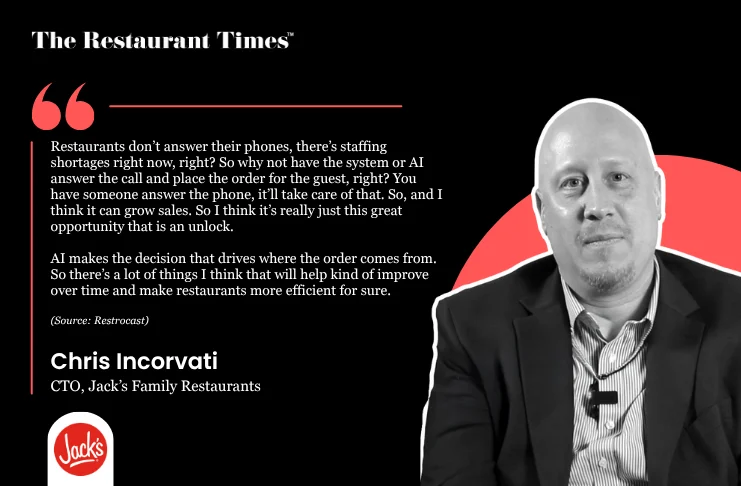
Chris Incorvati, CTO, Jack’s Family Restaurant, came on the Restrocast Podcast and explained how AI can be used in restaurants and how it benefits the brand. The different things AI is known to help with are;
Labor Cost Reduction
The timing of AI adoption in restaurants is not accidental. 84% of restaurant leaders surveyed say they feel pressure to improve their digital guest experience. At the same time, labor costs are rising, food waste is eating into margins, and customers expect faster, more personalized service across every channel: dine-in, delivery, and digital.
AI technology can help restaurants reduce labor costs by up to 26% through improved operational efficiency and smarter staffing solutions.
Food Waste
Restaurants using AI for inventory management can reduce food waste by as much as 50% by predicting usage patterns and optimizing purchasing decisions. These are not marginal improvements; they represent structural cost reductions that compound across every service period and every location.
What are the Food Industry Leaders Saying
68% of restaurant CMOs and CTOs say AI is now their top investment priority. That shift in investment priority reflects a recognition that AI is not a nice-to-have feature layer. It is becoming the competitive edge that separates efficiently run operations from those struggling with the same inefficiencies they have always had, which proves that AI helps in improving efficiency.
Core AI Use Cases by Restaurant Area
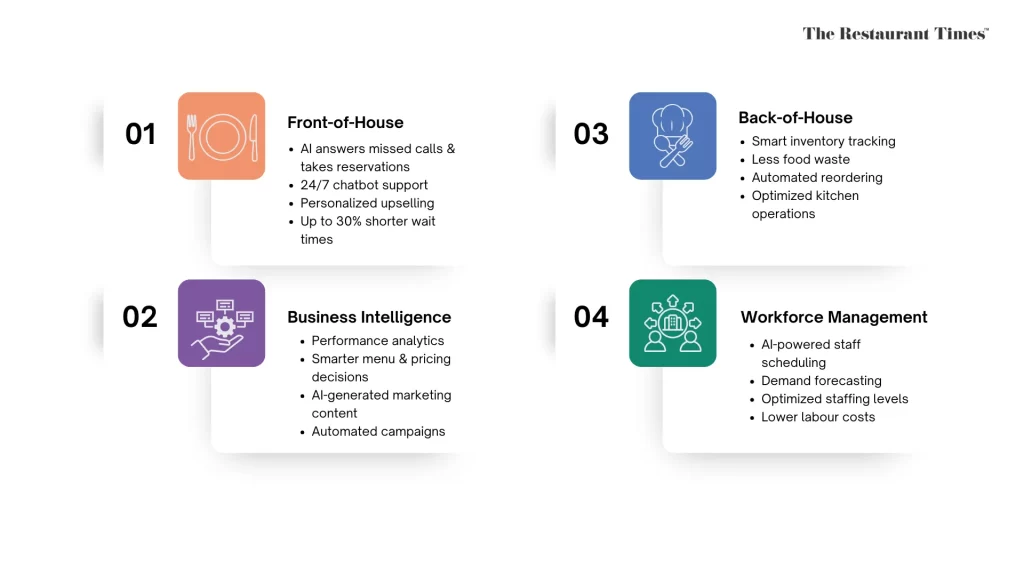
AI tools can assist restaurants in creating engaging content for marketing, including blog posts, social media captions, and even images, with over half of users employing AI for video creation and 42% for generating images. Let us explore how leveraging AI within your restaurant in different restaurant areas works:
Front-of-House: Reservations, Ordering, and Customer Service to Enhance Guest Experience
The front-of-house is where restaurant managers become acquainted with AI and where the value proposition becomes clear. 74% of restaurant reservations begin with a phone call, but 64% of customers try to book tables via phone call, and 40% of those calls go unanswered. Recent research shows that 83% of customers will move on to another restaurant after being greeted by an answering machine two times while making a call. That’s a lot of money leaving the business through the door.
AI voice technology can listen to customer requests and respond with help from data pulled from the restaurant’s website and Google Business Profile. AI voice technology can benefit restaurants by sending links to customers for online orders and reservations, resulting in substantial boosts in online sales. This is just one use of AI technology – handling missed calls – that allows restaurants to achieve ROI in less than a month.
AI-powered chatbots can handle common customer inquiries, reservations, and orders without human intervention, providing 24/7 customer service and freeing staff to focus on other tasks. AI can increase average check sizes through personalized upselling strategies based on customer preferences and behavioral analysis, and providing them with varied loyalty programs through these systems increases retention rates. AI-driven predictive analytics can enhance operational efficiency by anticipating customer demand, leading to a 30% reduction in wait times during peak hours.
Back-of-House: Inventory, Kitchen, and Operations, A Deeper Look into How to Cut Costs
55% of restaurant executives report using AI in inventory management on a daily basis, with another 25% using it regularly. AI systems can track inventory levels in real time, predict usage patterns, and automatically reorder supplies through their supply chains, leading to better inventory control and cost savings. Integrating inventory and purchasing systems with point of sale systems allows AI-enabled software to track historical inventory and purchasing data, making real-time recommendations for how many ingredients and supplies to buy.
AI can help reduce food waste by tailoring purchasing to only meet inventory needs, avoiding excess that won’t be used before expiration, and doing smart food preparation. AI enhances operational workflows in restaurants through predictive inventory management, automated kitchen production, and accurate demand forecasting. In the kitchen, AI can automate order management, prioritize tasks, and maintain hygiene by using computer vision systems that assess ingredient freshness.
Business Intelligence: Analytics, Pricing, and Content Creation AI for Marketing
Globally, 45% of restaurant operators are using AI for data analytics, which helps them gain a competitive edge by aggregating data from various systems to provide a comprehensive view of restaurant performance. AI-powered data analysis can help restaurants synthesize large amounts of data into actionable insights, enabling them to make informed decisions about menu design, menu items, pricing strategies, and service improvements.
AI tools can assist restaurants in creating engaging content for marketing, including blog posts, social media captions, and even images, with over half of users employing AI for video creation and 42% for generating images. AI content creation can help restaurants generate a calendar of marketing materials, such as emails and social posts, and pull information from their websites for use, which allows them to maintain consistent communication with guests without dedicating excessive time to content writing. AI marketing tools can automate the sending of marketing emails, social media posts, and targeted ads, helping restaurants maximize engagement and reach the right audience at optimal times.
Workforce Management: AI-Powered Scheduling and Staffing for Higher Success
38% of restaurant leaders agree that effective staff scheduling is the top benefit of AI for restaurants, as it helps automate insight reporting and forecast staffing needs. AI technology can help restaurants avoid under- or over-staffing by analyzing sales data and staffing trends, ensuring the right number of employees are scheduled for each shift. Automated scheduling tools in restaurants predict busy periods to optimize staffing levels, potentially reducing overhead costs.
AI-powered systems can analyze historical data, upcoming events, and local trends to predict restaurant traffic patterns, helping to optimize staffing and scheduling decisions. When your scheduling tool knows that a local concert or sporting event will drive a surge in covers on a Tuesday night, your staffing decisions stop being reactive guesses and start being data-driven calls.
INDUSTRY INSIGHT
| The worldwide AI market is expected to grow to over $631 billion by 2028 from $235 billion in 2024. For the restaurant industry, that growth means an expanding ecosystem of AI solutions built specifically for food service operations: more specialized tools, more competitive pricing, and more integration options with existing restaurant tech stacks. The window to adopt early and build operational competency before competitors catch up is narrowing. Restaurant operators who build AI fluency now will have a meaningful head start as the technology becomes table stakes across the industry. |
Real Benefits vs. Vendor Hype of AI in Restaurants: What AI Actually Delivers
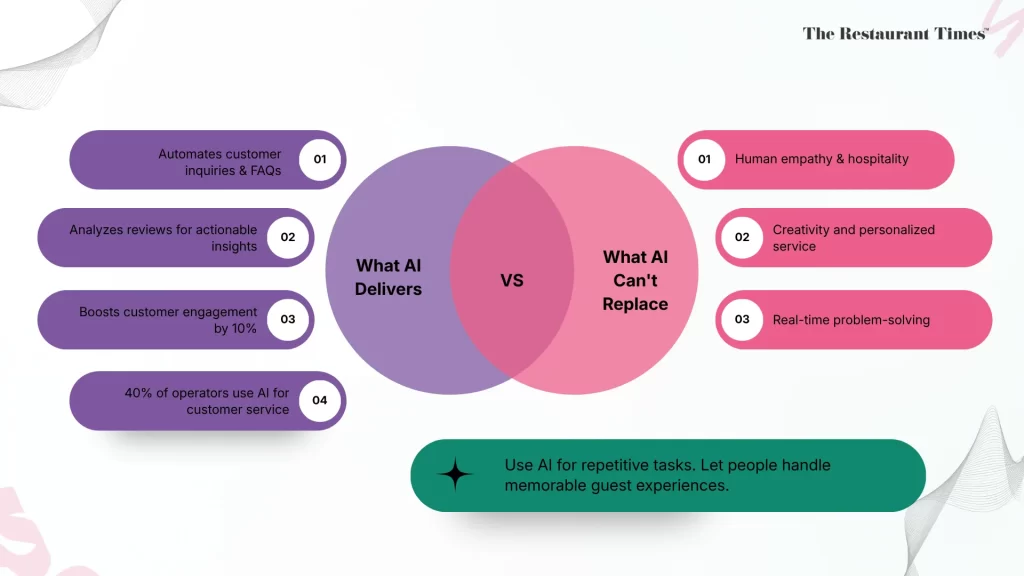
The gap between vendor marketing and operational reality is where most restaurant operators get burned. AI software can help with analyzing historical data, customer reviews, and feedback to extract actionable insights, helping restaurants improve service quality and address common issues. AI-based recommender systems improve user engagement metrics by 10% on average. These are real, documented outcomes, but they require proper setup, clean data, and staff adoption to materialize.
40% of restaurant operators globally use AI for customer service, such as replying to online inquiries via phone, text, or email. The operators who get consistent results from these tools share a common approach: they implement AI to handle specific, well-defined, mundane tasks, review responses, phone FAQs, and inventory reorders, rather than expecting the technology to replace human judgment across the board. The human touch remains irreplaceable in hospitality moments that require empathy, creativity, or real-time problem-solving. AI handles the repetitive volume so your employees can focus on those moments.
Is Artificial Intelligence Worth It? Cost-Benefit Considerations by Restaurant Type
Different AI technologies may be suitable based on different scales of operation. The requirements and capacities of a small one-branch restaurant chain are much different from those of a medium-sized chain with fifty locations. For small chains, high-ROI starting points include AI answering phone calls for reservations and takeouts, as well as AI-assisted scheduling, which eliminates overtime and understaffing through no deep integration required. Multi-location restaurant chains can use AI inventory management and demand forecasting technologies.
For example, a nationwide chain of fast-food restaurant settings cut the time of ordering through the drive-through by 10%, launched real-time analysis on 4,000 branches due to moving to a cloud AI system, and added dynamic dashboards that considered local sports events and weather forecasts.
The cost-benefit analysis of most AI systems depends on one main factor: what is the cost of the problem being solved? If there is a situation where 40% of all phone calls are not answered, and on average, there are $80 spent on each reservation, then the cost-benefit analysis of AI answering technology becomes obvious. If food waste is higher than 8% of purchasing cost, a cost-effective solution would be to cut it to 4%.
Managing Change: Getting Staff and Customers On Board
Introducing the AI to a restaurant is as much of a people problem as a technological one. People are scared that they will be made obsolete by AI and therefore refuse to utilize it even before it manages to help. The message here is clear: AI takes care of monotonous work, tedious data entry, responding to reviews, and scheduling so people can spend time interacting with guests and thus enjoying the work of hospitality.
Customers’ perceptions of AI vary by environment. They are more focused on their dining experience, not on how any AI systems might be functioning for you, when within the restaurant premises, but outside of it, the story is different. 22% of customers have used AI to find restaurants to visit, and 46% have used it to find recommendations in the last year, indicating a high level of acceptance of AI-based discovery. However, customers had a more negative view of food and restaurants evaluated via AI. This perception of AI is stronger in luxury restaurants than in casual dining. Once again, the message is clear: AI should remain hidden in the background and not replace people in interactions.
To conclude, AI-powered systems can analyze historical data, upcoming events, and local trends to predict restaurant traffic patterns, helping to optimize staffing and scheduling decisions. AI technology can help restaurants avoid under- or over-staffing by analyzing sales data and staffing trends, ensuring the right number of employees are scheduled for each shift. AI enhances operational workflows in restaurants through predictive inventory management, automated kitchen production, and accurate demand forecasting. AI can optimize kitchen operations by using intelligent systems to predict customer demand and manage inventory levels effectively. AI technology can help restaurants reduce labor costs by up to 26% through improved operational efficiency and smarter staffing solutions. AI-driven predictive analytics can enhance operational efficiency by anticipating customer demand, which can lead to a 30% reduction in wait times during peak hours. Globally, 45% of restaurant operators are using AI for data analytics, which helps them gain a competitive edge by aggregating data from various systems to provide a comprehensive view of restaurant performance. Restaurants using AI for inventory management can reduce food waste by as much as 50% by predicting usage patterns and optimizing purchasing decisions. So, when are you getting yours?
KEY TAKEAWAYS
| – AI for restaurants is not one tool; it is applied across phone systems, inventory, scheduling, kitchen operations, and marketing, each with distinct ROI profiles to reduce errors. – The highest-ROI entry points for most restaurants are AI phone answering, inventory management, and scheduling, mundane tasks where volume and consistency matter most. – Human touch remains irreplaceable in premium hospitality moments; AI works best as invisible infrastructure that frees staff to focus on guests. – Start with one specific problem, measure the result, then expand. Restaurants that try to implement AI everywhere at once rarely see it work anywhere |
Frequently Asked Questions
1. What is the best AI for restaurants?
However, there is no perfect AI for restaurants to adopt. Different restaurants need different AI technologies depending on their size, type of services, and the issue at hand. In terms of answering phone calls and managing reservations, AI answering systems that use data from websites and Google Business Profiles always yield a quick ROI.
2. How can AI be used in restaurants?
There are numerous applications that can be applied to all aspects of a restaurant business using AI. Applications for front-of-house include AI telephone answering services, AI-based chatbots that take care of reservations and phone orders (customized orders or otherwise), and upselling AI. Applications for back-of-house include real-time inventory management, AI-driven reordering, demand forecasting, and task prioritization in the kitchen.
3. What is the 30% rule for AI?
The 30% rule for AI suggests that AI should handle around 30% of repetitive work in any organization, while humans handle the remaining 70% of tasks that require judgment and creativity.
4. What is the 30/30/30 rule for restaurants?
30/30/30 is a standard for cost management in restaurants where the cost of food needs to be around 30% of the total revenue generated, the cost of labor around 30%, and the cost of overheads around 30%, resulting in a 10% profit.