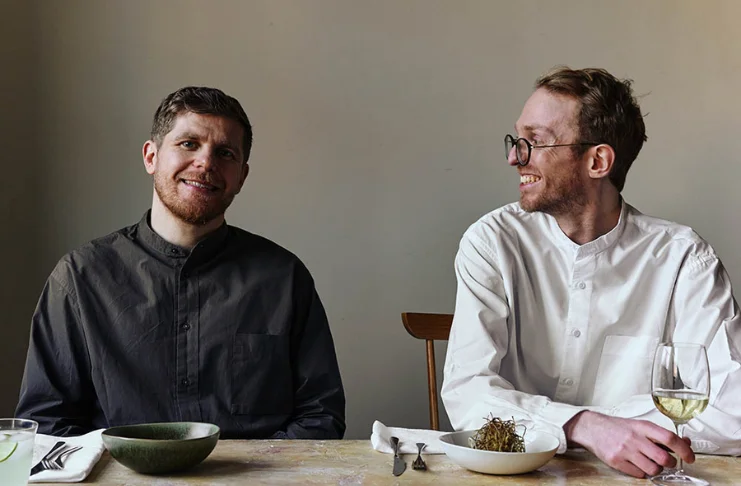

There is a type of obstinacy born of years being misjudged. Kirk Haworth knows this type of obstinacy first-hand. The chef spent the better part of a decade trying to prove to a very doubtful British dining scene that a plate of vegetables, with the same passion and respect as the finest duck breast or sole, could be just as thrilling, just as technically brilliant, just as worth making a pilgrimage for. It has taken a Michelin star, a trophy from the BBC television network, and one restaurant nestled in a courtyard off Old Street to finally make the case impossible to ignore.
Plates, which has just opened in its permanent location in Shoreditch in July 2024, is now the first and only vegan restaurant in the United Kingdom to hold a coveted Michelin star. The above sentence should linger on the page for a moment before we explain, against all odds, just how it came to be true.
A Lancashire Childhood, and a Father Who Set the Bar High
The Haworth family is not a stranger to this arena. Kirk and Keeley are the children of Nigel Haworth, a celebrated Michelin-starred chef who has run Northcote Manor, one of the North’s most esteemed culinary institutions. Growing up in a family that takes food seriously has had a profound influence on both Kirk and Keeley, though not necessarily in the same way. Kirk has followed in the footsteps into the kitchen. Keeley has worked within brand and creative teams for international corporations, eventually landing at her final destination, as has her brother.
Kirk’s training has been under his father’s guidance at Northcote. Winning Young Chef of the Year for the North West at 17 years old was Kirk’s first recognition that not only had he inherited his father’s passion for cooking, but also his talent. His career has since progressed through some of the most emanding kitchens across the globe: The French Laundry, California; Sat Bains Restaurant, Nottingham; The Square, Mayfair; The Quay, Sydney. Almost two decades of training, learning, and honing a classical technique that is so precise that eventually he would be able to do something rather unusual: apply it exclusively to plants.
That pivot was not a lifestyle choice. It was a survival strategy.
The Diagnosis That Changed Everything
In 2016, Kirk was diagnosed with Lyme disease. The illness, debilitating and at the time poorly understood by the mainstream medical establishment, took years to address properly. As Keeley explained to Antonia Lloyd at Women in the Food Industry: “About the five-year point, he’d got so frustrated with the mainstream help, he was thinking I’ve got to find some alternative ways, and his greatest kind of superpower was obviously cooking. So, it was like, if I can cook for guests and put so much passion and care into feeding other people, I’m actually going to flip that on its head and put all of that energy, care,e and passion into feeding myself.”
Through keeping a food diary, cooking obsessively for himself, and gradually removing specific ingredients, Kirk found his way toward a plant-based diet without consciously intending to. What he discovered there fascinated him: vegetables and fruits were not, as British fine dining had long treated them, supporting players. They were the entire performance. He told I-M Magazine: “More than ever, my lifestyle changes have influenced this creative venture. It’s an opportunity for me to create menus that excite, educate, and inspire our guests into a new style of eating and living.”
The darkest years of illness, Keeley has said, were held together by one shared ambition: opening a restaurant. Something to work toward. Something to prove.
Seven Years on the Road Before a Permanent Home
Plates did not begin with a lease, a dining room, and a full brigade. It began in 2017, the way most genuinely interesting restaurant ideas do: informally, stubbornly, on belief and momentum. Kirk and Keeley ran a roving supper club, a pop-up that changed settings with each season, operating one night a week out of Dalston for a time before building a reputation quietly and almost entirely through word of mouth.
As Kirk told the Vegetarian Society: “We’ve been doing Plates for nearly seven years. It’s been a hustle because we have never had our own full space. We started by doing pop-ups. There’s so much work that goes into that. It’s been a long dream to get our own permanent space.”
Two significant things happened in the years before that permanent space arrived. In 2021, Kirk became the first plant-based chef ever to compete on BBC Two’s Great British Menu, representing the North West. He didn’t win that year. He came back. In 2024, he returned to the finals and was crowned Champion of Champions, his winning dessert beating dishes built around lobster, scallops, and every protein the classic competition has always favoured. A vegan dessert. Champion of Champions. He was emotional at the ceremony, and the emotion was entirely earned.
“The reason it’s so emotional for me is this is eight years of a journey,” he told the Vegetarian Society. “It’s not been understood, it’s been ignored, and it’s not really been appreciated. To put plant-based food on a stage as prestigious as The Great British Menu, to go up against lobster dishes and scallop dishes and beat them, to come number one with a dessert that hasn’t got any dairy, that makes me very proud.”
The Room, the Courtyard, the Kitchen
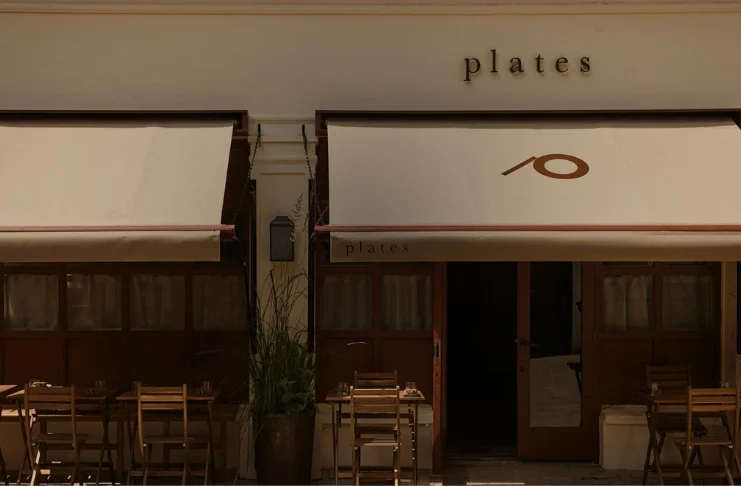
When the permanent location of Old Street finally opened its doors in July 2024, the conversation between Keeley and London-based design studio Design & That was as considered as the menu. Interior designer Emma Shone-Sanders took her brief from Kirk’s life story and made it physical in a way that extends far beyond the expected tropes of a ‘natural’ aesthetic.
According to design magazine Livingetc, which toured the finished space, the result is a space that “pairs rich woods, textures, and rattan with Brutalist-inspired walls. Plates London’s design celebrates the beauty of nature across design and food.” The slate floor, the seating areas with their warm ochre, the ceramics displayed on the walls, the terracotta lamps, the kitchen visible from the counter seating, all speak in a gentle, unhurried voice. Nothing screams out for attention. Nothing postures. The space, like the food, does its job with a focus on quality rather than quantity.
Keeley told Livingetc: “Emma evolved the brand in a way that we weren’t expecting, prompting us to move into uncharted territory, be a little braver, and risk it.”
The kitchen sits behind a short counter, open to view, where Kirk and his team work with focused intensity on a tasting menu that rotates with the seasons and changes entirely according to what is growing, fermenting, and expressing itself fully at any given moment.
What Goes on the Plate
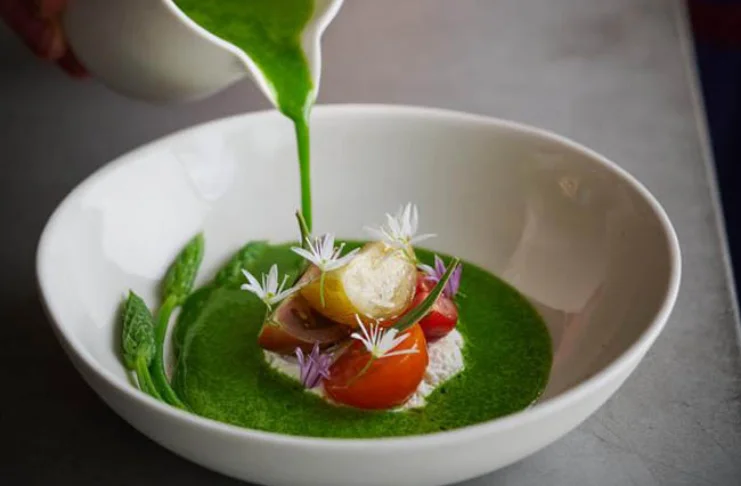
The menu at Plates is not a performance of restraint. There is nothing self-punishing about eating here. Mung and urad bean lasagne, kabocha squash and ginger soup, maitake mushroom with black bean mole, which the Michelin inspectors themselves described as “superb,” raw cacao gateau, which is “a real treat.” A bread course, which Kirk spent 18 months perfecting before judging it ready to serve. A wine list curated by Alex Price, Head of Wine, organized by climate and terroir, and which champions those working at the frontier of sustainable viticulture.
At the 2025 Michelin Awards Ceremony in Glasgow, when asked what he loved most about making vegan food, Kirk answered without hesitation: “Trying to get rid of that word is everything that I love about it. It’s just about flavour. Flavour, excitement, innovation, and trying to take it to a new space of deliciousness.” (Euronews, February 2025)
The Michelin Guide itself, in awarding Plates its star in February 2025, noted that Kirk “brings his strong classical technique to bear on inventive and inviting vegan dishes that give vegetables the respect they deserve.” Kirk’s own response, published by Euronews, was characteristically direct: “Earning a Michelin star is such an incredible honour and a lifetime goal since I was a young boy. To be the first in the plant-based sphere in the UK to win this prestigious award makes me unbelievably proud.”
Keeley added: “At Plates, we’ve always believed in pushing boundaries, and this achievement proves that plant-based dining can stand proudly at the highest level of gastronomy.” (Euronews, February 2025)
What It All Adds Up To
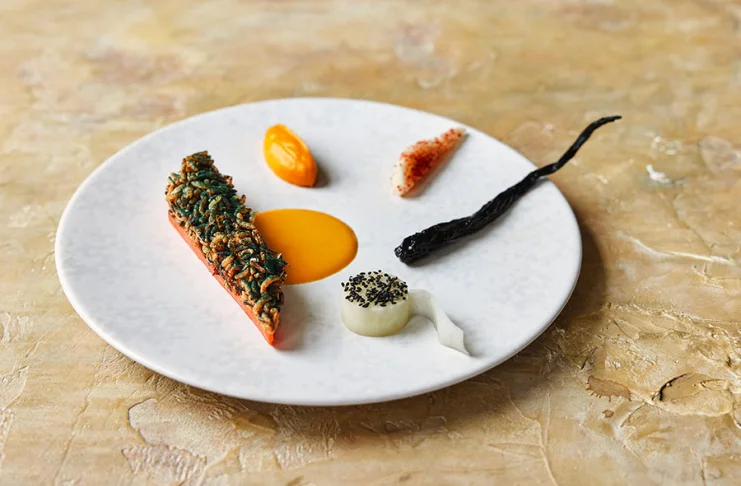
Plates is not a restaurant that has appeared at the top of this conversation through circumnavigation. It has taken seven years of pop-ups, supper clubs, a chronic illness, a television show, and a dogged commitment to ensuring that the vegetables on the plate were worth every bit of the attention that the rest of the industry had been lavishing upon the meat. Hot Dinners, after visiting Plates before it officially opened, said: “It was clear the love and attention that’s gone into it all. The food here is amazing, and that it happens to be plant-based is almost by the by.”
Almost by the by. That is the ambition of Plates: to create a restaurant that is so good that the fact that it is plant-based is ultimately of little consequence. And Plates is that restaurant. It is demonstrably so.
Securing a table is a patient business. Booking slots open seasonally and are announced via newsletter. They are snapped up quickly. The courtyard off Old Street is worth every bit of the circumnavigation it takes to access it.