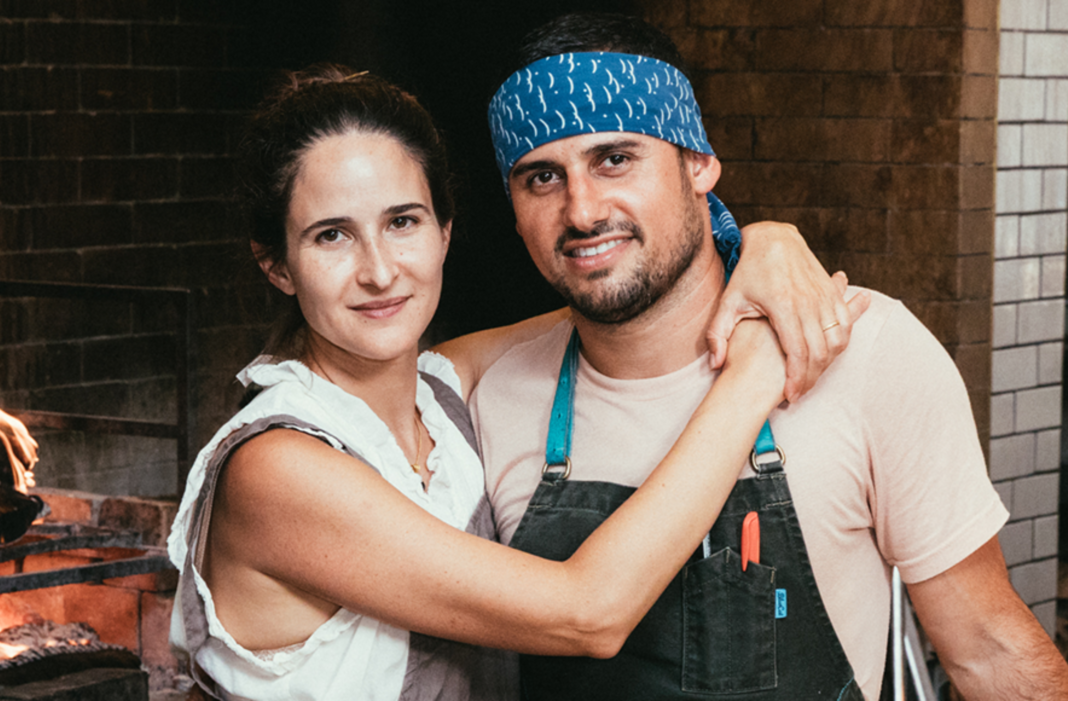

In Los Angeles’ Arts District, Bavel does a really, really good job of giving traditional Middle Eastern cooking a distinctly modern, personal expression. Founded by chefs Ori Menashe and Genevieve Gergis, alongside their business partner and Director of Operations, Leah Bunch, the restaurant grew out of the same team behind Bestia. The only difference is that while Bestia allowed Menashe to infuse Middle Eastern flavors into an Italian menu, at Bavel, he explores those influences without any sort of limitations or restraints.
“I’ve been cooking Italian food for so many years. And it’s all been leading to this place,” Menashe told Eater.
Bavel opened in April 2018 after years of anticipation. Menashe and Gergis had first announced plans for the restaurant in 2013, and when it finally opened, Eater described it as having the potential to “move the needle nationally” for modern Middle Eastern cooking.
The restaurant’s identity is rooted in the family histories of its founders. Menashe has Israeli roots, while Gergis’s family background connects to Morocco, Turkey, and Egypt. Both of them bring each of these influences together on one menu, and let me tell you, it is what makes this restaurant so worth talking about and visiting a hundred times over.
A Name Built Around Unity
Bavel takes its name from the story of Babel in the Old Testament. According to the restaurant’s own account, the original Hebrew word was Bavel, and the name was later rendered as Babel through translation.
For Menashe and Gergis, though, the word has an even deeper meaning, i.e., it comes from the story from a period when, in their interpretation, “everything was one,” before language divided people.
“We liked the word Bavel, because it was written during a time when everything was one,” the restaurant explains. “Bavel is not specific to any one region.” Drawing on the same philosophy, Bavel doesn’t restrict itself to Middle Eastern cuisine but takes on every culinary tradition and family lineage that shaped its founders.
And the resulting menu out of it was kinda a baby of Israel, Turkey, Morocco, Egypt, and other parts of the Middle East. “It’s not just za’atar, sumac, and orange blossom. It’s a lot more,” Gergis told Eater. “I see people taking dishes or ingredients we’re familiar with and adding unfamiliar spices. But we want to bring it forward.”
A Menu That Refuses to Stay in One Place
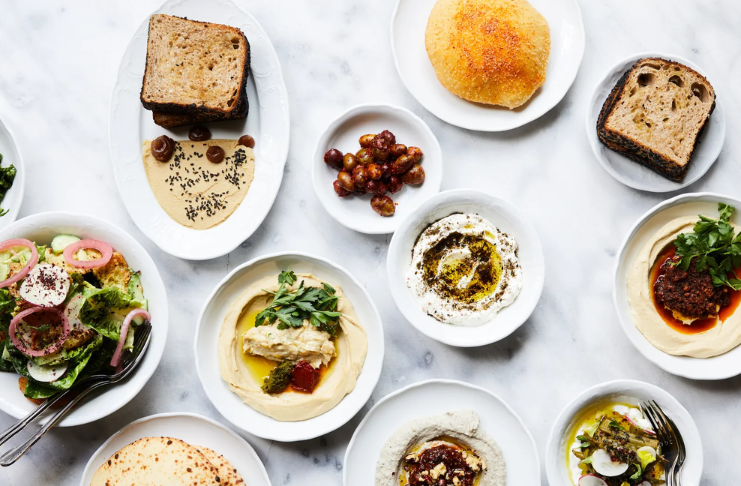
Bavel’s menu is structured around spreads and flatbreads, cold and hot appetizers, and larger entrées designed for sharing. According to Eater, Menashe and Gergis went through more than 100 recipes before settling on a list of 30 dishes when the restaurant opened.
The menu has continued to evolve since, but its central idea has always been to take dishes and ingredients associated with Middle Eastern cooking and experiment with them into something unexpected.
The hummus is a good example. The Infatuation describes two versions of it – a classic hummus and one topped with duck ’nduja. The latter brings smoky sweetness to the creamy dip, while both are served with pita.
The restaurant’s signature malawach is another such example. Condé Nast Traveler describes it as “essentially a Middle Eastern roti,” served with grated tomato, dill crème fraîche, a soft-boiled egg, and strawberry zhoug.
Other dishes on the menu are grilled oyster mushrooms, grilled prawns with eggplant tzatziki, lamb neck shawarma, wagyu beef cheek tagine, etc.
The lamb neck shawarma, in particular, is one of the restaurant’s most popular dishes. The Infatuation describes it as a whole roasted lamb neck served over a large piece of laffa, with fermented vegetables that turn the rich meat into what the publication calls a “fancy shawarma.”
The restaurant’s menu also leaves considerable space for vegetables and smaller plates. Dishes in this category include grilled celery root with honey mushroom tzatziki, oyster mushroom skewers, marinated beets with whipped feta, and smoked eggplant baba ghanoush.
Overall, Haute Living described the food at Bavel as a combination of “aromatic herbs, spices and smoke” with clean, fresh ingredients.
At Bavel, Desserts Have Their Own Identity
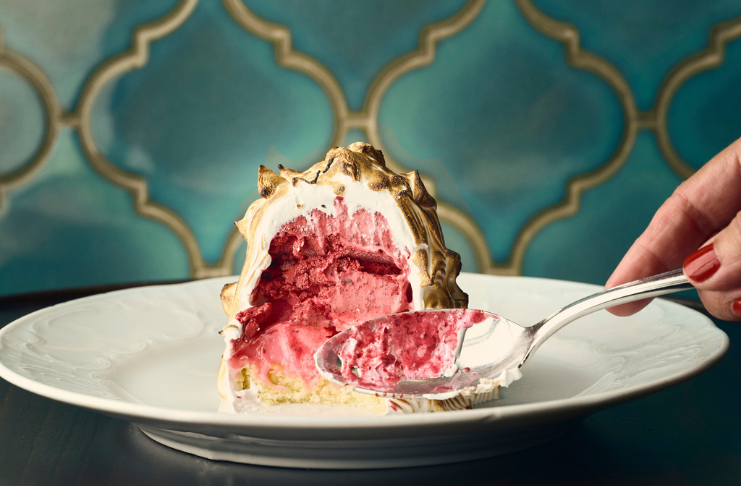
Menashe runs the savory kitchen at Bavel, while Gergis is in charge of desserts. Her pastry work was already a hit at Bestia, and Bavel gives her room to grow that side of the restaurant even further.
The dessert menu includes creations such as strawberry sumac and sweet cheese pastry, rose clove chocolate donuts, and paglava.
The rose clove chocolate donuts are especially popular here. The Infatuation describes them as small, round donuts that are worth ordering even after a substantial meal.
Desserts, too, in a way, follow on the same philosophy as the overall restaurant. Familiar formats are combined with ingredients and flavor profiles associated with the Middle East, creating dishes that feel playful and yet rooted in the restaurant’s culinary identity.
A Dining Room Designed to Break the Stereotype
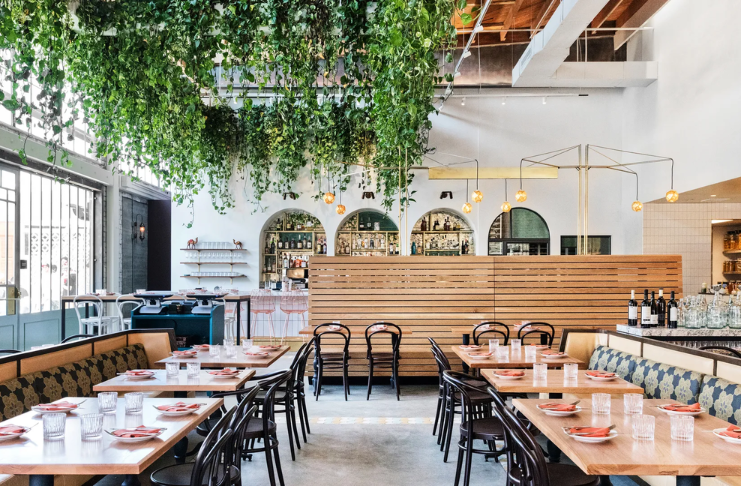
Bavel occupies a weathered brick warehouse in the Arts District. Studio Unltd and Gergis worked together on its design, choosing not to recreate the dark, ornate look often linked with Middle Eastern restaurants. Instead, they took a different approach.
“We’re keeping it clean,” Gergis told Eater. “It’s not a caricature.”
Natural light was a major part of the design. Tall sawtooth skylights, storefront openings and clerestory windows fill the dining room with soft northern light.
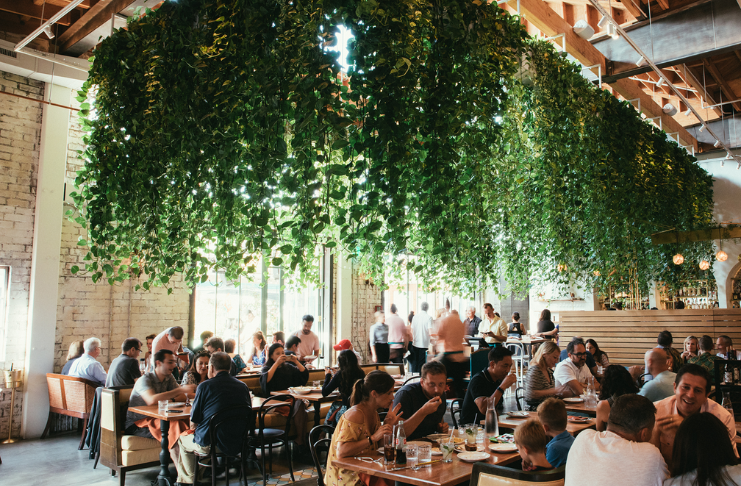
Whitewashed brick, greenery, tile, brass and vivid accents shape the space. Turquoise, saffron and turmeric hues reference Casablanca, while hanging planters form a canopy beneath the skylights.
The restaurant describes its interior as an interpretation of Middle Eastern influences “through the lens of its Arts District location.”
In other words, Bavel doesn’t try to recreate a Middle Eastern setting in Los Angeles. It draws on visual references from the region and brings them together with the neighborhood’s industrial character.
The result is a spacious, contemporary dining room that still feels closely connected to the cuisine.
Condé Nast Traveler described Bavel as a “wonderfully oversize restaurant with an open floor plan and hanging gardens,” comparing the atmosphere to the grandeur of Marrakech’s La Mamounia. The Infatuation similarly describes the room as an “orchestrated party,” with an open kitchen, hanging vines, and a side patio that nearly doubles the restaurant’s footprint.
From Bestia to Bavel
The Bavel founding pair (Menashe and Gergis) met at La Terza, where Menashe was working in the kitchen, and Gergis was a hostess. Menashe subsequently worked at Pizzeria Mozza, All’Angelo and Angelini Osteria, where he spent four years as chef de cuisine under Gino Angelini. Gergis, meanwhile, was originally studying to become a classical French horn player and began baking as a self-taught pastry chef.
In 2012, the couple opened Bestia. Six years later came Bavel, followed by Saffy’s in 2022, named after their daughter, Saffron.
Gergis’s background in interior design has also influenced the physical identity of their restaurants, including Bavel.
At Bavel, however, the culinary direction feels especially personal. The restaurant allows Menashe to return to the food connected to his own background while incorporating the influences of Gergis’s family heritage.
As Eater reported at the restaurant’s opening, the menu draws from Menashe’s Israeli background as well as Turkey, Morocco, and Egypt.
A Restaurant Built for the Table
Bavel’s food is designed to be shared, and that shapes the way the restaurant is experienced.
The menu moves from hummus, spreads, and flatbreads into hot and cold dishes and then larger-format meats and fish. A meal can therefore become an accumulation of flavors rather than a sequence built around one main course.
The Infatuation notes that almost every section of the menu is worth exploring and that many dishes arrive with pita, flatbread or another vehicle for scooping and sharing.
Time Out similarly highlights the restaurant’s family-style format, pointing to fire-roasted meats, seasonal vegetables and mezze alongside its Mediterranean-focused wine list and Middle Eastern-inspired cocktails.
The atmosphere reinforces that communal quality. The dining room is large, lively and designed to accommodate both intimate meals and bigger gatherings. Guests can sit at the marble bar, in large round booths or on the patio.
Yet despite its size, Bavel has retained a sense of occasion.
Condé Nast Traveler describes it as a place that “always feels like a celebratory night in LA,” while The Infatuation points to its energetic room, consistently strong service, and difficult reservations as part of its appeal.
Bavel’s Place in Los Angeles
Bavel was launched right when modern Middle Eastern restaurants were gaining greater visibility across the United States. But its appeal has never depended solely on being part of a culinary trend.
Its foundation is more personal: family histories, food memories, and a desire to explore Middle Eastern cooking beyond the handful of ingredients most commonly associated with it.
The restaurant takes familiar foods such as hummus, shawarma, tagine, and flatbread and gives them enough room to become something of their own. It combines regional influences without forcing them into neat categories, while its Arts District setting and contemporary design keep the experience firmly rooted in Los Angeles.