
What if I told you that the best way to move a business forward is to look back? Not to recreate what once was, but to understand what made people care about it in the first place. Was it the product, the experience that came with it, the people behind it, or the feeling customers carried home long after the bill was paid?
As a business grows and enters new markets, some change is inevitable. And there is a very real chance that, in the pursuit of what comes next, you lose sight of the very thing that made people fall in love with you.
Perhaps that’s exactly when growth stops being about what a business should become, but what it must never stop being. In the restaurant industry, that sounds almost like a dare. You have to know which parts of a place people actually came for, and which they merely put up with. Then you have to act on the difference, even when the answer flatters no one, least of all you.
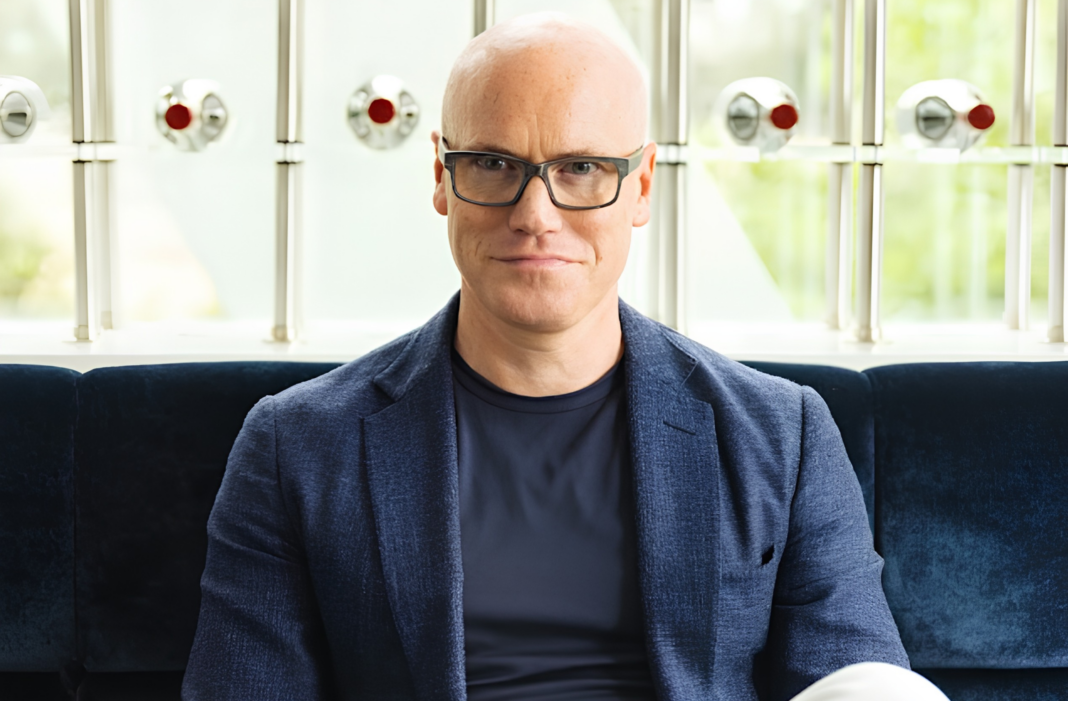
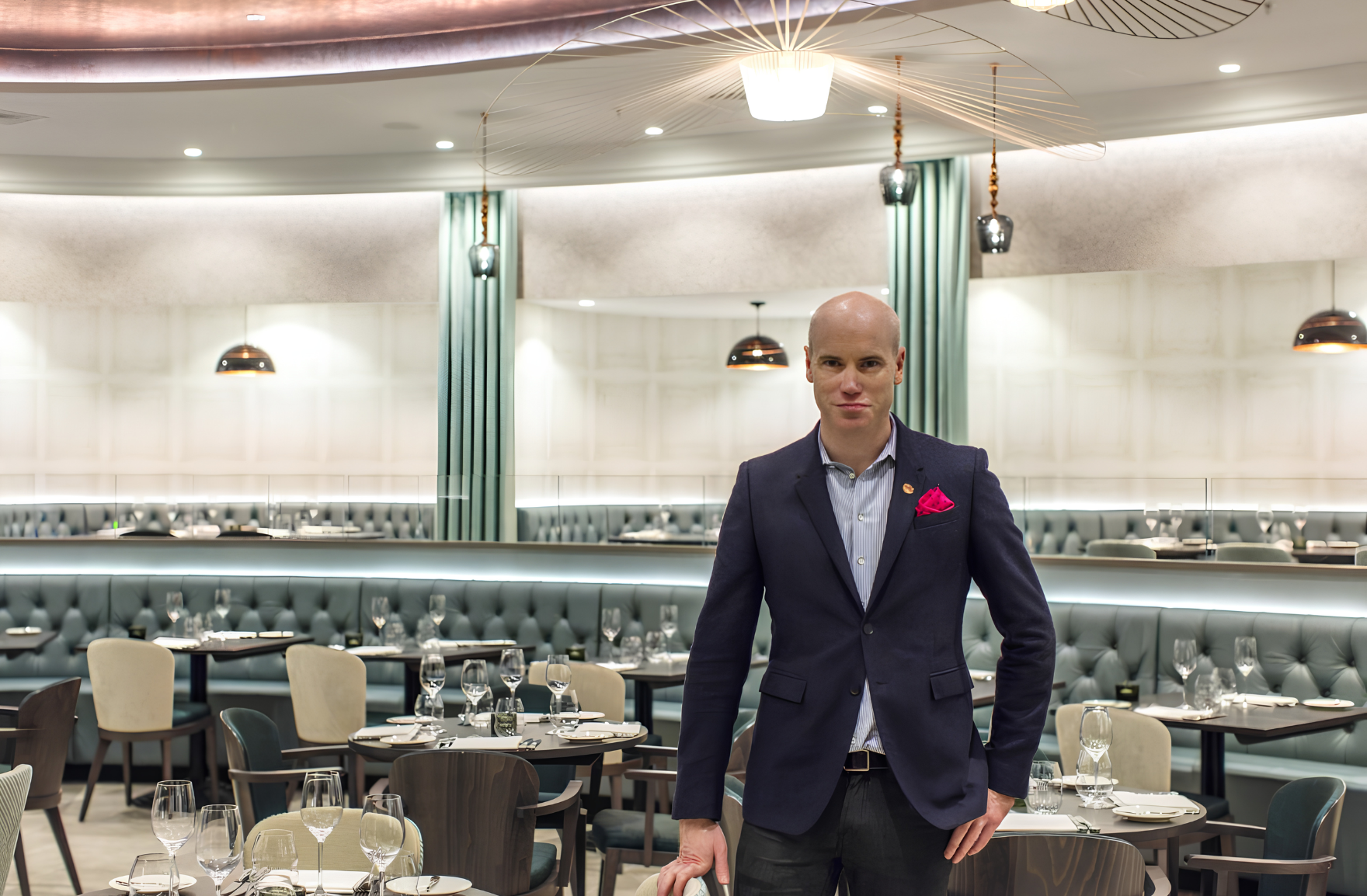
Martin Williams has spent twenty-five years doing exactly that. He is a multi-award-winning restaurant entrepreneur and a CEO who has led P.E. and angel-backed investments to profitable exits. Harper’s ranked him the thirteenth most influential person in the UK drinks industry. Maserati put him on its list of the hundred most innovative entrepreneurs.
Today, he runs The Evolv Collection, which manages thirty-three venues across the UK and New York. Its most famous room, by a distance, is Quaglino’s in St James’s.
Restoring the Room
Giovanni Quaglino first opened its doors on Bury Street in 1929. For a generation it was where royalty, writers, film stars and London’s café society went to be seen. In 1956, Queen Elizabeth II dined there, becoming the first reigning monarch to eat in a public restaurant. It closed in the late seventies. It was only again in 1993 that Sir Terence Conran and Joel Kissin brought it back, and it became the room of the decade. But then, slowly, the way these things go, it became a room people used to love.
“Over the last decade it’s lacked investment,” Williams shared. “It changed its configuration and lost some of those elements that were so wonderful and made it the institution that it is.”
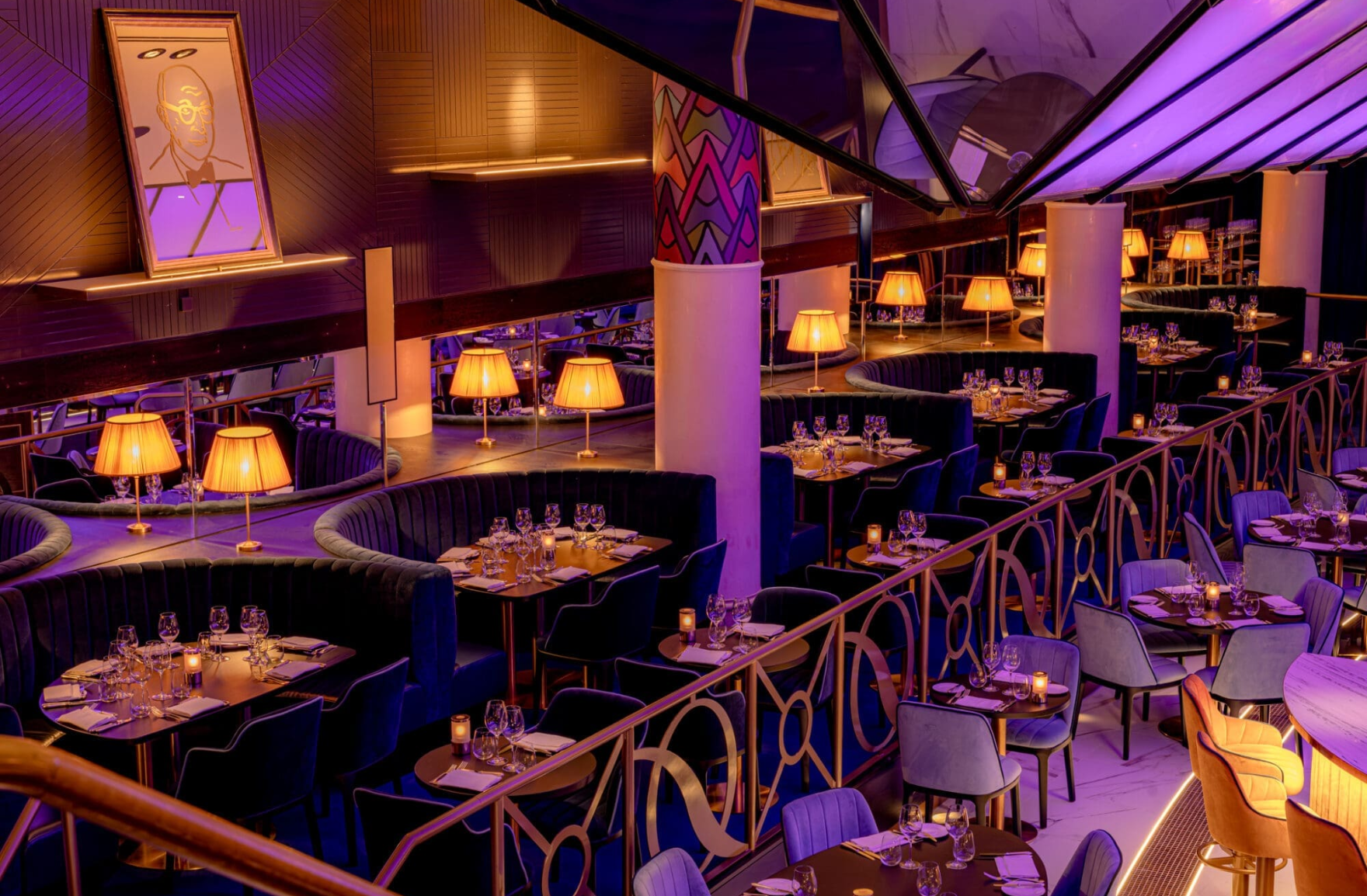
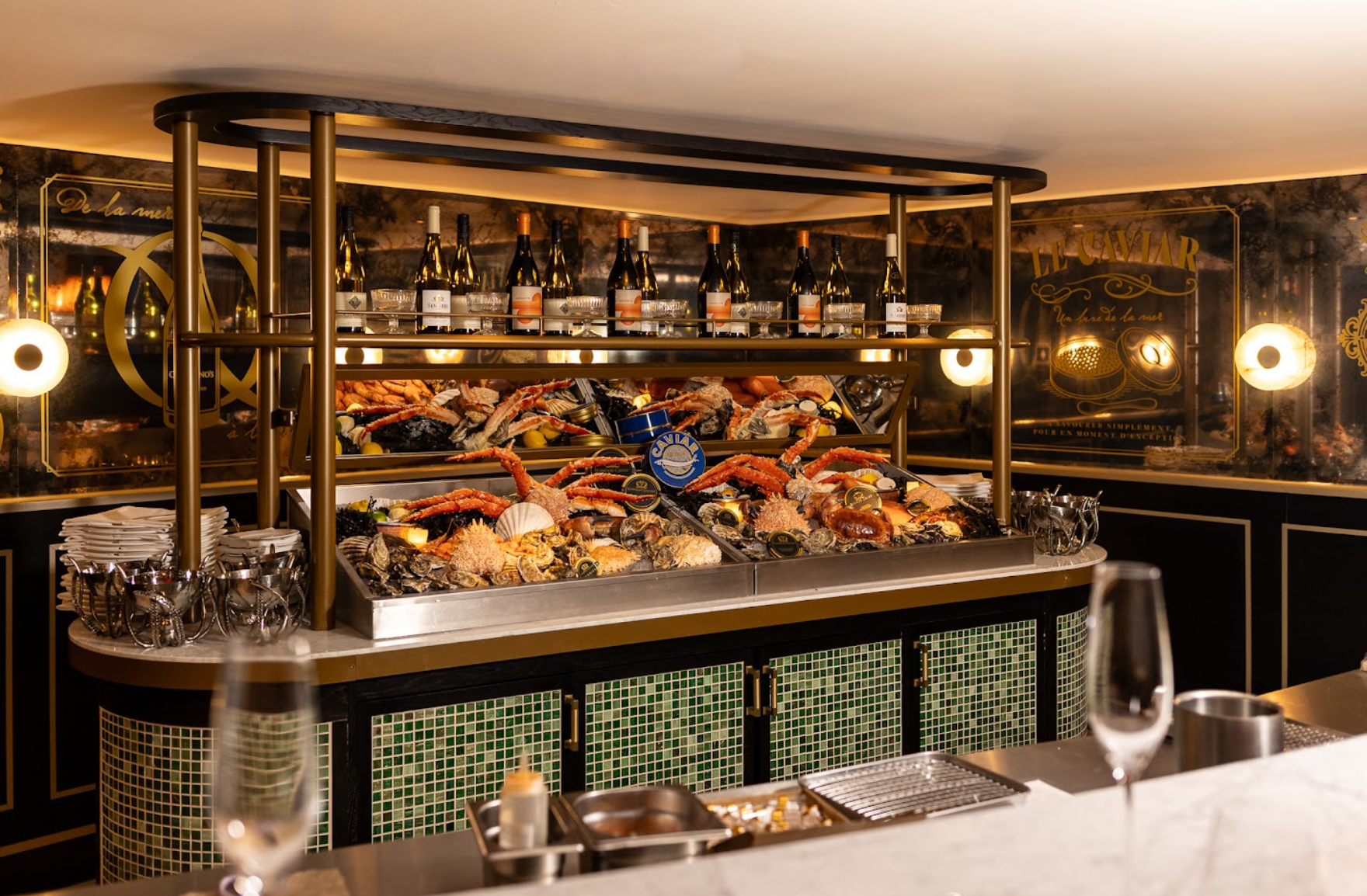
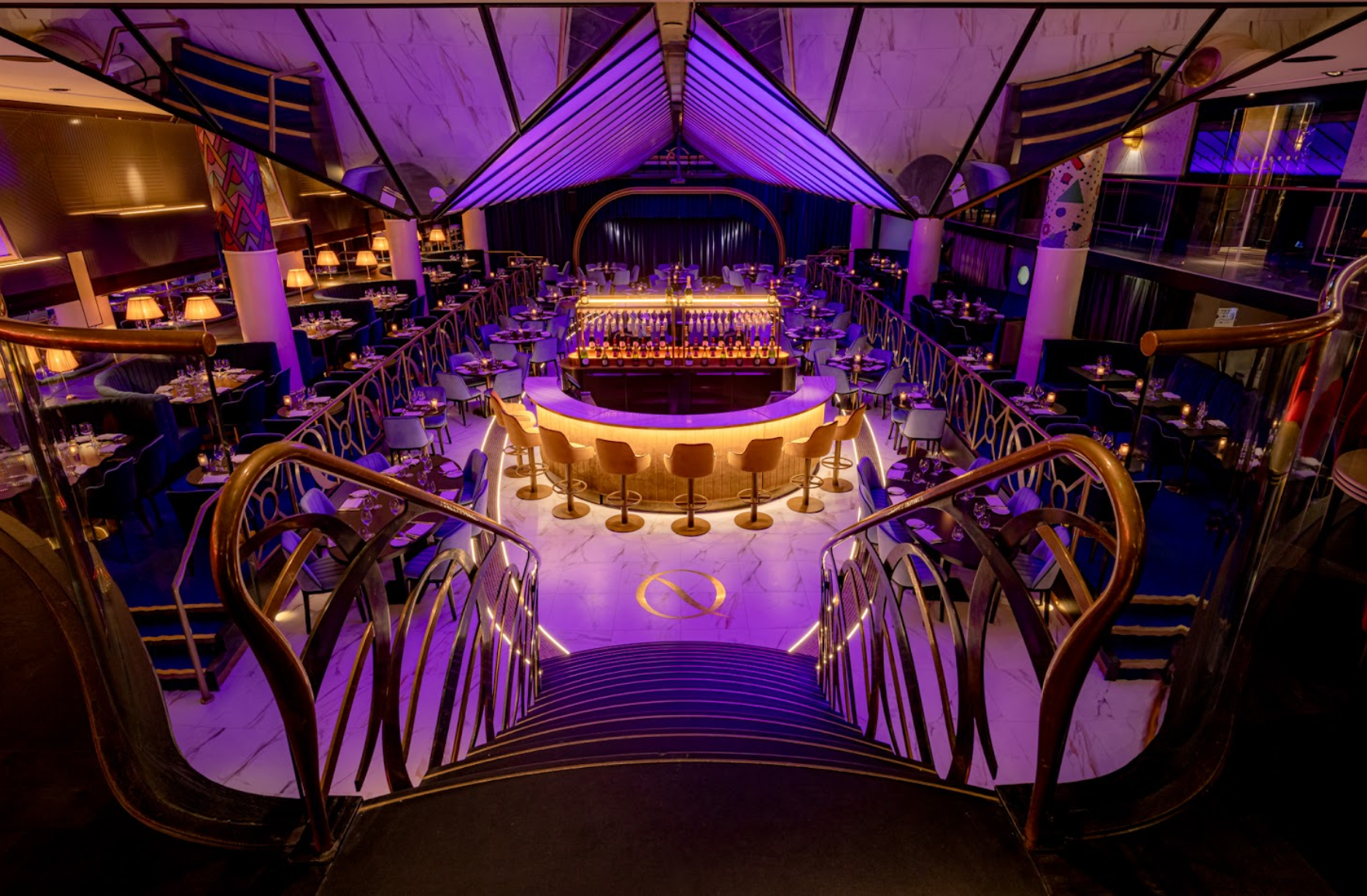
So its restoration in a way was less a redesign than an act of recovery. The fruits de mer counter is back, as it was under Conran. Lunch is back too, for the first time in a decade: “You can come for lunch and just enjoy champagne and oysters.” There is a new champagne bar, and behind it, a second stage. The perimeter of the room has been raised into balconies of what he calls “royal boxes.” This, as he tells it, is where the Queen was first seen dining in public after her coronation, and where she danced.
Then there is the dessert counter, which is where the actor in him clearly had the most fun (Yes, he used to be an actor, at a point). “We’re taking Sir Terence’s love of cigars, ashtrays and cigarette girls, and we’ve made it into a dessert counter,” he said. Even the walls got a brief. The room’s eight pillars now carry commissioned artworks, one for each decade Quaglino’s has been open, starting in the 1920s and going round to the 1990s.
While it is very much possible to read all of this as nostalgia, Martin Williams reads it as fidelity. “All in all,” he said, “we’ve reinstated the drama, the theatre, the glamour that Sir Terence would be proud of.”
The Arithmetic of Glamour
Conran’s 1993 revival was built on the idea of the democratization of dining, which basically means that glamour shouldn’t be reserved for people who could afford it every night. And so Williams has paired the new Quaglino’s evenings with “Ten Pound Plates” at lunch.
He says, “Everything we do isn’t like a knee-jerk or a superficial decision. It’s based on the history of the building and respectful of the heritage. [But] when you’ve got a restaurant which is 200 covers, there is a commercial element. You’ve got to make the lunch particularly a very accessible offering.”
Guests at Quaglino tend to order two to four plates, or share and order a few more, and still get “the glamour of the venue and the heightened hospitality and the elevated menu,” only at a price point more people can walk in at.
Similarly, if you take the stage – entertainment-led dining is already expensive, like who would want to surrender the center of the room to a stage? It turns out, Williams hasn’t done that. When the central stage isn’t in use, it holds a twelve-cover table, which splits in half for smaller acts, or moves to the other stage entirely. “When are you full? You’re probably using it as a table,” he said. “On the Monday, Tuesday, Wednesday nights, when we still have entertainment but might not be as busy, then the commerciality of it isn’t as important.”
The theatre, in other words, earns its keep on busy nights by seating 12, and on other nights by being a reason to come in.
Earning Its Keep
The restaurant industry is very margin-pressured, and when the situation calls for it, design is usually the first thing operators cut on. Martin Williams, on the other hand, treats it as an investment that has to prove itself, like any other.
“You’re always looking at a return on investment,” he says. “If you design a room well, it should generate incremental income.”
That income starts with understanding how a room is actually used. A restaurant might be full of booths when most of the demand is for tables of two. Today, operators have insights into table utilization and turn times, and, as he points out, with AI they even know which tables bring in the highest spend. “If you see a certain guest on a certain table, they spend more, they stay longer.”
So every design decision comes down to two questions.
- Will a more beautiful room lift the average spend? or,
- Will a better configuration create demand that didn’t exist before?
At Quaglino’s, it was the latter. Lunch is back because the room is now “suitable to open for lunch and attractive to open for lunch.”
As he sums it up, “It’s very important in today’s hospitality world to have venues which are beautiful, aspirational, but still remain accessible.”
One Call Martin Williams Would Have Never Made
When you take on a room with this much history, the issue is you don’t know what you can and what you can not touch.
For example, high up on the wall of Quaglino are three gigantic portraits of Giovanni Quaglino, Sir Terence Conran, and the Queen. Those, Martin Williams says, are sacred. But he doesn’t see them as a constraint on good design. “It gives the venue brand pillars. It gives the venue authenticity.”
Where he did have to overrule his own instinct, though, was the art on the pillars. “I like symmetry, I like clean lines, I like a sort of mono design,” he admits. Eight clashing pieces of art, even arranged symmetrically around the room, were not something he would have picked. The idea came from the brand historian Evolv brought in and the artists it commissioned.
And he concedes it works. “It takes your eye, it gives you another point of interest.” Any good dining room, he believes, needs different textures on the walls and floors to add warmth, like via wood, marble, and here, “the stimulation of these different decades of art.”
“But I wouldn’t have ever gone with that.”
Which, honestly, I personally think is an important lesson, i.e., knowing what not to change sometimes also includes knowing when not to trust your own taste.
Returning to Conran, Minus the Silos
Sir Terence started each of his restaurants with a vision. He’d travel, fall in love with a cuisine, and come back to build a grand, theatrical brasserie rooted in design, but run very independently. “That was probably the correct decision in the 90s,” Williams says.
Then came the management buyout by Des Gunewardena and David Loewi, who formed D&D. The ethos continued, but the company “didn’t continue to reinvest and retain the talent within the business.” And thus, every restaurant was created in a silo. “There was no group culture or group mentality.”
So what did returning to Conran even mean? Keep what he stood for, like an elevated offering, a passion for heightened hospitality, genuine appreciation of the guest, and theatrical design. And change how the business works underneath it.
Instead of working in one restaurant, people now work for a group of thirty-three venues, ranging from an accessible German restaurant to Michelin-starred venues and a five-star hotel, across the UK and New York.
“You could start your career in one restaurant as a kitchen porter, work your way up as a chef, then have Michelin aspirations, and you can have a 20-year career with us,” he says, all with the variety that otherwise comes only with switching employers. “Introducing a value-led culture across the restaurants has been a huge achievement. It gives people a huge sense of pride, a great sense of belonging and some purpose beyond just working in a single venue.”
Multiplying Identities
When Martin Williams took over, the portfolio was trading under far more brand names than it had restaurants. That, too, traced back to the D&D philosophy that every restaurant should be different and run on its own.
His philosophy, though, runs the other way. “Brands are very important today, and people have a sense of belonging with brands, consistency.” A name guests recognize tells them what quality to expect before they walk in. Commercially, it also lets the group consolidate its supply chain and use its people better, since teams can work across restaurants at different times.
The portfolio now can be placed into three buckets:
- Powerhouse (or growth) brands that can be rolled out nationally and internationally
- Heritage brands that will always remain one-offs
- Aspirational brands, i.e., the Michelin restaurants and the five-star hotel
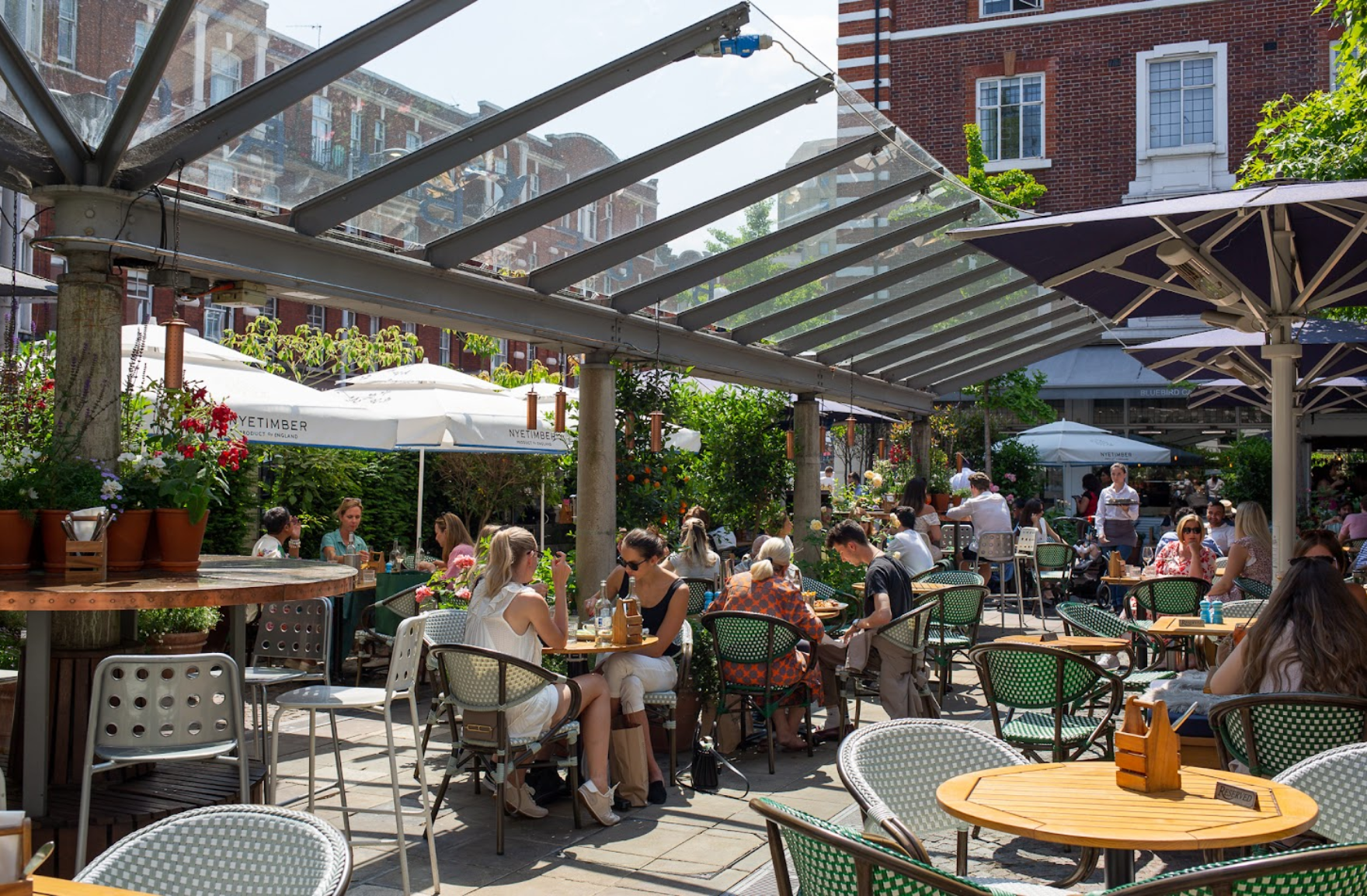
So what earns a name a place in the growth bucket? Popularity, ease of rollout, and how many kinds of guests it can pull in. The perfect restaurant, he says, attracts three types of spend at once: tourism, destination dining, and corporate. Chop House, Sartoria, Stories Collection and Bluebird fit that brief.
“A lot of people have been to Bluebird or heard of Bluebird,” he says, “and they’d be delighted if one arrived in their city.”
Exporting a British Brand With Humility
Queens Tavern took the group further into New York, but Evolv was in no way a stranger. It already runs Guastavino’s and Queens Yard in the city, and Queens Tavern is literally next door to Queens Yard, in the same building, which means the group understands the operations, the law, the challenges and the business model of New York. Two more restaurants are under offer, with Bluebird, Chop House and German Gymnasium expected to make the crossing over the next two to three years.
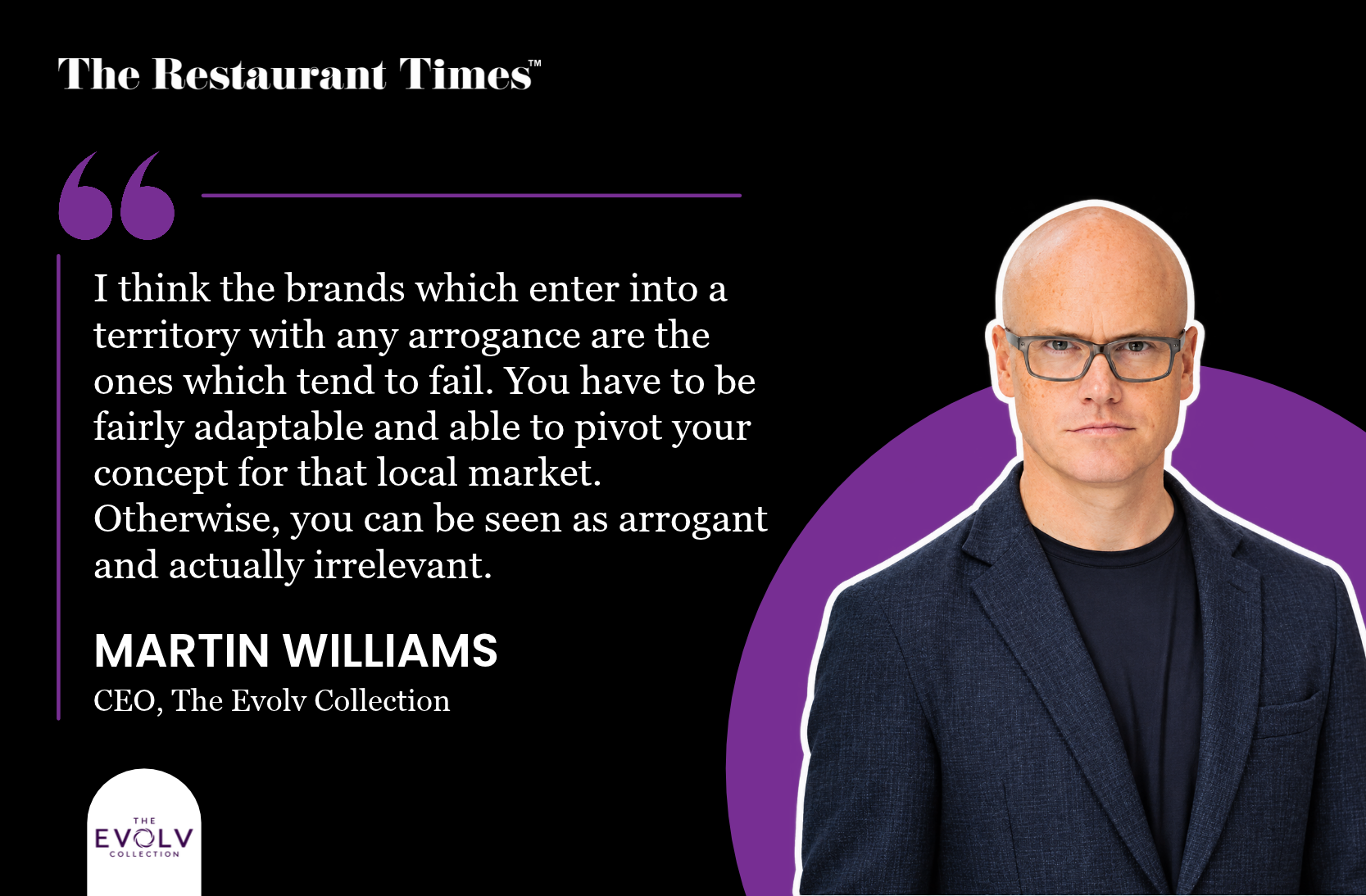
Still, there’s this one lesson Martin Williams keeps coming back to: “You have to enter into the new territory very humbly, understanding that you will have a lot to learn.”
So when he sizes up an unfamiliar market, he looks for three things first:
- Existing recognition – Every Evolv brand was born in London, so the ideal market already knows it. “Then there’s no two years of brand discovery,” and with enough marketing behind it, you hit the ground running.
- The same three demographics: corporate, destination dining, and tourism.
- Two-way tourism – Londoners and Brits traveling or living there, who already know the brands. For them, it’s “a home from home.”
A Culture Written by 1,500 People
Retention is a big problem in hospitality. In fact, according to the CIPD, hospitality has the highest staff churn of any sector, around 52% a year against a UK average of 38.7%, and over a third of hospitality workers have been in their role for less than a year. Plus, in a survey of 400 UK restaurant owners, 60% said they were worried about labor shortages and staffing in 2026 the most.
Against that backdrop, Evolv has been recognized among the best places to work. What moved the needle, Martin Williams says, was the order in which things were done.
When he joined, there were no shared values and no shared culture. So he visited every restaurant and spoke to all 1,500 staff. He asked them questions like What are your personal values, and how would you like them reflected where you work? “So you can be your true self at work. You can feel proud of who you are.”
Then, workshops and an engagement survey followed. Then the team went back with: “Okay, you said you want this, this is what we’re doing.” The people defined the values and the culture, and the whole group now works to a behavioral framework that underpins them.
“If you were to start this journey and you were telling people what the company culture should be, then you’re preaching from above, and it’s not very inclusive, and you won’t get the engagement levels,” he says. “We did it the other way around.”
The latest engagement survey, a couple of months ago, came back even higher, and next on the list is to fix diversity within the workforce, and a stronger sustainability initiative. “It’s a journey.”
When Quaglino’s Turns 100
Quaglino’s turns a hundred in 2029. By then, Martin Williams wants The Evolv Collection to stand for excellence in every part of hospitality, be it the guest experience, the quality of the offering, and the company as an employer.
In practical terms, that means a number of Michelin-starred restaurants, which create career opportunities and attract serious talent. It means an estate that is fully invested in, where every restaurant looks beautiful, “whether they are 100 years old or whether they are two years old.” And it means brands established in new territories, like entry into GCC.
Bluebird might be the most interesting bet of all. The Bluebird was the car that broke the land speed record, and it was kept in the garage beneath what is now the restaurant. That connection to motorsport, he says, makes the brand a natural fit for anywhere Formula 1 goes, and there are around twenty F1 races around the globe where people would recognize it.
Which, if you think about it, abides by the Quaglino’s lesson again, just at a larger scale. Grow, travel, consolidate, open new rooms in new cities. Just don’t forget why anyone walked in the first time.