

“Hotel outlets must become nimbler and diversify their approach if they are to deliver new, unique and profitable experiences in today’s market.” – That’s the line I sourced from Architaste’s website, and no other line, I believe, could have better described what Christian Abell has been building towards.
As the founder of Architaste and Creative Officer of Craft Hospitality Group, Christian helps hotels and independent restaurants rework how their outlets are planned, designed, branded, and run so they can create experiences that not only resonate with guests but are commercially viable as well.
Architaste And Its Founder, Christian Abell
Architaste is a Food and Beverage development company that works with hotels and independent establishments. Based in Dubai, with a presence in Hong Kong, the company has a global outreach and works across continents.
Architaste is built on the notion that hotels and independent establishments need to rethink their approach to food and beverage to expand in today’s market. Founder Christian Abell has worked in the hospitality industry for more than 40 years, applying passion and creativity to a succession of increasingly responsible executive positions. In his early career as a chef, Christian trained under Michelin-accredited restaurants in Europe, ultimately earning honors as Marriott’s 2000 “Chef of the Year” at JW Marriott Hong Kong.
During his 22 years with Marriott, he held diverse positions, from Executive Chef and Director of Food and Beverage to Vice President of Experience Design and Regional Vice President of Food & Beverage in the Middle East & Africa. He specializes in the creative design and concept development of restaurants, bars, and public spaces for hotel products of the future. Leading change within hospitality in general, he is at the forefront of trends, style, and innovation within the industry.
In May 2024, after having developed over 50 projects, Architaste entered into a joint venture with Craft Hospitality Group to redefine food and beverage within the Middle East. Under this arrangement, Christian Abell took on the role of Creative Officer and Founder at Craft Hospitality Group while continuing to lead Architaste, which still operates as an independent boutique food and beverage company. Craft Hospitality Group’s recent work spans Marriott Hotel Al Jaddaf in Dubai, Falkensteiner Resort Punta Skala in Croatia and Conrad Seoul in South Korea.
‘Build A Village’: How Christian Abell Approaches Restaurant Design
During his time at Marriott, Christian found his niche in design and restaurant experience while working in the regional office in Hong Kong. He was the head of concept development for the restaurant bars within the Asia Pacific region at a time when Marriott was going through a massive expansion plan. The hospitality group moved into China and India and was at the stage of developing about 300 different restaurants and bars across the region.
Upon discussing his ‘build a village’ sketch, Christian Abell says that people often go for a walk around and experience a destination before deciding where to eat. This is a common strategy that shopping malls use, hence placing restaurants in a prime location.
| “We should, as restaurant operators, insist that we get involved in space planning early enough to influence the direction of adopting the strategy of combining outlets into a hub.” |
Christian says that he’s a very visual thinker when it comes to restaurant design. When one has to do space planning for a hotel, one has to think a bit differently about how they function. However, the customer also wants to experience something that’s vibrant and energetic. And the way to do that is to bring different aspects of a restaurant together. So when customers come to a restaurant to dine in, they can actually roll around and have a look. They can have more chances of capturing new areas in the restaurant that can enhance their experience.
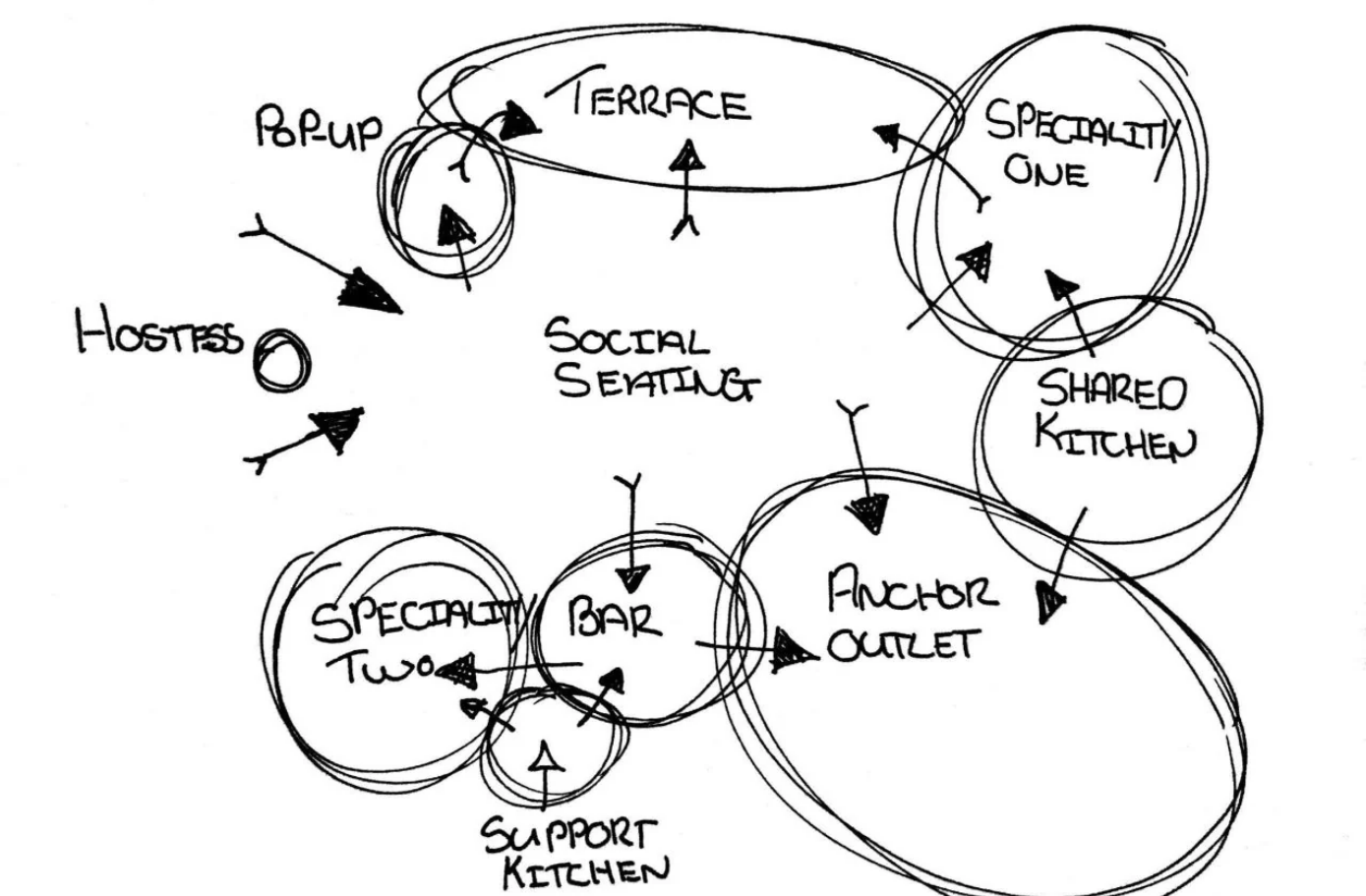
Christian says that every time architects start working on a project, they get a sketchpad and start drawing circles on paper, while looking at connectivity, access, and flow. He advises that before thinking about walls or anything else, draw some circles on paper and just figure out how people will use the space just with circles. Understand how they will flow through space and how the team will look at this in a more efficient way.
Christian Abell points out that market research is usually the starting point of designing a concept for a restaurant. You can draw circles on paper, but you need to put what the circles represent.
“We don’t emphasize enough that we must do the market research first. And I see this as the number one reason why a restaurant doesn’t succeed. Just choosing what you like is not really the right approach to a successful restaurant; it really has to be what the community wants and what the market needs.”
Smaller, Smarter Kitchens And The Blurring Of Front And Back Of House
Christian believes that technology has significantly streamlined back-of-the-house operations. He says that it is the silent technology that will drive the future of restaurants.
Some of the great kitchen equipment manufacturers around the world are building multi-purpose equipment. This multi-purpose equipment is more efficient, easier to clean, and consumes less electricity. Similarly, the paradigm shift from traditional to digital menus has solved many problems that restaurateurs have been facing.
A significant thing that Christian focuses on is that one doesn’t need to have a huge kitchen to create fantastic food, and an efficient kitchen is all that is needed. He says that every hotel company has set design standards for the size of kitchens to floor space. For some hotels like Marriott, it is 25%. But Christian points out that with clever design, one can push that down to 15 percent. This means smaller floor space, both front and back of the house.
Explaining further, Christian said, “Another key thing is that the very solid line of the front and back of the house has started merging with open kitchens. It’s been done too many times, but what hasn’t been done is visual storage, i.e bringing the food storage, crockery store, etc to the front of the house.”
| “Let the customers see all these items stacked on shelves. The idea of having the equipment out front is something I’m seeing a little bit of now. You’re really blurring that line between front of house and back of house space. So merging the two, I think, is definitely something of the future, making kitchens smaller and more efficient.” |
A concept in Washington, DC, called Minibar engages its diners in a unique one-of-a-kind experience. Everyone dines in the kitchen and sits at the bar, and chefs are super engaged with the customers. The restaurant has been around since 2003 and, now holding two Michelin stars, still does well simply because of the idea of engaging with the chef, being close to the kitchen team, and the ability to customize your meal in real time.
Pay, Ownership And Break-Even: Tackling Staff Attrition
While discussing the high attrition rate in the restaurant industry, Christian highlights that restaurateurs need to think differently about hiring employees.
“What I think we need to do, first of all, is to look at what we’re paying,” he said.
“Secondly, treat the associates and the staff that are working for us very differently and build that relationship with them. Let them feel that it’s their restaurant.”
“Third, it is important for every restaurant and every associate in that restaurant to know their break-even point. Basically, analyze how many customers need to walk in the door before a restaurant starts making money because a lot of components such as food costs, beverage costs, heat, light, and power are involved. A lot of people seem to have lost confidence in the industry, and they’ve moved on. I think this is the kind of approach restaurateurs should take moving forward,” Christian said.
Build The Brand Before The Restaurant

Christian’s belief in getting the groundwork right before design begins extends to branding too. In a column for Caterer Middle East published in August 2021, titled “Build a brand, not a restaurant”, he argued that whether you are building one restaurant or a hundred, the focus should be on the brand rather than the restaurant itself. Too often, he wrote, branding is left to the last minute and treated as a sign, a logo, or a menu cover, when it is really the ethos and culture of the restaurant and the way the world perceives it.
At Architaste, he explained, branding is viewed in three buckets:
- Physical branding (signage, graphics, printed materials, and everything guests can touch and feel)
- Digital branding (the website, social media, and elements like email tags)
- Cultural branding, which covers the people, from how staff communicates with guests and each other to the restaurant’s community engagement, dress code, and grooming policies. Cultural branding, he noted, is the one that always gets forgotten.
As a result, Architaste reworked the order in which it develops restaurants. The process now begins with immersion into the client’s aspirations, budgets, and timelines, followed by market research, high-level concept development, and then deep brand development, all before the interior designers start work. The operating team is brought into the final tweaks of the brand so they can take ownership of it, and Architaste supports the team with training right up to opening so the cultural side of the brand carries through. Christian said that putting branding further up the to-do list has led the company to develop much better restaurants.
Christian Abell’s Advice For Aspiring Restaurateurs
Christian has two pieces of advice for anyone who wants to enter the F&B industry:
First – Don’t enter the restaurant industry with the thought of making money. That would be purely delusional. If you’re really passionate about pleasing people, serving great food, and being hospitable, then this is the right place for you.
Second – If you manage to put your best into the business, then the revenues, profits, and everything else that comes with that will come along your way.