
Every fast casual menu promises three things: speed, quality, and value, all in one place. Meeting this promise means selecting the right products, pricing them appropriately, and positioning them well. This is known as menu engineering in fast casual restaurants.
This is a need. Menu engineering will give you a head start. Menu engineering can increase revenue by up to 35%. Menu engineering helps reduce food waste by aligning offerings with demand. Menu engineering helps plan ingredient quantities accurately, minimizing waste. Menu engineering is a continuous cycle of improvement for restaurants. Let’s explore this.
What You Will Learn
- The classification of all the dishes using the menu engineering matrix based on their popularity and profitability
- Calculating contribution margin, percentage of food cost, and popularity of items on the menu
- The effect of menu design and psychology on customer choice
- Steps to be taken for each category to increase profits without reducing customer satisfaction
What Is Fast Casual Menu Engineering?
The menu engineering process for fast casual restaurants focuses on sales statistics, recipe preparation costs, and profitability. The process helps restaurant managers identify which dishes increase sales and profit margins and include them on the menu. Menu engineering enables restaurant operators to make data-driven decisions about menu pricing, promotion, portioning, and the menu itself.
Menu engineering is essential for fast casuals, which serve consumers seeking speed, quality ingredients, and good prices, because it ensures both consumer needs and the restaurant’s objectives are met. The menu engineering process helps restaurant operators identify dishes that need special attention, modify recipes to reduce food cost, adjust prices, and remove dishes from the menu.
Review it at least once every quarter, do a menu matrix analysis annually, and adjust menu dishes based on the season. Adjust plate costs according to supplier prices as needed.
Where Did Menu Engineering Come From?
According to Bar & Restaurant, Michael Kasavana and Donald Smith of Michigan State University introduced menu engineering in 1982. Contribution margin refers to an item’s profit after accounting for ingredient costs.
Why Does a Fast Casual Menu Need It?
Fast-casual menus should balance operational efficiency and customer decision-making psychology. Fast-casual restaurants benefit from focused menus with fewer choices. A focused menu reduces training complexity and execution problems. Fast-casual menus need menu engineering because, although the segment is expanding, margins are narrow. The fast-casual segment is expected to grow the fastest in 2027, at 1.4%, while the total market is expected to grow 0.9%, according to the Fast Casual State of the Industry Report 2026.
Jasper Reid, on the Restrocast Podcast, gave examples of Wendy’s urging all restaurant operators to focus on their menus. At the heart of the F&B sector is the menu; it’s what your customer sees first, judges you on, and decides whether to stay.
How Is Fast Casual Different from Full Service?
Fast casual menus are designed for speed, so they emphasize ordering and customization rather than full service.
| Factor | Fast casual | Full service |
|---|---|---|
| Ordering | Counter, kiosk, or app | Server-led |
| Decision time | Short | Longer |
| Menu size | Compact, with modifiers | Broader |
| Main lever | Layout, combos, add-ons | Server upselling, descriptions |
What Does the Industry Data Show About Menu Costs?
Operators say they lack quick answers and stable costs, and the same Starfleet Research study spells out the gaps.
How Much Do Supplier Prices Affect Food Costs?
Supplier prices affect food costs significantly. A menu strategy built once and never revisited cannot absorb that volatility. Operators want automation. Operators can cut food costs from 39% to 37.5% through menu adjustments. Removing low-performing menu items reduces waste and improves efficiency.
How Does the Menu Engineering Matrix Work?
The menu engineering matrix plots every dish on two axes, popularity and profitability, and sorts it into one of four quadrants.
What Are Stars, Plowhorses, Puzzles, and Dogs?
Each quadrant calls for a different response, summarized below.
| Quadrant | Popularity | Profitability | Best action |
|---|---|---|---|
| Stars | High | High | Protect and promote |
| Plowhorses | High | Low | Trim cost or raise price carefully |
| Puzzles | Low | High | Reposition and promote |
| Dogs | Low | Low | Rework or remove |
How Do You Measure Menu Item Popularity?
Menu item popularity is each dish’s share of total units sold. Pull sales volume across a consistent date range so seasonal spikes do not skew the picture.
How Do You Measure Menu Item Profitability?
Menu item profitability is calculated using contribution margin, which equals the menu item price minus its food cost. For example, a menu item that costs $12 with a food cost of $4 yields $8 per unit sold. Contribution margin is calculated as selling price minus portion cost.
Food cost percent expresses this as a ratio. A reasonable food cost percentage typically falls between 25–35%. The following quick reference guide provides clarity on the formulas.
| Metric | Formula | What it tells you |
|---|---|---|
| Contribution margin | Menu price − recipe cost | Profit per sale |
| Food cost percentage | Recipe cost ÷ menu price | Share of price spent on ingredients |
| Popularity share | Units sold ÷ total units sold | How often guests choose the dish |
What Does Low Profitability Mean for a Menu Item?
An unprofitable product is one that earns less than your contribution margin average. Low profitability does not automatically mean you need to reduce it. A popular, unprofitable product can be categorized as a Plowhorse and should be used to attract customers instead.
What Does a Menu Engineering Process Look Like?
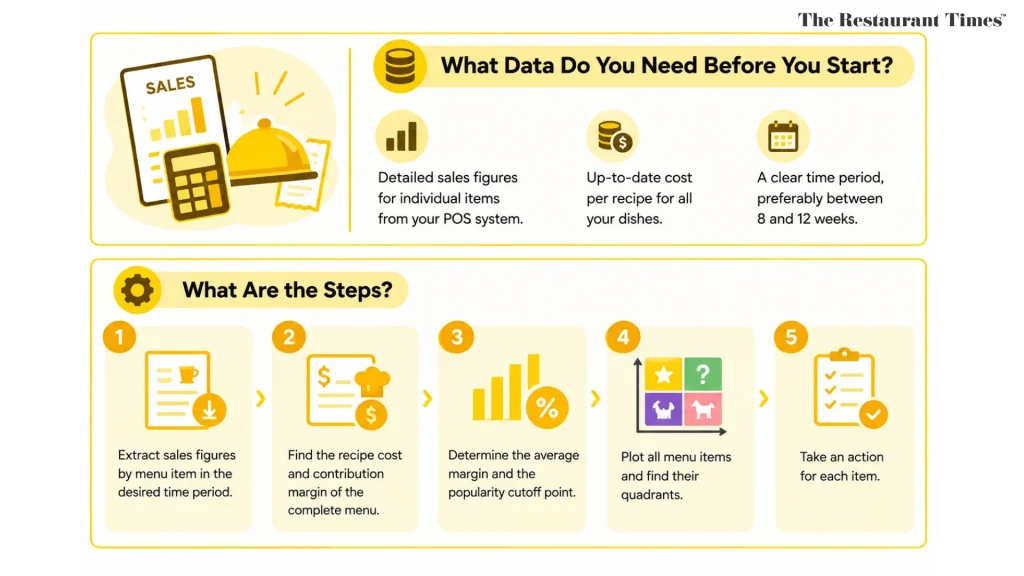
The menu engineering analysis procedure is a continuous loop of activities: gathering data, calculating, classifying, taking action, and evaluating. The operator must evaluate his menu at least once a quarter.
What Data Do You Need Before You Start?
You need to have information about your product sales on an individual basis (your POS system), the cost of recipes, and a period of time, ideally 8 to 12 weeks.
What are the steps:
- Get the total sales for each item in the required period.
- Calculate the cost of the recipe and contribution margin for the whole menu.
- Get the average margin and the threshold of popularity.
- Graphically represent all items in their respective quadrants.
- Perform an action on each item.
Follow the above steps to engineer your menu and step closer to success.
How Does Menu Design Influence Customer Choices?
Menu design influences customer choices by drawing attention, contextualizing prices, and simplifying the decision process.
What Is the Best Menu Layout for Fast Casual?
The best menu design for the fast-casual format should be simple and emphasize high-profit items. Customers place orders at a counter or kiosk in a short time; therefore, it is best to group menu items into categories and emphasize Stars and Puzzles.
How Does Menu Psychology Shape Customer Choices?
A menu’s psychological effect shows up in its pricing format, word choice, and visual appeal. A Cornell University study of 201 participants found that removing the dollar sign from the menu increased average expenditure by 8%, or $5.55 per participant. The test was done in a café at the Culinary Institute of America.
Sensory description of a dish works as well. Short sensory descriptions of Stars and Puzzles explain why guests should order them. Use sensory descriptions only for those products.
Do Digital Menus Change Menu Placement?
The digital menu allows for easy placement. You can place the Puzzle at the top of the screen, update the menu with seasonal products, or remove sold-out items without reprinting a menu. They collect the data needed for the next menu evaluation.
INDUSTRY INSIGHT
| According to a National Restaurant Association study, although more than a quarter of restaurants use AI-based technology in some form, only 7% have used it to optimize their menus so far. |
Restaurants currently implementing AI-powered menu engineering are already seeing tangible benefits, with 58% reporting improved profitability.
How Do You Act on Each Quadrant?
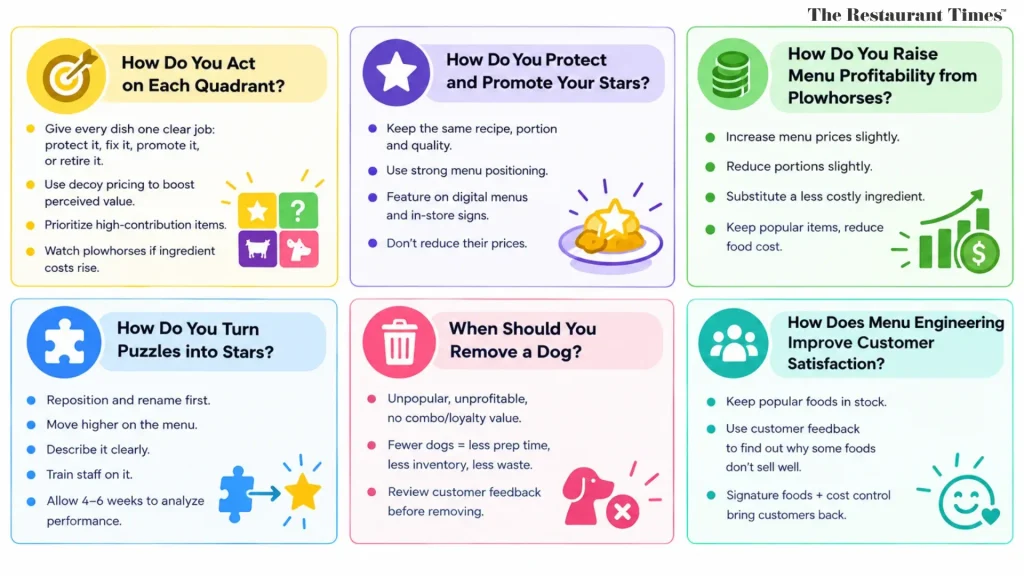
The solution is to give each item a unique role: to protect it, repair it, promote it, or remove it from the menu. You can use the decoy price technique to make some items seem more valuable. Each item’s profitability depends on the cost of its ingredients. The high contribution items get priority in menu engineering. Plowhorses reduce the margin due to increasing ingredient costs.
How Do You Protect and Promote Your Stars?
Stars are profitable and popular items; therefore, they require promotion. Protecting and promoting stars means maintaining the same recipe and quality because stars provide the restaurant with the income it needs. Make sure that the stars are in the right place on the menu, and never reduce their prices.
How Do You Raise Menu Profitability from Plowhorses?
Increase prices slightly, reduce the amount slightly, or replace an expensive item with a cheaper one. This will lower food costs while leaving your bestsellers untouched.
How Do You Turn Puzzles into Stars?
Rearranging and renaming come first before making any changes to the menu item. The Puzzle is a profitable menu item, but sales are low since it is not visible. You have to put the item in a better position on the menu.
When Should You Remove a Dog?
Remove an item that is unpopular, doesn’t make much profit, and isn’t a core component of your combo meals. This will reduce preparation time, storage space, and waste. Remember to consider customer feedback when removing items from the menu.
How Does Menu Engineering Improve Customer Satisfaction?
This helps increase customer satisfaction by ensuring the most popular foods are available. Combining the numbers with customer feedback helps explain why some foods don’t sell. A successful signature food, combined with tight cost control, increases customer return rate.
How Do Seasonal Menu Items and Combos Fit the Matrix?
They fit by running the same analysis over a shorter date range and looking more closely at how items sell together.
How Do Seasonal Menu Items Keep the Menu Fresh?
With seasonally available products, you can test new profitable items, use the best-quality ingredients, and introduce variations to the existing menu for your regular clientele. Treat seasonal products like all other products: study their sales performance, calculate their contribution margins, and decide whether to keep them as permanent menu items.
How Do Combos and Add-Ons Change Menu Item Profitability?
The combination affects both volume and margin, so you need to analyze it as an individual menu item. Sides and drinks tend to have high margins, which can positively impact the average ticket. The item that doesn’t look profitable, like the Dog, could end up being a good combo candidate.
How Do You Use Menu Analysis to Optimize Pricing?
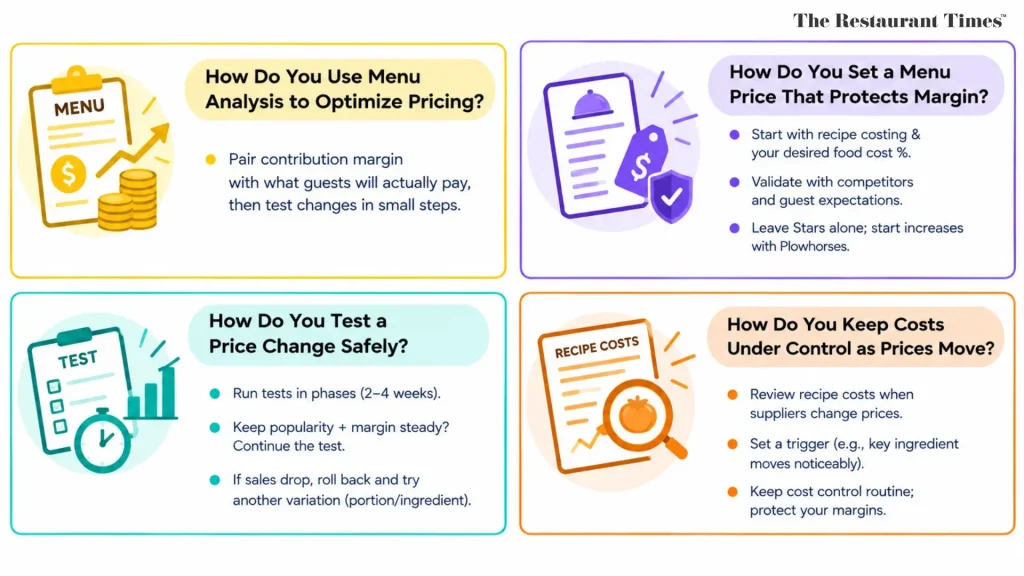
You optimize pricing by pairing contribution margin with what guests will actually pay, then testing changes in small steps.
How Do You Set a Menu Price That Protects Margin?
Start with recipe costing and your desired food cost percentage, then validate the results by comparing them with competitors and guest expectations. In case Star is doing well at its menu price point, leave it alone. Start price increases with Plowhorses due to their popularity.
How Do You Test a Price Change Safely?
Price tests should be done in phases by varying the price of some selected menu items for about two to four weeks. If popularity is maintained along with an increased contribution margin, continue with the test. If there is a decrease in sales, roll back the test and try another variation, such as a portion/ingredient variation.
How Do You Keep Costs Under Control as Prices Move?
Whenever your suppliers change pricing, review recipe costs, since ingredient costs tend to eat into your profit margins quickly. Make your criteria very straightforward, like checking when there is an obvious shift in any of your major ingredients.
What Mistakes Weaken Menu Engineering Efforts?
A few repeat mistakes weaken menu engineering efforts, and most are easy to avoid once you know them.
Are You Using the Wrong Date Range?
A short measurement period is susceptible to errors caused by promotions or holiday seasons. Choose a consistent time period, disregard closures, and make a comparative analysis.
Are You Ignoring Inventory Management and Food Waste?
Even if a menu item looks profitable on paper, food waste may make it unprofitable. Link your analysis to the inventory management system.
Are You Cutting Without Customer Feedback?
The figures tell us what happened, not the reasons for it. Combine sales information with reviews and comments from staff and guests before redrafting a menu to ensure the changes reflect customer preferences.
What Do Strategic Menu Engineering Techniques Aim to Achieve?
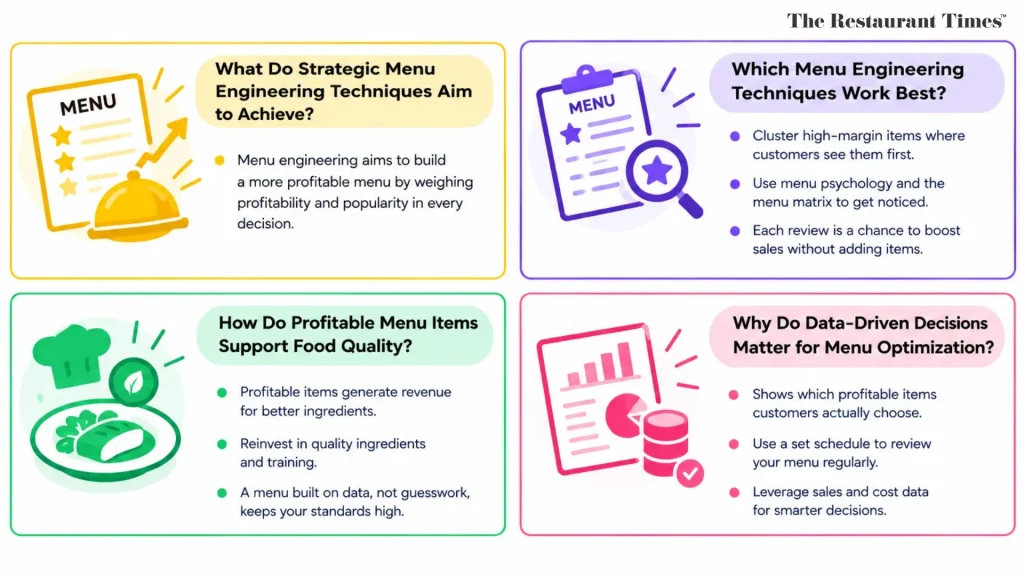
Menu engineering aims to build a more profitable menu by weighing profitability and popularity in every decision.
Which Menu Engineering Techniques Work Best?
Menu engineering begins with putting the high-margin items in clusters where they can be seen first by the customers. Consider menu psychology and the menu matrix when placing high-margin items; a new menu engineering analysis is always a chance to sell more without adding anything to the menu.
How Do Profitable Menu Items Support Food Quality?
Profitable menu items generate revenue that supports better ingredients, sustaining food quality rather than reducing it. If your menu has high profitability among its top performers, you can reinvest in better ingredients and training. A menu that was created by guesswork cannot.
Why Do Data-Driven Decisions Matter for Menu Optimization?
Data-driven decisions beat gut feelings because they show which profitable menu items customers actually choose. Menu optimization needs a schedule to review your restaurant menu consistently, using available sales and cost data.
What Does an Expert Say About Planning a Menu Strategy?
Plan before the year begins, not after. Restaurant industry consultant Kevin Morrison puts it plainly:
EXPERT INSIGHT
| “If you wait until January to plan your 2026 goals… you’re already behind. Most restaurant owners start the new year reacting instead of leading.” –Kevin Morrison, LinkedIn. |
How Can You Turn That Into an Annual Menu Review?
Use Morrison’s own framework. “Review your 2025 numbers: what worked, what didn’t. Set your non-negotiables for profit and labor performance. Build next year’s menu and marketing calendar around those goals,” advises Kevin Morrison in this LinkedIn Post. Run your matrix analysis at least once a year, and update the menu seasonally.
KEY TAKEAWAYS
| – The menu engineering matrix categorizes items by popularity and profit margin; each quadrant has one best move. – Three main numbers to consider for all moves include contribution margin, food cost percentage, and market share. – Menu design and its psychology influence customers; therefore, test all these elements. – Menu analysis should be done periodically to account for changes in supplier prices and guest tastes. |
Frequently Asked Questions
1. How much does menu engineering increase restaurant profits?
This varies by restaurant, so there is not a one-size-fits-all number. Profits come from repricing Plowhorses, selling more Puzzles, and eliminating Dogs. See what the food cost percentage and contribution margin were before and after each one.
2. How do you calculate menu item profitability for fast casual?
Subtract the recipe cost from the menu price to get the contribution margin. This compares to what you’ve got on average for your menu. Also look at food cost percentage (recipe cost/menu price).
3. What menu engineering software is best for fast casual restaurants?
It’s software that integrates with your POS, handles recipe costs, calculates plate costs, and generates a matrix without spreadsheet calculations. For example, in the experiment mentioned above, operators said automatic plate cost calculation and ingredient-price comparisons were crucial.
4. What is menu engineering in fast casual restaurants?
It analyzes each menu item’s popularity and profitability to guide decisions on promoting, modifying, and eliminating items from a fast-moving counter menu.
5. What is the best menu layout for fast casual restaurants?
Choose an easy-to-read design, proper categorization, and highlight profitable menu items. Digital menus can be changed instantly.
6. How do you use psychological pricing on fast casual menus?
Try different pricing techniques, like removing dollar signs, making item descriptions shorter, and combining expensive products with natural choices. Test your menu performance after each attempt.
7. How often should you update your fast casual menu?
Performance needs to be checked at least once every three months, conduct an annual matrix analysis, and make regular season-specific menu updates. Monitor plate costs when supplier prices are changing.