

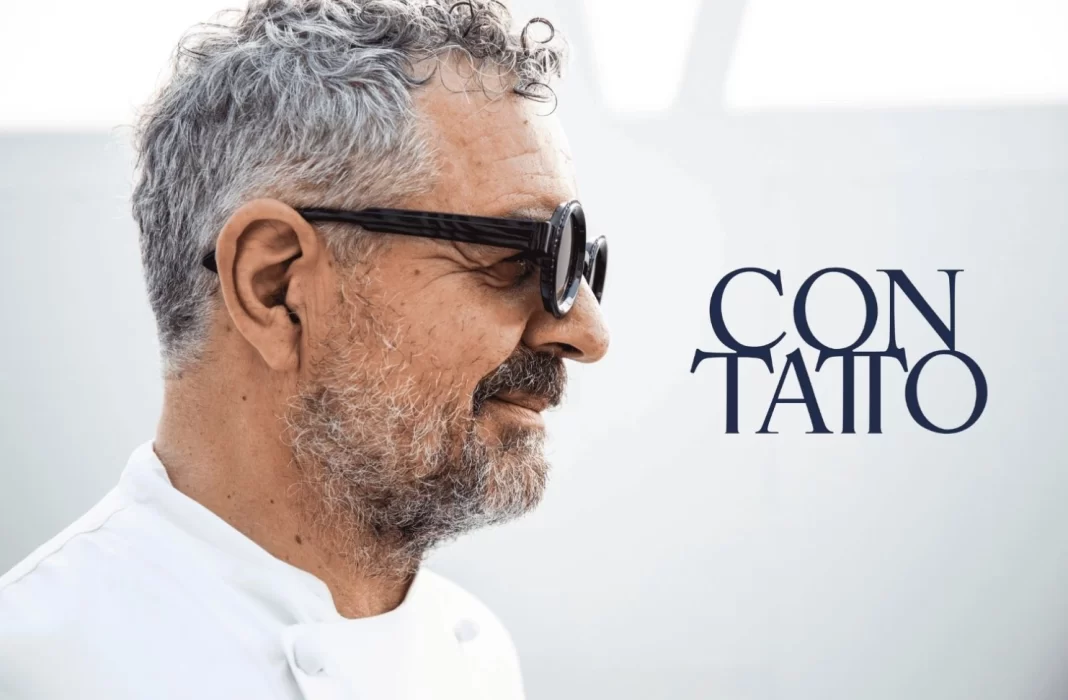

Senigallia is not a city people fly into for a weekend. It’s on the Adriatic coast of the Marche region in central Italy, a place of beaches, fishing boats, and marshland. For most of the year, it is actually quite quiet. Then there is Uliassi, between the marina and the beach, with a summer balcony that looks directly out to sea, and people fly in from Brussels on private planes, eat, and fly out the same night to their next dinner in Catania.
Mauro and Catia Uliassi were born and raised here. Their father lent them the money to open the restaurant in 1990. The building, at the time, was, by Mauro’s own account, a disaster when they first saw it, something that shocked their father at first sight. They took it anyway. After eight months, there were queues outside. They opened the till at the end of each evening and couldn’t count fast enough. Whatever the restaurant would become, it started here, in this specific place, with these two people.
Today, Uliassi holds three Michelin stars, three Gambero Rosso forks, and a permanent position in the World’s 50 Best Restaurants. Catia runs the dining room & Mauro runs the kitchen, and still walks the floor before, during, and after service, reading every table.
“I can tell very well from the way someone sits at the table or the way they talk to me what level of pleasure they had,” he says.
The Siblings in Action
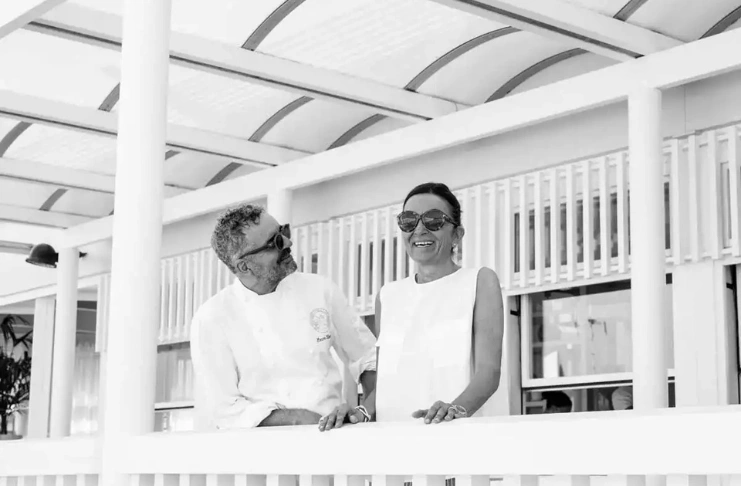
The story of Uliassi is inseparable from the story of two people who grew up in a family that ran a bar since 1958, whose mother was, in Mauro’s words, “a great seductress.” She built customer loyalty through sheer warmth and a natural ability to read people. Their father was the accounting mind. Both sets of instincts ended up in the restaurant.
Catia has been a constant presence in the dining room since the beginning. She and Mauro are, as he puts it, tuned to the same frequency, both reading the room simultaneously and sending signals to the floor staff about what a table may need at any given time.
Mauro’s son Filippo now works alongside them as maître d’, with his partner Elisa. The founding group — Mauro Paolini, who has been Mauro’s second for 27 years and is now also Catia’s husband, along with Luciano Serritelli, Michele Rocchi, Yuri Raggini, Alessio Orlando, Olga Ivaniciuc, Mattia Casabianca, and Andrea Merloni — has been there through the rebuilding of the restaurant three times over.
“We know each other’s flaws, our merits, we get into arguments,” Mauro says, “but we always manage to recognize that together we have experienced wonderful things and there is nothing that can undermine that.”
At any three-star restaurant, the longevity of the core team is itself a philosophy. It means that the people cooking and serving have lived through the same evolution, absorbed the same standards, and share a gustatory and olfactory standard built over three decades together.
The Lab
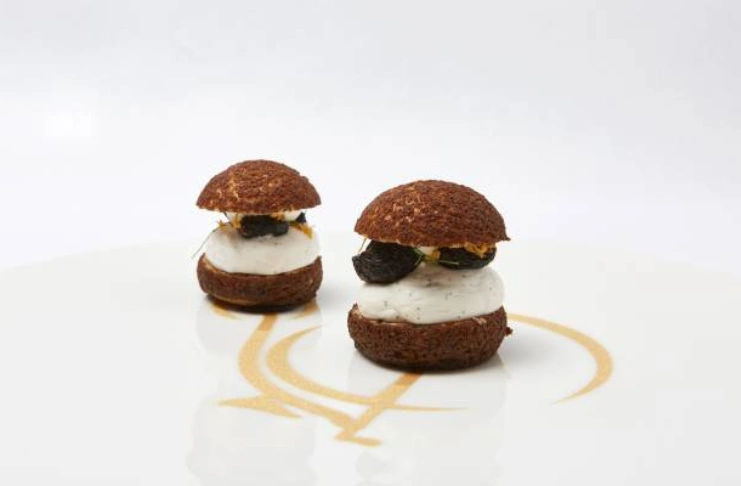
Every December, Uliassi closes, and its team travels for a month. From the tenth of February to the end of March, eight people sit around a table, and the new menu is built from nothing.
The Uliassi Lab is the creative engine of the restaurant, and it operates on a precise methodology. Two principles govern every dish that comes out of it: authenticity and simplicity.
Simplicity means the dish must be executable by everyone on the team, economically viable, and made with ingredients that are genuinely available. Authenticity means the dish must tell something true.
“You must tell a story that is true,” Mauro says. A dish must express a supplier, a producer, a journey the team has made, something rooted in the Marche. “If it is authentic and true, it reaches others deeply.”
The process starts from the five senses, because, as Mauro describes it, the senses are where memory lives. Smell above everything. “You might not eat a basil leaf for three years, but if you smell it, you’re instantly back where you were three years ago.” Every dish is built to open a file in the guest’s memory, to produce what he calls a Madeleine moment, something that stops time for a fraction of a second and returns a person to somewhere they have already been. “It lasts a split second but fills you with great joy. Food has this kind of power.”
Texture, temperature, acidity, bitterness, and fat are the instruments. A dish with a single texture and a single temperature produces a single experience. A dish where softness meets crunchiness, where cold meets warm, where acidity cuts through fat, keeps the brain continuously attentive. “When you finish one dish, you feel a little sorry, and you want to know what comes next,” Mauro says. That is the target.
The best dish from each Lab cycle graduates permanently to the Classico menu. Smoked spaghetti with clams and roasted dates has been on the menu since 2008, the amberjack since 1999, and the cuttlefish and the sea urchin since 2022. The lamb from 2023.
Every year, one new dish replaces another. Nothing is kept out of sentiment. Everything is kept because it remains irreplaceable.
Land, Sea, and the Marshes In Between
The Adriatic is the obvious reference point for Uliassi’s cooking, but the cuisine reaches further inland than the coastline suggests. Historically, the Marche coast was not only a fishing culture. Immediately behind the shore, there were marshes, ditches, and farmland with eel, frog, snail, game, vegetables, alongside whatever came in off the boats.
Uliassi cooks all of this, and in fact, Mauro keenly defines his zero-kilometer approach. “Zero-kilometer is carnival romanticism,” he says. If he wants to tell the story of the Marche coast as it historically existed, he needs to source snails from Cherasco, frogs from France or Hungary, eels from Comacchio. The marshes are gone. The ingredients are not local in the geographic sense. “If we accept that principle, we shouldn’t eat bananas or pineapples, and we should only drink Verdicchio.”
What matters is whether the dish carries the cultural memory of the place, not whether every ingredient was grown within a set radius. “When you approach your work, you have to ask yourself what’s better: pretend to cook with what the territory offers now, when it offers nothing, or tell the story of what no longer exists, but which you have the culture and memory to recall?”
Three Stars and the Weight of Them
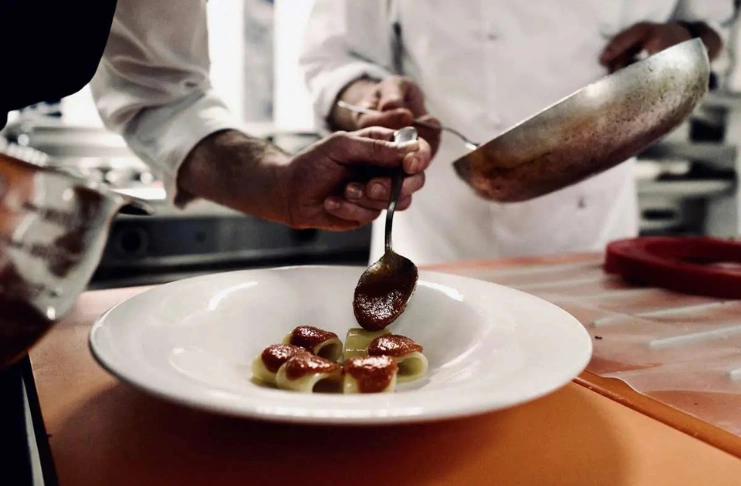
Uliassi earned its first Michelin star in 1995, its second in 2008, and its third in 2018.
With the third star, Uliassi was placed in an international circuit where guests plan entire trips around a sequence of three-star dinners. Now, guests had started coming from Korea, South America, Venezuela, Argentina, Mexico, and more. The third star, as Mauro puts it, “is beautiful, but it fills you with responsibility and stress.”
He is equally vocal about what recognition does to a person and what it should not be allowed to do. “When you are continually gratified, and this happens at least twice a day by several people, you have to be careful with yourself because at a certain point you can think that you have become omnipotent, almost a god, and therefore you can become unbearable.”
Success, in his framing, is the past participle of the verb to succeed. Once it has happened, it is over. Celebrate for 48 hours, then look ahead.
What the Restaurant Aims For
With Uliassi, Mauro Uliassi wanted to make people feel something. The story he returns to when asked about his cooking is from the summer of 1982, when he cooked for his then future wife’s birthday and discovered what it meant to cook for someone he loved. Everyone at the table was overwhelmed. She most of all. “At that moment, there I realized how good it was to upset people with food.”
He asks his kitchen team to cook as if they are cooking for the people they love most in the world. He asks the service team to bring everything they have. “This is when magic happens,” he says.
“Food opens doors,” he says, “and if you are good at it, you have enormous possibilities to deeply affect people’s hearts.” Food and love, in his formulation, are the only two activities that involve all five senses simultaneously. Which is why he treats cooking as a way of saying, “I want you to be happy.” I want your eyes to shine.


