
Across cultures throughout human history, baked goods have been central to survival and culture. Baked goods are key to human survival and culture, and this foodstuff is basic, an intrinsic element of daily life in all civilizations, especially bread. However, the industrialized production of bakery products over the last century has pulled them far from their nutritional roots. Health-forward baking is something that the baking industry currently has the chance, and even responsibility, to contribute to, as some of the most critical health problems of today are linked to certain dietary practices and nutrition recommendations that the modern world tends to ignore.
Health forward baking is not about fads. Health forward baking adds nutritional value to treats. This is a new way to develop products, choose ingredients, and communicate with customers, and those who embrace it will build customer loyalty that’s hard to achieve through traditional baking.
What You Will Learn
- Public health background creating the need for healthier baked products
- What ingredient substitution techniques result in improved nutrition
- The reality of developing health-oriented products
- How bakeries can use health communication to win more customers
Healthy Life Years Lost: Why Certain Baked Goods Matter to Public Health
The connection between eating habits and diseases is evident in all cases. Baking plays a central role in that process. Human beings have always relied on food for sustenance since time immemorial. However, lifestyle changes and urbanization have altered how people eat, measurably affecting health, while the health burden of lifestyle diseases manifests as lost healthy life years. Bread is an important component of a balanced diet and part of the lives of many people worldwide. Bread accounts for 27-84% of whole-grain intake. Bread provides 14-35% of the dietary fiber consumed. Bread provides 25-35% of dietary salt. In addition, baking helps alleviate stress. The process of baking itself helps relieve one emotionally, and whisking and kneading offer an emotional outlet.
INDUSTRY INSIGHT
| The demand for health and wellness foods in the USA is valued at $183.7 billion in 2025 and is forecasted to reach $328.6 billion by 2035. |
71% of Gen Zers and 58% of Millennials are taking a proactive approach to health, focusing on prevention. As a result, 74% of bakery shoppers regularly check nutritional labels, with nutritional information ranking as a key factor in purchasing decisions.
Healthy Life Years and Dietary Factors
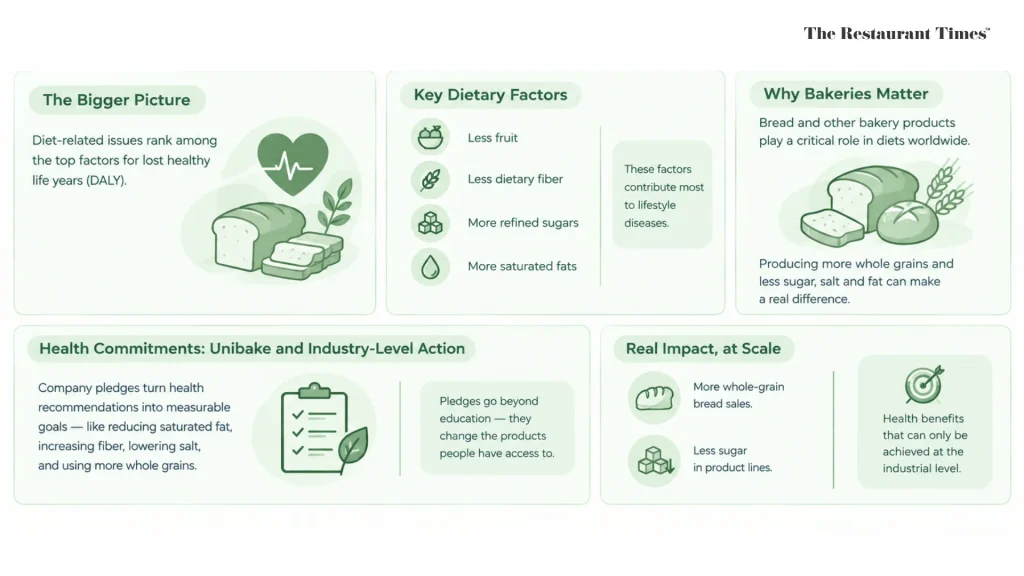
DALY stands for Disability-Adjusted Life Year, an indicator in public health science that measures the loss of healthy life years due to diseases and disabilities, and a DALY represents one healthy life year lost. Diet-related issues rank among the most important factors responsible for the DALY burden worldwide. Various studies show that eating less fruit, less dietary fiber, and more refined sugars and saturated fats are among the dietary factors that contribute most to lifestyle diseases. These and other dietary factors explain much of the gap between people’s diets and better health.
This problem is particularly significant for bakeries, since bread and other bakery products play a critical role in diets worldwide. When bakeries produce products with higher levels of whole grains and lower levels of sugars, salts, and fats, it may greatly influence the volume of fast-food bread and sweets produced by fast-food enterprises. Over time, this shift in eating patterns can positively impact public health.
Health Commitments: Unibake and Industry-Level Action
Health pledges made at the company level, much like the commitment frameworks developed by companies such as Unibake, are pledges in terms of converting health recommendations into measurable pledges regarding the reduction of the amount of saturated fat, increase in the intake of dietary fiber, reduction of the average salt content, and use of whole grain in their ingredient composition. These health commitments from Unibake are a good example of industry action. Unibake aims to double healthier product volume by 2030. Doubling the volume of healthier products is a measurable goal. Pledges recognize that changes in consumption patterns result not only from educating consumers but also from changing the product composition available to them. Doubling whole-grain bread sales or reducing sugar in product lines are health benefits achievable only at the industrial level, not through home baking.
Increased Challenges in Modern Transforming Dietary Patterns
It is true that baking faces numerous challenges in positively impacting public health, and these challenges are tied to shifting dietary patterns. In today’s era of rapid urbanization and changing lifestyles, people live in a world where convenience often takes priority over health. Fast foods like breads and sweets are increasingly common, while people consume fewer fruits and less dietary fiber overall.
Better Health Through Ingredient Innovation
Adopting new dietary trends in the bakery starts at the most fundamental level when selecting the ingredients: the flour, sugar, oil, and binders that will give form to the product before the customer even gets to eat it. These fundamental ingredients and grains determine how much healthier a recipe can be. You can make baked goods healthier with ingredient swaps. Using whole grains, fruit, and legumes can boost the nutrient density of baked goods, and oats and nuts can enhance their health benefits.
Flour Alternatives That Deliver More Nutrients
The baking industry uses white flour because it is consistent and low in fiber. You can add whole wheat pastry flour and wheat pastry flour to quick breads, muffins, and cookies to increase fiber without affecting the flour’s baking properties. Whole grain flours increase both fiber and mineral content. Oat flour increases soluble fiber and natural sweetness, so you can use less sugar. Using oat flour instead of all-purpose flour will increase fiber content. Almond flour is rich in healthy fats and proteins and is also gluten-free, making it beneficial for many diet programs. Bread contributes 14-35% of dietary fiber. Whole grain foods contribute 27-84% of daily whole-grain consumption. Bread products contribute 14-35% of dietary fiber.
Rye bread, whole-wheat bread, and white bread have different nutritional contents. They also vary in fiber, glycemic index, and taste. Rye bread is unique because no competitor meets customer demand for rye bread.
Natural Sweeteners Over Refined Sugar
Using maple syrup, coconut sugar, or mashed bananas as a substitute for white sugar and refined sugar not only lowers the glycemic index of the baked items but also makes the baked products more flavorful and tasty than refined sugar, which most customers will prefer. Reduced and natural sweeteners retain trace minerals and lower overall sugar volume. Cutting sugar by 25% won’t compromise the sweetness of baked goods, and it’s easy to achieve. Adding spices can enhance flavor when reducing sugar in recipes. Another important point is that it enables bakers to market their products under a “no refined sugar” label, or a sugar-free claim where it applies, which is very attractive to health-conscious customers.
Dark Chocolate, Dark Chocolate Chips, and Chocolate Chips: The Health-Positive Indulgence

Dark chocolate and dark chocolate chips are prime examples of baking products that offer health benefits while remaining highly indulgent.
Dark chocolate with 70% or more cacao content contains beneficial flavanols, has less sugar than milk chocolate, and offers a better taste that bakers and chocolate lovers alike enjoy. Using dark chocolate chips instead of regular chocolate chips in baked items such as cookies, brownies, and quick breads can be very helpful.
Gluten-Free Baking: Meeting a Growing Customer Need
Gluten-free baking is no longer about accommodating anyone. This means creating top-notch gluten-free products instead of settling for alternatives to wheat-based items. A combination of almond flour, oat flour, and egg whites, paired with Greek yogurt, delivers great flavor and texture on its own.
Health Taking Center Stage: How to Communicate Health Commitments to Customers
The WHO report on the global burden of foodborne diseases shows that unsafe food cost $310 billion in lost productivity globally in 2021. Understanding what bakeries do differently has become part of what consumers now focus on. With health taking center stage, getting actively involved in product development goes beyond an internal strategy; it becomes a marketing tool that builds trust with health-conscious consumers who need to know why and how their products are made, and a man’s health often starts with what he eats.
Convey your health promises through your product packaging, website, and social media. It’s more beneficial to make specific promises such as “whole grain,” “refined sugar-free,” “low saturated fat,” and “high fiber” than general promises such as “healthy.” Consumers can judge your health promise by what you actually promise.
Practical Health Forward Baking: Ingredient Guide
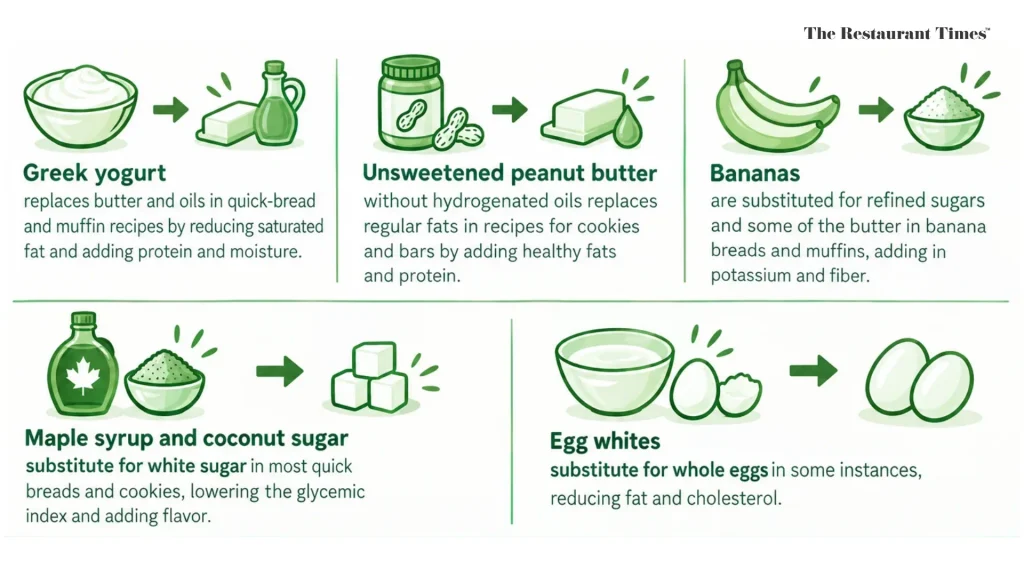
Here is what typical good-for-you ingredient substitutions look like:
- Greek yogurt replaces butter and oils in quick-bread and muffin recipes by reducing saturated fat and adding protein and moisture.
- Unsweetened peanut butter without hydrogenated oils replaces regular fats in recipes for cookies and bars by adding healthy fats and protein. Natural peanut butter is the best choice here.
- Bananas are substituted for refined sugars and some of the butter in banana breads and muffins, adding potassium and fiber
- Maple syrup and coconut sugar substitute for white sugar in most quick breads and cookies, lowering the glycemic index and adding flavor
- Egg whites substitute for whole eggs in some instances, reducing fat and cholesterol
- Ground flaxseed mixed with water can serve as an egg substitute.
- Unsweetened applesauce can replace part of the butter in baked goods.
Muffins and quick breads are suitable for modifications like whole grains and reduced sugar.
Active Role: Bakeries as Public Health Partners
The baking industry’s role in public health improvement is now well understood, and bakeries have an active role to play. As soon as big baking companies set health goals that include decreasing saturated fats, increasing fiber, and lowering average salt levels, they admit that baking affects people’s diets. Bread provides 25-35% of dietary salt intake.
Baked goods are associated with comfort and cozy feelings. Plant-based oils or pureed fruits supply healthy monounsaturated fats. Whole-grain flours increase fiber and mineral intake. It focuses on whole grains, natural sweeteners, and fiber-rich ingredients. Bread accounts for 27-84% of whole-grain consumption. Using whole grains, fruit, and legumes can enhance the nutrient density of baked goods. Cutting sugar by 25% won’t compromise the sweetness of baked goods. High-fiber ingredients can include rolled oats or chia seeds. Bread products provide 14-35% of dietary fiber. Functional additions like chia seeds can boost a recipe’s nutritional value. Half of consumers aim to reduce sugar and calorie intake.
Local bakeries also perform the same role. A small neighborhood bakery that starts using whole grains, reduces salt, and produces superb rye and whole-wheat bread promotes public health. Shifting eating habits toward healthier baked goods improves public health, one healthy year at a time.
KEY TAKEAWAYS
| – Health-forward baking links the choice of ingredients to real health outcomes for consumers; dietary fiber, saturated fats, sodium, and the amount of whole grains impact the number of healthy life years for an individual population group upon large-scale change. – Ingredients to include in recipes that promote good health include whole wheat pastry flour, oat flour, almond flour, rye, natural sweeteners such as maple syrup, coconut sugar, and mashed bananas, and healthy fats such as natural peanut butter and Greek yogurt. – Dark chocolate and dark chocolate chips are among the top healthy ingredients that can be added to baking products not only due to their higher level of health benefits compared to milk chocolate but also for taste. – Ingredient-based commitment in terms of healthier options (whole grain, absence of refined sugar, less saturated fat) will make consumers believe your brand more than vague “health” marketing slogans |
Frequently Asked Questions
1. What’s the healthiest thing you can bake?
Not every baked good is equally healthy; however, baked goods made with whole grains, fruit/vegetables, nuts, and low in sugar and fat will have better nutritional value. Popular choices include whole-grain muffins, oat bars, and fruit bread.
2. What is the 3:2:1 rule in baking?
It is a rule used to make pastry. The ratio is 3 parts flour, 2 parts fat, and 1 part liquid.
3. What is the 1234 rule in baking?
The 1234 rule refers to an old-fashioned pound cake ratio, which consists of one part butter, two parts sugar, three parts flour, and four eggs.