

You might love coffee the most in the world, and still, if you go on to open a business just based on the fact that you love it, who knows if your business will survive or not. I am not saying that the market isn’t there. In fact, data show that the U.S. coffee industry generated $343.2 billion in total economic impact in 2022. Plus, coffee is one of those beverages that is literally part of most people’s daily routine. Two-thirds of Americans drink it every day.
But the main point here is what kind of business you want to build around it.
And that brings us to this very question: Cafe chains vs. independent cafes – which one is right for you?
In very short:
A chain gives you a pre-vetted system, brand recognition, purchasing power, and a model that’s ready to scale.
An indie cafe, on the other hand, gives you control. You get to decide what coffee you’re gonna serve, which coffee bean to buy and from which supplier, what the cafe interior and exterior will look like, how much you wanna spend on marketing…etc., etc.
Neither of these two models is easier; it’s just which one are you willing to operate? If you can’t decide yet, this article is for you.
What You’ll Learn
- Key differences between local cafes and major chains.
- How to choose the right cafe model based on your goals, customers, and growth plans.
What is the Difference Between Cafe Chains and Independent Coffee Shops?
Here’s a quick table for you:
| Indie coffee store | Cafe chain | |
| Control | High | More standardized |
| Brand recognition | You build it | Already established |
| Menu | Flexible | Standardized |
| Purchasing | Smaller scale | Greater buying power |
| Customer experience | Personal and local | Predictable and consistent |
| Technology | You choose it | Often built into the system |
| Marketing | Mostly your responsibility | Centralized support |
| Expansion | Slower, usually | Designed for scale |
| Community identity | Usually stronger | Varies by brand |
| Operational freedom | High | Lower |
Why Should or Should You Not Choose a Local Cafe?
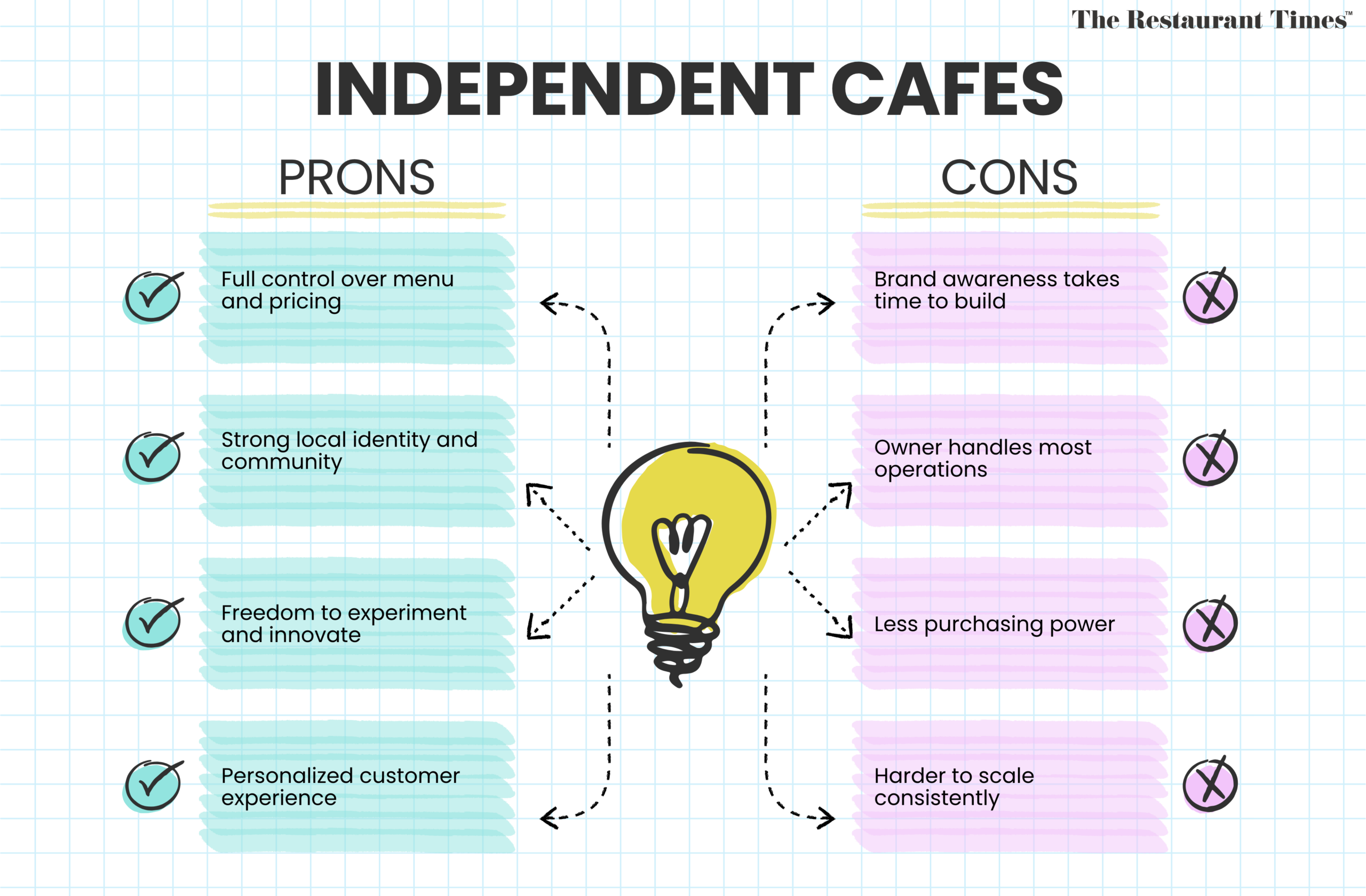
First of all, what is an indie cafe? Like wherever you live right now, there must be a local cafe in the vicinity…not a very popular one, but you know the owner, you recognize the baristas who work there, and you might even be a regular there.
That cafe might very well be one, given it is owned and operated by an individual, family, or, in some cases, a small group who has complete flexibility to:
- Change the menu as and whenever they want (of course, based on customer preferences and business performance)
- Choose suppliers and ingredients
- Set prices of each item and run promotions
- Decide the cafe’s branding and overall concept
- Hire and manage staff
- Test new dishes, drinks, and seasonal specials
- Make operational decisions without having to seek approval from someone else
Local coffee shops often go big on nurturing community culture and ethos. They feel like a deeply personal and intimate place to be at. Their menu has food and beverage options that locals prefer more.
Research comparing chain and local coffee shops confirms that chain coffee shops tend to put greater emphasis on tangible elements of quality, while indie coffee shops place more emphasis on social interaction.
Why (Or Why Not) Should You Choose Chain Cafes Over Local Shops?
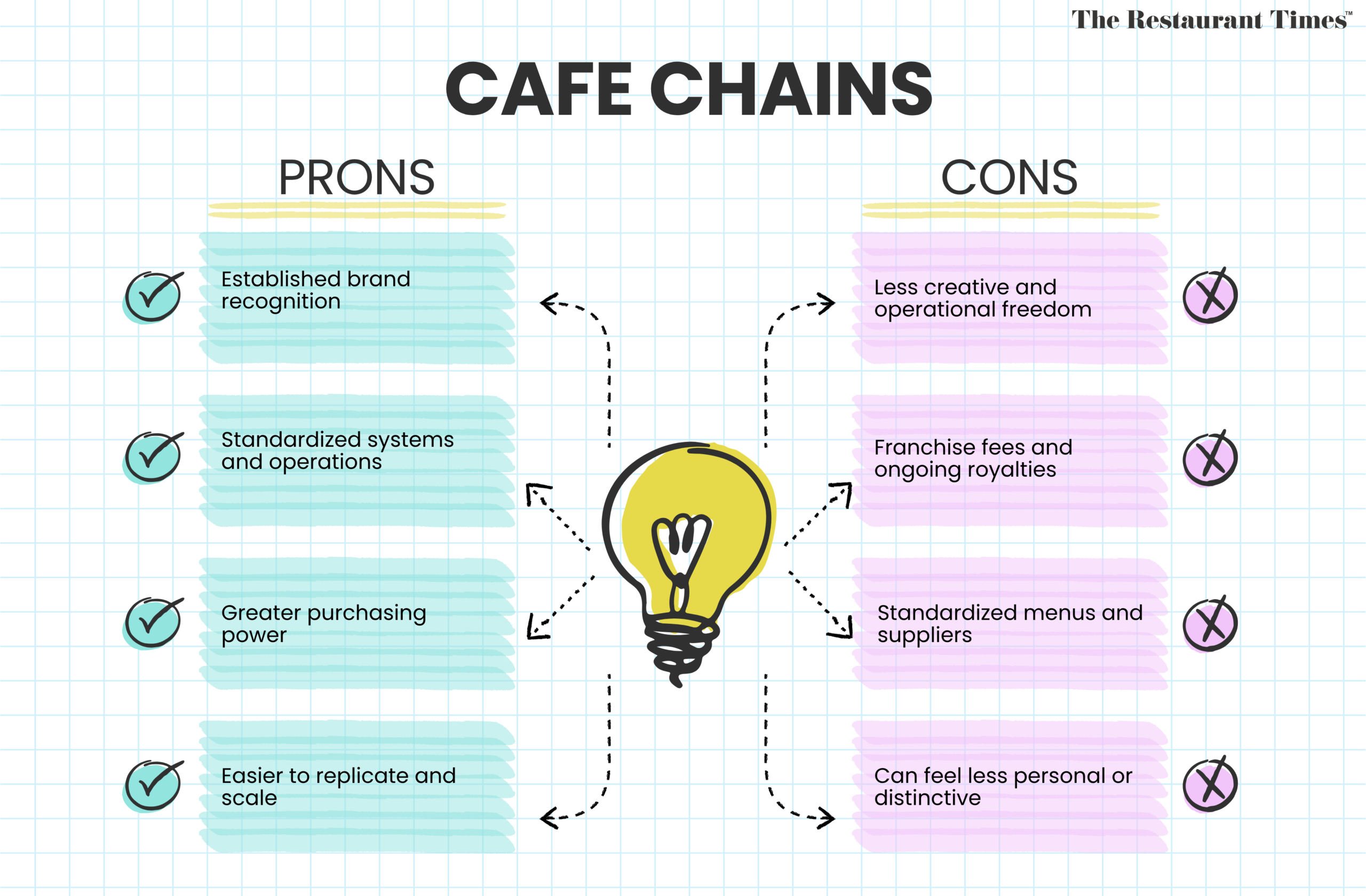
Imagine you’re planning to open a coffee shop tomorrow. You’ll need a brand, recipes, supplier relationships, POS, invest in staff training, marketing, a website, loyalty rewards, a customer acquisition strategy, a system for inventory, and decide where your cafe should be located…then the next location and the next as it scales.
Now imagine someone hands it all over to you – everything already tested and with very high chances of success.
That’s basically the appeal of a chain or a franchise model.
And because everything is standardized here, customers know what to expect in terms of food, atmosphere, service, ordering process…everything is super consistent and familiar.
Starbucks is a good example. It’s a cafe chain, and everyone around the world knows it for its consistent quality, reward programs, and service.
INDUSTRY INSIGHT
| There is an interesting middle ground emerging between cafe chains and local cafes. For example, now there are regional chains, specialty groups, franchise operators, and boutique coffee brands that combine some of the advantages of both. Dutch Bros is a perfect example. The company operates a drive-thru-focused model built around handcrafted beverages, speed, service, and community. It had 1,225 locations across 25 states as of June 30, 2026. Basically, it’s no longer “local equals experience” and “chain equals comfort.” Good operators can borrow from both. Local coffee shops can use strong technology, loyalty rewards, online ordering, and operational systems. A chain cafe can invest heavily in local marketing, community events, better coffee, and personalization. That is increasingly where the competition is. |
What About Coffee Quality?
Indie coffee stores often have more freedom to explore coffee. They can change the beans they buy, work directly with roasters, use different brewing methods, or play around with new food ideas.
That is one reason specialty coffee and local cafes have become so closely connected, especially after the pandemic (at least that’s what I noticed).
In fact, there’s a term: third wave movement. Google defines it this way: “It is a cultural and business movement that emphasizes the artisanal craft nature of coffee. It means you treat the coffee with the same attention to detail you would a wine or craft beer.”
With the third-wave movement, local cafe operators (and customers alike) have started giving more attention to coffee’s origin, processing, roasting, brewing, and the story behind cups.
But again, we can’t assume that if it’s an indie cafe, it’s 100% going to serve better coffee.
Quality and menu diversity can vary a lot from operator to operator. One of the local coffee shops might serve an exceptional pour-over and an average cappuccino. Another might have a brilliant product but inconsistent service.
Chains, though, have an advantage here because consistency is built into the model.
The customer may walk into a Starbucks in one city and another Starbucks halfway across the world and still get the same experience.
Convenience vs. Community: What’d You Choose?
We’d say choose the chain model if your target customers value:
- Speed
- Convenience
- Consistency
- Familiar dishes
- Loyalty rewards
- Easy access
- Predictable Wi-Fi and power outlets
- Multiple locations
- Mobile ordering
On the flip side, choose the indie model if your customers (and you too) value:
- Community
- Personal service
- A unique atmosphere
- Local identity
- Specialty coffee
- Artisanal brews
- Unique menus
- Local events
- A slower, more intimate experience
Neither list is absolute, and you can go and work from a local cafe as well, or maybe start recognizing a Starbucks-level cafe as your neighborhood cafe because it’s just there. What I have listed above are the tendencies each model is generally built to optimize, nothing hard and fast as such.
Next, Comes Your Budget: Which Model Costs More?
Don’t just go on to assume an indie coffee shop is automatically cheap.
Starting locally gives you more freedom, but it also means you carry the responsibility for everything. You have to negotiate your own lease, build your own brand, choose your technology, find suppliers, hire staff, create your menu, develop recipes, market the business, and figure out what works.
A franchise can involve substantial upfront investment too.
For example, Dunkin’s current franchise information lists an estimated initial investment of $443,000 to $1.8325 million, excluding the fact that actual pricing varies by location and format. It also lists a $40,000 initial franchise fee, a 5.9% royalty fee, and a 5% advertising fee.
So don’t compare only the cost of opening the doors. Compare what you receive for that investment – the ROI.
Your real comparison should be:
Local – Capital + time + experimentation + brand building + operational risk
Chain/franchise – Capital + franchise fees + royalties + less flexibility + established systems
There is Another Question: What Kind of Owner Are You?
If you enjoy experimenting, talking to customers, building a brand, and making decisions every day, an indie cafe may give you the freedom you want.
If you prefer established systems, operational structure, and brand recognition, a chain or franchise model may fit your working style better.
Ask yourself: Do I want to build the brand, or operate the brand? And there you have your answer.
Can Local Coffee Shops Actually Compete With Big Chains?
Yes, absolutely they can, and the only way is by being “themselves.” You can’t go and just copy what Starbucks or Dunkin’ is doing, and expect the same result.
The better approach is differentiation.
That could mean you can invest in:
- Making better coffee
- Local dishes
- Better barista knowledge
- A neighborhood-specific atmosphere
- Seasonal drinks
- Local collaborations
- Events
- A memorable interior
- Better food
- A community identity
Be uniquely you, and you’ll make it. See this example –
KEY TAKEAWAYS
| – A coffee shop can compete with big chains by leaning into local identity, better taste, personal service, and a unique vibe. – Local shops can build stronger community ties, while chain cafes tend to offer greater consistency, convenience, and uniformity across locations. – A coffee shop can become part of the local economy by hosting events, collaborating with nearby businesses, and creating spaces where conversation happens. – For remote work, reliable Wi-Fi, power outlets, comfortable seating, and a convenient location can matter as much as good taste. Customers may visit for remote work several times a week. – Remote work customers often value a calm vibe, while regulars may visit because they know the baristas, recognize familiar faces, and enjoy the whole experience. – Coffee quality can vary between locations. One shop may have exceptional taste in one shot, while another may miss on consistency. – A strong customer experience can deliver more than good coffee. Friendly baristas, thoughtful service, and a personal touch can make a big difference to repeat customers. – Owners should consider whether they want to build something highly flexible or operate within greater uniformity. Both approaches can work, but they matter differently depending on the owner’s goals. – Free drinks, loyalty rewards, local events, and collaborations can give customers more reasons to return, while simple choices like taking a walk to a nearby shop can make convenience part of daily life. – Don’t overlook the basics: cups, service speed, signage, location, and atmosphere all shape how customers eat, drink, work, and spend. There are plenty of ways to stand out without copying larger brands. – A business can save time by using established systems, while a local operator may have more freedom to experiment with products, service, and the signature elements customers remember. – The real difference comes down to what the owner wants to build: a highly standardized operation or a place with more personality, flexibility, and room for remote work. |
Frequently Asked Questions
1. What does it mean to have an independent café?
An independent café means a coffee business that is owned and operated by an individual or a small group. The owner has greater control over the menu, suppliers, pricing, branding, design, staffing, and customer experience.
2. Are independent coffee shops profitable?
They can be, but profitability depends on their sales volume, average check, rent, labor and food costs, pricing, waste, operating hours, and repeat customers.
3. How do independent coffee outlets compete with major chains?
They usually compete through differentiation. A local cafe can build a stronger community identity, offer artisanal coffee and unique food items, create a more personal experience, collaborate with local businesses, and respond quickly to customer preferences.