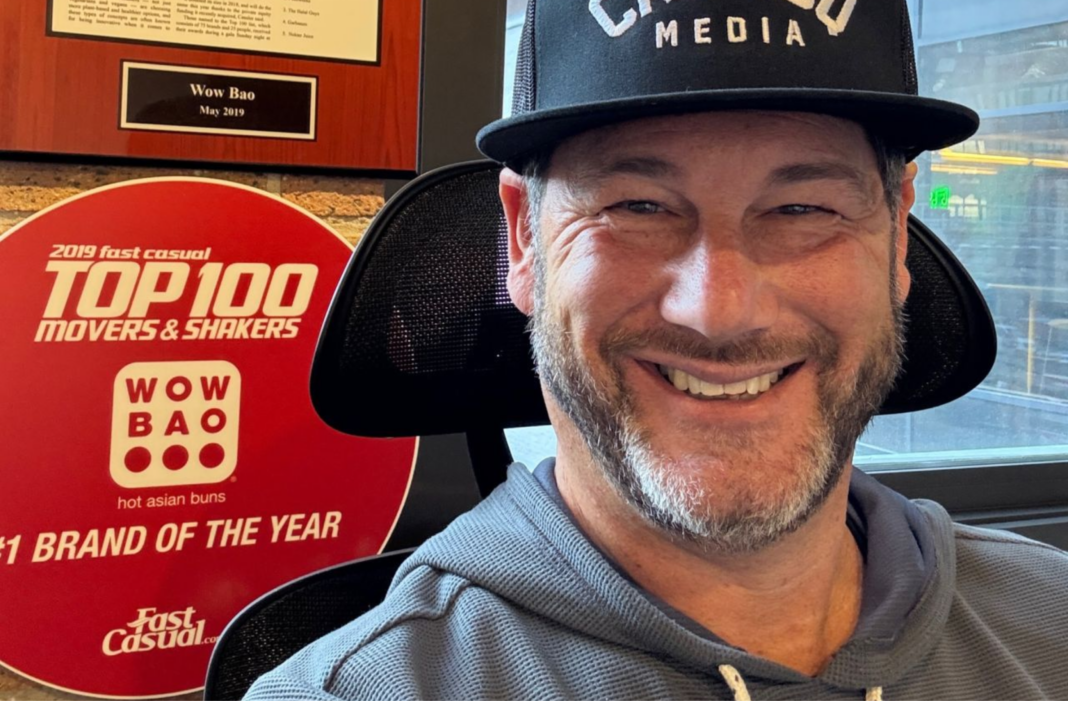

Geoff Alexander is President and CEO of Wow Bao, plus one of the key pioneers of technology and innovation in the F&B industry. From being one of the firsts to introduce online ordering to adopting Web3 and NFTs, Geoff has led the adoption of some of the most challenging innovations of our times.
Over the years, he has taken Wow Bao from three brick-and-mortar locations to a national food brand with a presence across restaurants, grocery stores, airports, college campuses, stadiums, vending, and other non-traditional channels.
Hop on as we talk to Alexander about his journey in the hospitality industry – about how he was super quick to adopt the concept of self-ordering kiosks, the importance of human touch and product quality in restaurants, and how to properly nurture staff.
Journey into the Hospitality Industry
Geoff Alexander began his journey in the hospitality industry as a general manager at Lettuce Entertain You in 1993. He worked his way up from a number four manager to a number two manager at Big Bowl, a small Asian concept restaurant in Chicago. He eventually grew into an area director role overseeing all the GMs.
Along the way, he gained a lot of valuable experience in menu development and restaurant design. This really came in handy as he eventually became the CEO of Wow Bao, a fast-casual Asian restaurant chain. One pivotal moment for Alexander was when he was given the freedom to make a bold design decision for the Minnesota kiosks.
He recalls calling Kevin Brown, the CEO of Lettuce Entertain You, and saying, “I think we need to make this wall green. Kermit the Frog green.” Brown’s response, “It’s only paint,” empowered Alexander to take risks and make bold decisions.
Embracing Self-Ordering Kiosks Early On
Alexander adopted self-ordering kiosk technology way before it was a common thing – in 2008. The inspiration to implement the technology at Wow Bao came when he was asked to wait in line or use a voting machine instead. He realized that technology could be a game-changer for his restaurant.
Lo and behold, post-installation, Wow Bao clocked in amazing changes:
- An immediate increase in check average (average amount of money that a customer spends at a restaurant) and tripled their flow-through (incremental profit)
- Eliminated a cashier and saved on payroll
- Ordering and receiving time was cut down to 54 seconds
Even today, Alexander almost always tests new tools to understand how they affect the guest experience and uses what works to improve the business.
Importance of Balancing Tech with Human Touch

Alexander coined the term ‘hospitechality’ to describe the combination of tech in hospitality while emphasizing that the human touch, which is btw the essence of hospitality, didn’t need to be sacrificed.
Alexander believes that food is not just about sustenance. “If you think about food, we’re surrounded by food at all times. We celebrate with food, and we commiserate with food. You always have to have food available. And if you remove the hospitality factor, the connection that food brings, that’s a problem,” he says.
During the pandemic, the restaurant industry relied heavily on technology; human interaction was minimal or non-existent. However, Alexander did the opposite. “… during COVID, when everybody was trying to stop having hospitality, right, and go to pick up and not have interaction, I actually ripped out all those machines and went back to counter service,” he says.
While AI and online reservations may be convenient, Alexander believes that a human can only handle special requests and personal touches.
Very recently, in 2025, Alexander spoke about AI-powered production planning and the importance of adopting emerging technology early, while also using physical restaurants as testing grounds for products before scaling them nationally across retail and other channels.
Using NFTs in Restaurants
When Alexander first explored NFTs, the idea was to use digital collectibles to build a more direct relationship between Wow Bao and its customers. Following on that vision, the brand, in 2013, launched its Digital CollectaBaos as part of the Hot Buns Club.
Created with NFT artist MANOVERMARS, the collectibles came with practical loyalty benefits, including discounts, additional Bao Bucks points, free meals, and merchandise.
Then, in 2024, Wow Bao brought the Hot Buns Club into Roblox through Dim Sum Palace, a virtual environment with a dance floor, restaurant, lounge, and hidden speakeasy. Players could explore the space, find a limited-edition Bao avatar accessory, and connect their Roblox account to the Hot Buns Club to unlock real-world rewards. The experience also included a chance to win free Wow Bao for a year.
Basically, the brand was using NFTs as part of a larger loyalty and digital engagement ecosystem.
Today, the consumer-facing Hot Buns Club is presented primarily as a traditional digital rewards program. Wow Bao’s current app focuses on points, discounts, birthday rewards, and personalized ordering, while the brand’s website still references the metaverse as one of the ways customers can experience Wow Bao.
Envisioning a Restaurant-Less Future for Wow Bao

Alexander envisions Wow Bao to be available wherever its customers are. It has established a significant physical and online footprint in airports, college campuses, stadiums, grocery stores, and other non-traditional venues.
The brand’s retail footprint has grown a lot since its early expansion into grocery. In 2025, Alexander described Wow Bao as having products available in approximately 15,000 grocery stores, while the brand had also expanded into roughly 500 hot-food vending machines. Together with its restaurant and virtual-kitchen network, these channels have made Wow Bao a sort of omnichannel food brand.
The obvious next step is to build an infrastructure to support that growth. In Q1 2026, Wow Bao opened a 77,000-square-foot manufacturing facility, producing four SKUs within its first eight weeks, with 15 more planned for the year.
Plus, Wow Bao’s ability to manufacture its products and ship them frozen also opens various doors for the brand, something that cannot be said about other brands. This versatility allows the brand to be placed in even unlikely places such as a space shuttle or a Tesla charging site.
Maintaining Product Excellence in Dark Kitchens
The dark kitchen model is a delivery-only restaurant concept that operates out of a commercial kitchen without a storefront, and Wow Bao operates on the same concept. While the dark kitchen model offers benefits such as lower overhead costs, it also presents challenges such as maintaining quality control and brand consistency.
But some cons Wow Bao faces are:
- Cooks at partner locations may not even be aware they are cooking Wow Bao dishes. This leads to inconsistencies in the quality of food.
- Cooks may not appreciate working with Wow Bao and may not be invested in maintaining its high standards.
“So this is the most dangerous thing a company can do. And all we can do is teach and share culture. And if someone’s not doing right, we can turn them off, and we have the right to turn them all at once,” Alexander says.
Because at the end of the day, the absence of a physical storefront does not mean the absence of a brand experience. In fact, it makes the brand even more important. “We have a soul,” Alexander says. “You can socialize – like we exist. We’re not a brand that just made ourselves last night, who had some packaging and threw some food in.”
For Wow Bao, maintaining product excellence in a distributed kitchen network comes down to three things: standardized execution, shared brand culture, and the willingness to remove partners who cannot deliver either.
Importance of Social Listening for a Restaurant
Social listening refers to monitoring social media platforms to gather insights and customer feedback about a brand, product, or service. At Wow Bao, Alexander stresses the need for pattern recognition when addressing customer complaints in the restaurant industry.
He emphasizes the importance of understanding the problem before attempting to solve it, as external factors may be at play, such as third-party delivery fees. After that, responding positively to both positive and negative reviews can help mitigate negative feedback’s impact.
According to Geoff, the key is dedicating resources to social listening and understanding what is important to the brand. As he says, “It (Social media) is as simple. It’s just, are you dedicating resources to it?”
Hiring and Nurturing Talent

When it comes to hiring the right talent, Geoff believes it is a must to assess whether the candidate fits the company culture and if they’ll be good in the bullpen with all the other players. He says, “If I don’t get that emotional spark that you’re going to add value to the team, that’s the problem.”
Regarding nurturing talent, Alexander emphasizes connecting with your team members. He advises entrepreneurs to invest in their employees’ growth and development and give them opportunities to learn and advance.
He says building a nurturing environment is key to retaining top talent. “People want to know that you care about them, that you’re invested in their growth, that you’re invested in them as a person,” he says.
In all, Alexander’s tenacity and vision have earned him industry-wide recognition, including being named a Top 25 Executive in the Fast Casual Industry for 6+ consecutive years. In 2025, he added another major industry honor to that record when he was named a Silver Plate Award winner by IFMA’s Food Away From Home Association in the Grocery, Convenience & Specialty Retail category.
He has also been hailed as one of the most influential restaurant CEOs in the country by Nation’s Restaurant News, cementing his status as a prominent figure in the restaurant industry.
Beyond his love for the culinary arts, Alexander is a fitness enthusiast and doubles as a Spin Instructor, where he uses his passion for helping people stay fit and healthy with indoor cycling workouts.