

Home to office, office to home, repeat, repeat, repeat…so much that now one can’t even tell which is better: work from the office or work from home. Literally, both sometimes feel indistinguishable, minus that at home people get to work in their pajamas, albeit for longer hours and no gossip with colleagues over coffee.
And that’s where a very appealing middle ground comes in, i.e., work from cafe culture.
For guests, they get a change of surroundings, which makes the workday feel less repetitive without requiring the structure of a traditional office.
For owners, it’s a chance to fill tables, build a loyal customer base, and keep the business afloat during slow hours.
But the question is: how do you make sure your coffee shop is a spot that remote professionals want to work at, stay at, and come back to? This blog lists a few super practical tips to help you with the exact.
What You’ll Learn
- Why remote professionals choose coffee shops as workspaces.
- How to build work-friendly spaces for remote professionals.
Why Coffee Shops Became Everybody’s Second Office
It’s pretty obvious – remote work gives people the option to work from anywhere…and when the whole world can be your office, the cafe is an easy pick.
And it’s not even something that started just yesterday. Coffee houses in 1600s London used to be hubs for news and business deals. Issac Newton too worked from a cafe, the Grecian Coffee House. What changed was that, over time, cafe culture shifted from social gatherings to more serious workspaces.
Today, working from cafes is a global subculture, with its own etiquette, memes, and “I found the best table” flex.
Almost anyone, be it freelancers, remote workers, students, entrepreneurs, digital nomads, etc., can walk into a coffee house with their laptop and headphones on, order a coffee and sides, and get working.
INDUSTRY INSIGHT
| Between 2019 and 2023, work-from-home rates rose 5x, and about 40% of US workers now work at least one day a week remotely. At the same time, work-from-cafe started gaining traction too. In a 2024 Coffee Intelligence survey report, 60% of respondents said they prefer working from coffee shops when not at their own place, while 40% chose dedicated coworking spaces. |
Why & How a Coffee Shop Boosts Creativity
In 2012, a few researchers ran five experiments. They found that moderate background noise of about 70 decibels is better for working than low noise at 50 decibels or loud noise at 85 decibels. They described the pattern as “an inverted-U relationship between noise level and creativity.” Basically, if you want to work on something creative, a little hum is good.
Why? A small distraction nudges our brain to think bigger and more abstractly, and that’s what happens at coffee shops. There’s very soft music in the background, there’s a whoosh of the espresso machine, clinking cups, and very low chatter, if at all.
Note: This research supported an effect on creative cognition, not a universal productivity boost; still, it’s a super useful piece of info for operators.
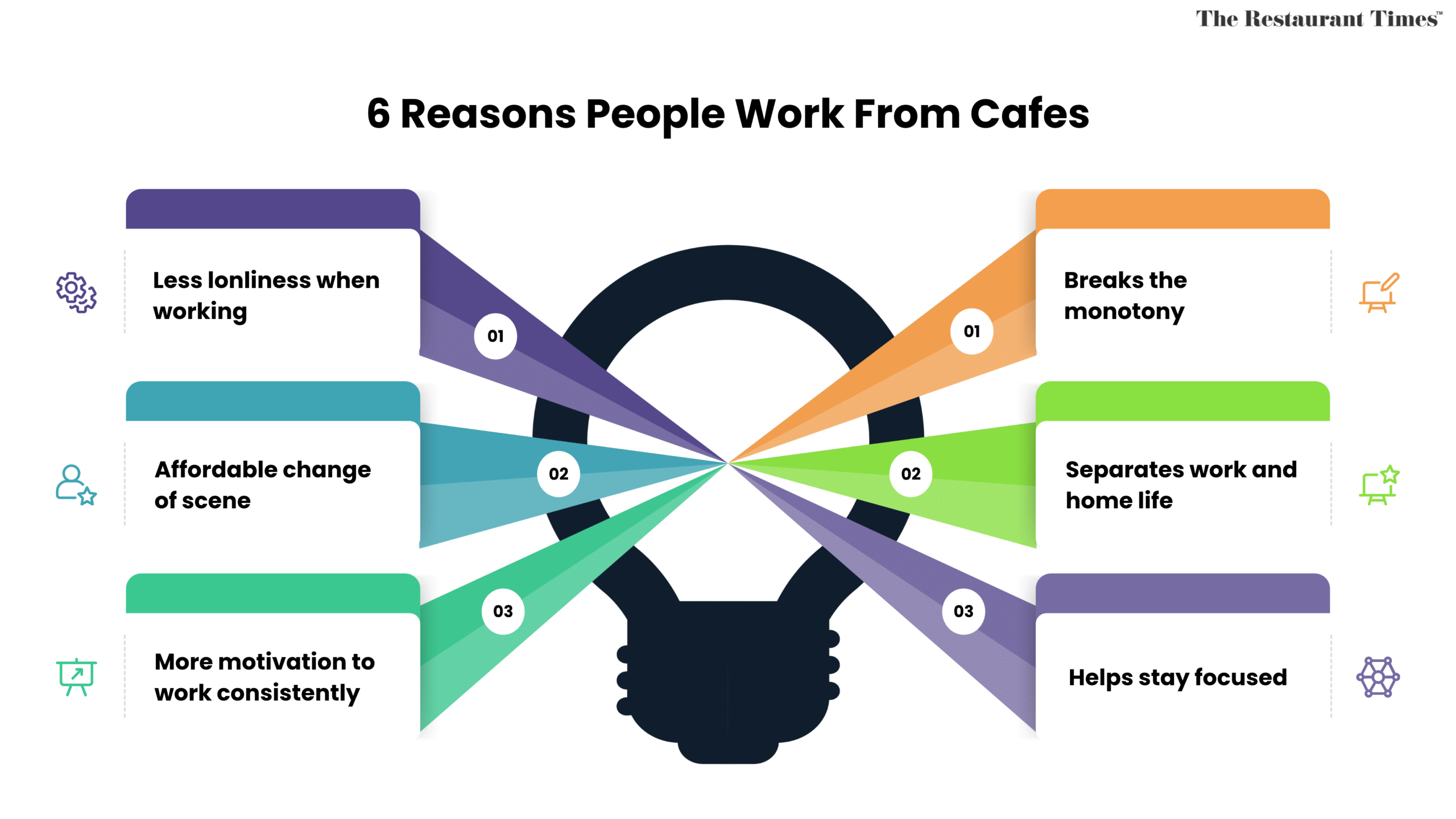
Because understanding why people choose to work from cafes in the first place is how you’ll know what they actually return for. Some of the biggest draws are:
- They feel less lonely
- It doesn’t cost much – just the price of drinks and sides.
- It’s kind of motivating – cafes create a comfortable space, with warm lighting and a cozy spot to sit, that boosts productivity.
- It reduces the monotony of working from the same place every day
- Leaving the house helps separate work from personal life.
- Because many people are working around, it gives people a soft push to stay on task.
What Remote Workers Need from a Cafe
A person working from a cafe may need to:
- Stay on a laptop for several hours
- Join a video meeting
- Charge a phone and computer
- Take a private call (which, btw, you should state that they take it outside)
- Order another coffee without having to get in the queue
- Eat lunch
- Use the restroom without worrying about their belongings
- Connect to reliable Wi-Fi
And most importantly, leave without feeling that they have overstayed their welcome.
How do you provide all this?
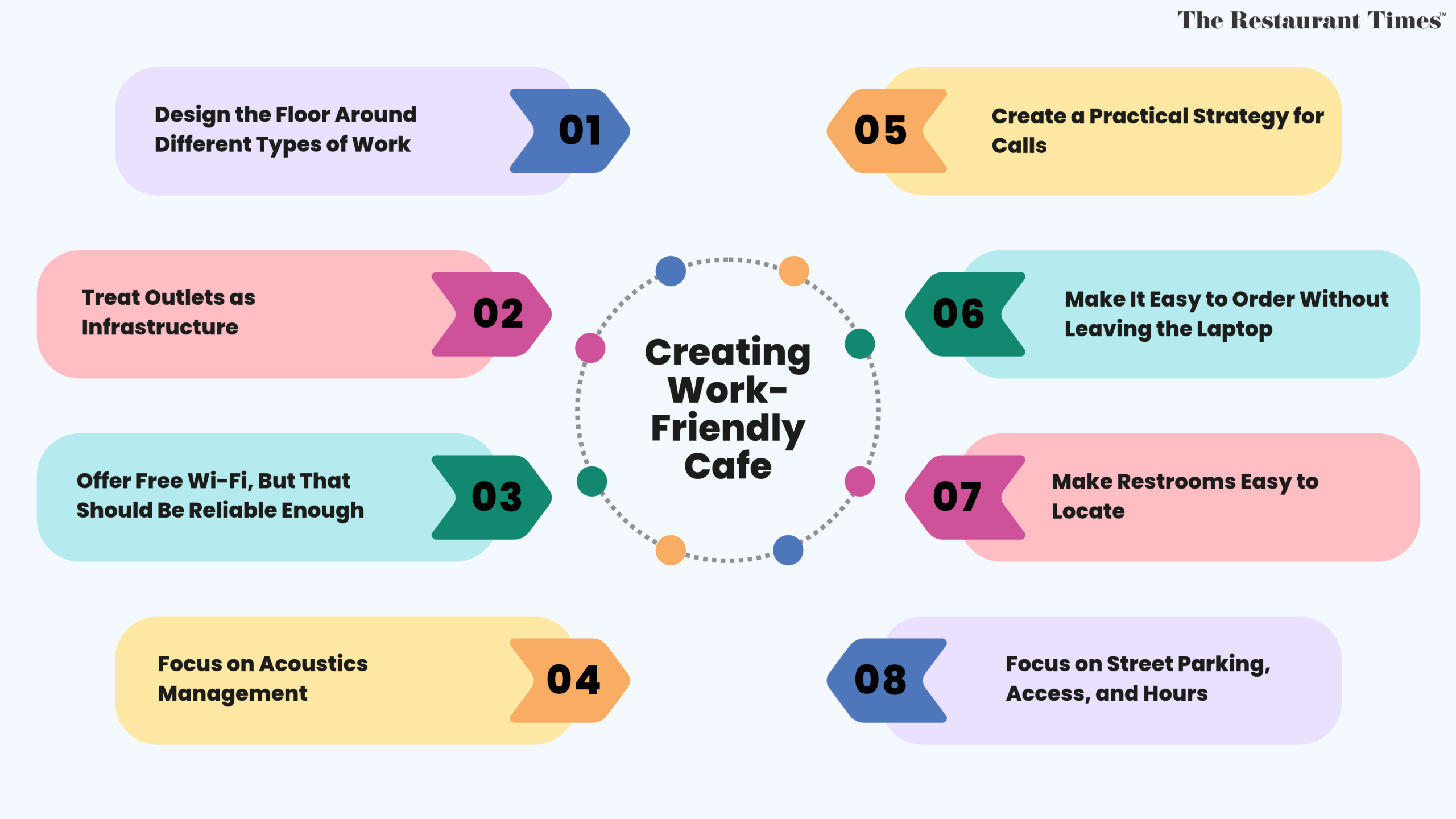
#1: Design the Floor Around Different Types of Work
Of course, unless you are a dedicated work cafe, you will likely serve different types of crowds across dayparts. There will be people who are just meeting their friends for chit-chat. Then, there will be those who will grab a quick coffee and leave. Some will spend three hours working on their laptop. Each of these people has different behaviors and preferences, and you must meet them all.
How? First, maybe you can play around with seating – get larger tables for groups and smaller two-tops for solo customers, and if your footprint allows it, designate a separate section for people who need to concentrate on their work.
For this, you’ll need to be super attentive when you’re designing your coffee house – like you can’t put a work table near a pickup counter and expect people to keep showing up, can you?
#2: Treat Outlets as Infrastructure
If someone is working on a laptop, they would need to charge it – that’s obvious. For that, what you should do is place the outlets where customers can reach them easily. In fact, you can install tables with integrated power and wall outlets at seated height.
Avoid any kind of setup where customers would need to run charging cables across walkways – it’s inconvenient and may cause safety issues as well.
Most importantly, make sure there is no dead outlet.
Note: Someone working on a laptop may not feel comfortable leaving their belongings unattended in case they need to step away for a bit. It’s always better to have seating planned with clear sightlines to tables.
#3: Offer Free Wi-Fi, But That Should Be Reliable Enough
Make sure your wifi is reliable and secure. You’d better test it yourself, like try connecting multiple devices to it, stream content, run a video meeting, and check performance from different corners of your cafe and at different times of the day.
For security, the Federal Trade Commission recommends keeping guest Wi-Fi separate from a business’s internal network and using appropriate wireless security such as WPA2 or WPA3.
If you advertise that you offer free Wi-Fi, make sure people can easily see the network name and password (stick it on every table if you want). Plus, if there are any, clearly communicate login requirements, usage limits, and time restrictions with customers.
#4: Focus on Acoustics
A productive cafe doesn’t necessarily need to be quiet. It needs to be comfortable to listen to. While you probably can’t control the footfall, you can try using upholstered seating, acoustic panels, curtains, rugs where appropriate, plants, and other sound-absorbing materials throughout your space. These things help control reverberation.
#5: Create a Practical Strategy for Calls
Most often than not, remote employees may need to join a Zoom meeting, take a sales call, conduct an interview, speak with a client, or attend a presentation during the day.
To make it work, it’s always better to provide them with a semi-enclosed corner away from the main traffic – at least for short calls.
If your space and budget allow it, a small phone booth or enclosed booth for brief meetings can be extremely useful. If not, set the rules. For example, you can ask customers to use headphones for meetings, keep their voices low, and in case of longer conversations, take it outside. Be very polite in doing so.
#6: Make It Easy to Order Without Leaving the Laptop
One of the most overlooked revenue opportunities in a work-friendly cafe is the second order. If a customer has been working from a seat for a longer hour and their coffee is finished, they will likely order lunch next.
But with a laptop, phone, and bag on the table, leaving everything unattended doesn’t feel like the best option.
That’s where you can play smart and offer them options like QR ordering, mobile ordering, or simply waitstaff who go to their table and take the order.
Plus, make sure your menu is practical enough. People tend to repeat ordering sandwiches, salads, snacks, smoothies, tea, fries, etc.
#7: Make Restrooms Easy to Locate
Again, if someone is working at your coffee house through an afternoon, of course they might need to use the restroom. If their seat gives them no way to keep their eye on their belongings, they may feel forced to pack up their laptop every time they leave the table.
So, where possible, arrange seating so customers have reasonable visibility of their belongings. Plus, keep walkways clear and make the restroom easy to locate.
#8: Treat Street Parking, Access, and Hours as Part of the Product
A remote professional arriving with a laptop, charger, headphones, and notebook is going to value convenience at every stage of the visit. If your coffee shop has nearby street parking, a paid garage, bike parking, or convenient public transportation, make that information easy to find.
The same principle applies to hours. Someone may choose your store specifically because it opens early enough for their first meeting or stays open through the afternoon. Keep your website and Google Business Profile accurate, particularly if your hours change seasonally or on weekends.
See, creating a work-friendly space doesn’t mean you just put an outlet beside every chair and call it coworking. You need to understand what your customers want, which is, btw, very different from those who come to a coffee shop to hang out and have fun. Plus, for everything you offer, you need to make the economics work as well.
Cafes are really great spots for people to work (it’s proven time and again) – all you need to do is create an environment that they can rely on and would want to come back to.
KEY TAKEAWAYS
| – Create ample seating with different setups so solo workers, groups, and people meeting friends can comfortably co-use the space.Great coffee still matters, but remote professionals also look for reliable Wi-Fi, comfortable seating, useful food options, and convenient drinks that make staying for several hours easier. – A thoughtfully designed main area should balance conversation and concentration, while the overall atmosphere should feel comfortable enough to stay productive without becoming completely silent. – Reliable outlets, strong Wi-Fi, and clear sightlines can go a lot toward making the experience practical. Test the network, check every outlet, and make sure customers can work without worrying about their belongings. – Acoustics are a lot more important. Upholstered seating, rugs, curtains, plants, and acoustic panels can create an atmosphere that feels calmer without eliminating the natural energy of the space. – Make ordering easy for people working on laptops. QR ordering, mobile ordering, or table service gives customers a perfect opportunity to order more food, including sandwiches, salads, snacks, smoothies, and tea, without leaving their belongings unattended. – Keep food practical and easy to eat between meetings, while offering tea and great coffee for customers who want something beyond a quick meal. A lot of remote workers may return for the quality and convenience as much as the workspace itself. – Calls require a little respect for everyone sharing the space. Semi-enclosed seating, headphones, lower voices, and clear rules can help. Longer calls can be hard to accommodate, so make expectations easy to understand and open to everyone. – Accurate hours, parking information, public transportation details, and a visible sign can help people find the right entrance or understand where to go. Keep your website page and business information current so customers do not have to search through their inbox for basic details. – The perfect work-friendly environment does not have to be silent or overly formal. It needs to make live work easier while leaving room for enjoying food, tea, conversation, and the occasional creative hit of art or energy. It can be hard to balance all these needs, but there are plenty of practical ways to make it work. – Start by understanding how people actually use the space. There is a lot to consider, from seating and sound to ordering and access, but operators can explore these details one at a time and build a list of improvements that make the experience better across different places in the space. – There is a lot of value in creating a reliable work environment. The goal is not to make every corner identical, but to give remote professionals a perfect place to work, eat food, enjoy tea, and return when they need a dependable change of surroundings. |
Frequently Asked Questions
1. What is proper cafe work etiquette?
For customers, basic cafe etiquette includes making a purchase (or two if you stay for even longer), keeping calls at a reasonable volume, using headphones for meetings, respecting shared seating, and more.
2. Is there a dark side to coffee culture?
There can be. Long laptop stays create pressure on seating capacity, particularly in small cafes during busy periods. Research also found that weekday customers who stay often work alone, which makes cafes feel less socially interactive overall.
For customers, poor Wi-Fi, unreliable outlets, noise, crowded seating, and environmental interruptions can make a cafe a difficult workplace.