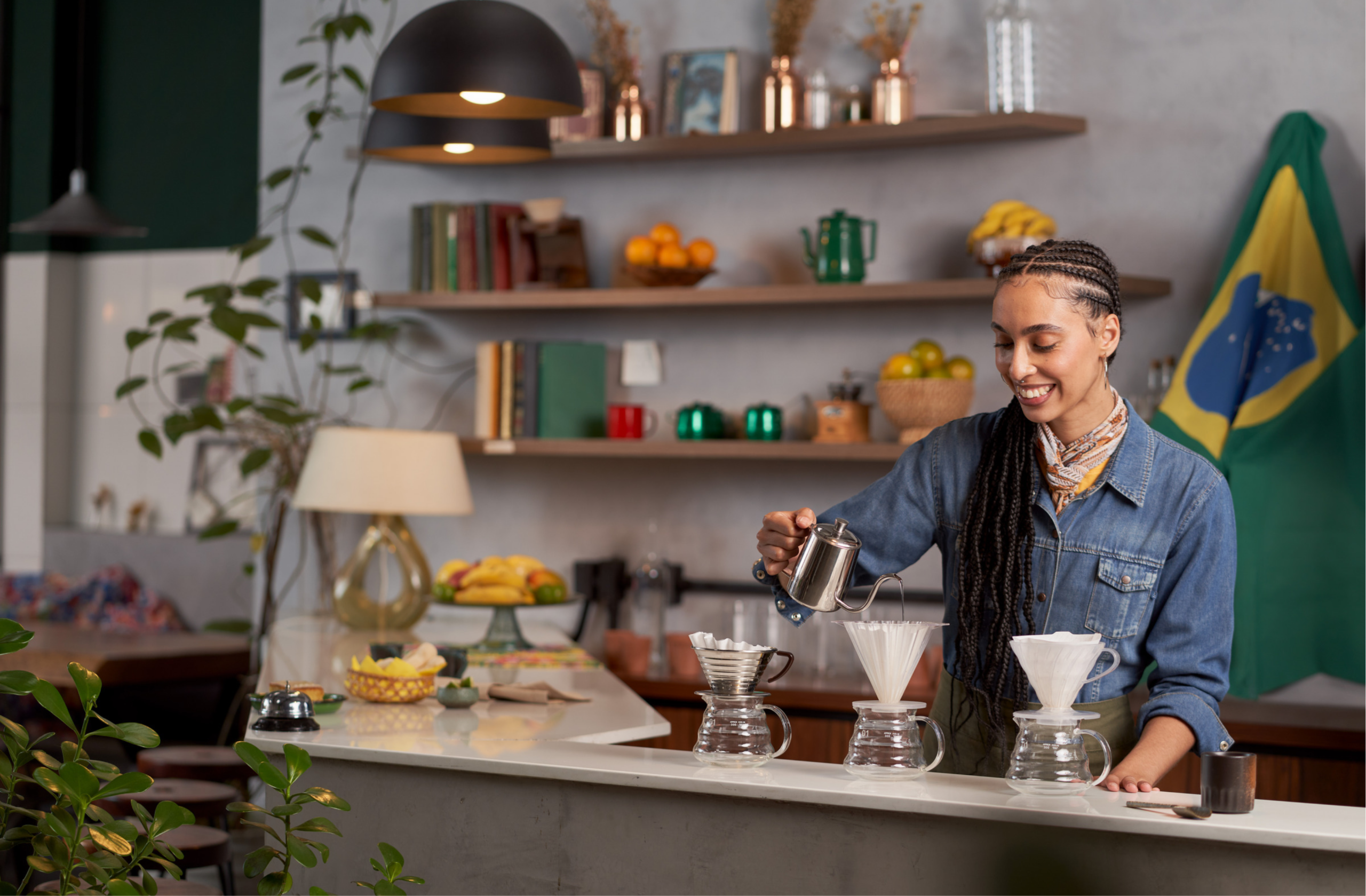

We very, very recently did an interview with Abhinav Mathur, Founder and CEO of Something’s Brewing, where he said this one line: “Home brewing doesn’t eliminate the café experience because cafés offer things that a home kitchen can’t replicate, be it in terms of hospitality, discovery, social interaction, new coffees, food, and the experience of being somewhere.”
Of course, more and more people nowadays prefer to make their own coffee at home, but that doesn’t cannibalize the cafés. Instead, people now have far greater expectations for each visit.
And that makes it all the more important to talk about coffee shop interior design. Because a café, yes, it serves coffee, but it’s also a place where people work, meet friends, have their first dates, business meetings, and more. And whether they’d want to come back again partly depends on how well your interiors do the convincing.
That’s what this article is about – best cafe interior design ideas that you could implement right away, whether you’re working with a sprawling floor plan or a small coffee shop design that has to make every square foot count. We’ve pulled together coffee shop ideas for bigger footprints and small coffee shops alike, so there’s something here whichever category you fall into.
The ideas listed below will help you –
- Reel in more customers
- Give them a reason to take out their phone and click a selfie
- Encourage them to recommend your place to their friends
We’ll also get into small coffee shop layouts, budget-friendly coffee shop design tricks, and a full round-up of cafe themes you can explore, so consider this your one-stop guide to cafe interior design ideas. Here you go!
What You’ll Learn
- How to design your café interior to balance customer comfort, functionality, space, and visual appeal.
- Practical café interior design ideas to make your space more memorable and inviting.
- A dedicated approach to small coffee shop design for tight footprints.
Budget-Friendly Coffee Shop Interior Design Ideas
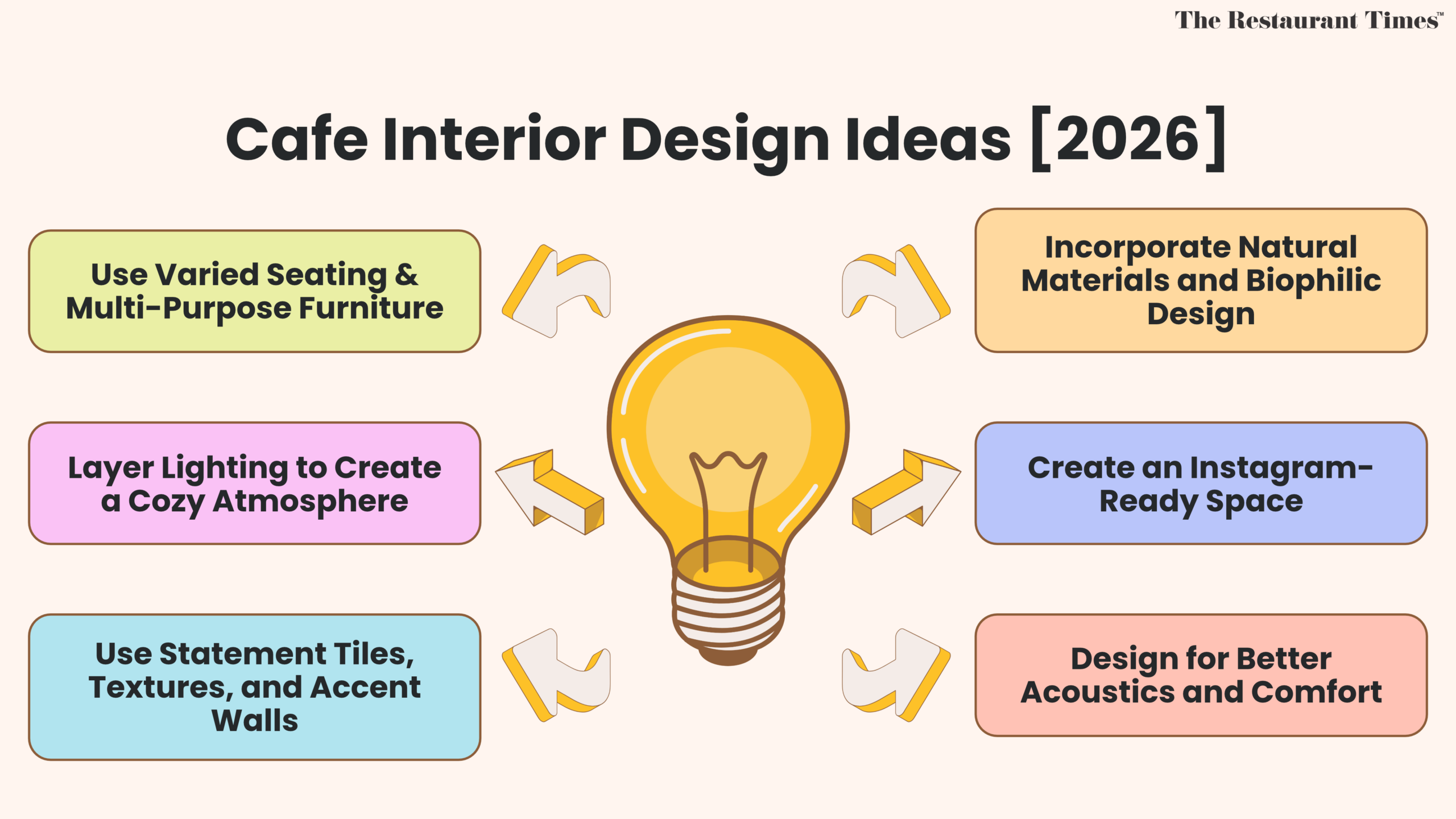
Every one of these interior design ideas is meant to be used together, not in isolation, because your seating, your lighting, your materials, and your walls are all telling the same brand story at once.
A strong coffee shop interior design happens because every design decision, from the wall art you hang to the palette you pick, is made with the same customer experience in mind.
Think of these cafe interior design ideas less as a checklist and more as a single cafe interior design language that should run consistently from the entrance to the back wall. If you only take away a handful of ideas from this guide, let it be this: good cafe interior design ideas rarely work in isolation, so pick two or three and let them shape every other decision in the room.
A confident, coherent cafe interior design will always beat a room stitched together from a dozen unrelated ideas, no matter how good each individual idea looked on its own.
Idea 1: Use Varied Seating & Multi-Purpose Furniture
So, the first idea is to use varied seating arrangements. It is actually one of the simplest upgrades you can make in your cafe right away, and it will enhance your customer experience fr. In fact, there is this particular study on the same topic if you want to go into the very detail of it: Effect on users of the seating element types in cafe/restaurant.
What it means is if you use a mix of, let’s say, high chairs, lounge seating, and a few floor-level nooks – you’re curating to the preferences of a solo laptop worker, a group of friends, and a couple on a date at the same time, and each feels extremely personal to guests.
If your footprint is tight, you might try using multi-purpose furniture as well. They enhance space efficiency without making the room feel cramped or crowded. Like you may get stackable stools, benches that double as storage, or some small tables that can be pushed together to make one big table for groups.
Plus, get lightweight chairs so they can be moved around as needed. It will allow for easy movement between layouts so one coffee shop interior is ready to serve both morning and evening crowds with the same confidence.
Very important point: Furniture is important, but so is the overall layout of your cafe.
For example –
Single-line layouts improve customer flow in narrow spaces and keep the line to the counter separate from seated guests.
Narrow counters create additional seating space.
Wall-mounted menus save counter space and improve visibility, and wall-mounted shelves and vertical displays let you use height instead of floor space – Again, one of the most budget-friendly design decisions you can make for your small coffee shop.
As for which one you should go with, we’d suggest you think about the constraints of your space. Like if your café is narrow, prioritize flow. If floor space is limited, go vertical. Use wall-mounted shelves near the counter. It will do much more for a small space than adding another table ever could.
Idea 2: Layer Lighting to Create a Cozy Atmosphere
Albert Hadley says, “Design is defined by light and shade, and appropriate lighting is enormously important.” Well, can we even argue?
Lighting shapes people’s mood. For example, if you layer in warm-toned bulbs, vintage pendant lights above tables, wall sconces, and table lamps, your cafe will look more alive, lived-in. Why? Because layered lighting creates pockets of light and shadow that add depth and make different areas feel distinct.
Sticking to warm tones across your fixtures, rather than mixing cool, clinical bulbs with cozy furniture, keeps the whole room reading as one cohesive, cozy space rather than a patchwork of unrelated design decisions.
Warm lighting, specifically, encourages customers to stay longer, which is really important if you want your cafe to double as a workspace or meeting spot. Soft lighting near lounge seating does the same job in a different register, cueing people to slow down, while accent lighting on a single feature wall gives the eye somewhere to rest.
Natural light makes small cafes feel more open, so you should try to prioritize unobstructed windows over heavy drapes, since a bright, sunlit room always looks more inviting for customers looking from outside.
Plus, if you play around with spotlighting, it will emphasize your decor elements more, and a well-placed ceiling fixture can pull focus toward a mural, a shelf, or a favorite object without you having to say a word.
Idea 3: Incorporate Natural Materials and Biophilic Design
Biophilic design is where you use more greenery in and around your cafe to soften the room a bit and improve overall atmosphere. There was even a study published in the International Journal of Contemporary Hospitality Management on the effect of indoor plants in restaurants. Researchers found that plants have a real positive impact on customer satisfaction and loyalty, partly because they improve the aesthetic value of the space and create a stronger sense of escapism.
Adding a few planters here and there, like near the entrance or hung above the counter, breaks the linearity, adds visual softness, and makes your cafe look more approachable and photographable.
Similarly, when you use natural materials like wood, stone, rattan, linen, cork, etc., throughout your cafe, the interior feels much warmer and more tactile. A reclaimed wood counter, a stone accent wall, or even a single wood shelf looks much, much better than just a whole wall of paint. They also tend to age really, really well, which means your café develops more character over time instead of looking dated.
Skip the overly polished, brand-new look here – A slightly worn wood surface or a rough-cut stone tile seems authentic, so keep it that way.
Caution – Don’t overdo greenery or natural materials. Bring in only as much as the space allows without looking cramped.
Idea 4: Use Statement Tiles, Textures, and Accent Walls
In case you were planning to, or in the future will, ever do a renovation of your cafe, start with tiles.
For starters, subway tiles brighten walls and are cost-effective. Accent tiles create a focal point behind the counter or around the entrance. Glossy tiles reflect light and make spaces feel larger. Pairing them with the right color scheme keeps a small space from feeling busy at all times.
When choosing which tile to go with, think about your budget, available space, and how much maintenance you can afford. Here are some tips to help you out:
- If you have a tight budget and can’t hire a crew, you can DIY with peel-and-stick tiles. It’s one of the easiest DIY projects you can take on – and it will be a really fun activity + will count as smart design too.
- Use large-format tiles if you want your café to look even more spacious. Fewer grout lines create a cleaner visual view.
- Use tiles that are easy to clean and look neat in places like the dishwashing area, food-preparation zone, behind the espresso machine, etc.
- For the floor, use tile that provides appropriate traction/slip resistance, especially near the entrance and where spills are common.
Most importantly, even if you can and would want to, don’t tile every wall in there, at least not with the same kind. Use statement tiles to draw attention, practical surfaces where you expect heavy cleaning, and simpler finishes elsewhere.
A single accent wall, done well, beats four walls of the same pattern “trying” too hard – almost always.
Idea 5: Create Instagram-Ready Coffee Shops
Gen Z are social creatures. They photograph and post on SM almost everything, and everywhere they go. Design plays directly into that. For example, if you use something artistic, not-so-common element in your cafe…people are going to look at it, click a selfie, and add it to their stories…which is basically kind of free promotion for you.
A bold mural, a gallery-style installation, or even a hand-painted sign by the entrance gives people a reason to pause and shoot.
You can also use bold, expressive color palettes so that your cafe stands out, but make sure it still looks appealing to the eye because “one sits more comfortably on a color that one likes,” says Verner Panton.
INDUSTRY INSIGHT
| Design elements you choose should add to the comfort of your guests. Technology here can play a big role. After all, customers prefer quick service and convenience, and investing in POS that speeds up billing, offers multiple payment options, and routes orders directly to the kitchen can enhance customer experience. Moreover, 62% of customers love it when cafes offer free WiFi and wireless charging. See if you can offer something special too. |
Idea 6: Design for Better Acoustics and Comfort
Okay, so while most cafes go all in on how their space looks, how it sounds is just as important.
What you can do for it is reduce echo by using upholstered seating, rugs, curtains, textiles, or ceiling panels so the room is quieter and allows more comfortable conversations.
Softer materials on the ceiling and walls absorb sound and soften light at the same time, so the two design decisions tend to reinforce each other.
As for why you should double down on acoustic management?
Because “when customers feel comfortable and engaged, they spend more time in the space. Longer engagement often leads to higher conversion and repeat visits. Good design doesn’t push sales aggressively. It creates the right conditions for them to happen naturally.”
A Few More Coffee Shop Interior Design Ideas Worth Testing This Year
Still looking for some unique ideas? Here are a few that work wonders for smaller coffee shop interior design:
First – Swap a flat ceiling for a textured or exposed one. It will instantly lift a modern coffee shop interior design without touching the floor plan, and a change to the ceiling treatment often helps with acoustics too.
A coffee shop interior that leans into visible beams, exposed brick, or a vaulted ceiling is especially trendy these days.
Next, you can play around with texture. A rougher stone counter next to a smooth wood table gives the eye somewhere to travel between walls, counters, and the ceiling without any single surface fighting for attention.
Two well-chosen walls of interest tend to outperform four fully decorated walls every time, and mixing two kinds of texture is almost always more interesting than one polished surface everywhere.
If you’re short on inspiration here, sticking to a materials palette built around three types of texture – one rough, one smooth, one soft – is a reliable starting point for any coffee shop interior.
Style-wise, don’t feel locked into a single modern look just because it photographs well. A modern coffee shop can still borrow warmth from an older style, and the best coffee shop interior design ideas usually blend more than one era or style.
The ambiance you’re chasing matters more than any single style label – a cafe with the right ambiance will earn repeat visits even when none of its individual design choices are especially bold, and that ambiance is worth protecting even as trends shift around it.
A little decor goes a long way, too. One or two considered decor pieces near the entrance can do more for a small cafe design than decor scattered across every surface, and a small cafe design with a light touch tends to age better than one that chases every trend. If you’re renovating on a tight timeline, stick with a short list of design ideas you can actually execute well.
For anyone working with small spaces, remember that small spaces read as inviting, not cramped, the moment you stop trying to fill every wall and every inch of floor.
A little breathing room near the window gives the whole coffee shop interior an open feel, and a single clear sight line from the door to the counter goes a long way toward the kind of inviting atmosphere that makes people want to stay for a second visit rather than duck in and out.
It’s a small, welcome relief from the outside world when a café gets this right – a five-minute stop can suddenly feel like an actual pause in the day, which is really the whole point of getting coffee shop interior design right in the first place.
Small Coffee Shop Design: Making a Compact Space Better with Glossy Tiles, DIY Projects, & More
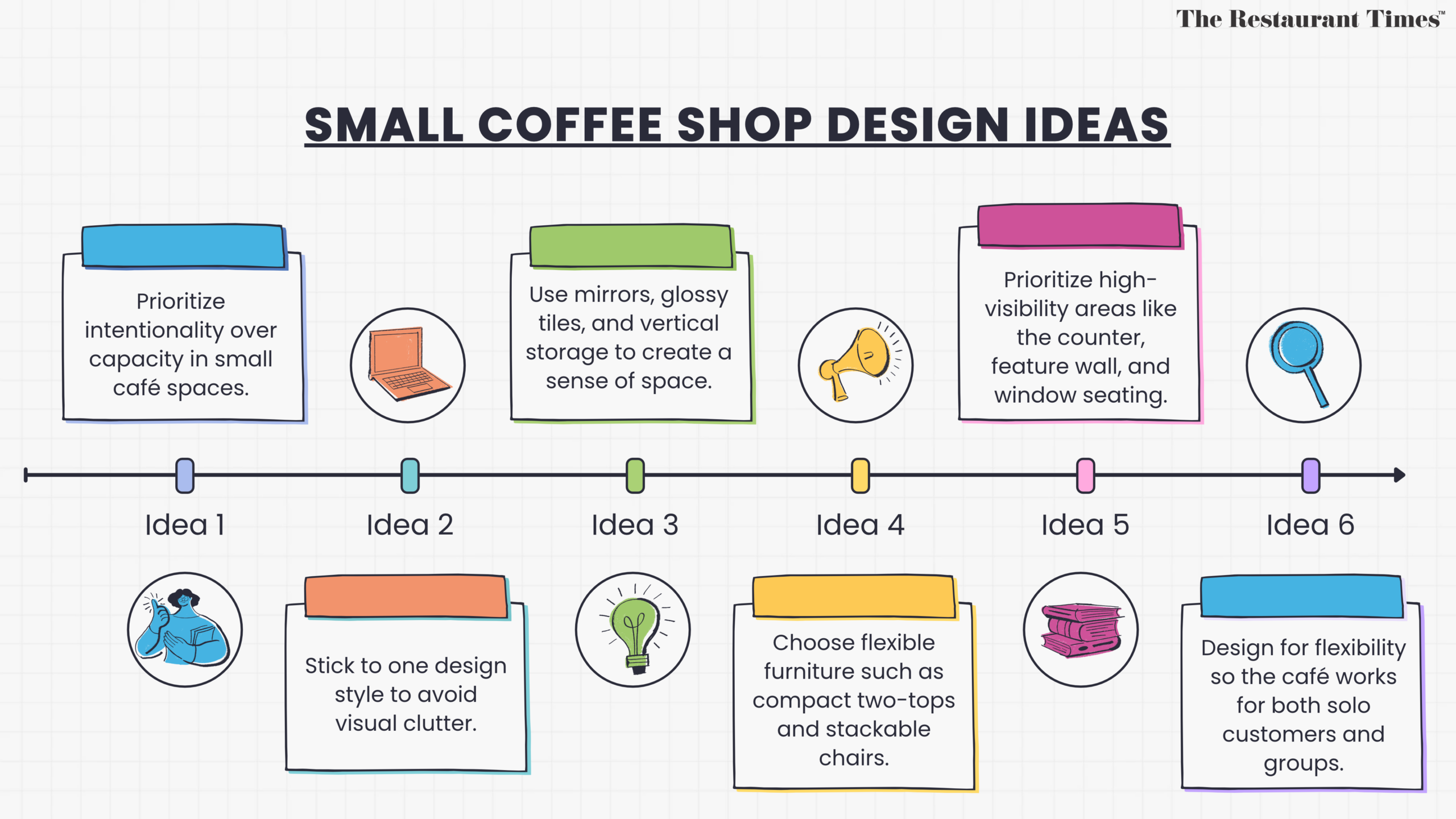
Not every café has room to spare, and small coffee shop design comes with its own rulebook.
If you’re working with small spaces, the goal isn’t to squeeze in more furniture – it’s to make the small space you do have feel intentional.
Start by picking a single style and sticking to it because a small coffee shop that mixes five aesthetics reads as cluttered no matter how good the individual pieces are.
For a small coffee shop, mirrors and glossy tiles help bounce natural light around and make the room feel bigger than it is, while narrow counters and vertical storage free up floor space for actual seating.
A couple of compact two-tops that can be pushed together, chairs that stack, and one simplified palette all do a lot of quiet work in a small coffee shop design – they let the space flex between a solo laptop customer in the morning and a full table of friends by evening.
If budget is a concern, and it often is with a small cafe design, prioritize the few design elements guests will actually notice – the counter, the wall behind it, and the seating closest to the window. Everything else – the back wall, the storage nook – can be simple.
A well-lit, well-styled small coffee shop will always outperform a bigger space that tries to do everything at once and does none of it well.
10+ Popular Cafe Themes to Explore in 2026 & Beyond
There is no right or wrong way to design your cafe. The best cafe theme is the one that reflects your brand and community. Some examples that are worth considering are:
#1: Rustic Industrial – Mixes warehouse-style elements with warm, cozy touches.
#2: Art-Inspired – Gallery-like. Centered around artwork and local culture.
#3: Tropical – Uses light wood textures and botanical wallpaper for an airy, escapist feel.
#4: Rustic – Countryside-inspired with simple, natural, handcrafted elements.
#5: Industrial Chic – Features exposed brick and steel fixtures. Leans into a warehouse-inspired aesthetic.
#6: Vintage – Nostalgic, old-school theme. Inspired by designs from an earlier era.
#7: Modern Farmhouse – Uses warm distressed oak finishes and black metal accents.
#8: Cafe Core – Focuses on creating intimate, slow-paced environments reminiscent of local coffee shops – kind of an anti-chain aesthetic.
#9: Mid-Century Modern Warm – Uses retro silhouettes and geometric rugs inspired by the 1950s- 60s.
#10: Japandi – Blend of Japanese functionality and Scandinavian minimalism. Prized for its calm, uncluttered feel.
#11: Bohemian – Colorful, eclectic mix. Feels artistic, relaxed, layered, and highly personal.
Remember: Whatever theme you choose, try to tell your brand story through it. Feel free to borrow inspiration from more than one theme on this list – most of the best cafes out there mix ideas from two or three of these rather than committing to just one, and that mix-and-match approach is usually where the most memorable ideas come from.
Explore a few of these design directions side by side before you commit, because the right one should feel obvious once you see it next to your space, your menu, and the customers you’re trying to serve.
Use a consistent color palette, signage, and decor that reflects your café’s values and gives customers something to connect with beyond the menu.
KEY TAKEAWAYS
| – Use varied seating arrangements to enhance the café experience. For smaller cafes, add compact two-person tables, and choose lightweight, multi-functional furniture that adapts to different customer needs. – Use single-line layouts to improve customer flow, narrow counters to create additional seating, and vertical storage to keep the room organized while maximizing limited floor area. – Layer ambient, task, and accent lighting instead of relying on one source, and lean on warmer bulbs and soft lighting wherever you want customers to linger. – Use warm lighting to encourage customers to stay longer, natural light to make small cafés feel more open, and spotlighting to draw attention to featured décor. – Acoustic management improves conversation comfort in cafés. Use biophilic design to introduce greenery and soften the atmosphere. – Choose tiles for both appearance and practicality. For example, glossy tiles for a sense of space, matte for grip and easy upkeep. – Build a café people want to photograph and remember, with strong visual details and decor that supports the overall style. For a small coffee shop, prioritize the design elements customers actually see, and let simple diy projects handle the rest on a tight budget. – Choose a theme that supports the customer experience and tells your brand story. |
Frequently Asked Questions
1. What are the café trends for 2026?
In 2026, sustainable spaces, emotional design, and personality-driven lighting are some of the most popular café interior design ideas, alongside hybrid work-café concepts, biophilic elements, and open kitchen layouts.
This year (and ahead), you can expect to see more cafés explore a modern, pared-back look built around natural materials and a single confident palette.
2. How much does it cost to design a café interior?
Well, the exact cost depends on the size of your café, what materials you prefer, and whether you’re renovating or building from scratch. Can’t put one number on it. If you want a rough estimate, you might need around $45 to $90 per square foot for a café refresh, while a more extensive build-out costs $140 to $300+ per square foot.
For a small coffee shop design working with a genuinely tight budget, DIY projects – refinishing an old table, hand-painting your own signage, or hunting down secondhand chairs – can bring that number down significantly.
3. What are common coffee shop design mistakes to avoid?
Some of the most common café design mistakes you should avoid are –
- Overcrowded layouts, especially in a small coffee shop where every extra chair works against smooth traffic flow.
- Poor lighting
- Uncomfortable seating
- A lack of a clear design theme
Ignoring acoustics is another big mistake that turns customers away.
4. How do I apply the 3-5-7 rule to café décor?
The rule suggests grouping decorative objects in odd numbers, i.e., putting 3, 5, or 7 items at varying heights within a vignette, such as on a shelf or counter display. Odd numbers and varied heights read as more natural and visually balanced than symmetrical, evenly spaced arrangements.