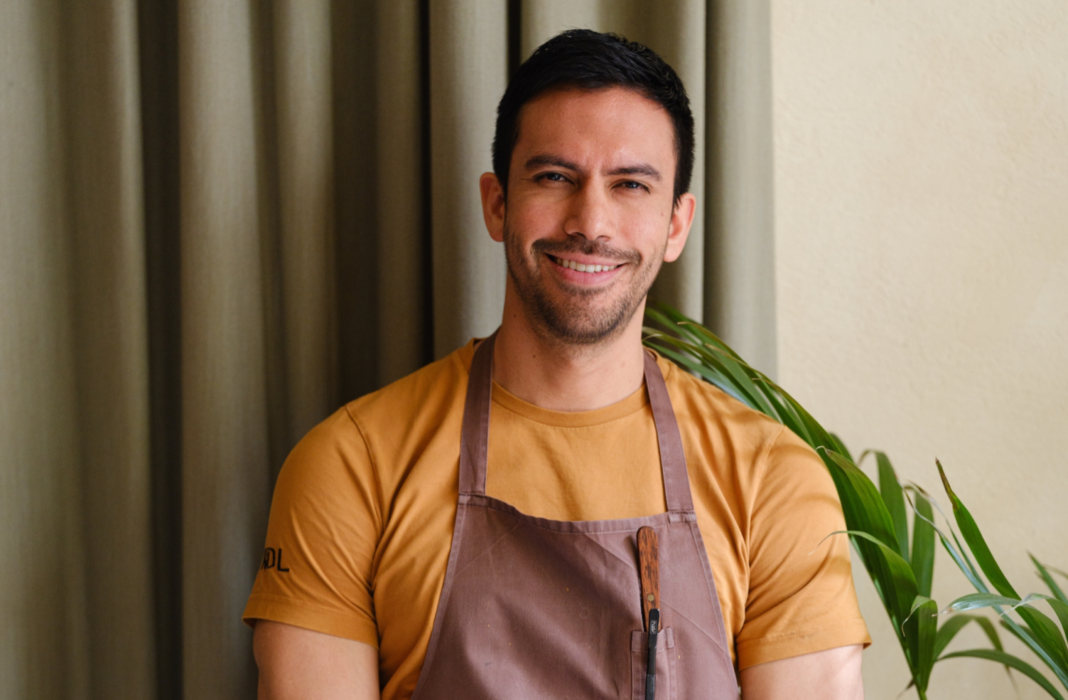

Santiago Lastra, Mexican Chef & Co-Owner, Kol, grew up wanting to be a mathematician. He went to Maths Olympiads as a teenager. “It’s not about remembering everything or being some highly intelligent person,” he told Tatler. “I think maths is more about creativity, and finding the best way to get a solution.”
And believe it or not, he literally carries that mindset into cooking as well.
Born in Mexico City and raised just south of Cuernavaca, in the state of Morelos, Lastra’s first real memory of food was a taquería called La Princesa, right outside his school.
“It was a very low-key, traditional place where you could get quesadillas, tortas, and tacos,” he said. “They served dry cured meat that’s very traditional from Morelos, which is where I’m from.”
As a kid, he bought meat there. By high school, he was going there with friends just to hang out.
His first cooking attempt was at 14, and “the first dish I learned to cook was a crab dip recipe that was on the back of a Ritz cracker box,” he said. “I bought the ingredients, made it right away, and everyone in my family loved it.”
A Chef Who Trained Everywhere Except a Kitchen at Noma
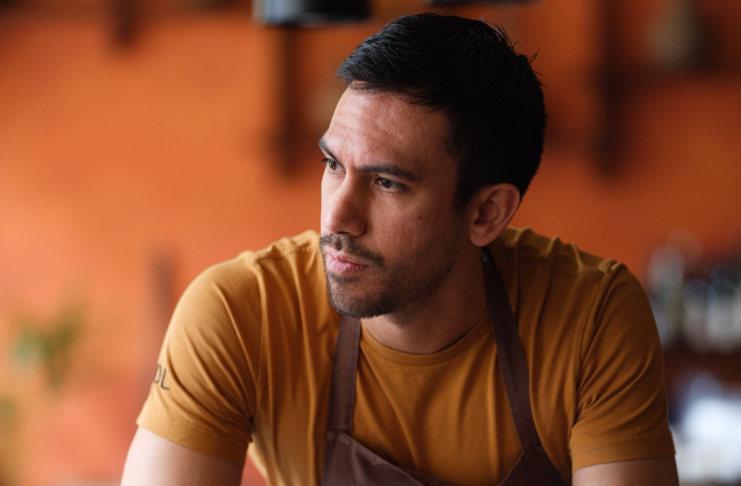
Lastra studied at Arte Culinario Coronado in Mexico, then earned a master’s in culinary innovation at the Basque Culinary Center in Spain, followed by a course at the Nordic Food Lab at the University of Copenhagen.
He worked under Andoni Luis Aduriz at Mugaritz in San Sebastián. He also spent time with René Redzepi’s team at Noma, including a seven-week residency for Noma Mexico. But he never actually cooked there.
“I didn’t cook at Noma. I wasn’t a chef,” he said. “I was sourcing ingredients, making deals with producers and suppliers, and organizing research trips. So it shaped me as a person.” It was there that “I learned how to deal with people, which is a skill that you cannot learn in the kitchen. I also learned how to find quality, and that quality is not something overly luxurious. It is something that is crafted with respect and has meaning.”
Before landing in London, he traveled through 27 countries across Europe, Southeast Asia, Japan, and Russia, trying to cook with local ingredients wherever he went.
Meanwhile, he was actively looking for a place to build his own restaurant, and a community around it, a team, local producers, and guests.
Convincing Investors With No Reference Point
Getting Kol off the ground took years, partly because Lastra couldn’t point to anything else like it…like there was no reference point.
“I remember when I first moved here, it was really hard to convince people of my vision,” he told Tatler. “They’d ask, ‘What is your restaurant going to be like in comparison with other restaurants in London? Give us an example of the place that you want to open.’ But I had no reference because I had never lived or worked here.”
Eventually, a landlord took the bet, handing him a 5,000-square-foot space in Marylebone. “This is the biggest restaurant unit in the history of this area, and they gave this place to the Mexican guy with a dream,” he said.
Kol opened in October 2020, in the middle of Covid-19 lockdowns.
“It was horrible,” Lastra said. “I’m a happy, positive person but I just felt so sad.” The restaurant could only stay open for stretches of two weeks at a time.
But people still loved it a lot. “They would walk through the door, see the space and hear the music, and feel like they were on holiday. They’d thank us, and I think that shaped us and our hospitality,” he said.
The repeated closing and reopening also gave him time and room to fix things early. “That was the silver lining.”
No Avocado, No Lime, No Citrus at Kol

Kol runs on a rule, i.e., not to use avocado, lime, citrus, or tomato out of season.
“The cuisine is inspired by Mexico, the culture, ingredients and flavors,” Lastra said. “Then, we take that inspiration, and we translate that using British ingredients.”
In place of coriander, for example, the kitchen uses sea arrowgrass, also called beach coriander. In place of lime, they use fermented gooseberries. In place of habanero and lime together, you have fermented gooseberries paired with Scotch bonnet. For citrus notes, there are grated pine cones. For grapefruit flavor, they use branches of Douglas fir, and for color and a softer bitterness than grapefruit, grilled rhubarb.
“We’re not an educational restaurant,” Lastra said. “If you want to know more, we can tell you, but we just want to be a restaurant where people have fun and enjoy the food. It doesn’t matter how many processes we use to get that flavor, even if it is a little bit hard to get there.”
The Dish Behind Two Memories
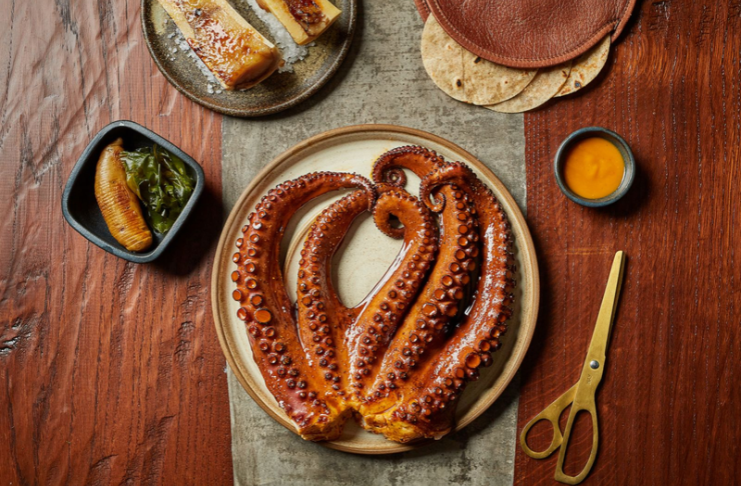
Lastra’s favorite dish at Kol is the langoustine taco, the first dish he made for the restaurant, and of course, there’s a story behind it.
The first is a meal at Puerto Nuevo in Baja California. “They have these massive pans with pork fat on the beach. They cut the lobsters and fry them in the shell, and it’s incredible,” he shared. “It was one of the best experiences, and when I was there, I just felt thankful to be alive. I don’t think you can top this.”
The second was when he was on a sourcing trip to Scotland, looking for langoustine producers on the Isle of Skye. He brought a griddle and tortilla ingredients with him.
“I took two big rocks from the sea and put some wood underneath. I rolled the tortillas on the cold griddle and then heated it up, cooked the langoustines and made the tacos there,” he said.
He used crushed berries in place of lime, squeezing the juice inside the langoustine heads, then ate the tacos in the wind off the cold Scottish sea. “It’s going to sound tacky, but I cried,” he said. “A recipe is more powerful when it has a meaning behind it and a story.”
From Tasting Menu to Family Table
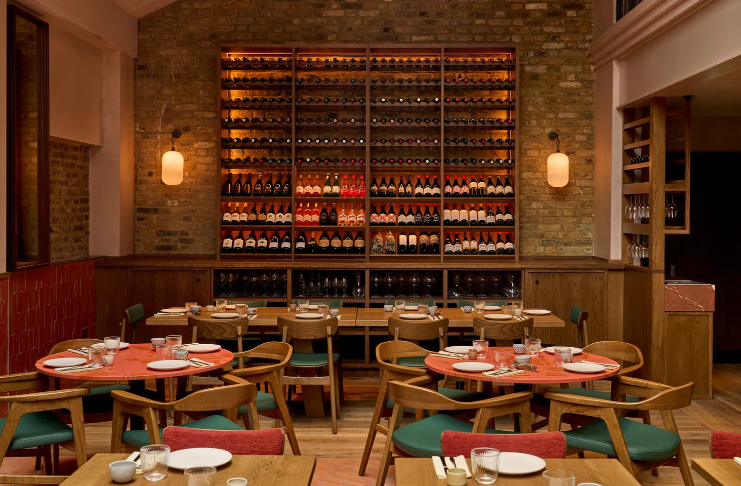
Four years after Kol opened, Lastra opened a second restaurant in Soho called Fonda, named after the family-run canteens found across Mexico.
“Growing up, you pick your own fonda,” he said. “At school or work you pick the one you like. There are streets with ten or fifteen fondas, so you choose yours. Sometimes they don’t have a name, but they might have painted the outside wall in yellow, so it becomes the yellow fonda.”
The word itself dates back to the 17th century, originally describing hostel-style setups used by the Spanish during their occupation of Mexico. After independence, it came to mean the family trattorias people know today.
Lastra had the idea for Fonda since before Kol even opened, but held off. “I was doing tastings for both back-to-back, but at the time it was too similar,” he said. “It couldn’t be done until Kol had become successful.”
Fonda is looser than Kol in a few ways. Lastra allows himself imported dry ingredients there, though fresh produce still stays local, which means avocados and limes are still off the table.
At Fonda, instead of substituting them one for one the way he does at Kol, he builds dishes that don’t need them at all, like Sikil Pak, a toasted pumpkin seed take on guacamole finished with pine oil.
“The more and more I go to Mexico, the more I learn,” he said. “The cuisine doesn’t need to rely on those flavors. There are so many recipes that work around them.”
Cooking With Debts to Real People
Lastra doesn’t credit only trained chefs for his food. Two home cooks in Mexico shaped dishes still on his menus today.
“One of them is Juanita. She taught me how to make mole,” he said. “And Martha in Veracruz taught me so many preparations of indigenous cooking, including combining chocolate and chili. That was the inspiration behind the chocolate and pasilla chili sorbet we serve at Fonda.”
His mentors, Andoni Luis Aduriz and René Redzepi, are still part of his life.
“We are good friends now, and I keep learning from them,” he said.
His most memorable meal, he added, wasn’t in Mexico at all. “I had my most memorable meal ever at Noma. It just really felt like my home.”
A Voice for a Cuisine Still Being Underestimated
Kol has climbed the World’s 50 Best Restaurants list since opening, from No. 73 in 2022 to No. 23 in 2023 to No. 17 in 2024, the highest ranking of any UK restaurant that year.
It also holds a Michelin star, awarded about fifteen months after opening, and a place on La Liste. Lastra won Best Chef at the GQ Food and Drink Awards in 2021.
But none of that changes the real purpose behind what he does. “When you’re outside of your country, you become an ambassador,” he said. “I believe that I have a responsibility. I also feel that it’s a shame that Mexico and Mexican quality are not well understood in the world. I believe this is the time to change that perception of low quality, cheap street food view of Mexico, and Latin America.”
Great British Chefs writer Lauren Fitchett noted that alongside chefs like Adriana Cavita, Lastra is part of a shift changing how London sees Mexican food, one that has also brought new appreciation for agave spirits like tequila and mezcal.
Lastra puts it: “Mexico is having a moment.”