

I get one question a little too often: “What are some of the best restaurant management software for enterprises?” and hence, have spent a good chunk of this year looking at different restaurant management brands, all of which are offering essentially the same thing: an all-in-one solution, from inventory management to payroll, guest management to online ordering.
And here is what I have discovered: the offer does not necessarily correspond to the product itself. Some solutions are POS systems dressed up as management suites; others are developed specifically for multi-unit operations, but the delivery process makes you wait. Some products indeed live up to their description, and I was interested to find out which ones.
Why Restaurant Owners Say Not All Restaurant Software Is Created Equal
Unified solutions in the restaurant industry frequently incorporate POS, payroll, online ordering, and analytics – at first glance, they all seem to be interchangeable. The difference I observed during discussions with owners of restaurant establishments is that a solution designed for a five-store fast-casual restaurant works quite differently when you have 200 of them operating in three different time zones. In this piece, I analyzed the six software solutions reviewed by their users on G2 and Capterra and most frequently asked by enterprise buyers to evaluate.
It turned out pretty quickly that the six software solutions mentioned above cannot be rated equally, and the difference is big enough to mention right away. Among these six restaurant management solutions, there was one leader with the highest rating scores – 4.8 on G2 and 4.9 on Capterra, and the others were rated in the high 3s and low-mid 4s range. Why so? Find that below.
Quick Picks: The Best Restaurant Management Software for Every Restaurant Industry Need
| Best Overall & Highest Rated: Restroworks — the strongest reviews on this list, and a genuinely unified restaurant management system from POS through kitchen automation. Best for Financial Management: Restaurant365 — accounting-first, built for multi-entity restaurant groups. Best for Hospitality Chains: Oracle Simphony POS — deep customization for large, complex F&B operations. Best for Data-Driven Operators: Lightspeed Restaurant — analytics that go beyond basic sales dashboards. Best for Full-Service Guest Experience: TouchBistro — built around the dining room, not just the register. |
What Restaurant Operators Actually Need From One Restaurant Management System
But before I rank any of them, perhaps it is appropriate to find out what “all-in-one” ought to deliver. All-in-one solutions consolidate multiple restaurant management tasks such as point of sale management, inventory control, labor management, and reporting into one solution instead of having five separate solutions to log into. Good restaurant management solutions must have strong multi-location control capabilities, and they offer in-depth data analysis, good inventory control, and multi-location capability as standard features, not as an expensive add-on option later.
| Restaurant Management Software | Best For | Overall User Ratings | Enterprise Features | Ease of Use | Customer Service | Value for Money | Pricing |
|---|---|---|---|---|---|---|---|
| Restroworks | Best all-in-one restaurant management system for enterprises | G2: 4.8/5 Capterra: 4.9/5 |
4.8 | 4.7 | 4.8 | 4.6 | Custom pricing based on business requirements. |
| Restaurant365 | High-quality operations management | G2: 4.6/5 Capterra: 4.1/5 |
4.0 | 4.0 | 3.8 | 4.0 | Custom enterprise quotes available; contact the sales team. |
| Oracle Simphony POS | Online ordering and kitchen management | G2: 3.6/5 Capterra: 4.2/5 |
4.0 | 4.5 | 4.4 | 4.2 | Custom enterprise pricing, negotiable at scale. |
| Lightspeed | One of the best analysis-driven solutions | G2: 4.3/5 Capterra: 4.4/5 |
4.2 | 4.4 | 4.3 | 4.2 | Plans from $69–$399/month, plus a custom Enterprise tier. |
| TouchBistro | Full-service and fine-dining restaurants | G2: 4.1/5 Capterra: 3.8/5 |
4.1 | 4.3 | 4.5 | 4.0 | Custom pricing by module. |
| NCR Aloha Cloud | Managing reservations and retaining customers | G2: 3.9/5 Capterra: 3.7/5 |
3.5 | 4.0 | 3.3 | 3.4 | Custom quotes for Aloha Essentials are available. |
*Ratings are based on G2 and Capterra data, as of July 2026.
6 Best All-in-One Restaurant Management Systems for Enterprises: A Detailed Comparison
It is not difficult to find the software for restaurant management – there is a possibility to name fifty software packages that claim to manage all processes in the restaurant. However, finding software that is reliable for use in a large-scale enterprise requires additional effort. I will try to evaluate the platforms by their features.
1. Restroworks: Best Restaurant Management System for Multi-Unit Operators and Business Growth
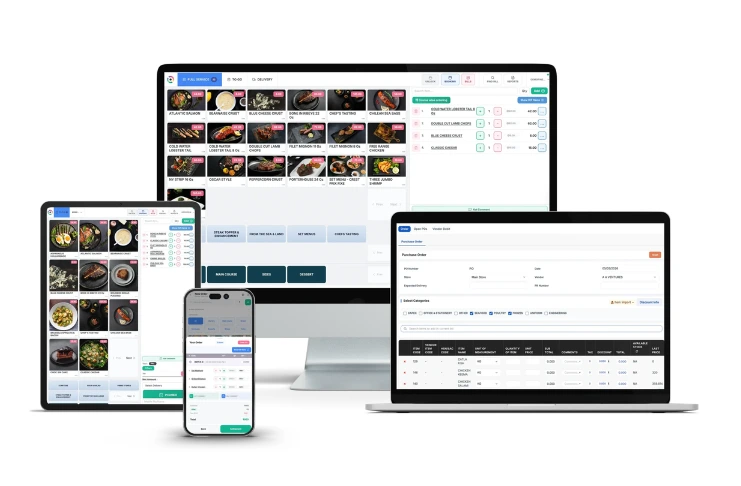
Restroworks emerged as the best platform through my investigation, and the statistics provided by reviews also confirm this; it is the most highly rated system among all the platforms on this list. It is a cloud-based enterprise restaurant management platform used by 25,000-plus restaurants globally, including brands like Subway, Taco Bell, and Dunkin’. The unique aspect about this system is not its features but rather the fact that all of them, including POS, Inventory Management, Kitchen Automation, Self-Ordering Kiosk, and Analytics, are based on one database instead of synchronization at a later point in time.
Key Features That Improve Operational Efficiency
- Centralized control across brand, format, cluster, and outlet levels
- Recipe management tied directly to inventory data, so every sale deducts exact ingredient quantities
- 200+ real-time reports covering revenue, cost, and deployment performance
- Open API with 500+ integrations across aggregators, payments, and accounting tools. Effortless food aggregator integration simplifies online order management.
Where It Excels
In inventory control and food safety. After reviewing several hundred G2 reviews, one common denominator stood out: real-time inventory management that reduces manual errors and identifies food cost leakages daily through variance reporting. It maintains an average rating of 4.7 stars based on more than 2,575 verified G2 reviews, with operators praising its consumption and variance reporting capabilities.
What Could Be Better
Some advanced enterprise features benefit from dedicated onboarding time, and the platform suits multi-location operators better than single-store owners chasing a basic POS system.
Pricing & Ratings
Custom pricing based on business requirements.
G2: 4.8/5 ·
Capterra: 4.9/5
2. Restaurant365: Financial Management and Payroll Data in One System
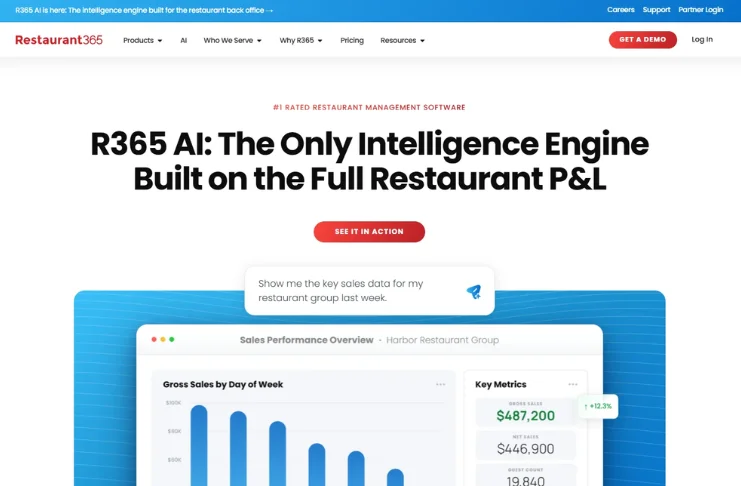
If you’re one of those people who loses sleep over accounting, then Restaurant365 was made just for you. Restaurant365 is the most robust all-in-one restaurant management software suite for those restaurant operators for whom accounting is their biggest headache, and it combines financial management, inventory, and staff management in one ledger rather than three spreadsheets. This software caters to mid-level and multi-unit restaurants charging around $499 per month per location.
Key Features for Cost Control and Labor Forecasting
- Restaurant-specific accounting with automated journal entries from POS data
- Recipe costing and menu engineering tools tied to real-time inventory valuation
- Labor scheduling and labor forecasting based on sales projections
- Payroll, hiring, and HR add-ons alongside 400+ integration partners
Where It Excels
Reduces labor costs and control costs. What I noticed about this software is that it was frequently mentioned as the tool to merge accounts payable, budgeting, and task management into one database in order to make faster decisions. It helps teams track staff and make changes in real time without making assumptions.
What Could Be Better
Multiple Capterra reviewers describe it as expensive and complex to set up, with a real learning curve, the tradeoff for its accounting depth.
Pricing & Ratings
Custom enterprise quotes available; need to reach out to sales team.
G2: 4.6/5
Capterra: 4.1/5
3. Oracle Simphony POS: Advanced Features for Full Service Restaurants and Quick Service Restaurants
Oracle has a completely different lineage: years of experience in enterprise hospitality, and the technology to prove it. Simphony integrates online ordering, kitchen management, stock management, menu management, delivery management, and loyalty programs in a single platform, focusing heavily on real-time reports so that operators can always know what is going on in terms of sales, expenses, and employee performance. Cloud-based architecture is preferred in enterprise QSR and fast casual chains, and Simphony is a perfect example of a platform designed for just such operators.
Key Features: Real-Time Reporting and Seamless Integration
- Open API and cloud marketplace for seamless integration with third-party tools
- Enterprise-level configuration pushed from HQ down to every property and workstation
- MyMicros reporting app for on-the-go sales visibility
- Deep ties into hotel and hospitality systems like Oracle Opera PMS
Where It Excels
In payment processing and peak-hours reliability. Simphony is said to be highly configurable after setup and to perform reliably during peak hours at full-service and quick-service restaurants of all sizes. The ability to push changes from one dashboard to all terminals in an entire fleet, its enterprise deployment feature, is what gets praised the most.
What Could Be Better
Implementation is the recurring complaint. Several Capterra reviewers describe rocky rollouts and support response times that lag for smaller accounts, and its 4.2 Capterra score reflects that friction.
Pricing & Ratings
Custom enterprise pricing, negotiable at scale.
G2: 3.6/5
Capterra: 4.2/5
4. Lightspeed Restaurant: Sales Data, Sales Trends, and Menu Engineering
While Lightspeed made a name for itself in POS hardware, my research found that the company’s restaurant offering (Upserve until recently) now positions itself as one of the more analysis-driven solutions out there. The company’s unique selling point– Advanced Insights– converts sales data into menu profitability, server effectiveness, and sales trends.
Key Features: Optimize Menu Offerings and Track Customer Preferences
- Advanced Insights suite for menu engineering and profitability analysis
- Granular floor-plan and table management for full-service restaurants
- Multi-location menu coordination to optimize menu offerings by outlet
- Delivery aggregator consolidation from apps like DoorDash and Uber Eats into one dashboard
Where It Excels
Intuitive user interface and immediate visibility. What reviewers on G2 just kept bringing up was how easy the user interface is to use; employees become comfortable working on the floor without much training. The reporting layer allows managers to see what menu items and dayparts generate margins immediately.
What Could Be Better
Pricing climbs quickly with add-ons, extra registers, and locations, and merchants who skip Lightspeed Payments face additional fees. There’s no bundled free hardware, so budget for upfront hardware costs.
Pricing & Ratings
Plans from $69–$399/month, plus a custom Enterprise tier.
G2: 4.3/5
Capterra: 4.4/5
5. TouchBistro: Dining Room Management and Team Communication for Restaurant Staff
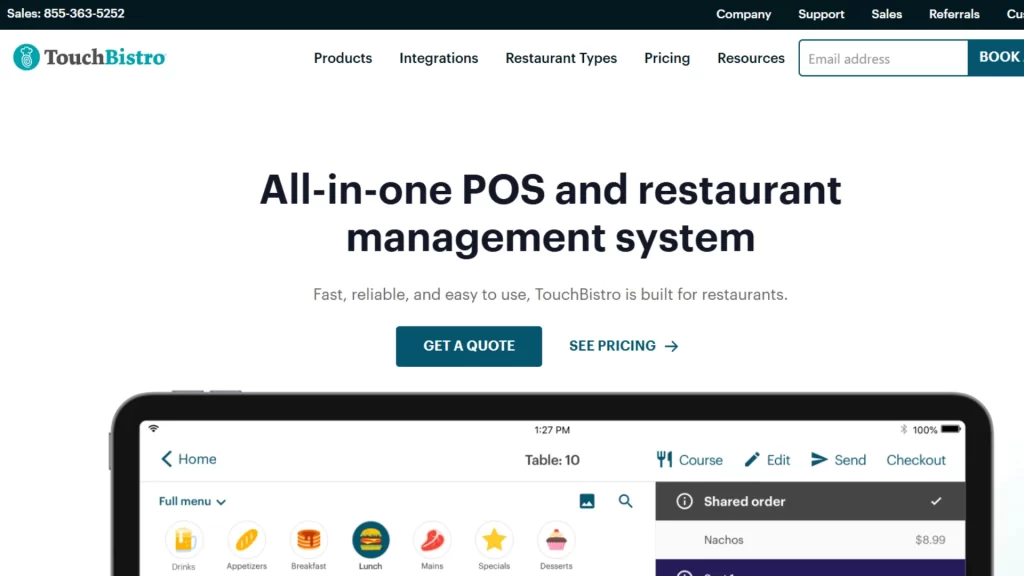
TouchBistro takes a different angle: it’s an iPad-native POS and restaurant management system built around the dining room, not the back office. It now powers more than 29,000 restaurants across 100+ countries, with particular strength in full-service and fine-dining settings where guest interaction matters as much as ticket speed.
Key Features: Employee Scheduling and Loyalty Programs
- Tableside ordering directly from the iPad, cutting down ticket errors between restaurant staff and the kitchen
- Built-in employee scheduling and team communication tools
- Loyalty programs and guest-facing engagement features
- Room-charge and tab management suited to hotels and resorts
Where It Excels
The strengths of this software include guest experience and customer satisfaction. The TouchBistro system is often referred to as “the most powerful yet easy to use” system by users. The touch screens reduce the time required to train new employees in the restaurant, boosting customer satisfaction. Guest engagement tools in the TouchBistro system are key factors that motivate full-service operators to switch from old systems, as loyalty programs can turn one-time guests into loyal customers.
What Could Be Better
Larger organizations report friction integrating TouchBistro with other software, and reporting by custom time periods has room to improve. A handful of reviewers also flagged rocky cancellation experiences, which shows up in its 3.8 Capterra score, the second-lowest here.
Pricing & Ratings
Custom pricing by module.
G2: 4.1/5
Capterra: 3.8/5
6. NCR Voyix- Aloha Cloud: Cloud-Based System With Online Reservations and Delivery Management
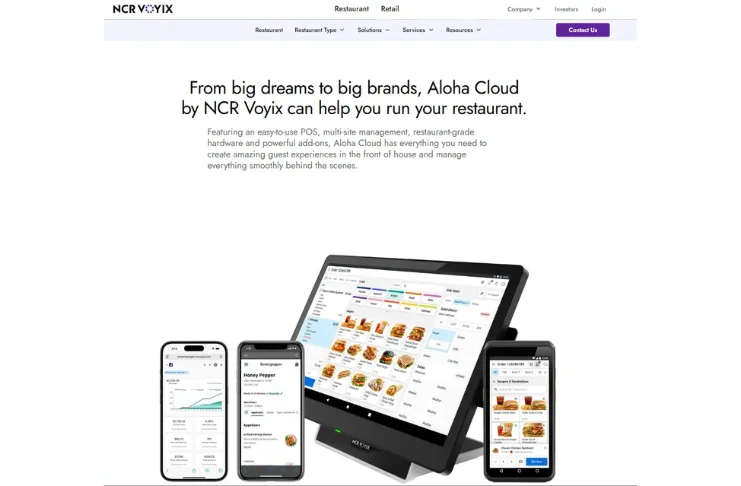
Aloha has been around as one of the oldest brand names in the domain of restaurant technology, having been in use for over 30 years in the business. Aloha Cloud is the cloud solution offered by NCR Voyix to small and expanding chains of restaurants, while Aloha Essentials is an enterprise offering.
Key Features: Process Payments and Provide Insights
- Fixed and handheld POS with offline mode for outages
- Aloha Order Direct for online reservations, online ordering, and delivery management
- Robust reporting built to process payments and provide insights across every location
- Loyalty and email marketing tools bundled into the core platform. Personalized marketing campaigns boost customer engagement significantly.
Where It Excels
Managing reservations and retaining customers. I’d give Aloha Cloud credit for an interface that’s fast to train new staff on, plus reliability that keeps service running even offline. Its ability to manage reservations, run loyalty campaigns, and retain customers appeals to operators who want proven, if not cutting-edge, technology.
What Could Be Better
Customer support response times are a frequent complaint, integration options are more limited than newer competitors, and multiple reviewers describe difficulty exiting long-term contracts.
Pricing & Ratings
Custom quotes for Aloha Essentials are available.
G2: 3.9/5
Capterra: 3.7/5
Why Inventory Control and Real-Time Data Are Reshaping Restaurant Operations
The features that sound most “nice to have” on a demo call are usually the ones that save enterprise operators the most money. Here’s why.
Inventory Management, Recipe Management, and How to Reduce Food Waste
Restaurants waste 4-10% of food purchased due to poor inventory management, and automated inventory management reduces food waste by up to 50% when it’s paired with tight recipe management. In practice, that means inventory management software automates purchasing based on stock levels, so restaurant owners aren’t manually re-ordering every case of romaine.
Real-Time Inventory Tracking and Inventory Data: Cutting Food Costs
Real-time inventory tracking optimizes menu offerings and reduces shortages before they hit the dining room, and effective inventory management can lower food costs significantly. Integration with POS systems provides real-time sales and inventory insights, and integrated systems streamline procurement and inventory management processes.
Waste Tracking and Inventory Tracking: Two Sides of Cost Control
I think of waste tracking and tracking inventory as solving two different problems; one flags what’s being thrown out, the other flags what’s about to run short. Together they’re core to real cost control, not a report nobody opens.
Workforce Management, Employee Management, and the Real Cost of Labor
Labor scheduling increases efficiency and cuts down costs and overstaffing as well as understaffing. Efficient labor management maximizes staffing during peak hours. Labor data helps optimize labor scheduling and reduce costs, while automatic time tracking ensures accurate hour registration. Insights based on artificial intelligence allow optimizing both menu performance and staff at the same time.
Food Safety Standards, Kitchen Operations, and the Kitchen Display System
Proper stock management helps maintain compliance with food safety laws, while automatic records of product shelf life can prevent food-borne diseases before they become headline news. Food safety systems also integrate with kitchen operations, ensuring safe kitchen operations; an integrated kitchen display system means all cooks in the line use the same information as the compliance team. Food safety systems track expiration dates to minimize waste.
Customer Relationship Management, Online Ordering, and Consistent Food Quality
63% of customers look for convenience while ordering food; hence, online ordering is no longer optional. CRM software enables proper relationship management with customers, and RMS platforms provide reservation and waitlist management capabilities as well as guest analytics related to food quality.
POS System Integration, Payroll Software, and Real-Time Insights for Restaurant Owners
Restaurant management solutions usually work in conjunction with existing POS systems instead of ripping out hardware and replacing it, and smooth data flow ensures better financial decisions when payroll software, sales, and inventory information are in one place. That is how the bunch of reports turns into actionable insights.
Operational Excellence: Taming Administrative Tasks and Administrative Overhead
All-in-one solutions make multi-location administration more efficient, and an integrated solution allows for more efficient running of restaurant operations by taking administrative activities – like scheduling, invoicing, and compliance- out of Excel. Multi-location scalability allows simultaneous rollout of promotions and compliance checks. For me, this is the essence of operational excellence: not more dashboards but fewer places to go to find the same information.
Efficient cash management can increase profitability in the restaurant industry as well. A cash management system automates cash handling procedures for accuracy; the integration of a cash management system with the POS system makes cash handling more efficient, and real-time banking integration increases cash visibility and forecasting. A cash management solution offers analytics on cash flow that cannot be achieved through a manual system.
| The Takeaway: Of course, the best all-in-one restaurant management system would be one that integrates POS, inventory, and accounting systems, yet the best for you will depend on where exactly things go wrong in your business. If you are growing into multiple brands, different formats, or different regions, then Restroworks is the solution I recommend as the best overall one and the top-rated platform out there. Restaurant365 and Oracle Simphony POS can handle complex situations with finance or enterprise hospitality management. |
My recommendation is to avoid choosing based only on features. Instead, narrow down two or three platforms, seek references from operators at your scale, and take into account the review trends listed above.
Frequently Asked Questions
1. What is the best restaurant management software?
It is the one that can take care of billing, payments, and order management as well as inventory management, workforce management, financial management, and customer relationship management in all locations.
2. What POS system do most restaurants use?
This cannot be answered as it depends on what type of restaurant you have. Quick-service restaurants usually give preference to speed, online orders, and deliveries, which are well managed by Lightspeed and Oracle Simphony POS. Full-service restaurants usually focus on guest experience and dining room management, which is done exceptionally well by TouchBistro and Restroworks.