
Remember when serving “good food” at a “prime location or hot spot” was enough to fill tables? Now, you can try posting 5 carousels on Instagram every day, partner with influencers, run targeted ads, offer 10-min delivery, and still, there’s no guarantee you’ll break through.
The best restaurants today must compete on the Venn of convenience, technology, pricing, and experience. As for 2026, experts describe the current state of the restaurant industry as “cautiously optimistic” despite ongoing economic uncertainty and evolving market conditions.
According to the National Restaurant Association, nationwide restaurant sales are projected to reach a record $1.55 trillion this year, reflecting inflation-adjusted real growth of 1.3%. On paper, the industry’s growth looks modest by historical standards, but it comes at a time when restaurant operators are contending with persistent cost pressures, a tight labor market, and consumers who have become far more deliberate about where and how often they spend their money on dining.
This article lists the key trends, risks, & growth opportunities reshaping the food and service industry, as well as what the year ahead holds for restaurant leaders across full-service, limited-service, and independent segments.
What You’ll Learn
- Restaurant industry outlook in 2026, including sales, traffic, and total employment figures.
- How are consumer behavior, consumer priorities, and household budgets reshaping demand across generations?
- The key factors driving up labor costs, food prices, and overall operating expenses.
- What are the biggest challenges and risk factors operators need to plan around?
What’s the Current State of the Restaurant Industry?
The restaurant industry, as of today, is mostly stable but maybe kind of strained on the sidelines.
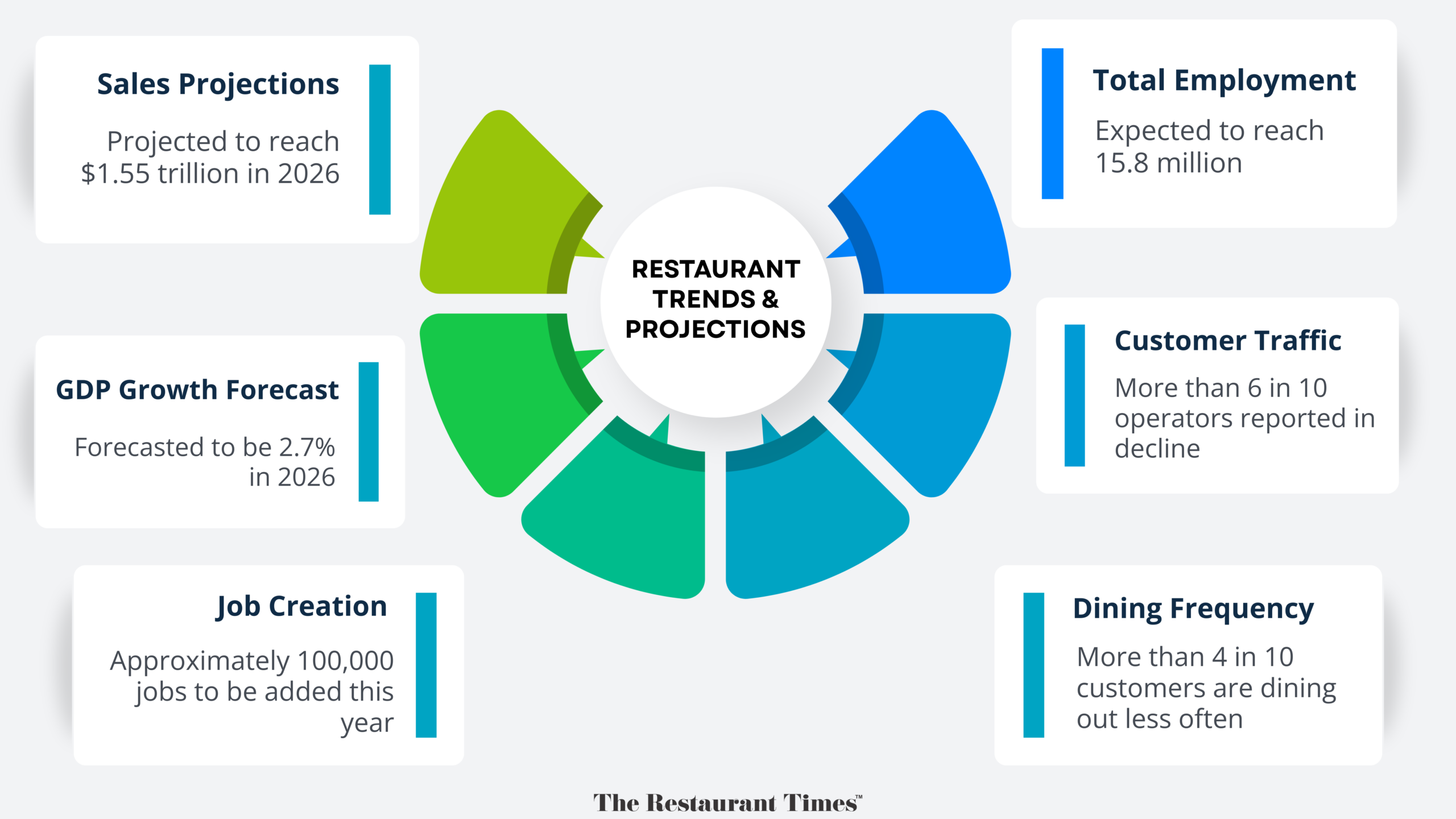
For the record, more than 60% of operators reported that they noticed a decline in customer traffic last year compared with the previous year (2024), while only about 15% saw an increase.
On the consumer side, more than 4 in 10 say they are using on- and off-premises dining less often than they did a year earlier. Yet total consumer spending on food away from home continues to represent more than half of all U.S. food and beverage spending, which means dining out is still very much ‘people’s favorite’ in everyday life for most of us, even when budgets are tight.
Plus, data has it that nationwide restaurant sales are projected to reach $1.55 trillion in 2026, and the National Restaurant Association forecasts real GDP growth of 2.7%, up from 2.3% in 2025.
Operators say they’ll add approximately 100,000 jobs this year, bringing total industry employment to 15.8 million and continuing to fuel economic activity in local communities. That would mark the industry’s sixth consecutive year of payroll growth since the end of 2020.
Restaurant Sales and Economic Projections
Over the past year, the cost of eating out increased by 4% year over year, while food at home increased by 2.1%, meaning dining-out costs have risen faster than prices at grocery stores. The U.S. Consumer Price Index shows a similar divergence over a longer window, i.e., “food away from home” rose about 6% from January 2024 through September 2025, compared with roughly 3% for “food at home” over the same period. If that gap widens further, consumers will likely perceive less and less value in dining out relative to the cost.
There’s also something called a K-shaped economy in effect right now, with particularly nuanced insights across consumer income groups and business sectors.
Higher-income households, particularly high-income baby boomers and millennials, have remained relatively resilient, while low- and middle-income households (especially among Gen X and baby boomers) have pulled back sharply across quick-service, sit-down, and delivery categories.
40% of consumers say they are cutting back on restaurant visits altogether. Among those planning to reduce spending, most intend to cut back on both how much they spend per visit (though most prefer to trade down within their preferred restaurant by ordering less or using more promotions than switching to a “more affordable” restaurant) and how often they dine out.
This is just as Cristin O’Hara, head of Bank of America Global Commercial Banking’s Restaurant Group, notes: “In lower-income segments of the population and in economically stressed regions, dining out frequency is falling,” and uncertainty around supply chains and tariffs continues.
Supply Chains and Rising Costs of Food
Wholesale food prices and domestic producers’ costs remain a defining pressure point for 2026.
Average food costs are now more than 35% above pre-pandemic levels, according to the U.S. Bureau of Labor Statistics. In 2025, 82% of operators reported higher average food costs, while 68% said tariffs drove those costs higher. Two-thirds of operators said tariffs on imported food and beverage items posed the biggest challenge to their restaurant operations.
Egg prices, along with beef and chicken, have been especially volatile, even as other staples like milk, cheese, and flour have occasionally seen relief. Because the food price index is based on prices paid to domestic producers, though the full impact of tariffs on supply chains wasn’t immediately visible in headlines, operators felt it in their invoices.
Restaurants that raised menu prices by more than 10% were most likely to expect lower profits, since diners have grown more sensitive to sticker shock even as they continue to demand quality. More than 56% of restaurants increased menu prices in 2025, but most operators say they have limited room left to keep raising prices. In response, many have shopped around for new suppliers, renegotiated with existing ones, cut costs elsewhere in operations, or adjusted portion sizes to protect margins.
“There’s just not a lot of elasticity left [in the market],” said Anne McBride, VP of impact at the James Beard Foundation.
Fast-food restaurants in particular have raised prices faster than casual dining chains in recent cycles (about 4% versus 2% to 3%), which has narrowed the value gap between quick-service and full-service dining.
Labor Statistics: Staffing, Turnover, and Wages
Labor costs are one factor that has a big, big impact on a restaurant’s profitability. In fact, more than 90% of operators cite high costs for food, labor, insurance, and energy as a challenge, and more than 80% feel strain from credit and debit card processing fees and utility costs.
According to the statistics, 96% of operators say they’re spending more on labor this year than last, and 54% report labor cost increases of 21% to 50%.
Staffing shortages in the restaurant industry have declined by 13% compared to 2024, but 49% of operators still report some level of staffing insufficiency, so much so that the average restaurant is now short 5 team members, up from 3.8 in 2024, and 44% of employees who leave cite a desire for higher hourly wages as the reason.
As labor costs have risen amid a tighter labor market, many restaurant operators are increasingly outsourcing back-office operations like payroll, accounting, and administrative functions to be able to focus better on core business activities and improve efficiency.
Key Trends Redefining F&B in 2026 and Beyond?
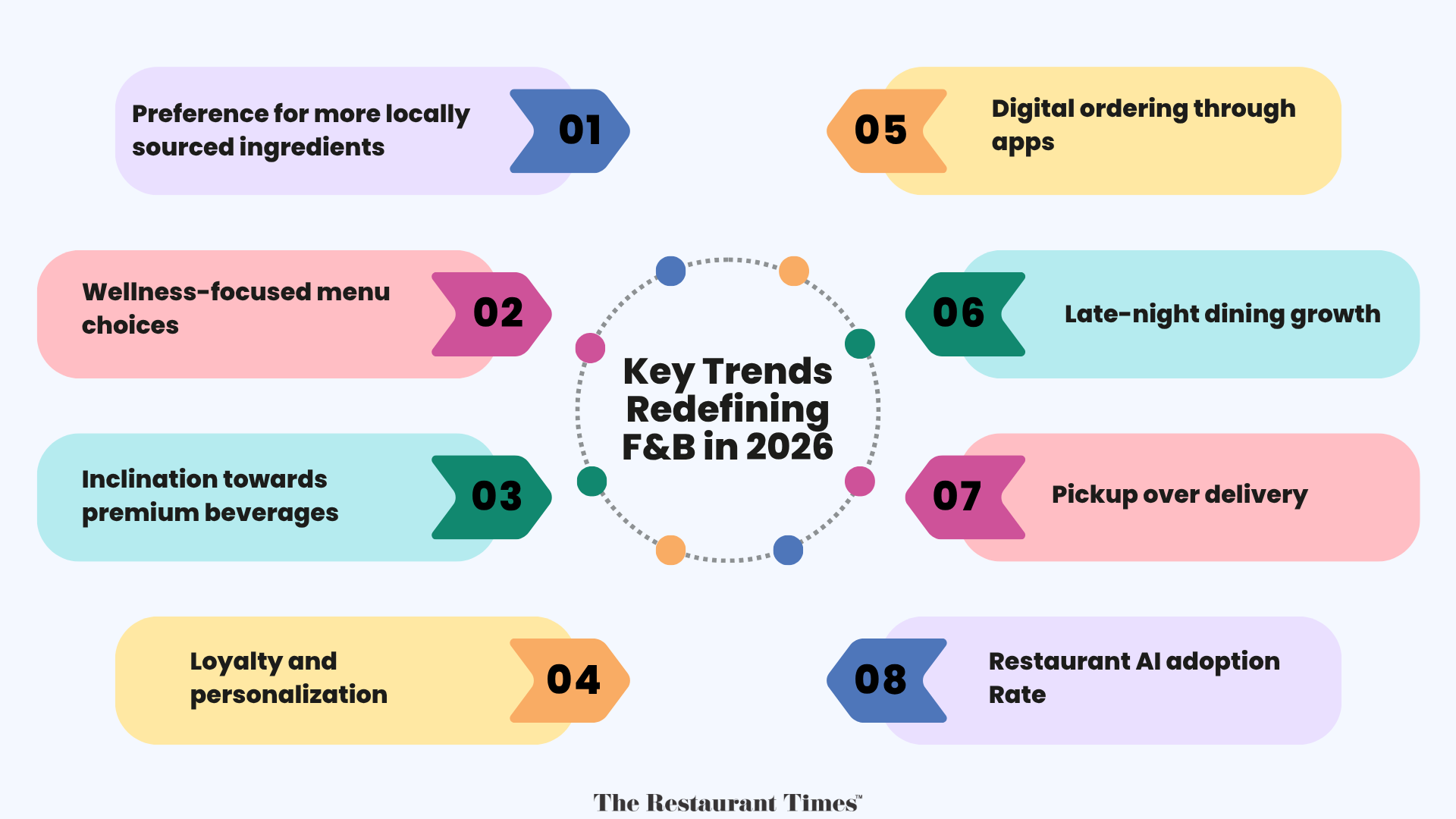
Below, we’ve pulled the 8 most important trends in the hospitality industry that tell you how restaurants are competing for guests and dollars this year.
#1: Consumers are seeking “comfort with restraint.” Diners these days prefer menus that feature authentic global flavors alongside intentionally sourced, local ingredients. In response to this trend, 39% of restaurants plan to add more locally sourced ingredients to their menus in 2026.
#2: Wellness is reshaping menu design: Menus now reflect a “wellness” focus, driven by the popularity of anti-obesity medications and consumer demand for cleaner, plant-based, and sustainably sourced options. Even McKinsey found that only 18% of consumers said they’d reduce spending on salads, compared with 57% who said they’d cut back on burgers.
#3: Innovation in beverage offerings: The desire for cold, caffeinated, and photogenic drinks is creating entirely new occasions for visits, and major chains have rolled out a wave of premium beverages as the quick-service segment searches for high-margin additions.
#4: Loyalty programs and personalization are helping brands drive traffic and repeat visits. More than 80% of diners say access to daily specials, discounts, or value promotions matters a lot to them when choosing a restaurant for delivery, and roughly 3 in 4 say the same for takeout, drive-thru, and on-premises visits at limited-service restaurants.
70% of consumers in loyalty programs say they consider whether they have a membership when choosing where to eat.
#5: Online ordering and proprietary apps are central to how brands like McDonald’s, Chick-fil-A, Starbucks, and Chipotle track and act on customer behavior, though operators who are new to the space have a difficult time persuading diners to download yet another app.
#6: Sales of late-night dining have climbed more than 10% annually since 2021, even as breakfast, which, btw, was once the daypart when the industry made the most money, has cooled.
#7: Pickup is outperforming delivery. Over the past few years, pickup orders grew 14% in frequency while basket sizes have held steady. On the other hand, average delivery basket value fell by 6%, and the spend per unit dropped by 12%, largely due to hidden fees that strain already tight consumer budgets.
#8: Artificial intelligence adoption is accelerating across the board. 87% of operators now use some form of AI in their restaurant, with larger brands embedding AI into customer journeys, dynamic pricing, staffing forecasts, and inventory decisions.
INDUSTRY INSIGHT
| According to the James Beard Foundation, independent operators are more prone to fluctuating food prices, unpredictable demand, and rapid changes in technology expectations. Plus, the consumer expectation gap is widening, with 49% of surveyed chefs ranking social media as a top trend expected to affect restaurant operations in 2026, reflecting how central digital engagement and social discovery have become even for small, single-location businesses. |
Challenges and Risk Factors to Look Out For
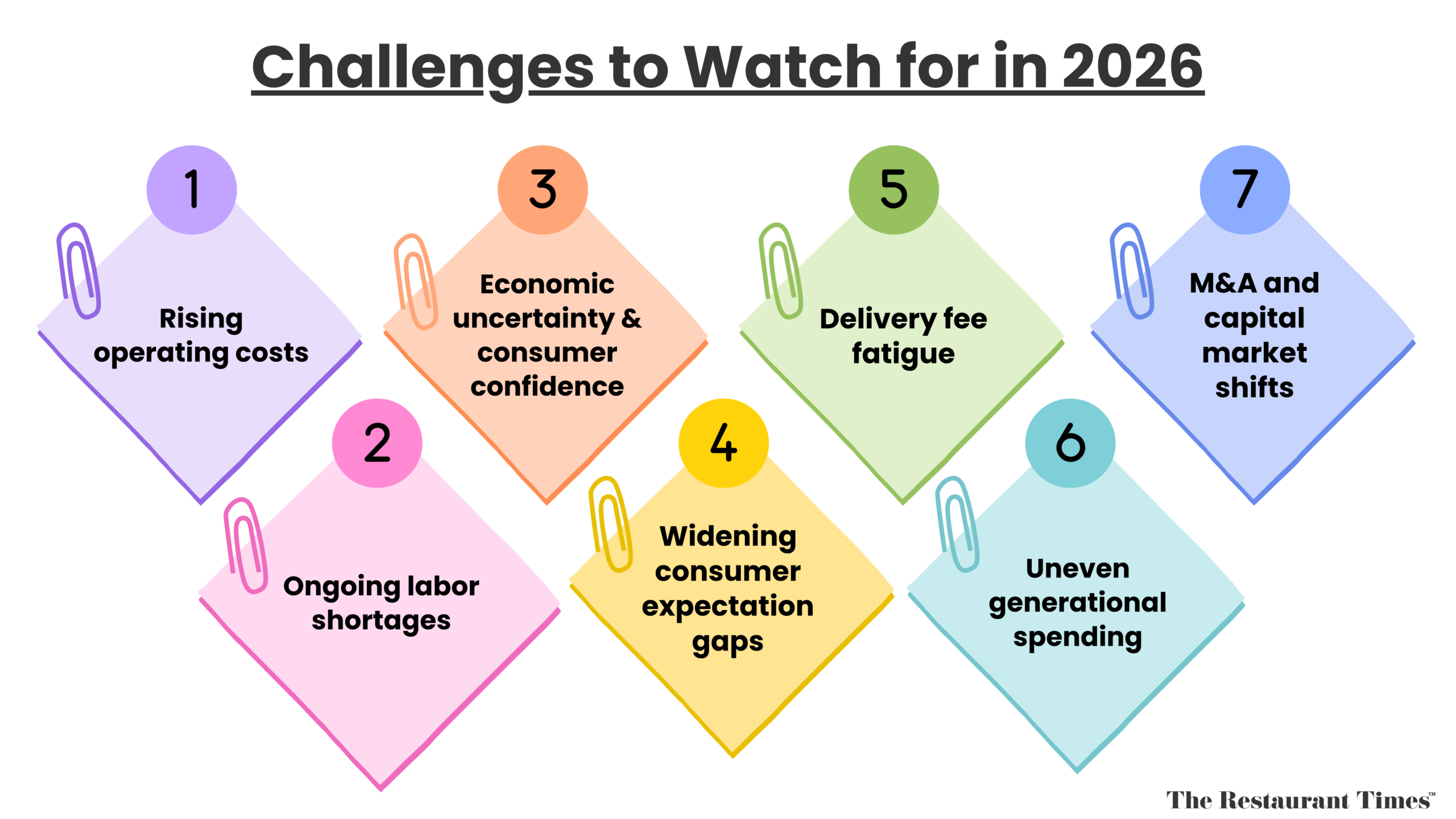
Despite the modest optimism in most 2026 forecasts, there are some challenges that could weigh on restaurant sales and profitability:
- 42% of restaurants reported zero profitability over the past year due to inflation. Sixty percent of operators say business conditions deteriorated in 2025, while just 15% say they did not.
- Consumer confidence has fallen sharply in recent months, reaching a record low amid persistently elevated gasoline prices tied to geopolitical conflict during the first half of the year. Even before that shock, many households were struggling to make ends meet, placing greater emphasis on affordability and more deliberate spending.
- While hiring has slowed nationally, the unemployment rate in hospitality remains historically low at 4.3%.
- As dining out becomes less frequent for many households, customers now expect both consistency and care in their dining experience, leading to a decrease in tolerance for mediocrity. Poor food quality and small portion sizes are the top drivers of lower value perception, particularly among Gen Z, 73% of whom ranked food quality among their top three sources of disappointment on a recent visit, versus 57% of diners overall.
- Consumer budgets are strained, causing guests to pull back on full third-party delivery orders due to hidden fees.
- Gen Z’s spending growth at limited-service restaurants has slowed sharply (down 19 percentage points over the past two years, compared with an 11- to 12-point drop for older age groups) even though affordability and digital convenience should, in theory, align well with Gen Z budgets and habits.
- After three years of declining deal activity, restaurant industry M&A is expected to build in 2026 as investors who had been waiting on the sidelines re-enter the market, aided by expectations of easing capital costs and a more merger-friendly regulatory environment.
What Does the Future Hold for Restaurant Operators?
We’re again bound to bring you back to the term “cautious optimism.” Why? While consumers remain selective about discretionary spending, the appetite for dining out hasn’t disappeared. More than 7 in 10 customers say they would visit restaurants more often if they had the financial flexibility, with that figure rising to nearly 90% among Gen Z and 84% among millennials.
For operators, Christopher Holtz believes that culture and hospitality remain powerful differentiators in a crowded market. In his own words: “Restaurants are a people business; your assets walk out the door every day, and the way you interact with people makes a tremendous difference. Value, quality, and execution are more important than ever, and those companies that outperform are doing well because they provide excellence in all three.”
So, what should you do next? Add these priorities to your calendar:
- Refining price architecture and loyalty programs to reinforce value perception.
- Leaning into growth areas such as protein-forward menus, late-night dining, and affordable entry-level items that keep guests engaged and give you alternative revenue streams.
- Using AI and digital tools to personalize offers, forecast demand, optimize pricing, and streamline restaurant operations.
- Investing in workforce development to offset a smaller, more selective labor pool.
- Pursuing sourcing optimization and design-to-value initiatives that free up capital to reinvest in quality and guest experience.
And, yes, that’s it. Follow these strategies, and your restaurant will be bulletproof and better positioned for long-term success altogether.
KEY TAKEAWAYS
| – Businesses are facing a highly competitive landscape where pent-up demand for experiential dining remains robust. – Consumers are increasingly seeking strategic value when dining out, as the cost of eating out has risen faster than grocery prices, leading to more intentional dining decisions. – As dining out has become less frequent, consumers are now more selective about where to eat, requiring restaurants to deliver consistent quality and a worthwhile experience to justify the cost. – The restaurant industry is facing significant labor market challenges, with operators needing to adapt to a new reality characterized by persistent cost pressures and workforce complexity. – Total industry employment is expanding toward 15.8 million workers, but finding experienced kitchen managers and chefs is highly difficult. – Operators are shifting to smaller, more efficient physical footprints due to high rent and construction costs. – Operators are increasingly using outsourced back-office operations to create capacity for strategic initiatives, leveraging technology and AI-enabled capabilities from third-party providers. – Restaurants with moderate, intentional tech adoption report stronger business performance than those with low- or high-tech extremes. |
Frequently Asked Questions
1. Is the restaurant industry growing or declining?
The restaurant industry is definitely growing, but at a slower pace than in recent years. The National Restaurant Association projects real (inflation-adjusted) restaurant sales growth of 1.3% in 2026, bringing total industry sales to a projected $1.55 trillion.
2. How can restaurants adjust their cost structure to stay profitable?
Restaurants can adjust their cost structures by shifting to new suppliers or renegotiating with the existing ones for better prices, adjusting portion sizes, increasing tracking of food waste, outsourcing back-office operations to reduce overhead, and adopting technology.
3. Is the restaurant industry oversaturated?
You may say, by some measures, competition in the restaurant industry is intense. As of 2025, for example, there were roughly 152,000 single-location full-service restaurants and about 142,000 chain restaurants operating in the U.S. But again, “oversaturation” on the segment and geography we’re talking about. Restaurants or concepts, wherever they are, that offer clear value, unique experiences, or innovative menus continue to grow regardless.