

Starting a restaurant is one of the most common entrepreneurial fantasies, as well as one of the hardest industries to manage statistically. Almost 26% of new restaurants fail or switch owners in the first year, 60% by the end of the third year, and 80% within five years. These statistics should be taken into consideration by every would-be owner before renting the place and hiring the chef.
The restaurant industry is a money-making business, with estimated annual sales of $1.55 trillion in 2026, driven by consumer spending. But the survival of individual restaurants is a completely different thing to consider. Restaurant owners usually have low-profit margins, which are equal to 5%, before taxes; thus, mismanagement becomes one of the key causes of failure.
What You Will Learn
- Real restaurant failure statistics
- The top 11 reasons why restaurants fail and their realistic explanation
- The red flags that indicate your restaurant is destined for failure
- Strategies to improve the chances of success for new restaurants
Why Do Restaurants Fail: What the Data Reveals
Rising costs, including food, rent, and utilities, are outpacing revenue growth for many restaurants, contributing to their financial struggles and potential closures. But not just this; there are many other reasons for failure, and many statistics about it.
What Percentage of Restaurants Fail in the First Year?
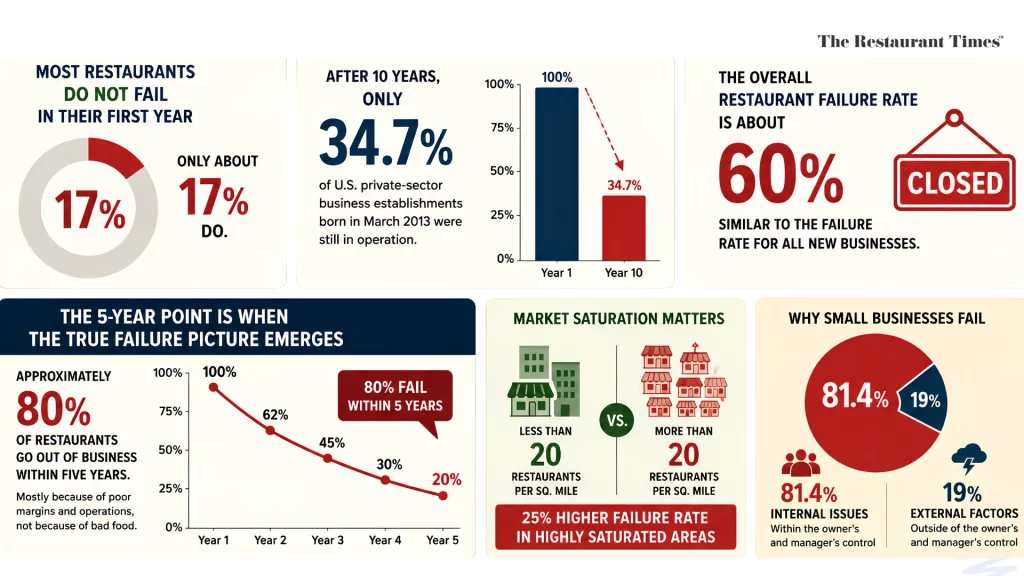
Contrary to popular belief, most restaurants do not fail within their first year; in fact, only about 17% do. This is not an encouraging statistic, especially given that the percentage jumps significantly after the first year. In March 2023, only 34.7% of U.S. private-sector business establishments born in March 2013 were still in operation after 10 years. The restaurant failure rate is reported to be about 60 percent, similar to the failure rate for all new businesses.
5-Year Restaurant Survival Rates in the Restaurant Industry
The five-year point is when the true failure picture emerges for restaurants. Approximately 80% of restaurants go out of business within five years, mostly because of their poor margins and operations, not because of any bad food. Areas with more than 20 restaurants per square mile had a 25% higher failure rate compared to less saturated markets. 81.4% of small business failures are due to internal issues, over which owners and managers have full control, and only 19% are due to external factors. It sounds humbling but, at the same time, empowering.
Top 11 Reasons Restaurants Fail
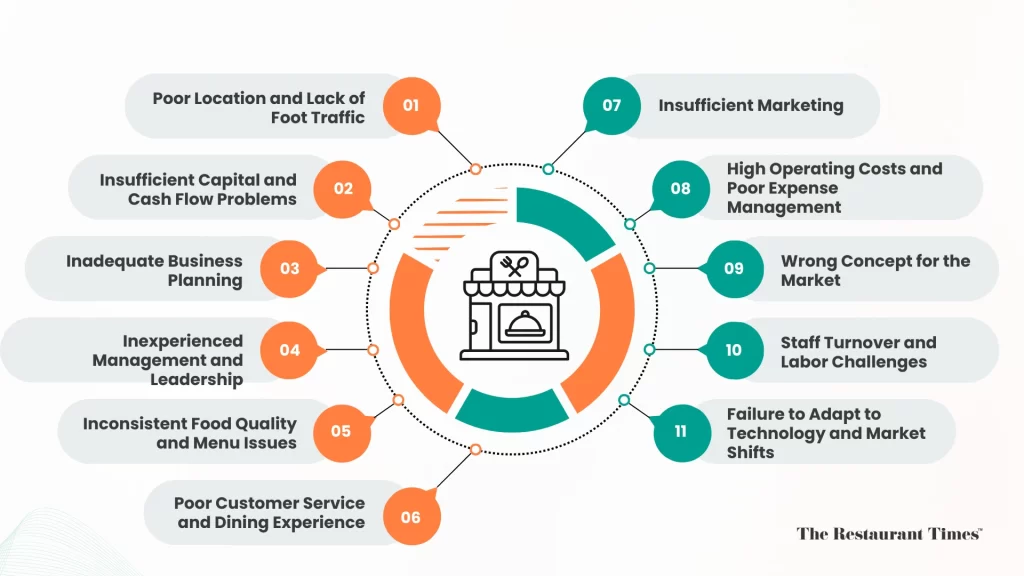
Many restaurants still use outdated methods for procurement, such as old spreadsheets and manual orders, which can lead to inefficiencies and increased costs. Inconsistent quality and customer experience can lead to operational inefficiencies, as negative reviews and lost loyalty can significantly impact a restaurant’s performance. Choosing a poor location can significantly impact a restaurant’s traffic, labor costs, utility bills, and food expenses, making it one of the most critical decisions for a restaurant’s success. The reasons are many. Let’s explore the top 11:
1. Poor Location and Lack of Foot Traffic in New Restaurant
Location affects how busy a restaurant is as well as how much it pays in terms of labor, utility, and food costs; thus, it becomes one of the most important aspects for opening a restaurant. Places with too much competition and where a restaurant may not have enough visibility put the business at greater risk of failure because it will be hard to attract customers in a crowded place.
The place where a restaurant will operate depends on several factors, including how easy it will be for people to access it and whether it will have sufficient visibility and competition. For example, what makes a good location for a fast-casual restaurant differs greatly from what makes a good location for an upscale restaurant.
2. Insufficient Capital and Cash Flow Problems
One reason some restaurants go under is insufficient capital and financial incompetence, as business owners tend to overestimate how much capital will be required to launch and run the enterprise. Financial incompetence is reflected in miscalculations of startup expenses, inefficiency in inventory control, and failure to monitor cash flow daily; all of the above cause the exhaustion of working capital long before the business gets off the ground.
Financial opacity may affect the decision-making process within restaurants because restaurant owners are often unaware of their actual costs, which limits their ability to properly manage pricing and staffing. Expenses related to food costs, rent, and utilities are rising faster than revenues. In addition, the initial six months after opening an establishment are a critical period for finances; owners who fail to reserve sufficient working capital for that transitional period often find themselves bankrupt before they can build a clientele.
3. Inadequate Business Planning by Restaurant Owners
Many restaurants start with enthusiasm and a great food idea, but without any solid business plan. A well-thought-out business plan with market research, realistic financial projections, and an operating strategy is not something formal; it is what will help your restaurant succeed. Many restaurants still employ old-fashioned procurement strategies, such as using old Excel sheets and manual orders.
Inflation, duties, and economic instability keep pushing customers to think twice before eating out in 2026. Thorough pre-opening market research is more crucial than ever. Operators who know their target audience, competitors, and realistic revenue expectations in advance have a much better chance of surviving the first year.
4. Inexperienced Management and Leadership
Almost 50% of restaurants in the United States are chain restaurants owned by professional corporate firms, underscoring how important industry experience is for independent restaurant owners. A lack of industry experience is one of the main reasons why restaurant owners make mistakes and demonstrate poor leadership skills.
Owners of successful restaurants usually have considerable experience in the restaurant industry before starting their own businesses. They understand how difficult running a restaurant is; passion for cooking does not necessarily mean the ability to run a business. The restaurant business requires many different skills at once, such as human resources management, finance, inventory management, scheduling, customer relations, and vendor management. Lack of industry experience leads to poor management decisions and affects the success of the restaurant.
5. Inconsistent Food Quality and Menu Issues
Poor-quality food or service inconsistency causes restaurant closures because consumers require excellent-quality services, and when they do not receive what they want, they do not visit the restaurant anymore. When there is inconsistency in both the quality of food and services, the result is loss of loyalty and bad reviews that spread very fast in the modern age. Poor food quality and small portions are the main reasons for lower consumer value perception in 2026.
An excessively large menu is difficult to handle in the kitchen and increases food costs by causing wastage. In addition, an unnecessarily large menu creates problems with maintaining consistency of food quality. Many successful operators recommend starting with a smaller menu that focuses on great food rather than including Indian, Chinese, and other cuisines.
6. Poor Customer Service and Dining Customer Experience
EXPERT INSIGHT
| “It takes roughly 40 positive customer experiences to undo the damage of a single negative review.” — Jon Younger, Forbes |
Establishments that have high-quality food, high levels of cleanliness, and great customer service will attract positive reviews and loyal customers. Diners will find a poorly managed restaurant inefficient because a lack of positive reviews and customer loyalty undermines the restaurant’s overall performance. Poor communication or ignoring reviews will negatively affect the establishment’s reputation, since today’s diners learn about restaurants online.
Customer experience is the entire process, from making a reservation or arriving at the venue to the last bite and paying the bill. Any gap in the process is a reason not to come back to the restaurant. An establishment offering great food but poor customer service, or good customer service but poor food, can survive for some time, but consistency in both areas leads to a sustainable business.
7. Insufficient Marketing
Not investing in the promotion process can be quite harmful to restaurants, since most cannot survive without advertising. Poor marketing strategy and an inadequate online presence result in an inability to attract new customers. About 77% of people living in America used social networks in 2019, and by 2026, more than half of customers will find their favorite restaurants online.
Most restaurants begin working without the idea of the importance of marketing. This approach results in an underfilled room, where the restaurant owner fails to attract any new clients. When a restaurant lacks marketing, it becomes invisible to those who have not even heard about this amazing place. In 2018, there were over 660,000 restaurants in the United States.
8. High Operating Costs and Poor Expense Management
Labor and food cost percentages usually make up 25 to 35 percent and 28 to 35 percent of revenues, respectively. If these two expense categories are added along with rent, utilities, and other expenses, there is very little room for error. Restaurants often close because food costs get out of control without adjusting menu prices, and because they are mismanaged in terms of labor during times when there are few customers.
Data-driven restaurants have a 23 percent higher survival rate than restaurants that do not use data analytics. Managers who analyze the prime cost (food costs plus labor costs) in relation to revenues on a weekly basis, as opposed to a monthly basis, identify the problems before they become disasters. Successful restaurants earn money because they control their costs in a disciplined manner.
9. Wrong Concept for the Market
When restaurants do not adjust to changes in their customers’ preferences, there may be inefficiency, as they cannot meet the growing needs of their clientele. A restaurant concept that is too advanced or outdated compared to the market appetite, for example, an upscale restaurant in a locality that does not require expensive services, or vice versa, a quick-service restaurant in a locality where customers desire a more relaxed environment, becomes a fundamental misalignment, which is extremely hard to counterbalance with the help of either marketing or operations.
In 2026, the fast food industry will experience a 1.1% decrease in revenue due to weak consumer sentiment, which will lead consumers to opt out of eating out. To determine which categories of restaurants are viable in a particular location and at which price point the restaurant should be priced, based on the locality’s demographics, some fundamental research should be conducted.
10. Staff Turnover and Labor Challenges
The high employee turnover rate, often close to 70 percent, may have a significant impact on the restaurant’s efficiency and service levels. Recruiting new personnel is always difficult; however, frequent turnover leads to ongoing increases in recruitment and training costs, as well as inconsistent customer service from new employees.
Training personnel is a never-ending process that needs to be built into the business. High-performing restaurants establish effective training systems that enable their personnel to develop, feel valued, and pursue career opportunities. Low-quality management and leadership are among the major reasons restaurants fail, as they lead to poorly organized operations and an unpleasant work environment.
11. Failure to Adapt to Technology and Market Shifts
Refusal to adopt technologies such as mobile ordering and online review management may lead to a loss of market share. There has been tremendous technological change in the restaurant industry in recent years, where digital ordering, delivery service platform integration, POS analytics, and automatic inventory management systems have become common practices rather than an added advantage for many businesses.
Restaurant establishments that do not upgrade their technology face operational difficulties while their competitors continue to evolve and gain an edge over them. The use of digital procurement software will assist restaurants in conducting automatic price checks and managing rebates, which is important for ensuring operational effectiveness and cost control. Many restaurants continue to rely on outdated procurement systems, including outdated spreadsheets and manual ordering.
INDUSTRY INSIGHT
| The issues of costs and uneven traffic, as well as rising costs, are expected to have an impact on revenues and profits in 2026, while the resilience of consumers offers some relief, as stated by the National Restaurant Association’s State of the Restaurant Industry 2026. It should be noted that the climate for the restaurant industry in 2026 is not lenient towards those businesses that fail to manage their cost drivers, every customer interaction point, and operational system. |
Warning Signs Your Restaurant Is Failing
A lack of clear vision and mission can lead to poor management decisions, ultimately affecting a restaurant’s success and sustainability. Watch out for these to tackle restaurant failure:
Financial Red Flags to Watch
Possible financial warning signs signaling problems in other areas of business operations include:
- Continuous negative cash flow for more than two consecutive months, which makes it impossible to meet the cost of daily operations.
- Continued increase in food costs exceeding 35% of total revenues without raising the prices of menu items or an increase in sales volumes.
- High labor costs exceeding 35% of revenue, thereby reducing profitability and operational flexibility.
- Increasing dependency on loans, credit cards, or credit facility borrowing to finance operational expenses as opposed to investing.
- Persistent reduction in average checks without a definite promotion strategy.
- Increasingly negative customer feedback through reviews and surveys, with no definite plan for improvement.
Operational Warning Signs
Operational problems usually precede the identification of financial difficulties. Look out for:
- A sharp rise in the number of complaints from customers about food quality, service speed, hygiene, or general service.
- High staff turnover beyond industry standards, causing training problems and inconsistency in service delivery.
- An increase in kitchen errors, incorrect orders, and ticket times during the busy periods of service delivery.
- Constant shortage of inventory, variance in inventory levels that cannot be explained, and signs of wastage, losses, or even theft.
- Poor employee morale, low engagement, and a lack of management response to employee problems in the work environment.
- Consistent shortages of important menu items as a result of poor planning, purchasing, or inventory control.
- Unpredictable service levels due to inconsistency among different shifts, branches, or employees.
How to Prevent Restaurant Failure: Proven Strategies
Rising costs, including food, rent, and utilities, are outpacing revenue growth for many restaurants, contributing to their financial struggles and potential closures. But not just this; there are many reasons behind the failure of a restaurant, and this is how you can prevent it:
Master Your Food Costs and Prime Costs
Two major costs in the restaurant business are food and labor costs. Monitor both in relation to the sales on a weekly basis. Establish a target prime cost figure below 60 percent of sales, and conduct a thorough investigation if you find any cost exceeding that figure. Many restaurants that are in financial trouble have found out that the cost of food has been above target by five to eight percentage points for several months.
Build Strong Systems for Proper Training
Training is what makes all the difference between a successful restaurant and an average one in terms of proper positioning, food, and management. Without proper staff training programs, it becomes difficult to provide consistent food quality and excellent customer service, both of which are key factors behind customers’ reluctance to visit restaurants more than once. Efficient restaurant managers develop training processes that help onboard new employees without requiring the general manager to train them individually.
Invest in Marketing and Online Presence
The new establishment cannot depend solely on word of mouth to keep its tables occupied. Start working on your Google Business Profile, respond to all online reviews, both good and bad, and get on social media well ahead of the actual launch. Failing to address your online reviews is especially detrimental, since diners nowadays learn about and judge restaurants through digital channels, and failing to respond to a bad review can make them think your business doesn’t care about what its customers think.
Use Data to Make Decisions
Data-driven restaurants have a 23% increased chance of survival over those that do not employ data analytics. Current point of sale systems give you the information on sales, labor, and inventory that is necessary for making sound judgments instead of guessing. Find out what your peak and slow times are, which menu items sell the most and least, and the ratio of labor costs to sales per shift.
Read more: https://www.forbes.com/sites/lelalondon/2026/01/29/why-even-great-restaurants-are-closing-in-2026/
Case Study: True Food Kitchen, A Restaurant Success Story
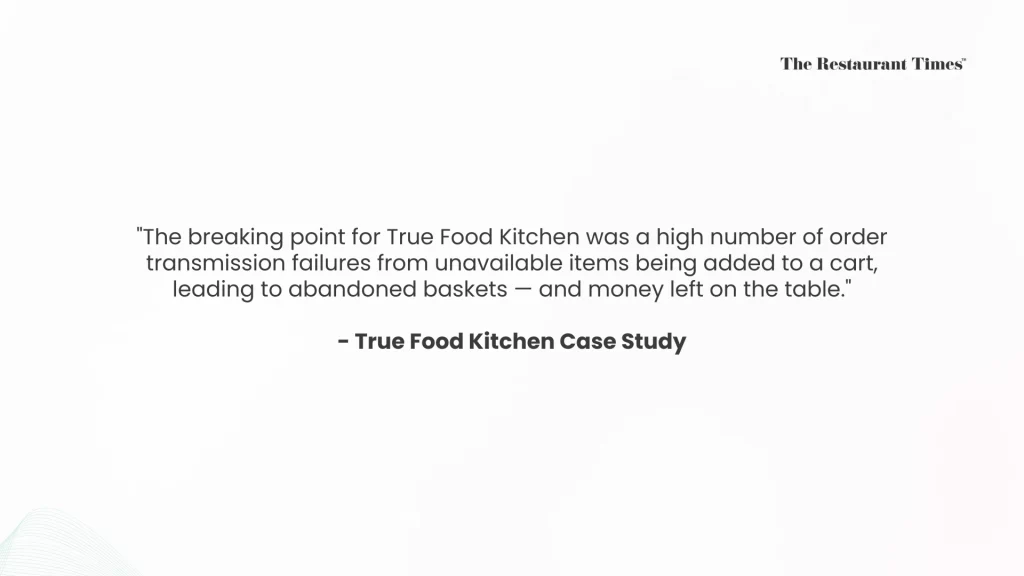
True Food Kitchen, a casual dining or multi-unit restaurant in the United States, increased sales 8.5% and cut order errors 52% by switching to a digital ordering platform. They migrated from a complex custom CRM with layered third-party tools to a white-label ordering platform. The 46-location brand simplified the checkout process from multiple clicks to a streamlined experience, implemented AI-powered Smart Cross-Sells, and reduced order transmission failures from unavailable items. Implementation took less than 90 days. It worked because
the custom solution was creating friction with too many clicks and order transmission failures that led to abandoned carts. By switching to a unified platform designed specifically for restaurant ordering, they eliminated technical failures and simplified the guest experience. AI-powered cross-sells added incremental revenue without manual work.
Restaurants that maintain high standards in food preparation, cleanliness, and customer service are more likely to earn positive reviews and retain customers. Poor leadership and management are significant contributors to restaurant failures, often resulting in disorganized operations and a toxic work culture. Inexperienced restaurant owners often lack the necessary operational experience, which can lead to poor decision-making and ineffective management. A lack of financial visibility can lead to poor decision-making in restaurants, as many operators do not have a full picture of their costs, making it difficult to manage pricing and staffing effectively. Mediocre food or inconsistent service quality can lead to restaurant failure, as customers expect exceptional dining experiences and will not return if their expectations are not met. Successful restaurant owners often have years of experience in the business before opening their own establishments, which helps them navigate the complexities of restaurant operations. Choosing a poor location can significantly impact a restaurant’s traffic, labor costs, utility bills, and food expenses, making it one of the most critical decisions for a restaurant’s success. Restaurants that fail to adapt to changing consumer preferences often struggle with operational efficiency, as they may not meet the evolving demands of their customer base.
Remember these reasons and do better.
KEY TAKEAWAYS
| – About 17%, not 90%, of restaurants go bankrupt within their first year, but about 80% fail in the first five years, mostly because of operational and financial problems rather than the quality of their food. – The top causes of restaurant failure include poor location, lack of sufficient capital, lack of good business planning, unskilled or inexperienced management, poor food quality, poor customer service, insufficient marketing, high cost of operations, wrong concept of restaurant for market, high staff turnover rate, and failure to embrace technology. – 81.4% of the causes of restaurant failure are controllable by owners and management; restaurant failure is preventable with the right preparation. – Successful restaurants have the following things in common: financial discipline, consistency in their operations, marketing efforts, good training programs, and adaptability using data. |
Frequently Asked Questions
1. Why do restaurants have a high failure rate?
Restaurants are very difficult to run successfully because there are many problems involved at once. These problems include very low profit margins of around 5% before tax, very high costs due to food and labor, stiff competition in the area, high staff turnover, and substantial capital needs before earning money becomes possible. The rise in the cost of food, rent, and utilities is outpacing income growth for many restaurants. This makes mismanagement financially very dangerous indeed. Restaurants go bankrupt mainly through controllable means.
2. What is the 30/30/30 rule for restaurants?
A 30/30/30 guideline has been suggested for managing costs, with 30% of revenue coming from food costs, 30% from labor costs, and 30% from overheads; the remaining 10% goes to profits. It is often difficult for restaurants to ensure that both their food and labor costs remain at 30% while ingredient costs and the minimum wage continue to rise.
3. Why are so many restaurants failing?
Most restaurants are struggling in 2026 because it has become increasingly difficult to operate a thin-margin business due to macro-environmental conditions. Continuous inflation, tariffs, and economic uncertainty have prompted consumers to rethink their dining-out practices. Low food quality and low portion sizes are the biggest factors behind the reduced value perceived by consumers at restaurants. The cost of doing business, especially food and labor, has risen much faster than most menu prices.
4. What are the top 3 reasons businesses fail?
For restaurants, the three most important reasons for failure include: Financial problems (bad budgeting of costs, failure to manage cash flows, and inability to cut costs on food and labor); improper location and lack of traffic (opening a place without a proper demographic study); and lack of business skills (love of food but no knowledge needed for running a business). 81.4% of all small businesses fail due to factors that owners and managers can control, meaning business failures are usually avoidable.