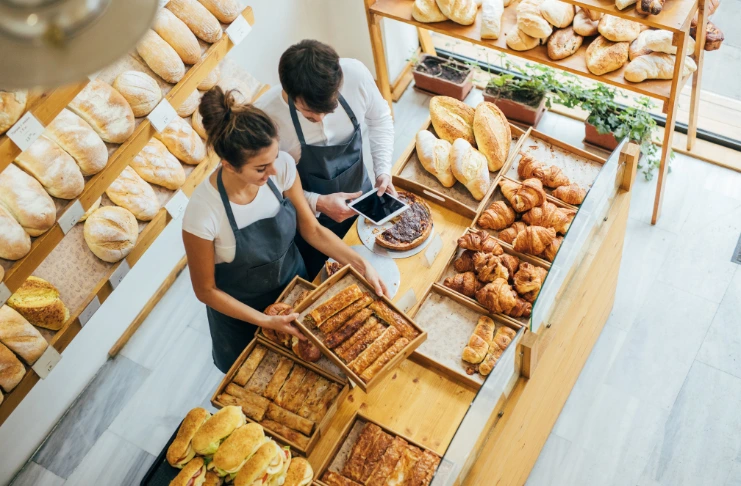

Choose any loaf from the racks in your grocery store; it will be exactly the same, sliced, soft, and able to stay fresh for up to one week. Compare that with going into a boutique bakery and purchasing a sourdough loaf. It has been handmade and baked in a deck oven, and its composition and structure are the result of the flour and fermentation process as well as the time spent on making it. The first is bread; the second is bread, but they are entirely different products.
A decision whether to run an artisan bakery or a commercial bakery is inevitable for any baker, food entrepreneur, or café owner. And the decision will be based on your production expectations, consumers’ demands, and the profits you expect.
What You Will Learn
- The core differences in production, ingredients, and techniques between artisan and commercial baking
- How cost structures, equipment, and profit margins differ between both models
- Which business model suits different scales of operation and market positioning
- What the research says about consumer demand and profitability in each category
What Is Artisan Baking?
The art of artisan baking is essentially about tradition, skill, and flavor, not speed, and the surprising thing is that there is a huge demand for it. Artisan baking focuses on small-batch production and craftsmanship. Artisan bakers often require longer fermentation periods for flavor. Artisan baking relies heavily on the skill of experienced bakers. Artisan bakeries produce small batches that sell out quickly.
Artisan bakers take pride in their work of fermenting, flour type, hydration, shaping, and the environment they bake in.
INDUSTRY INSIGHT
| The artisan bakery market size was valued at $37.34 billion USD in 2025 and is expected to grow at a CAGR of 5.13%, reaching nearly $53.00 billion USD by 2032. |
This growth proves true: people are willing to pay for quality bread produced by dedicated bakers.
Artisan bakers have longer fermentation periods– usually 12-24 hours for the naturally leavened bread –with the use of wild yeast starters or a small amount of commercial yeast. Every step in this process requires personal skills that cannot be replaced by a machine, resulting in a unique bread with complex taste, texture, and crust.
What Is Commercial Baking?
Commercial baking emphasizes volume, consistency, and efficiency. Commercial bakers must maintain quality across high production volumes. Commercial baking environments value discipline and speed. This is an entirely different practice from making bread as an artisan. While the artisan baker produces each loaf separately by hand, a commercial bakery operates using hundreds of units of machinery, such as mixers, dividers, proofers, and tunnel ovens, to produce the same bread consistently and at the lowest cost possible. Commercially produced bread undergoes less fermentation time, uses commercially available yeast, and is made with additives that extend shelf life. The flour used in commercial baking is not for its taste but for its predictability in machinery.
Artisan Baking vs. Commercial Baking: Key Differences
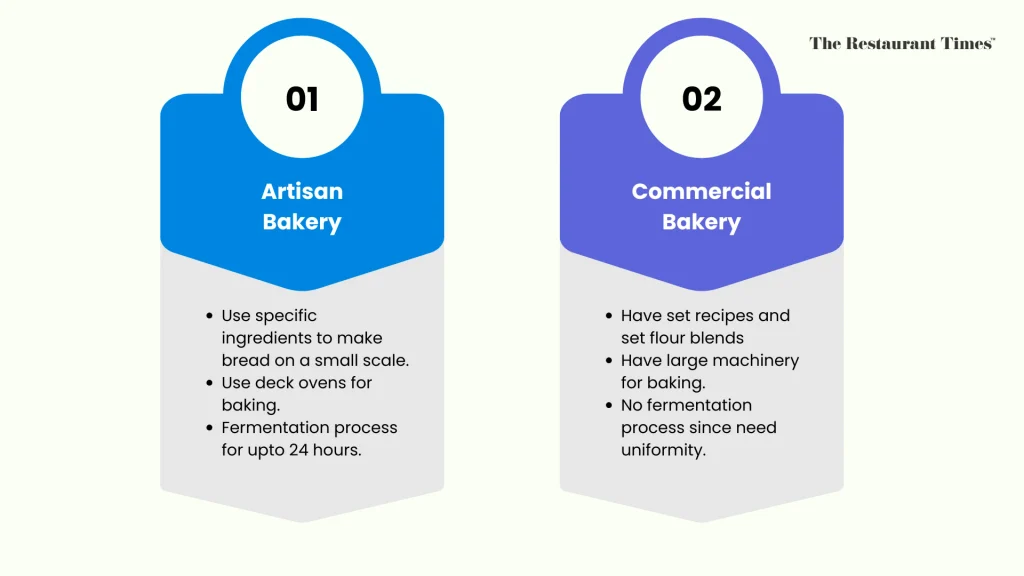
The distinctions between the two methods are not limited to the ingredients they use but run deeper into their philosophy of baking.
EXPERT INSIGHT
| “Artisan products are more likely to be produced with traditional processes, using clean-label ingredients and few preservatives than their larger commercial baked goods counterparts.”—Global Market Statistics report authors, Market research analysts, Global Market Statistics |
Ingredients and Techniques and Traditional Methods
These artisans are likely to buy from specific mills for the historical varieties of their wheat, stone-ground flour, or local grain, as the flour will make some difference on a smaller scale. An artisanal baker influences variables such as water, salt, and the fermentation process to achieve the uniqueness of his or her bread. Products from artisan bakeries have shorter shelf lives due to fewer preservatives. Artisan bread uses carefully selected flour for better quality. Artisan baking prioritizes ingredient quality over speed and efficiency. In comparison, industrial bakers follow set recipes and have set flour blends. Commercial breads often rely on standardized mixes for consistency.
Production Scale and Equipment
Although an artisanal baker makes 50-200 loaves of bread daily in a small bakery with deck ovens, bannetons, and a lame to make slashes, an industrial bakery produces tens of thousands of loaves daily with the help of machinery, with humans involved only for quality-checking purposes. The machinery required depends on the scale. For example, the right machinery for an artisanal bakery would cost between $50,000 and $250,000, whereas an industrial bakery requires machinery that could cost millions of dollars. Commercial bakers focus on high-volume production and efficiency. Commercial baking prioritizes volume, consistency, and efficiency.
Good Bread: Fermentation, Flavor, and Texture
The fermentation process, which lasts between 18 and 24 hours, creates the organic acids that generate flavors that cannot be created by commercial bread made within 90 minutes of processing. The creation of the crumb in quality artisan bread, which is characterized by irregular holes, is achieved through manipulation of the dough via the fermentation process not employed in commercial bread in order to achieve uniformity in production. The skilled artisan working with baguettes, rye, or enriched pastries knows that every recipe is different and needs its unique handling process. Commercial baking prioritizes consistency over creativity. Consistency in commercial baking requires strict adherence to recipes.
Business Model, Costs, and Profit Margins
The economics of each model are not only different but almost incompatible, which is why it is so important to understand your scale and market before taking a direction. The global artisan bakery market is projected to grow from $5.596 billion USD in 2025 to $8.946 billion USD by 2035, exhibiting a compound annual growth rate (CAGR) of 4.8%.
Artisan Bakery Economics
Artisan baking is costly in terms of labor and more expensive ingredients while producing smaller quantities. Profits are made through high markups on selling prices and clientele willing to pay for them. The global artisan bakeries market is expected to grow with a CAGR of 4.9% between 2024 and 2032, and buyers at farmers’ markets, independent coffee shops, and specialty stores are already spending $8, $12, or even $18 for a single loaf, which is only $3 at a grocery store. The artisan bread market in the United States had revenues of $2.5 billion in 2023, thanks to health-conscious customers looking for whole grain and sourdough breads.
Commercial Bakery Economics
Bakery businesses that manufacture their goods for commercial purposes operate under economies of scale; that is, the bigger their scale of operation, the cheaper bread is, which means they can be more profitable because of low margins due to selling a lot of products. The issue is in the positioning. In the bread industry, which is price-sensitive and marginally profitable, it is hard to differentiate. The best commercial bakers will be those that can create scale to reduce their unit costs enough to compete on price, or those with a semi-artisan positioning.
The artisan bakeries that tell a story about what they do and where their ingredients come from have a competitive advantage that cannot be beaten by price. Consumers who understand fermentation, buy sourdough because of its nutritional benefits, and care about where their flour is milled are not shopping by price; they are buying trust.
Which Model Is Right for You?
This is ultimately not a question about bread; rather, it is a question about what kind of business you want to build and what trade-offs you are prepared to accept.
For Independent Artisan Bakers
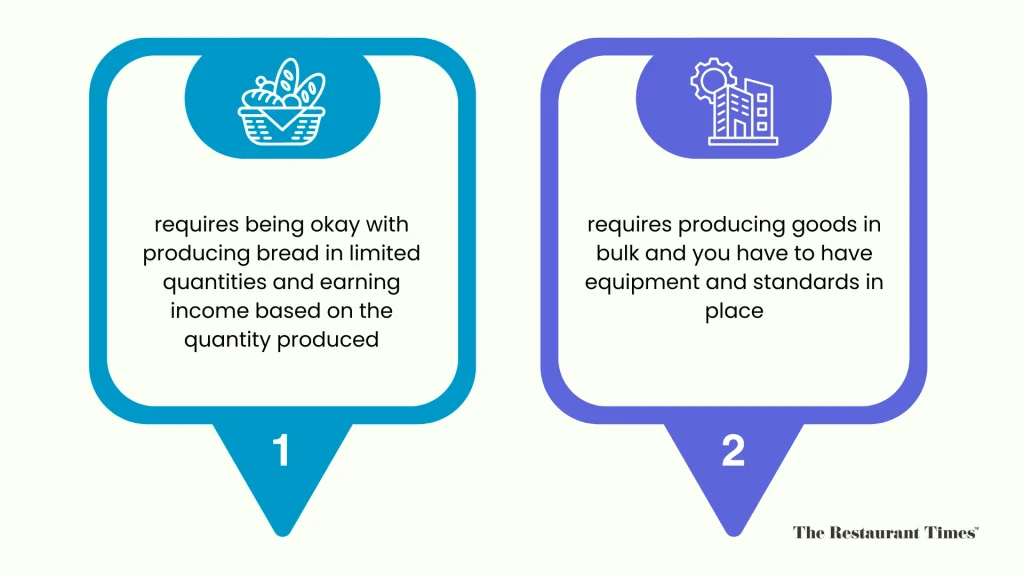
If your passion is the craftsmanship of creating a good loaf of bread through skillful fermentation techniques using selected mills, then the artisan model will suit you. The artisan bakery model requires being okay with producing bread in limited quantities and earning income based on the quantity produced, while having buyers who can afford high prices. The artisan bakery model suits farmers’ markets, subscription services for bread, small cafes, and direct selling through the internet.
For Production-Scale Operations
But if your business needs to provide for cafés, restaurants, and grocery stores in bulk, then even if you do not want to go the commercial way, you are going down that road regardless. The realities of producing goods in bulk mean you have to have equipment and standards in place that cannot be handled purely through artisan methods. Semi-artisan is the happy medium, using natural leavens, good flour, and proper fermentation times in bulk production. It is challenging to pull off, but it commands higher prices than the purely commercial route.
KEY TAKEAWAYS
| – The artisan method is characterized by its use of tradition, fermentation, quality flour, and craftsmanship, resulting in bread that simply has more flavor than can be delivered by industrial processes – The industrial bakery model uses automation for consistency, production, and efficiency, which is a very different approach that targets a very different market with a very different price point – The artisan bakery business model is sustainable through high prices and direct sales, but it requires strict adherence to a carefully defined product line – The correct model is dependent on your production objectives, funding, and the kind of baker that you want to be; profit can be made in both cases, but through totally different means |
Frequently Asked Questions
1. What is the difference between an artisan bakery and a commercial bakery?
The traditional bakery uses the age-old method of preparing bread, where bread is prepared through a natural fermentation process, use of good-quality flour, hand kneading, and good judgment throughout the production process in small batches and with close contact with the consumer. On the other hand, a commercial bakery prepares bread in large volumes using machine processing and ingredients that can survive storage for some time. All this is evident from the nature of the bread itself.
2. Is artisan bread more profitable than commercial bread?
However, in artisanal baking, the profit margin per unit can be far higher due to the high price – $8 to $18 for one loaf, as against $2 to $4 for the commercial bakery item. The point is that total income depends on how many units one sells, and artisans do not have unlimited capacity to make products. For individual artisans, an artisanal marketing strategy is superior to competition.
3. Can an artisan bakery scale to commercial production?
This is possible but with some trade-offs. Most bakeries that try this will find themselves in what can be called a “semi-artisan” middle way, whereby their baking is better than that of the commercial bakery but not quite artisan. It all boils down to whether this model will work for you and how much you can charge for it.
4. What equipment does an artisan bakery need?
Functional artisan bread production requires a commercial mixing bowl, deck ovens with steaming, proofing facilities, bannetons and linen for forming the dough into shapes, and a scoring blade known as a lame. The cost of setting up such a system is between $50,000 and $150,000, depending on the quality of the oven. The oven is the most important item purchased.