

Efficiency in running a restaurant is entirely about consistency through repetition. Whatever gets done or prepared needs to be done in the exact same manner, whether it is done by one person or another. Consistency in the restaurant is never an accident; it has to be written down. The restaurant’s SOPs get that job done.
42% of restaurant owners reported that their businesses are not profitable in 2025, an increase compared with previous years. Those who succeed in closing the gap do it by creating a system. SOPs help ensure that all staff members follow proper food safety protocols consistently, which is crucial for preventing foodborne illnesses and maintaining health compliance. This guide will show you how.
What You Will Learn
- What restaurant SOPs are and what every effective SOP must include
- The major SOP categories every restaurant needs to document
- How to create, implement, and update SOPs that staff actually follow
- Common mistakes that make SOPs ineffective and how to avoid them
What Is a Restaurant SOP?
In the restaurant business, SOP stands for standard operating procedures. It refers to a document that contains instructions for carrying out certain tasks in the restaurant effectively. It describes the process, the people responsible for doing the job, and the standard to which it should be done.
Key Components of Restaurant SOPs
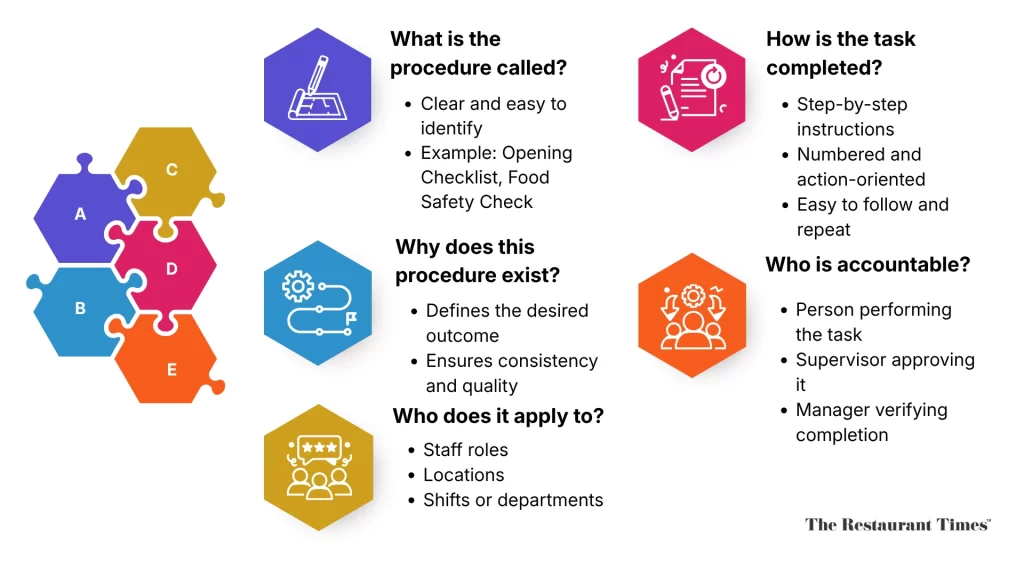
Effective SOPs should include a descriptive title, the purpose of the task, the scope, specific step-by-step instructions, and assigned responsibilities. Every well-structured SOP requires five core components:
- Title: What the procedure is called
- Purpose: Why this procedure exists and what outcome it ensures
- Scope: Which staff, locations, or shifts does this procedure apply to
- Procedures: The numbered, step-by-step instructions are written in actionable language
- Responsibilities: Who is accountable for completing, supervising, and verifying the procedure
Defining clear roles and responsibilities in a restaurant SOP promotes accountability and efficient workflows among staff members, ensuring everyone knows their specific duties.
Why Restaurant SOPs Are Essential for Success
Effective SOPs use actionable language, include checklists, and are regularly reviewed for consistency, safety, and operational efficiency. Creating effective SOPs requires documenting clear, step-by-step instructions for tasks like food prep, cleaning, and service with staff input. Specific SOPs for restaurants may cover areas like food preparation standards, cleaning and sanitation procedures, and staff personal hygiene guidelines. Regularly updating SOPs is essential to keep them relevant and effective, as the restaurant industry is constantly evolving with changing standards and customer expectations. Failing to regularly update SOPs can lead to inefficiencies and non-compliance with current regulations, making routine reviews necessary.
EXPERT INSIGHT
| “The first step to scaling operations is to nail down your current standard operating procedures (SOPs). You won’t be able to effectively expand without them,” according to a Forbes Business Council member writing about restaurant growth. |
The limitation holds true whether there is one location or multiple locations because, without procedures in writing, each shift will always be an experiment, and quality will depend on who works that day.
With SOPs, the time new employees spend on training is drastically reduced, allowing them to be more productive right from the start. They can refer to written procedures at any time, improving customer service. Restaurants have higher success rates when standards are set, and procedures form the distinction between success and failure.
Types of Restaurant SOPs

Restaurant SOP templates can cover many areas, but they fall into four primary categories: front-of-house, back-of-house, food safety, and management and administration.
Front of House SOPs
Front-of-house service protocols include greeting customers, taking orders, handling complaints, and maintaining service quality. Standard operating procedures help ensure that every guest receives a consistent, high-quality dining experience by providing clear guidelines for greeting and seating guests, taking orders efficiently, and managing special requests.
For a fine-dining restaurant, front-of-house SOPs are particularly detailed, covering everything from the precise timing of greeting a guest to the language used during order-taking and the sequence in which courses are cleared. For a casual restaurant or food truck, FOH SOPs are leaner but no less important for maintaining consistent service across every customer interaction.
Back of House SOPs
Kitchen operations are where the most critical food-preparation SOPs are found. Back-of-house procedures cover everything from how ingredients are received and stored to how dishes are plated and expedited to the pass. Implementing SOPs can significantly reduce food waste and improve food quality by standardizing kitchen operations and ensuring that all staff follow the same procedures for food preparation and handling.
Standardized recipes are a core component of back-of-house SOPs; they ensure that a dish tastes the same whether it is made on a Monday morning or a Saturday night, by a veteran line cook or a new hire in their second week. Kitchen equipment use, cleaning schedules, and cooking equipment maintenance procedures also fall under this category.
Food Safety and Hygiene SOPs
Food safety SOPs are both functionally significant and legal requirements. Every year, there are around 800 foodborne disease outbreaks in the US, of which 60% occur in restaurants. Some HACCP food safety and hygiene practices include temperature control, avoiding cross-contamination, proper labeling of foods, and handwashing.
SOPs help ensure that all employees follow food safety protocols properly and are an important practice for preventing foodborne diseases. Health department inspections are a legal requirement, and failure to comply results in the closure of business premises, fines of up to $50,000, and reputational damage.
Management and Administrative SOPs
Management SOPs cover the operational and financial processes that run the business itself: scheduling, inventory management, cash handling, POS system reconciliation, and reporting. Common types of SOPs in restaurants include opening and closing procedures, inventory management, and cash handling protocols.
Essential Restaurant SOPs Every Business Needs
Key SOPs include food safety and HACCP, sanitation schedules, inventory management, and front-of-house service standards. Here is what every restaurant needs documented first.
Opening and Closing Procedures: Food Flow SOPs
Checklists for opening and closing the restaurant help ensure everything is set up correctly for restaurant operations and that security measures are in place when the restaurant closes. Procedures for opening the restaurant include equipment inspection, checking food temperatures, completing mise en place, preparing the cash drawer, and initiating the POS system.
Procedures governing how food moves through the restaurant fall into this category. They specify the acceptable times and temperatures for a specific point in the food-preparation process.
Food Preparation and Food Handling SOPs for Smooth Kitchen Operations
Creating effective SOPs requires documenting clear, step-by-step instructions for tasks such as food prep, cleaning, and service, with staff input. Food preparation SOPs cover portion sizes, recipe execution, cooking temperatures, prep labeling, and the sequence of item preparation to minimize cross-contamination risk.
Food safety standards extend throughout the entire kitchen – the way raw proteins are stored relative to ready-to-eat foods, the handling and communication of ingredients that contain potential allergens to FOH, and the temperature recording of food products during service. The food safety standards are not suggestions for this type of SOP – they are the starting point for all SOPs.
Food Waste and Inventory Management SOPs for Controlling Labor Costs & More
Inventory and Waste Management consist of practices for managing inventory levels, controlling inventory, and disposing of waste effectively. Proper inventory management SOPs include processes for receiving goods, organizing inventory by expiry date and category, scheduling cycle counts, and documenting waste. Proper SOPs for food waste should include guidelines on what happens to excess food prepared for meals – holding the extra meals at proper temperatures or cooling them down for the next day, or food donations where necessary.
Currently, the industry average cost of food percentage for full-service restaurants is 32.4%. Proper inventory management SOPs can directly affect the figure, since over-ordering, improper storage, and waste will increase food costs without generating additional income. Lower your labor costs from last-minute orders and supplier trips by implementing proper par-level SOPs in your inventory management SOPs.
Handling Customer Complaints SOPs
It is inevitable that customers lodge complaints, and whether they leave as a lost guest or a recovered one depends on the SOP for dealing with the complaint. Having an SOP will help provide quality customer service as processes become standardized.
This customer complaints SOP includes: how the complaint should be acknowledged immediately; the right language and tone to de-escalate situations; which complaints are solved at the server level and which should be passed to the manager; what compensation should be done by which level; and how to log the complaints for future trends analysis. All staff members who interact with customers must be made aware of the SOP, rather than relying on their judgment.
Cash Handling and POS System Procedures
Cash handling SOPs protect the business against both accidental error and intentional theft. A cash handling SOP covers: how opening cash drawers are counted and verified; when and how cash drops occur during service; who is authorized to void or discount transactions in the POS system; how end-of-day reconciliation is conducted; and how discrepancies are reported and investigated.
Dishonest workers cost the restaurant industry billions of dollars every year, with employee theft accounting for roughly 75% of inventory shortages and approximately 4% of total revenue loss. A well-configured POS system SOP that requires manager approval for sensitive actions, voids, discounts, refunds, and no-sales significantly reduces exposure to this risk.
Emergency Procedures SOPs
SOPs for emergency procedures are among those that many operators wait to develop until they are needed, which is precisely when there will be no time to do so. These SOPs address fires, kitchen incidents, serious allergic reactions, and medical crises involving staff and patrons alike. They clearly delineate each person’s role in an emergency, calling the authorities, evacuating the dining area, managing the media, and so forth.
How to Create Effective Restaurant SOPs
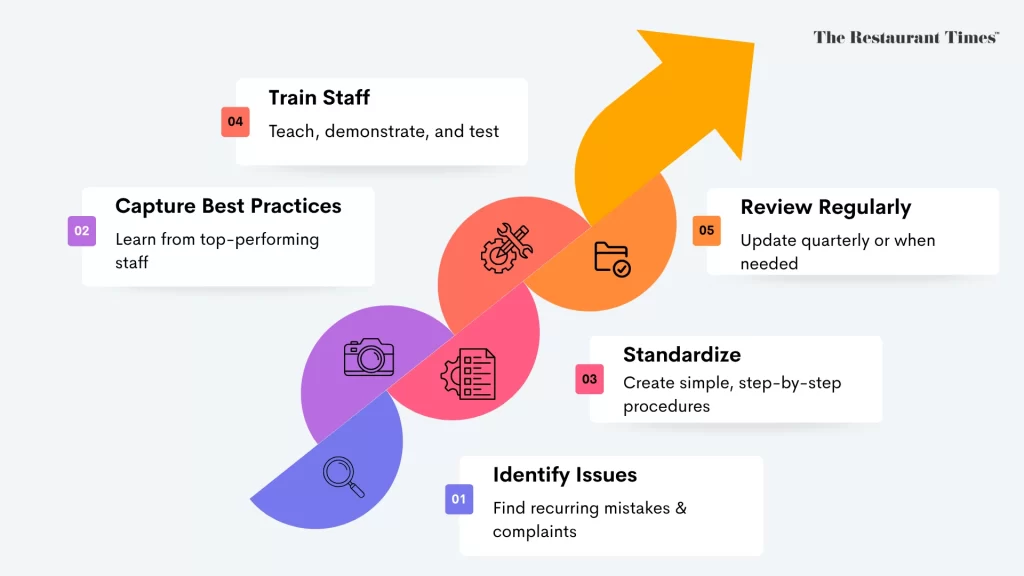
Creating effective SOPs requires documenting clear, step-by-step instructions for tasks such as food prep, cleaning, and service, with staff input.
Step 1: Identify Processes That Need SOPs
Begin by considering those areas that show signs of inconsistency the most, places where customer complaints tend to accumulate, where health inspector findings become common, or where newly hired staff make errors consistently.
Step 2: Document Current Best Practices
It is important to include employees from all departments in the SOP development process, as their input will help identify problems and ensure the processes are feasible and effective. Watch how your best-performing employees carry out the process and note in detail the steps they take. You will save the corporate know-how that would be gone when these employees quit.
Step 3: Standardize and Format Your SOPs
An effective SOP uses action language, includes checklists, and should be reviewed regularly for consistency, safety, and efficiency. Use clear and concise language when writing your procedures. Procedures should be numbered and not written in paragraph form. Photographs may be used if necessary. SOPs should be kept to one page whenever possible.
Step 4: Train Staff on New Procedures
Insufficient training on SOPs leaves employees ill-prepared, leading to inconsistencies in their implementation and execution. New recruits must be given SOPs at the time of recruitment, while old recruits should be informed about the changes made to SOPs with a live demonstration. SOPs must be tested and improved upon actual experiences and employee input.
Step 5: Review and Update Regularly
Updating SOPs regularly is essential to ensure their relevance and effectiveness, as the restaurant industry is constantly evolving in response to changing regulations and requirements. Make sure to review SOPs at least quarterly, and do so right away when there is a need for an inspection, the launch of a new menu, or staff changes.
INDUSTRY INSIGHT
| Food prices are currently over 35% higher compared to before the pandemic, as measured by the Producer Price Index for All Foods by the Bureau of Labor Statistics in the U.S. Under such circumstances, all inefficiencies, such as portioning excess food, food waste during preparation, irregular cleaning schedules, and machine failures, translate into financial losses each and every time. Restaurant SOPs are among the most economically viable operational investments for restaurant owners, as they help create procedural efficiency. |
Common Restaurant SOP Mistakes to Avoid
Not involving relevant stakeholders in the SOP creation process can lead to impractical procedures that do not address the real challenges faced by staff. Neglecting user feedback from staff who implement SOPs daily can result in impractical procedures that are not followed consistently. These are the most common failure patterns:
- Creating SOPs without staff input. Procedures written in isolation by management frequently miss operational realities that floor staff navigate every shift
- Overloading detail. A five-page SOP for a two-minute task creates resistance to compliance. Keep procedures lean and executable
- Keeping SOPs away from areas where employees can access them. A book on the manager’s desk is not training. SOPs must be made available at the time of implementation
- Never revising them. The SOP that captures how the kitchen was working two years back is not an SOP; it is history
- Training once and assuming it’s adopted. SOPs call for continuous reinforcement rather than one-time orientation
Standard operating procedures (SOPs) are essential for maintaining high standards and ensuring smooth operations in restaurants, as they provide clear guidelines for staff to follow, which enhances efficiency and consistency. Implementing SOPs can significantly reduce food waste and improve food quality by standardizing kitchen operations and ensuring that all staff follow the same procedures for food preparation and handling.
Restaurant SOP Checklist
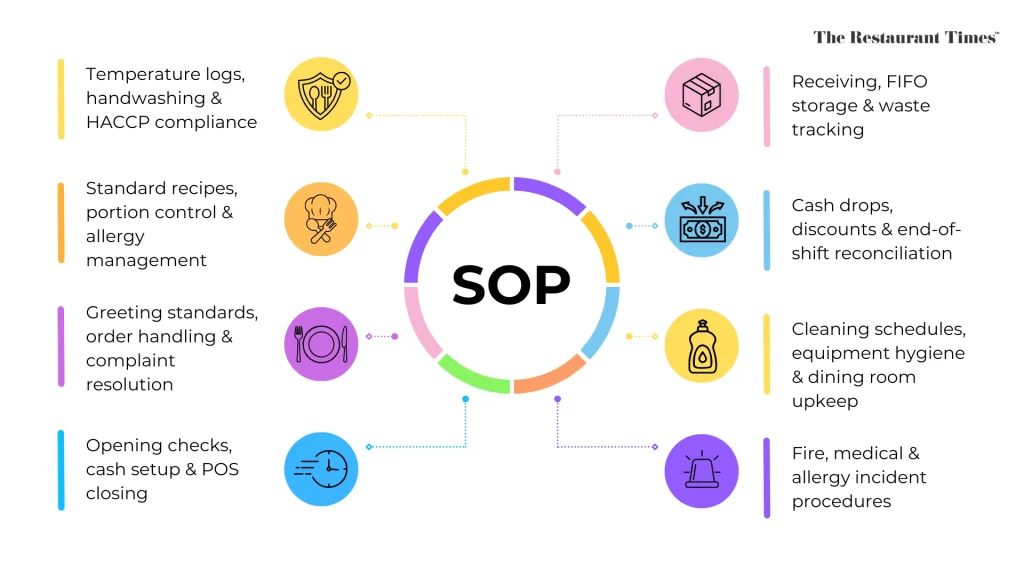
A comprehensive restaurant SOP checklist should cover several critical areas to ensure all aspects of restaurant operation are efficient and effective, including food safety, service protocols, and employee roles. Key components of a restaurant SOP include food safety and hygiene standards, service protocols, employee roles and responsibilities, cleaning and sanitation procedures, and inventory management. Use this checklist to assess whether your core SOPs are in place:
- Food Safety & Hygiene: Temperature tracking, hand washing procedure, HACCP guidelines, hygiene rules for employees
- Food Preparation: Recipe standardization, portion control, avoiding cross-contamination, and dealing with allergies
- Front of House Services: Welcome, Ordering process, Complaint procedure, Recovery authority
- Start/End of Shifts: Checking equipment, checking food temperatures, preparing the cash drawer, and POS closing
- Inventory Control: Inventory check upon receiving inventory, Storage using FIFO system, Cycle count, Waste disposal
- Handling Money: Money drop process, Void/Discount authority, Money count upon ending shifts
- Sanitation: Sanitation schedule, Equipment cleaning for food preparation, Dining room sanitation
- Emergency Procedures: Fire emergency, Medical emergency, and Allergy emergency
Key SOPs include food safety/HACCP, sanitation schedules, inventory management, and front-of-house service standards. Inadequate training on SOPs can leave staff unprepared, resulting in inconsistent application and adherence to procedures.
SOPs help restaurants achieve compliance with health regulations, as they ensure that all staff members are trained to follow proper food safety protocols, which can prevent costly violations and maintain the establishment’s reputation. Implementing SOPs can significantly reduce food waste and improve food quality by standardizing kitchen operations and ensuring that all staff follow the same procedures for food preparation and handling.
Defining clear roles and responsibilities in a restaurant SOP helps promote accountability and efficient workflows among staff members, ensuring that everyone knows their specific duties. Testing and refining SOPs based on real-time scenarios and employee feedback ensures their effectiveness. SOPs can significantly reduce training time for new employees, enabling them to become productive faster by providing clear, written guidance that can be referenced at any time, which ultimately improves customer service.
Common types of SOPs in restaurants include opening and closing procedures, inventory management, and cash handling protocols. Effective SOPs should include a descriptive title, the purpose of the task, the scope, specific step-by-step instructions, and assigned responsibilities. Not involving relevant stakeholders in the SOP creation process can lead to impractical procedures that do not address the real challenges faced by staff. Inadequate training on SOPs can leave staff unprepared, resulting in inconsistent application and adherence to procedures.
Overcomplicating SOPs with excessive detail can confuse staff and hinder compliance, making it essential to keep procedures clear and concise. Neglecting user feedback from staff who implement SOPs daily can result in impractical procedures that are not followed consistently. Hence, detailed opening and closing checklists ensure the restaurant is ready for service and secure upon closing. So, go prepare your SOP today!
KEY TAKEAWAYS
| – The SOP in restaurants refers to a set of written procedures that ensure consistent performance across routine processes, such as food preparation, financial transactions, and customer complaint handling, regardless of the person performing them. – Five key elements common to every efficient restaurant SOP include the SOP title, purpose, scope, step-by-step procedures, and responsibilities. – Employee participation in the development process, a convenient format, and timely updates distinguish successful SOPs from those that never get implemented. – SOPs on food safety are the most critical, as about 60% of all foodborne disease outbreaks occur in restaurants. |
Frequently Asked Questions
1. What does “SOP” mean in restaurants?
The abbreviation SOP means Standard Operating Procedure. In the restaurant industry, SOPs are detailed, step-by-step guides for employees to follow when performing a task, from properly storing raw proteins in a walk-in cooler to greeting a customer within 30 seconds of seating. The purpose of SOPs in restaurants is to ensure that tasks are performed exactly the same way by any employee, regardless of the shift.
2. What is an example of an SOP?
The most common SOP is an opening server SOP. This could be an example: log in 15 minutes before service; look at the reservation list and see your assigned section; clean glasses and roll cutlery as per requirements; ensure all the table settings are in order; look into the special board about any changes in the menu; go through the 86 list with the kitchen staff; ensure that the POS system is working properly.
All the steps are numbered to indicate who is responsible for completing this task.
3. What are the 7 steps of service in a restaurant?
The sequence of service in restaurants generally includes the following: greeting the customer within a set period of time after their seating; providing menus and telling about special offers; placing an order of drinks; ordering food items taking into consideration the modifications and allergens; delivering the order and achieving customer satisfaction within a set period of time after service; staying in table presence and cleaning up the table if necessary; and finally providing the bill and doing the payment procedure, along with saying goodbye to the customer. These sequences of actions can be used as separate SOPs.
4. What is an SOP checklist?
The checklist for a restaurant’s SOP is the verification document that proves the SOP process has been completed. While the SOP itself serves as the instruction guide, the checklist will serve as the accountability measure, which is basically a set of check marks that the employee or supervisor initials as they finish each part of the process. The SOP checklist is useful when doing routine processes such as restaurant opening and closing procedures, cleaning routines, food temperature monitoring, and inventory receiving procedures.