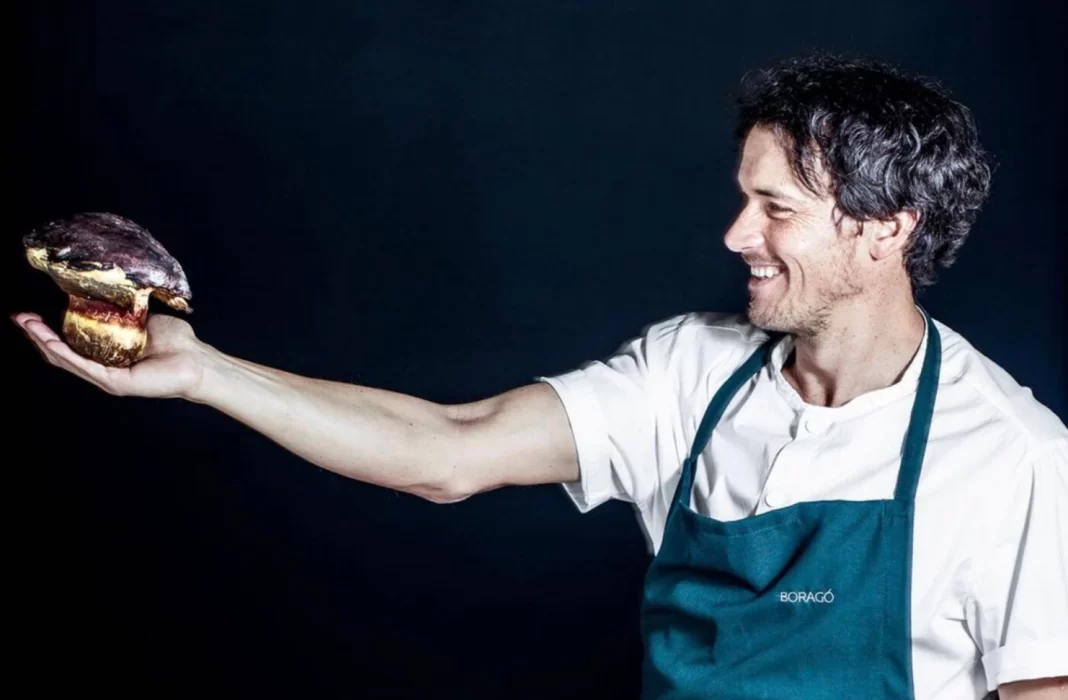

Try putting a label on Rodolfo Guzmán or what he does at Boragó, or even the restaurant itself, and chances are Guzmán will almost certainly, every single time, challenge it.
Call him a researcher, and he’ll say: “I am not a researcher, I am a cook. The word research is prostituted. What I can say is that we have become professional learners.”
Similarly, call Boragó sustainable, and he’ll counter with something like, “I don’t think there is a sustainable restaurant in the world. Every meal implies an intervention, a loss, a violence.”
At first, this may sound to you like he’s just being difficult or maybe provocative. But the more you listen, the more you’ll realize that Guzmán is genuinely precise when he talks about food, nature, and the relationship between the two, and, to be honest, that precision may actually be the whole point of Boragó in the first place.
Bringing Chile Into Focus
Guzmán trained under Andoni Luis Aduriz at Mugaritz in San Sebastián, and he learned a lot of useful techniques there. But when he returned home to Chile, he wasn’t interested in recreating them as is. Instead, he modified them to better sync with Chile itself, the full 4,270 kilometers of it, from the arid Atacama Desert in the north all the way down to Patagonia, and then further still toward Easter Island.
When he opened Boragó in Santiago in 2006, his idea was not to build another sustainable restaurant or even a great Chilean restaurant in any conventional sense. He wanted to understand what happened when local ingredients were treated with the same level of care and attention usually reserved for fine-dining staples.
“I don’t want to be a zero-kilometer cook,” he said. “I don’t want to cook with ingredients from 100, 200, 1,000, or 3,000 kilometers away. I cook with 4,000 kilometers of ingredients to explore the depth of what my country has to offer.”
While the trend in recent years has been to shrink the sourcing radius and go hyper-local as proof of ecological seriousness, Guzmán argued that to truly know Chile, you had to use all of it: the Pacific coastline, the Andean valleys, the temperate forests, the salt marshes, and the cold southern waters. In a way, he wanted to “cook the entire country.”
The Larder and the People Behind It

Boragó works with over 200 producers, foragers, and smallholders across the entire country, and that network reflects years of relationships with people who harvest produce in Patagonia, gather seaweed along the Pacific coast, and collect mountain herbs at altitude.
The restaurant’s endemic larder now includes 700 varieties of seaweed, rock plants, and fungi that appear on the menu year-round. There are tubers from Chiloé Island, edible flowers, rocks that lend mineral flavors to dishes, and a biodynamic farm 30 minutes from Santiago that provides vegetables, milk, and ducks for the kitchen, using water irrigated with Patagonian rainfall.
The most revealing story about all of this involves a tree called the espino, which Guzmán and his team spent years working with before visiting Mapuche communities to share what they had found. The Mapuche smiled and told them they had been using it for about 2,000 years and called it kirinka. Guzmán later reflected on it: “This shows how unplugged we Chileans are from our roots.” He was not embarrassed exactly, but genuinely humbled by the gap between what the restaurant thought it had discovered and how long those ingredients had actually been known and used.
The Experience of Eating at Boragó
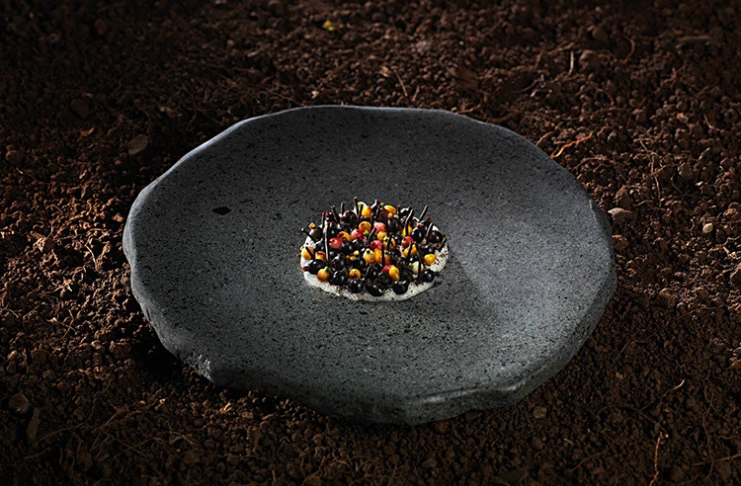
The Endémica tasting menu changes based on what arrives at the kitchen on any given day, which means the chefs do not always know in the morning what they will serve at night, and the menu a diner sees in one week may be substantially different from what appears the following week. Courses run between twelve and eighteen, and each one arrives with a story about where the ingredient came from, who grew or foraged it, and what tradition or technique surrounds it.
The presentation is somewhat playful, yet genuinely thought through. For example, what looks like soil turns out to be smoked fish, black volcanic rocks are made from squid ink dust, and ice cream is shaped like a mushroom sitting on a leaf.
There’s also this one dessert made from a goat’s milk ice cream infused with espino seeds, a paste of dark chocolate with espino extract, carrots slow-cooked with the tree for hours until they reach a texture somewhere between candy and mineral bitterness, and the empty seed pods of the tree refilled with chocolate-espino balls shaped like the original seeds.
As for drinks, Boragó offers juices made from wild herbs, evergreen shrubs, salt-marsh plants, and Andean berries, served in proper wine glasses, each complementing the accompanying dish. The wine list, described by Guzmán as being “as wide as a pool rather than a list,” specifically supports smaller family-run vineyards across Chile, including vines grown at 4,000 meters of altitude in the Atacama and Mojave deserts.
The Pandemic, the Closure, and MuuMami
Between 2020 and 2021, Boragó was closed for 18 months, which, in practical terms, meant that a network of 200-plus foragers and smallholders suddenly had no buyer for what they were growing and gathering. Guzmán understood that if the community collapsed during the closure, there would be nothing left to reopen. “If we couldn’t support them during the pandemic, when Boragó would awaken again, there would be no community.” So the team created MuuMami, a delivery service offering burgers and ice cream made entirely from native Chilean produce that could be ordered online. It kept the relationships intact and the people employed, which was the whole point.
When Boragó reopened in August 2021 and won the Flor de Caña Sustainable Restaurant Award at the World’s 50 Best Restaurants a few months later, Guzmán responded with “I have no words. It’s out of this world.”
Knowledge as the Actual Product
After eight years of documenting ingredients, Guzmán and his team built an online encyclopedia covering where to find, how to pick, and what to do with hundreds of plants, fungi, and marine ingredients found across Chile. In 2017, he published Coming from the South, a cookbook with 100 recipes. He has been an active participant in research teams working across neurological, nutritional, and psychological disciplines to understand the relationship between food, health, and human experience.
“Our challenge now is to generate knowledge, because if you look all around you, there are so many opportunities for so many people,” Guzmán said. “In Latin America, unlike in Europe, there is something we perhaps haven’t discovered yet, and that thing is called knowledge. It’s the secret to Chile’s development.”
The Constant Behind the Change
Boragó sits in a 1,200 square meter space on the outskirts of Santiago that opened in 2019, with 54 covers and floor-to-ceiling windows looking out over the Andes. Behind the kitchen, behind the seasons, the sourcing, and the eighteen-course menus, is Alejandra Tagle, Guzmán’s wife, who runs the operational side of the restaurant with a consistency he acknowledges he cannot fully put into words. “Doing it once has merit. Doing it every day, with consistency, is something else.” When he talks about Boragó as a family, it feels like the most accurate description of what has kept a project like this alive across twenty years.
Guzmán has turned down multiple opportunities for expansion and marketing because the price would have been time, and time is the one thing he has decided not to negotiate. “For me, the greatest luxury is time. I have never wanted to trade that time.”