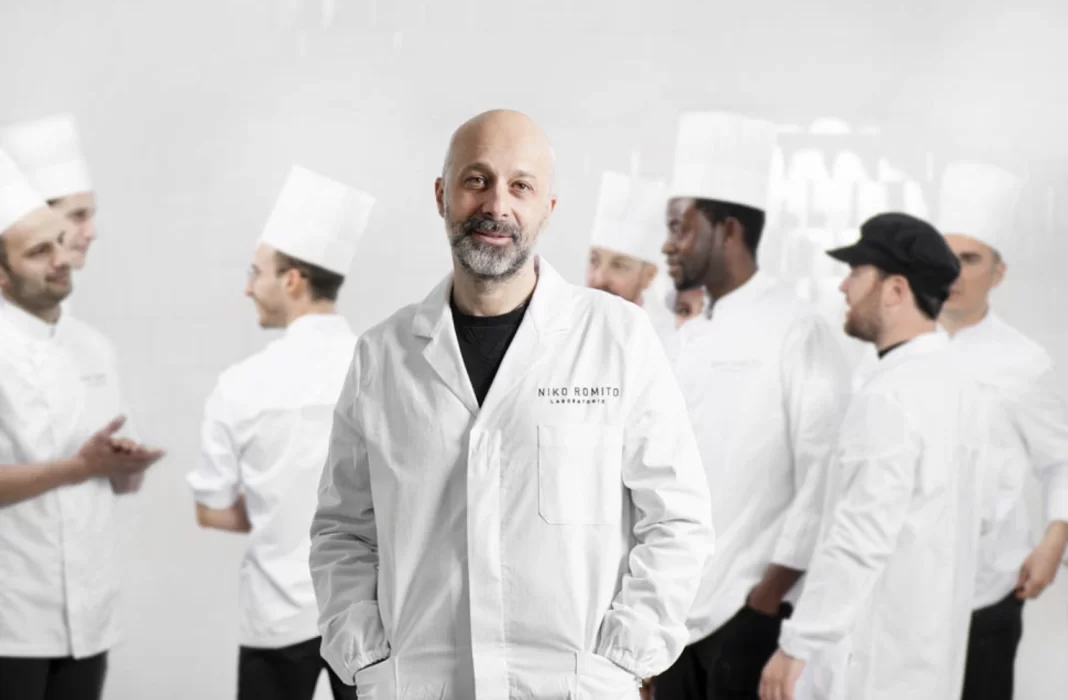

Niko Romito’s father used to run a pastry shop in Rivisondoli, a small town in the Apennine highlands of Abruzzo. But around the mid-nineties, when ski tourism was bringing people through, Antonio Romito turned that pastry shop into a trattoria and called it Reale. His son was in Rome at the time, getting his Economics degree and planning a career in finance, when Antonio fell ill, and so Niko had to come back. His father died soon after, and the family was left with “Reale.”
In a way, one can say, Niko Romito entered the kitchen with grief and out of circumstance then.
Niko and his sister Cristiana (who had trained as a translator and interpreter in French and German) took over the Reale together. The plan was to run it until they found a buyer, but they never did, or maybe they stopped looking for one altogether.
An Accidental Chef With a Deliberate Vision
Most chefs with serious ambition prefer to leave small towns and settle in metropolitan cities like Paris, Milan, or Rome to make a name for themselves.
Niko Romito, however, stayed in Abruzzo. He taught himself to cook by working a few weeks with Valeria Piccini at Da Caino, twenty days at El Celler de Can Roca in 2006, and more, just enough to understand how things work in professional kitchens. Alongside, he read. He read everything he could about gastronomy.
And by 2004, he had refurbished the trattoria, cut the covers from fifty to thirty, and started cooking.
The early years at Reale were hard because the customers who had loved the old trattoria did not immediately grasp what he was trying to do. Some nights the restaurant was nearly empty, and, in fact, there were moments where the only sensible thing would have been to stick to what “worked” or return.
He did neither, and finally, in 2007, Michelin took notice. Just two years later, in 2009, the second star came too.
In 2011, he and Cristiana moved the restaurant to Casadonna, a 16th-century monastery on a hill above Castel di Sangro. They spent years renovating the property and took on significant debt to do so. Every detail there was deliberatively chosen, from the local stone and wood to the artwork throughout the space, to match their vision.
Three years later, in 2014, Reale earned its third Michelin star, which they have held since.
The Ecosystem As a Whole
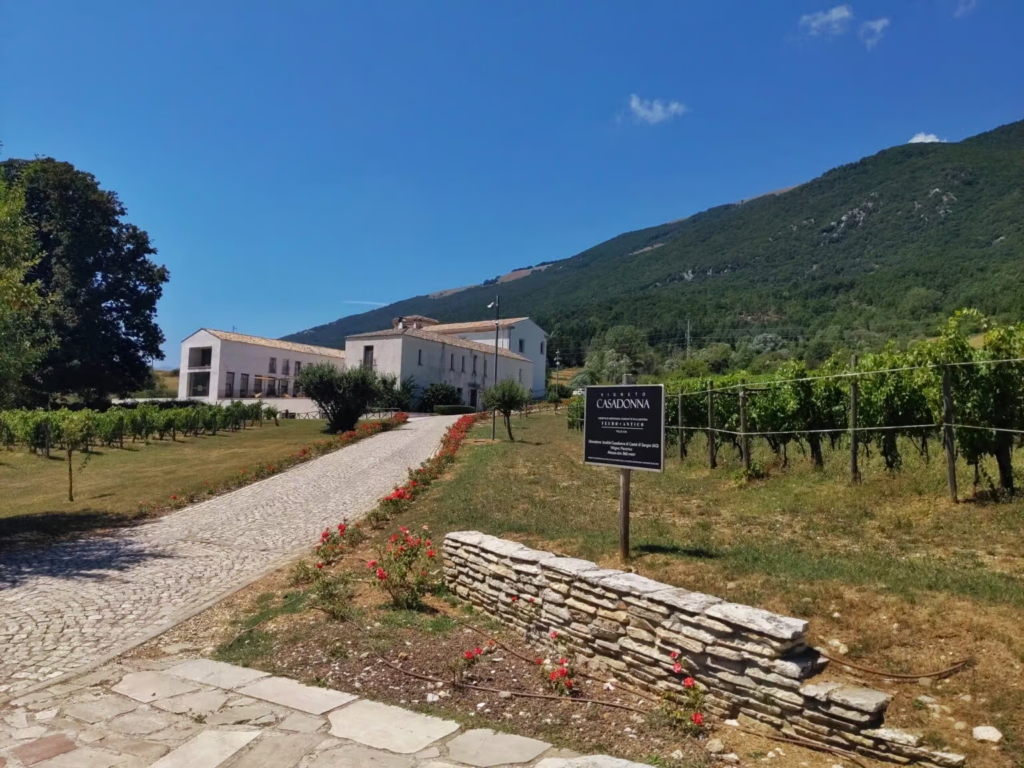
Casadonna is a former monastery atop a hill at 860 meters, U-shaped, built around a terrace that overlooks the entire valley and the rooftops of Castel di Sangro below.
Its renovation cost the duo over four million euros. They took on a fifteen-year mortgage to make it happen. Every detail throughout the restoration was carefully thought through. Nothing was added just for the sake of decoration.
And that’s how the ecosystem at Casadonna came to include:
- Reale, the three-Michelin-star restaurant.
- Guest rooms for visitors who want to stay overnight.
- A vineyard planted mainly with Pecorino grapes.
- Accademia Niko Romito, a culinary school for aspiring chefs.
- The Laboratorio, where Romito and his team conduct research and develop new ideas.
The Accademia is one of the most important parts of the project. Founded in 2012, it trains young chefs and prepares them for professional kitchens. Many graduates go on to work at Spazio, Romito’s restaurant concept, which first opened at the original Rivisondoli location and later expanded to Rome and Milan.
Then there is the Laboratorio. This is where much of Romito’s work happens when Reale is not in service. Here, new techniques are tested, dishes are refined, and ideas are developed before making their way onto menus.
By 2014, when Reale earned its third Michelin star, Casadonna had become a center where education, research, hospitality, and fine dining all came together.
“The Reale Restaurant is the center and engine of my creative universe,” Niko Romito says. “It is a real laboratory of research and experimentation on matter and taste, where all my projects come to life. Everything starts from here.”
The Philosophy: Purity as Discipline
To understand Reale, you have to understand why purity matters so much for Romito.
In his own words: “Purity is the supreme synthesis of flavor, it is essentiality and then beauty. Searching for purity means making the synthesis of something extremely complex, but in a clear way, and catching the quintessence. Synthesis is the hardest thing to achieve, but it is the form of beauty I am searching for.”
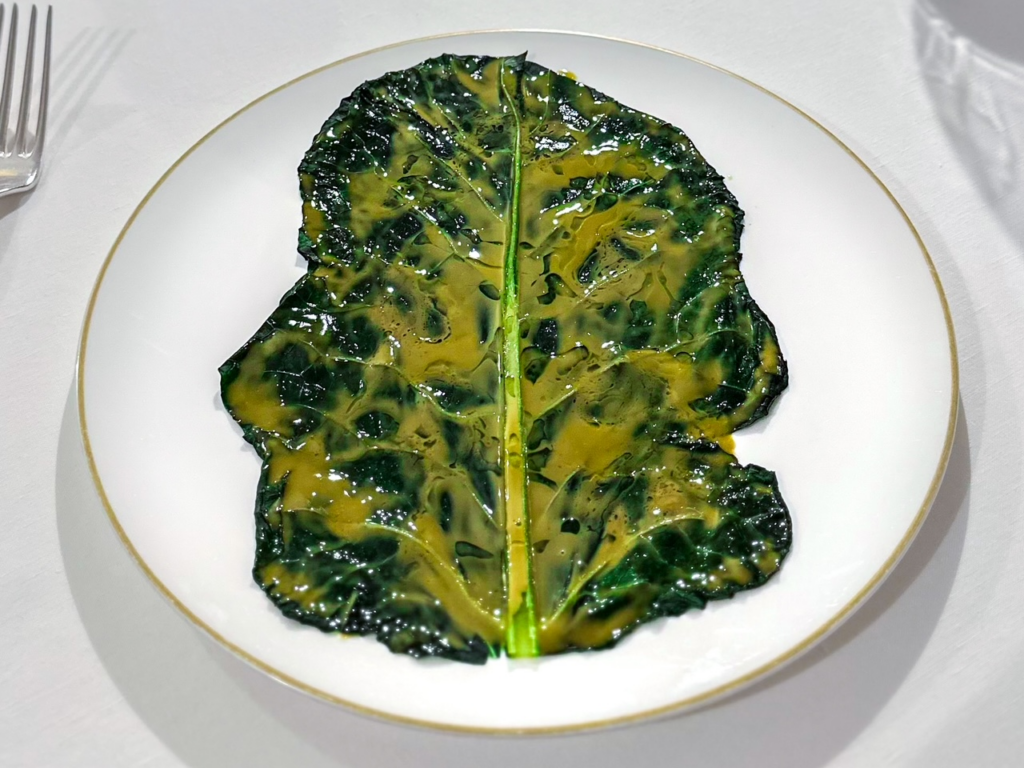
This manifests on the plate as radical minimalism with dishes named simply Carrot, Escarole, Lentils, & Broccoli, whose names suggest almost nothing of what they contain. Behind each one is what Romito calls a process of stratification: layers built not to add complexity for its own sake, but to uncover what is already there.
Take a carrot. He processes it into juice, cream, caramelized glaze, marinated cubes, and raw slices, not to show off technique but to exhaust the vegetable and find the fullest version of itself. The effect, as one reviewer described it, is like “a magnifying glass that makes the matter appear clearer.”
“Verticality of flavor, in its full expression, is at the core of my cuisine,” he says. “I try to go deep into the matter before exploring its content. It is like bringing back an unknown world by unfolding flavors which are unexpected and completely new.”
Lightness is not incidental to this process. Romito deliberately removes fat, salt, and added sugar where others lean on them, specifically because he believes restriction intensifies the taste.
“My cuisine is not tasty in spite of being light; it is tasty because it is light. I leave no room for the superfluous to intensify flavors and make them purer.”
The Vegetables at the Center
No aspect of Romito’s recent work has been more discussed (or, let’s say, more radical) than his treatment of vegetables. In 2022, he took the singular decision to make the entire tasting menu vegetable-only.
Of course, the skeptics were loud. Nobody would come, they said.
They were wrong, to say the least. The menu ran for over a year and entered the conversation around Italian haute cuisine on its own terms.
It was not a statement born overnight. Romito had been working with vegetables since at least 2009, when his Onion Absolute (a kind of broth) became one of his first iconic dishes. Then came the roasted aubergine, an artichoke, a broccoli leaf, and so on and so forth.
“My research and experimentation on vegetables blaze new trails. It gives me an incredible creative excitement, although it requires the highest precision. The most unexpected results are achieved by using common ingredients, like a carrot or an onion.”
Many critics who see a lack of prolificacy in the menu’s slow evolution miss the point entirely. The dishes at Reale do not stay the same year to year. The lentils, hazelnuts, and Garlic you eat today are not the same as the dish from three years ago. Indeed, the shape holds, but the taste keeps pushing forward.
A Little About Cristiana
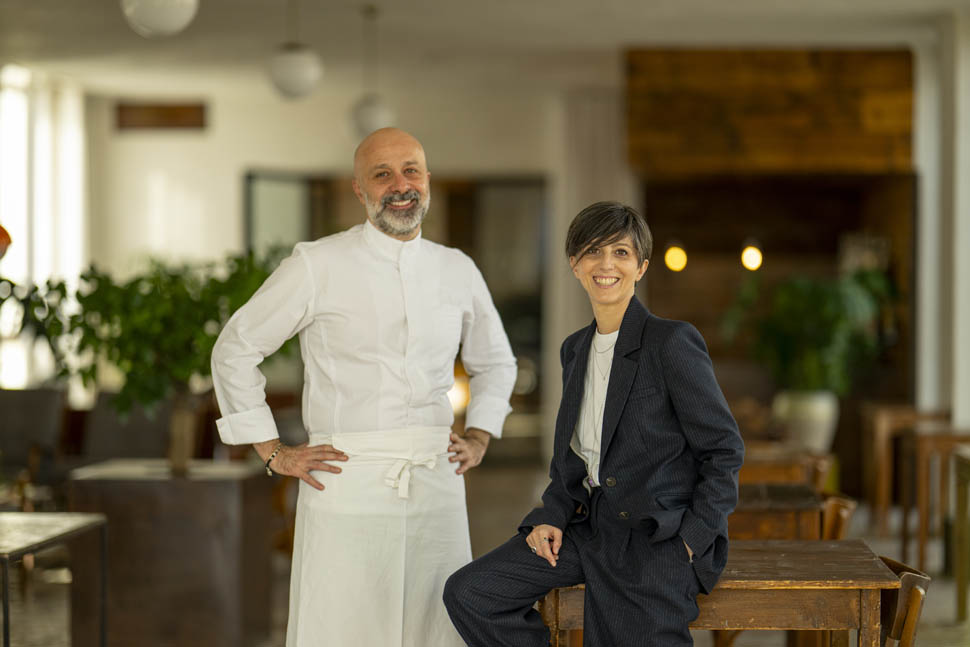
Cristiana Romito has been running the front-of-house at Reale since 2000. She has her own philosophy, her own awards, including the Mauviel 1830 Best Dining Room Director prize from Les Grandes Tables Du Monde in 2019, and her own very specific idea of what hospitality should feel like.
“It is essential to welcome the customer very naturally, to make both customers accustomed to a certain type of catering, and those more intimidated by the first-starred experience feel at ease. You don’t need any special artifice, you just need to be yourself, authentic.”
The team she has built operates without a rigid internal hierarchy. She is, in fact, explicit about this, and the result is a dining room that doesn’t perform its own professionalism. The service is technically precise, deeply informed about every dish, ingredient, and the ideas behind them, and entirely relaxed about it. This is harder to achieve than the stiff formality it replaces.
On Fine Dining, Plainly
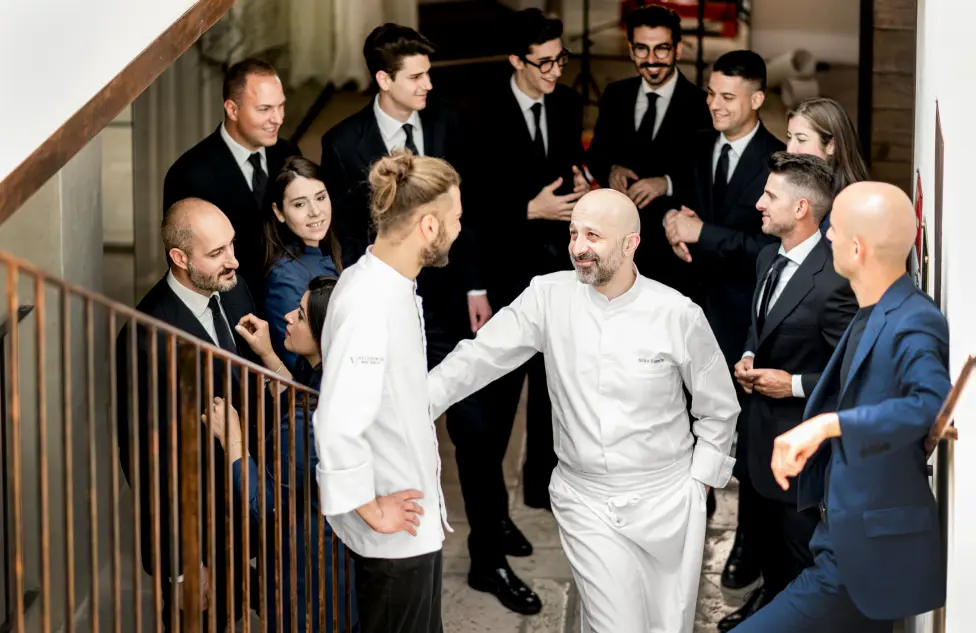
Romito does not do hand-wringing about the state of the industry. When the closures of several prominent starred restaurants in 2025 prompted the usual questions about whether fine dining was dying, his answer was: “No, fine dining is absolutely not dead; on the contrary. Let’s not confuse the difficulty of doing business with its end.”
His position is that the restaurants closing are doing so for their own specific reasons, be it due to management, the offer, or a failure to justify the price through the actual experience, and that conflating those individual failures with a sector in terminal decline is sloppy thinking. He has run Reale for 25 years, and the clientele, national and international, grows each year. He is not interested in the conversation that treats every difficult moment as evidence of an inevitable collapse.
“I think it is a moment of great dynamism and creativity, in which we are finally aware of the value that our tradition can have to face the future. We have stopped looking at models that do not belong to us, to develop something of our own, new, true.”
At the end, Castel di Sangro is halfway between Rome and Naples, two hours from either. There is no good reason to be there unless you have decided to go. That is, in some respects, the whole point. Reale does not ask you to stumble upon it. It asks you to make the decision, get in the car, and drive up into the mountains to find out what happens when someone with serious ability spends 25 years refusing to leave or stop.
The answer, as it turns out, is considerable.