
For a bakery owner who has built a business that can be replicated into a chain, a bakery franchise is one of the most formulaic routes to expansion. Bakery franchise operations give savvy owners and other entrepreneurs the chance to grow using a proven franchise model, while the franchise partner provides capital and labor in return, so you can capitalize on that framework from day one. Whether you own one unit or build a portfolio, the right bakery franchise multi-outlet playbook sets the strategies that let a business scale.
However, this route to expansion isn’t right for every bakery, and franchising isn’t right for every business owner. Aspiring business owners avoid costly surprises by figuring out early whether franchising fits their business goals or whether starting from scratch makes more sense.
This guide covers both angles: how to prepare for a bakery franchise and whether bakery franchises make sense for an aspiring business owner.
What You Will Learn
- What a franchise playbook is and what it must contain for a bakery franchise to succeed
- How bakery franchise brands build the standardization that protects quality at scale
- What franchise opportunities look for in franchise partners
- How to evaluate a franchise system before committing your capital
Franchise Playbook: The Infrastructure That Makes Franchising Work
The franchise playbook is the operational manual that ensures consistent quality across all franchise locations, regardless of who runs them. In the bakery industry, the playbook covers production, ingredients, customer service procedures, staffing, training, compliance, and quality control to maintain the brand at each location. U.S. franchising will reach 845,000 units, 8.9 million jobs, and $920 billion in output in 2026.
The Franchise People Playbook introduces four core concepts for success. Franchise People Playbook was founded in 2022 by Dan Claps. Without a franchise playbook, franchise operations don’t create consistency; they create inconsistency. Successful franchisees collaborate with franchisors and adopt proven system improvements. Bakery executives who have built multi-unit operations have always said the franchise playbook is the most critical thing they developed before their first franchise sale. This is because the playbook makes a great bakery into an even better one that champions can operate to championship standards. A strong bakery franchise playbook defines operational execution and customer experience. A multi-outlet bakery franchise requires operational consistency across all locations, and effective multi-location bakery franchises focus on scalable business systems.
What a Bakery Franchise Playbook Must Cover
Components of a playbook for the bakery’s franchises include:
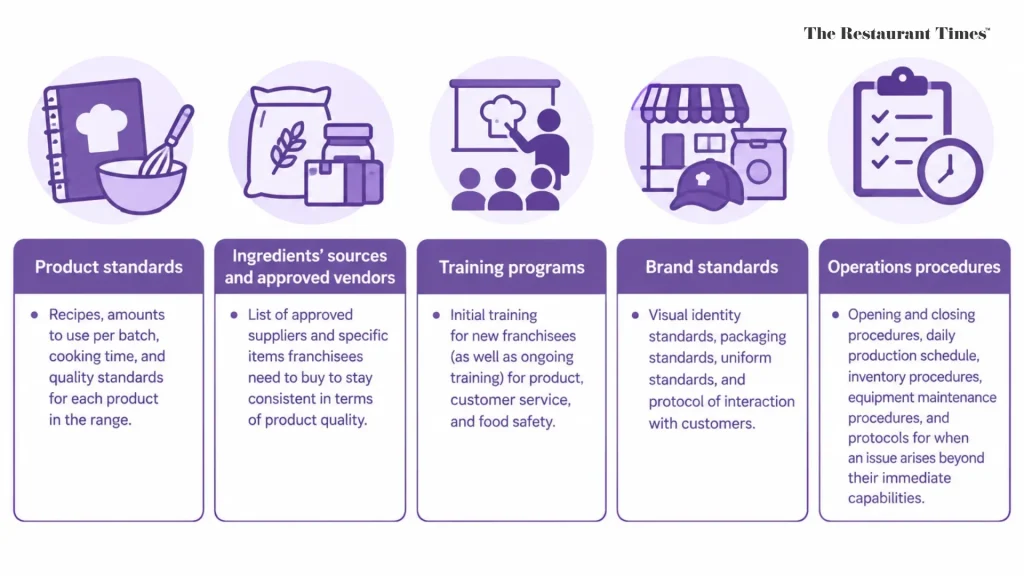
- Product standards: Recipes, amounts to use per batch, cooking time, and quality standards for each product in the range, written in enough detail that any properly trained franchisee can recreate the same products consistently without improvisation. Master recipe cards provide exact measurements and baking times for bakery items. Standardized recipes ensure consistent taste and quality in bakery products, and centralized recipe management is vital as bakery networks grow.
- Ingredients’ sources and approved vendors: A list of approved suppliers and the specific items franchisees must buy to stay consistent in product quality. This ensures product quality and, in many franchise networks, provides the franchisor additional revenue due to rebates earned from bulk buying
- Training programs: Initial training for new franchisees (usually done at the corporate training facility), plus ongoing training materials and a framework for training each facility’s staff in product production, customer service, and food safety. Strict food safety protocols are essential for maintaining product quality in bakeries.
- Brand standards: Visual identity standards, packaging standards, uniform standards, and protocols for interaction with customers
- Operations procedures: Opening and closing procedures, daily production schedule, inventory procedures, equipment maintenance procedures, and protocols for what to do when the franchisee faces an issue beyond their immediate capabilities. Daily operations SOPs should document every routine bakery task.
Key performance indicators should include operational metrics beyond sales to benchmark locations and track results across the system. Monitoring cash flow is critical for sustainable growth in bakery franchises. A leadership structure is essential as the number of locations increases in bakery franchises.
Proven Business Model: What Bakery Franchisors Build Before They Franchise
Potential business owners can avoid some of the most expensive mistakes when they choose to invest in a franchise, but only if the franchising company has truly proven the business model before offering the franchise opportunity. A premature franchised bakery business that hasn’t proven its unit economics, established stable production processes, or put the infrastructure in place for its franchisees is a problem for every franchisee. Achieve consistent profitability at one location before expanding to others.
A proven business model means consistent profitability across several outlets; a system that ensures consistent product quality regardless of the teams running each unit; franchisee support mechanisms that enable them to serve multiple operators; and an economic model showing the possibility of profitable operations within the system. Franchise businesses with a successful multi-year track record of franchisee success are more credible than those offering their first franchise opportunities based on just one successful outlet. Before you sign, look at the approval process, the support on offer, and how franchise executives respond when you ask for access to real franchisee data.
Not every franchise system keeps its promises. Pizza Hut exited markets in Turkey, the UK, and Denmark. Subway closed 631 stores in one year. Independent operators are winning against traditional franchise brands. Franchise systems are losing to independent operators due to bureaucracy, and franchise systems built on control are losing to independent operators. Franchise agreements often exceed 47 pages of restrictions. Smart operators read every page.
Franchise Brands: Building Recognition That Travels Across Markets
Brand recognition is one of the most valuable assets a franchise system offers, but it’s also one of the most costly things a bakery owner must build on their own. When a customer enters a franchise location in an unfamiliar city and instantly recognizes the brand, products, and experience, that recognition becomes a competitive advantage each franchisee enjoys right away.
Successful franchisees prioritize hiring and retaining a winning team. The team a franchisee builds predicts their success. People are the differentiator in franchise systems. Investing in people drives long-term profitability. Successful franchise operators prioritize hiring and retaining a winning team. Franchising systems often lack support for franchisee hiring processes, and franchisors often avoid helping franchisees with hiring, even though job posts and hiring are where franchisees stand to win or lose.
INDUSTRY INSIGHT
| In 2020, an estimated 753,700 franchise establishments in the United States produced about $ 670 billion in economic output. |
Franchises that strictly monitor their brands will do better than franchises that treat brand standards as guidelines rather than requirements. Franchise brands that watch standards closely shift from guidelines to requirements early, and that commitment to excellence protects customer loyalty.
Proven Systems: Operations, Training, and Quality Control at Scale
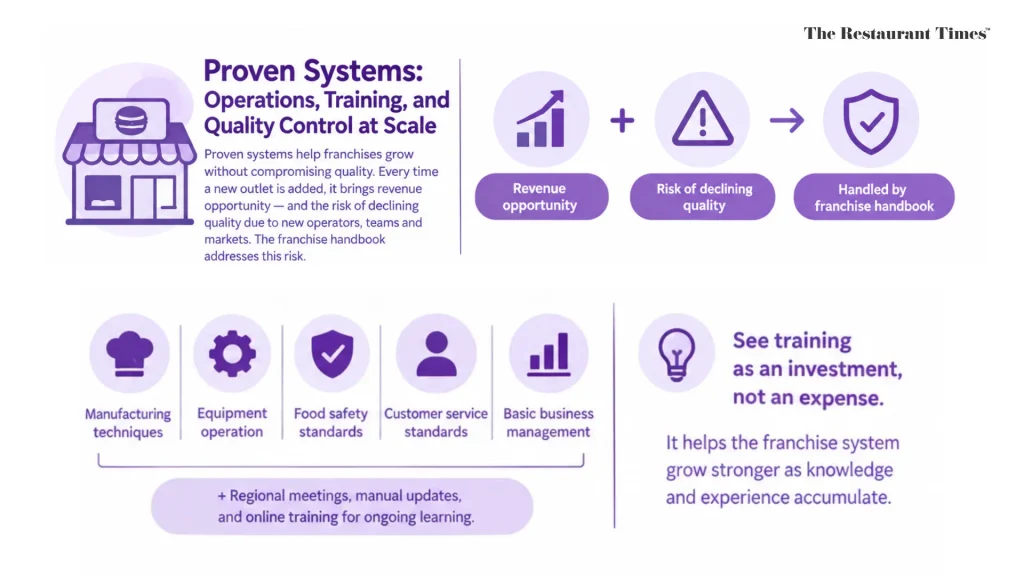
Proven systems help franchises grow without compromising quality. Every time a franchise outlet is added to the existing system, it creates two factors: a revenue opportunity and a risk of declining quality due to new operators, new teams, and a new market. The franchise handbook already addresses this risk.
Le Macaron French Pastries implemented a modern franchise model targeting convenience-focused customers seeking high-end, affordable, healthy cuisine. The brand positioned bakery franchises as daily destinations offering convenient choices with quality pastries and coffee. They emphasized convenience, coffee, and confections to build loyal customers who stop on their way to work or on their way home. The brand recognized that modern consumers need convenient food options but want to feel good about their choices. By positioning itself as a quality daily break from routine rather than just another quick-service option, Le Macaron built customer loyalty through consistent quality and a welcoming environment that allows guests to savor the moment. Bakery cafés are a $17 billion industry, with a record of growth nationwide and in cities large and small. That growth has increased over the past year to almost 3% annually.
Training as a Competitive Advantage
The most common way to transfer a franchise system’s business model to new franchises is through extensive training. Training periods for bakery franchises usually last from two to four weeks and are held in a training center. The training program covers topics such as manufacturing techniques, equipment operation, food safety standards, customer service standards, and basic business management. Regional meetings, updates to the operations manual, and online training programs provide ongoing training.
By viewing training as an investment, not an initial expense, franchise executives can build a franchise system that continually improves as knowledge accumulates through training programs.
Franchise Opportunities: What Championship Caliber Partners Actually Look Like
Just as franchise development is essential, evaluating franchising options is equally vital. Evaluation criteria for individuals considering bakery investments through franchise programs include the franchise organization’s reputation, the adequacy of its playbook, the training and support framework, the financial model for representative franchise units, and the franchise owners’ experience operating the system.
Get in touch with existing and ex-franchisees, not only those who have been mentioned by the franchise organization in its job offers and marketing communications, but all players in the system. Contact franchise owners directly, and hear what they say about the process. Ask about the quality of support provided when problems arise, how responsive the franchisor is to franchisees’ suggestions, and how actual performance compares with projections in the franchise disclosure document.
Partners in any franchise venture should have business expertise, sufficient capital, a commitment to maintaining brand standards, and the ability to build teams of skilled workers. These championship-caliber partners conduct rigorous evaluations of the franchise opportunity before getting into it, and that thoroughness itself indicates the professionalism they will apply in managing the unit.
The bakery industry has grown globally and has seen the rise of franchises and bakery brands with multiple outlets, rather than individual bakeries, because consumers demand quality and consistency across locations. 94% of consumers purchase bread products, demonstrating near-universal market penetration. In 2026, the brands that will grow the most are those that developed franchises with comprehensive playbooks, supported by training programs before going full throttle. The playbook is the product while the bakery is the concept.
KEY TAKEAWAYS
| – The franchise playbook is the key document that ensures quality across all franchise units because it has to be detailed enough to cover production, ingredients, training, brand standards, operations, etc., everything, so that the well-trained franchisee could operate to the same extent as anyone else. – Proven business model testing, with data from actual franchisees and their revenues and satisfaction, is the key distinction between valid franchises and those that launch prematurely and cause problems to the initial franchisees. – Brand recognition is an advantage that franchise brands have created through the entire system, and that each franchisee will get right away; the protection of such an advantage by strict standards enforcement is a must. – The championship-level franchise partners do the evaluation of franchise opportunities just like franchisors evaluate franchise applicants; the most successful relationships come from mutual due diligence |
Frequently Asked Questions
1. What franchise can I open with $50,000?
You can open various home-based, mobile, kiosk, and low-cost food franchises with $50,000. Remember to include working capital, equipment, and other expenses besides the franchise fee.
2. How much is a bakery franchise?
Bakery franchise costs depend on factors such as brand, location, store type, equipment, and size. You should check out the FDD for the complete amount.
3. What do you call a company that owns multiple franchises?
It is commonly called a multi-unit franchisee or multi-unit franchise operator. The company owns or manages several units.
4. What operational systems do multi-outlet bakeries need?
Multi-outlet bakeries need recipe standards and SOPs, an inventory and purchasing system, a sales recording system, a production or logistics process, employee training, quality management, scheduling, and more.