
Did you ever notice how a significant chunk of your so-called regular customers never even come to your café that often? In fact, according to the National Coffee Association’s Spring 2026 National Coffee Data Trends report, 82% of Americans who drank coffee in the past day had it prepared at home, while only 28% had it prepared away from home. Your coffee shop wins the latte on the way to work. But when customers are making coffee at home, they’re more likely to buy it from –
- A grocery store
- A big-box retailer (like Costco, Walmart, etc.)
- Another brand’s coffee subscription service
The best way you (or any local coffee shop, for that matter) can win back those at-home cup sales is through a coffee subscription model. Like, it basically means now you’re not just selling a full-on prepared drink but also a recurring relationship via providing your customers with freshly roasted coffee that they choose to get delivered to their home on a set schedule, get a monthly drink plan that can be redeemed in-store, or even join a membership that offers both. If you can get this right, your occasionally visiting customers are sure to turn into regulars who bring on predictable monthly revenue around which you can plan your inventory, staffing, and roasting.
This is a really great opportunity, but again, we are not denying the risk, too. Coffee prices are on the rise, and there’s a term called subscription fatigue that’s more than real. Plus, if you somehow end up badly pricing your plans, you’ll lose more members than you could ever gain. So, how do you get it right? This guide will walk cafe owners like you through every step, from how you can choose the right subscription model and price it profitably to launching the plan without making it extra work for your baristas.
What You’ll Learn
- Which coffee subscription model should you choose for your café, and how can you price it so every member is profitable?
- How do you launch, market, and retain subscribers without having to worry about your day-to-day café operations?
Why Should a Coffee Shop Consider a Coffee Subscription Model?
The reasoning is actually quite obvious – a coffee shop should consider a coffee subscription model because it does three things –
- It helps you create stable income from customers who already love your coffee and keep coming back for more
- It captures the market of those consumers who prefer at-home drinking, and you might otherwise be missing out on
- Since walk-in sales tend to go up and down a lot depending on the weather, or if it’s a holiday, and foot traffic in general, subscription revenue keeps the income coming.
Plus, because subscription revenue automatically renews on a fixed date (unless someone cancels), you already know in advance how much coffee you should order or roast, how many bags you should pack, and how much cash you will be making at the end of each month.
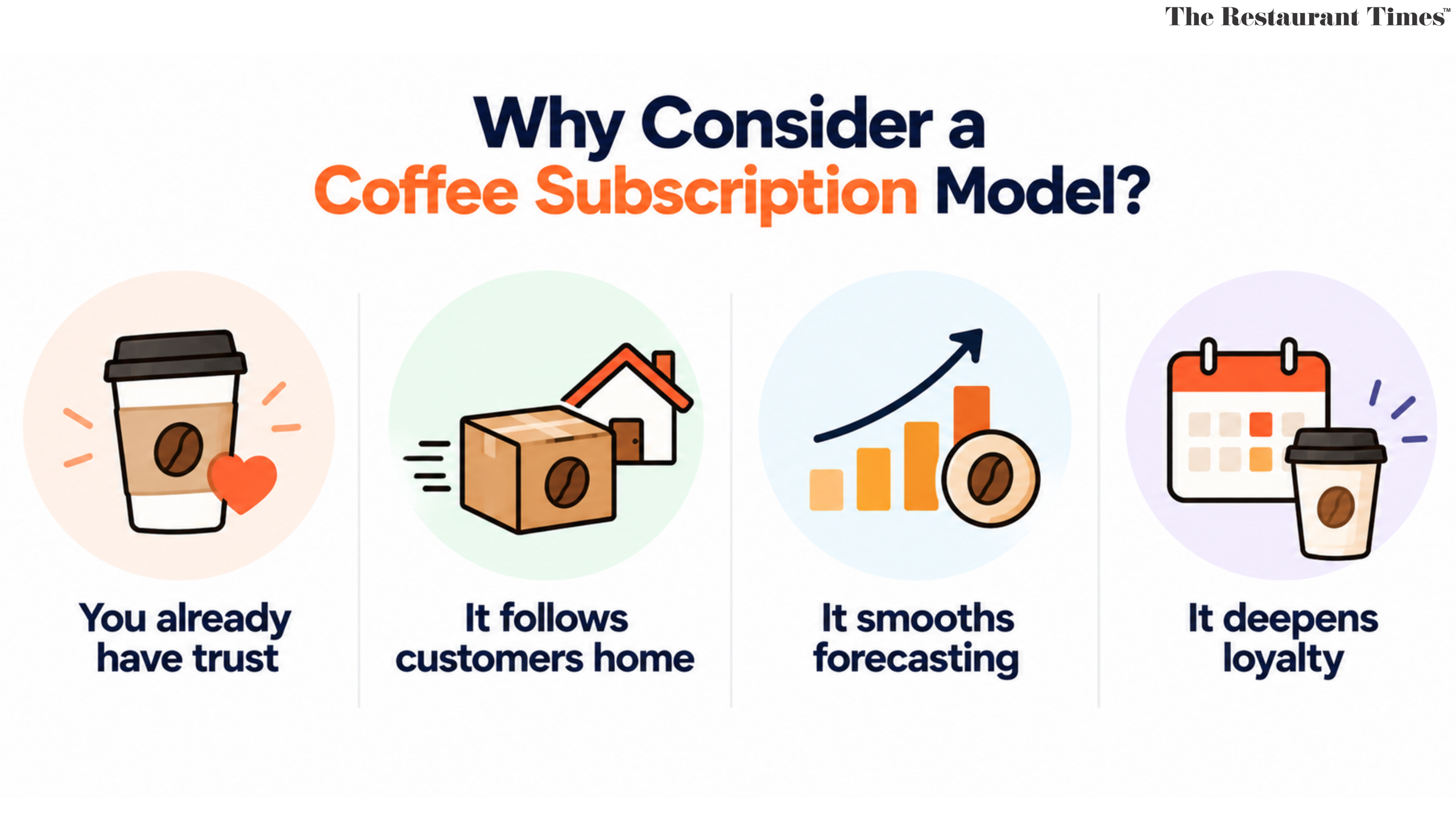
There are four practical reasons the model suits cafés:
- You already have the hardest asset, i.e., trust. Your regulars already trust that you serve great coffee – they know what coffee beans you use, your baristas (some even know each other by name), and your flavor notes, so selling them a subscription is very easy than if you go online and try to convince a total stranger to try a new coffee.
- It follows customers home, which is really important because more and more coffee drinkers are now buying coffee online. NCA data shows the share of past-day coffee drinkers who bought coffee online doubled from 7% in 2020 to 14% in 2025.
- It smooths forecasting. Fresh Cup notes that subscriptions give roasters predictable revenue because they know how much coffee they need to roast for subscribers.
- It deepens loyalty because, obviously, a member who is getting their coffee delivered at home every two weeks is surely thinking about your brand quite often too.
INDUSTRY INSIGHT
| Data shows that specialty coffee is now the default for a large share of American coffee lovers, and maybe that’s why a café subscription works really well there. The NCA’s 2026 Fall National Coffee Data Trends report found that a record 48% of U.S. adults had specialty coffee in the past day, and out-of-home coffee consumption hit its highest level since January 2020. Subscriptions are still in the process of getting “accepted” more, though. In fact, coffee subscriptions account for roughly 2% of global coffee spending, or about $685 million a year, with that share expected to reach 5–7% by 2032. This means that brands that can commit to this model can expect a good enough payoff. At Philadelphia-based La Colombe, roughly 20% to 30% of customers are active subscribers. |
Which Coffee Subscription Models Work Best for Coffee Shops?
For cafes, there are a few types of coffee subscription models that you may want to try:
- Bean replenishment plans
- In-cafe drink memberships
- Hybrid local memberships
- Curated discovery boxes
Each of these suits a very different café profile, and how do you find which one suits yours? Depending on whether you prefer to roast or not, how much counter capacity you have, and how many customers live near your shop.
| Model | How It Works | Best For | Real U.S. Example | Main Risk |
|---|---|---|---|---|
| Bean Replenishment | Members receive the same house blend or a chosen coffee on a set schedule, shipped or picked up. | Cafés that roast or have a strong private-label roaster. | Oddly Correct’s No Fuss plan: $14 a bag, weekly or every other week. | Shipping costs can erase margin on low-priced bags. |
| In-Café Drink Membership | Customers pay a flat monthly fee that covers a set number of drinks, redeemable at the counter. | Cafés that receive high traffic and have spare capacity beyond serving the morning rush. | Panera’s Sip Club: $14.99 a month or $119.99 a year for 30 self-serve drinks per month – started on August 19, 2026. | Members who visit the café very often may redeem more value than they pay for. |
| Hybrid Local Membership | A bean subscription bundled with in-store perks such as café credit. | Neighborhood cafés with many regulars living nearby. | Nice Coffee Roasters’ Locals Only: a $15 café gift card every month. | Perks must be priced just as carefully as the beans themselves. |
| Curated Discovery | A rotating single-origin assortment specifically chosen by the café team. | Cafés with access to multiple origins and staff who can write tasting notes. | YES PLZ’s rotating weekly coffee, from $22 a week. | Sourcing new beans every cycle takes time and skill. |
| Paid Annual Membership | An annual fee unlocks free shipping, member pricing, and early access. | Established brands with an existing subscriber base. | La Colombe’s membership: $44 a year. | Members expect visible, ongoing value for the fee. |
There are two more formats that you may consider, but only as add-ons and not as standalone plans. These are –
- A cold brew subscription which can be sold as weekly concentrate or growler refills for local pickup. This is perfect for cafés that already batch cold brew.
- A gift subscription that is sold in three-, six-, or twelve-month blocks, and brings in cash upfront during the holidays and introduces new coffee drinkers to your brand.
Mind that, while we’ve listed every popular model there is, you should choose one that fits your brand the best. If we go just by what other operators share on the internet, bean replenishment is the least risky entry point because here you are using the same coffee you already sell on the counter, so there is no additional pressure on your espresso bar whatsoever (minus staff you’d need for packaging).
How Do You Choose the Right Coffee Subscription for Your Café?
To choose the right coffee subscription, what you have to do is – match your preferred plan to four things –
- Your coffee supply
- Where your customers live
- Your bar capacity
- What your regulars drink at home
The right subscription model will always be the one that your cafe can fulfill reliably every single cycle.
Work through these questions before you commit:
- Do you roast, or do you buy from coffee roasters? In case you roast in-house, you can control the freshness of the bean you deliver and your margins too. In this case, a bean replenishment plan will be best. But, in case you buy from a wholesale roaster, you’d need to confirm if they can supply consistent volume with private-label bags and a roast date mentioned on each of those bags.
- Where do your regulars live? If most of them live within a few miles of where your cafe is located, a pickup-first plan will reduce the need for shipping, which btw unnecessarily adds to the cost too. Take Oddly Correct in Kansas City, for example: it estimated (of course after proper market research) that its subscribers are about half local and half national, so it planned for both – pickup + shipping.
- How busy is your bar? See, if you already receive a good enough morning rush, a drink membership would only add to all that chaos. What you can do here is maybe offer member drinks during off-peak hours or simply go for a bean plan instead.
- What do your customers brew at home? NCA’s 2025 specialty coffee research found that the drip coffee maker is the favorite preparation method for past-day specialty coffee drinkers (36%), and 62% of them prefer to drink a medium roast. That means you can offer this population whole or ground beans, and make your house medium roast the default option, while keeping a single origin choice for adventurous members too.
Now, how would you know which type of coffee your customers are brewing at home, or about their brew method, their personal preferences on roast level, etc.? Simple, just ask them outright. You can even run a short survey at the counter, and let us tell you to be vocal at this point because unless you know what your customers want, you anyhow can’t retain them for long. Plus, answers to these questions will help you decide your bag sizes, grind options, and delivery intervals as well.
Also, don’t forget to consider your audience’s age. The 2026 NCDT Specialty Coffee Report found that 69% of 25- to 39-year-olds had specialty coffee in the past week, the highest of any age group. If that group makes up a large share of your regulars, an app-first, cancel-anytime plan will likely feel more natural to them than a prepaid annual contract.
How Should You Price a Coffee Subscription Without Losing Money?
When you are pricing your coffee subscription, first, calculate the total cost per delivery you’ll be bearing, then add to it your target margin. Give discounts only if the margin still allows it. While we’d say that you should look up online and do a bit of research on how other similar brands are pricing their models, it would be a losing deal if you copy their prices without accounting for your own costs and shipping. What to do instead is –
Start with your coffee cost. In Fresh Cup’s 2026 survey of more than 40 U.S. roasters, the median wholesale price for a roaster’s most-purchased coffee was $12.85 per pound, and 52% of the roasters who answered said they plan to raise wholesale prices in 2027. Retail prices are moving too: retail coffee prices were running 10.3% higher year over year in the July 2026 Consumer Price Index.
Now consider these numbers – it shows how, if you, let’s say, plan to sell a 12 oz bag at $24, in both ways – ship vs. pick up – how do both compare against each other?
| Cost Line (per 12 oz Bag) | Shipped | Picked Up In-Store |
|---|---|---|
| Coffee (0.75 lb at $12.85/lb) | $9.64 | $9.64 |
| Bag, Label, and Mailer | $1.50 | $1.00 |
| Shipping (1 lb, Zone 5) | $8.74 | $0.00 |
| Card Processing (2.9% + 30¢) | $1.00 | $1.00 |
| Total Cost | $20.88 | $11.64 |
| Gross Profit on a $24 Bag | $3.12 (13%) | $12.36 (52%) |
Sources: Fresh Cup, Ship.com, Website Builder Expert.
See how your “free shipping” on just one 12 oz bag leaves you no margin for covering labor, rent, or the cost of acquiring the subscriber. So, now the question is: how can you still protect your margins?
- Make pickup the default for local members. First, this way you’ll have to offer shipping to every subscriber. Second, it will bring your local subscribers into the cafe, where there is a high chance that they will buy a sandwich or pastry alongside the coffee as well.
- Charge shipping, or set a free-shipping threshold. Like, clearly mention that “delivery allowed only when you order more than 2 bags or 2 lb at minimum.”
- Keep the member discount modest. Discount from a profitable full price, not from cost – just like Evans Brothers in Idaho. The brand looks for a minimum 40% margin on its all-in cost, and La Prima’s director of operations advises “no loss leaders.”
- Write price changes into your terms. With green coffee costs volatile, state upfront that prices may change with advance notice.
Mind that if you have chosen to go with an in-café drink membership, things would work a little differently. In this case, you should first estimate how many drinks a member tends to redeem on average, then multiply it by your cost per drink, and then set the fee in a way that looks defensible but is actually still earning you a profit. If by chance it’s not profitable, you can try to cap the limit on redemption too. If you look at Panera’s own explanation of its Sip Club, it clearly states how even if members select just four drinks per month, the fee of their subscription is more or less covered. In 2026, the chain even added a 30-drink monthly cap.
What Should You Include in a Coffee Subscription to Make It Worth Paying For?
Ask yourself, if you were a customer, what would you have willingly paid for if you had to take a coffee subscription? Probably your list would include freshly roasted coffee, flexibility to choose what you prefer, useful information on how and where your beans are coming from, and at least one perk that walk-in customers are not getting. Ask yourself, if you were a customer, what would you have willingly paid for if you had to take a coffee subscription? Probably your list would include freshly roasted coffee, flexibility to choose what you prefer, useful information on how and where your beans are coming from, and at least one perk that walk-in customers are not getting.
See, those who have chosen to subscribe to you are not paying for coffee beans alone – like, literally, they can get those beans at the next grocery store. What they’re really paying for is the freshness, the convenience, the thrill of discovery, and that sense of community that your café must have given them when they first walked into the store.
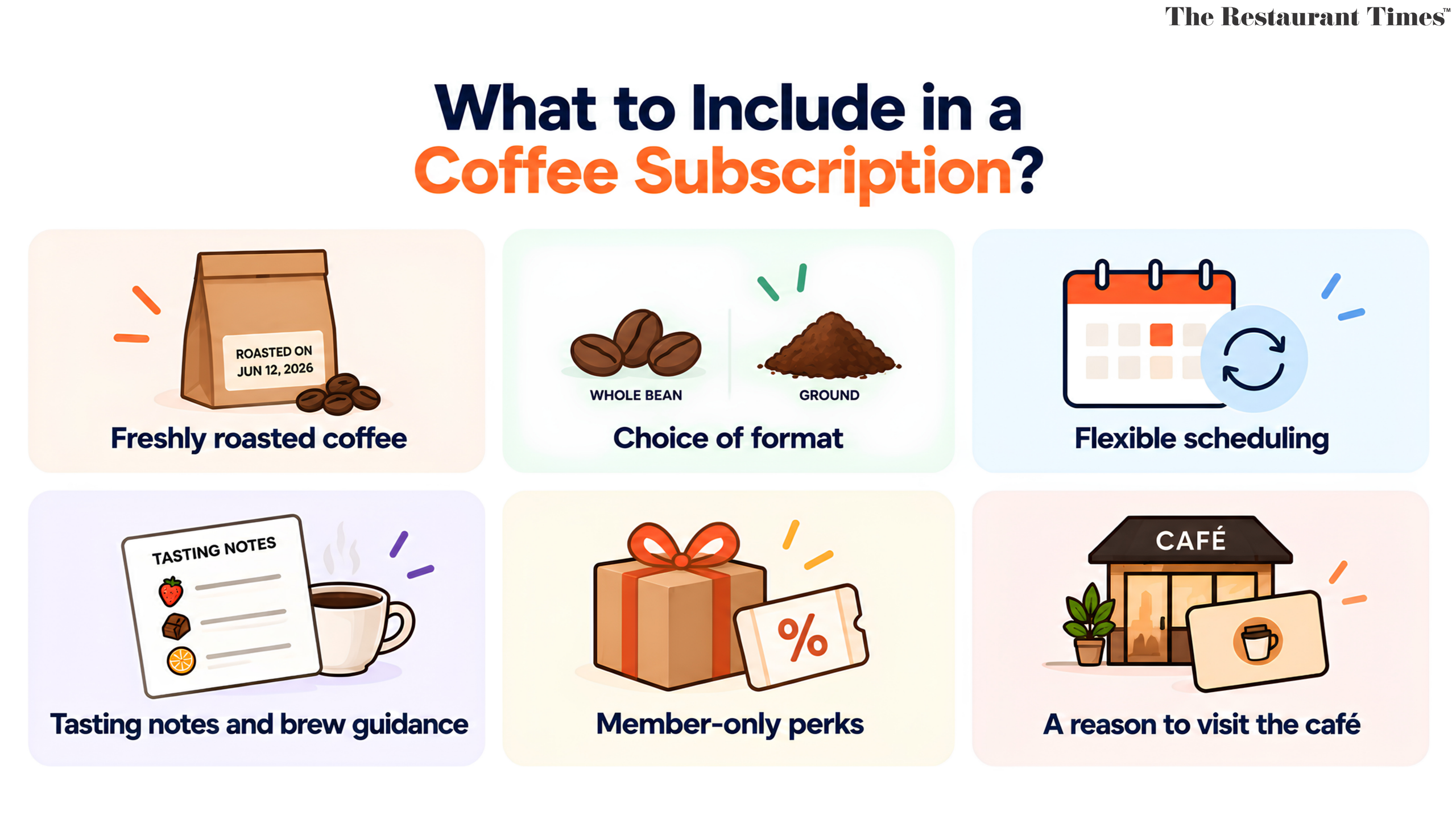
Leading U.S. coffee subscriptions share a common core. Build yours around these elements:
- Freshness you can prove. Always print a roast date of the beans on each bag. For example, you can write that the coffee is roasted to order and is shipped within 24 hours of roasting – just make sure you’re actually doing that too. As for the example, Blue Bottle describes its subscription coffee as roasted daily to order.
- Choice of format. Let members pick whole or ground beans, a grind setting for their brewer, and a bag size. Atlas Coffee Club, for example, ships either whole bean or freshly ground coffee.
- Flexible scheduling. Blue Bottle allows its subscribers to skip a shipment, pause their deliveries, switch up their coffee choices, and pick delivery every one, two, three, or four weeks.
- Tasting notes and brew guidance. Atlas Coffee Club includes tasting notes, brewing tips, and a postcard from the coffee’s origin country in each box.
- Member-only perks. Blue Bottle subscribers get free shipping, early access to product releases, and subscriber-exclusive pricing on add-ons. Bean Box offers members 15% savings on coffee purchases and 5% back in credits.
- A reason to visit the café. This is where a local coffee shop beats national brands. Nice Coffee’s Locals Only plan includes a $15 café gift card every month.
You can also add tiers for different coffee enthusiasts. A core tier might ship your house medium roast. For a discovery tier, just rotate a single-origin coffee each month. And a premium tier, as the name says, should feature limited coffees and small-batch micro-lots. For members who love cold brew, you may offer them a coarse-ground option labeled for cold brew, or a pickup plan for ready-to-drink concentrate.
Finally, tell the story behind your beans – what farm were they sourced from? What was the processing method like, etc. If you pay fair trade prices or source through direct relationships with coffee producers, say so, and back it up with specifics. Arkansas roaster Onyx, for instance, has very clearly mentioned publicly that X is the amount they pay for coffees, along with who they bought them from.
How Do You Launch a Coffee Subscription Without Disrupting Café Operations?
Very simple – just start small. If you don’t want your coffee subscriptions to disrupt your daily café operations, you will need to separate subscription work from, let’s say, your bar work, and you also need to set a fixed schedule and SOPs for roasting, packing, and pickup of your beans.
Follow this sequence:
- Run a capped pilot. Open the plan to a limited number of regulars first, such as your first 25 or 50 members. A cap protects your capacity, lets you test packing times and bag costs, and makes early membership feel exclusive.
- Pick one fulfillment day. Choose a slow weekday afternoon to roast or receive beans, bag, label, and pack every order. Batching is far faster than packing orders one at a time between drink tickets.
- Create a pickup shelf. You can label member bags by their respective name and keep them away from the main counter, so your in-store queue and your pickup queue are organized.
- Connect billing to your POS. Use a platform that charges members automatically, flags failed payments, and shows each member’s plan when a barista looks them up.
- Write a one-page staff guide. Cover how to sign someone up, how to look up a member, which drinks are included, and what to say when someone asks to pause or cancel.
- Set clear redemption rules for drink plans. You can do three things here: put a limit on how many drinks a member can have per visit, do not allow redemption on drinks that require a lot of labor to make, and maybe allow redemptions only during off-peak hours.
Once the pilot is up and running, forecasting usually becomes super simple. And because you know each member’s delivery schedule, you can determine how many pounds you’ll need each week ahead of the roaster’s order deadline.
Digital ordering habits help here too. In the NCA’s Fall 2026 report, a record 40% of past-week out-of-home coffee buyers ordered through an app. If your customers already order ahead, let them manage their subscription in the same place.
How Can You Market a Coffee Subscription and Turn Regulars Into Members?
You turn regulars into members by marketing the subscription inside the café first, making the first step cheap or free, and giving people a reason to sign up now. Your best prospects are already in line every morning. They know your coffee and trust your baristas, so the pitch is short.
Start at the counter. Train baristas to mention the plan when a regular buys a retail bag or orders the same drink every day. Add a QR code to cup sleeves, table tents, and receipts that goes straight to the sign-up page.
Lower the risk of the first order. Big-name brands really lean into this strategy. For example, Trade has a Discovery Trial that includes three bags from different roasters, plus the first bag is free, while Bean Box promotes “Your 1st Coffee’s on Us” on their website. If it’s possible, you can go on to provide a free drink on sign-up too, or a discount on the free bag, or even a free in-store tasting of the subscription coffees.
Host a cupping night. Get your regulars together to sample three subscription coffees side by side, share the flavor notes, and allow them to sign up right there.
Use the local angle. There’s one roaster in Los Angeles called Nice Coffee Roasters. What it did was build a Locals Only plan where they started giving out a free cup of coffee with a bag purchase.
Sell gifts in the fourth quarter. Gift subscriptions in three-, six-, and twelve-month blocks are a natural holiday product. Atlas Coffee Club offers three-, six-, and 12-month gift options. A gift introduces new people to your café, and it gives you a chance to invite recipients to continue on a paid plan when the gift ends.
Reward referrals. Give members a free bag or drink credit when a friend joins. Atlas Coffee Club’s rewards program awards points for referrals, and the same idea works on a punch-card scale in a single café.
Position the plan as a gateway, not just a luxury. Oddly Correct in Kansas City says its affordable No Fuss subscription now introduces many people to specialty coffee, and it prices it deliberately to do so. Not every member needs to be a coffee obsessive; many simply love coffee and want great coffee at home without thinking about it.
How Can You Reduce Coffee Subscription Cancellations and Improve Retention?
You reduce cancellations by making it easy to adjust instead of quit, recovering failed payments, and giving members ongoing value rather than repeated discounts. Churn is the number that decides whether a subscription model creates stable income or a leaky bucket. Shoppers are also pruning subscription services: Fresh Cup reports that the average American spends more than $300 a month on subscriptions and memberships, and nearly half have canceled at least one service in the past year.
Know the benchmark you are fighting. Recurly, a subscription billing platform, reports that B2C sectors, including consumer goods and retail, average a monthly churn rate of 7.1%, higher than B2B subscriptions. Fresh Cup notes that consumer replenishment subscriptions like coffee typically see 4% to 7% monthly churn, with many cancellations happening in the first one to three billing cycles. That means your first three deliveries matter most.
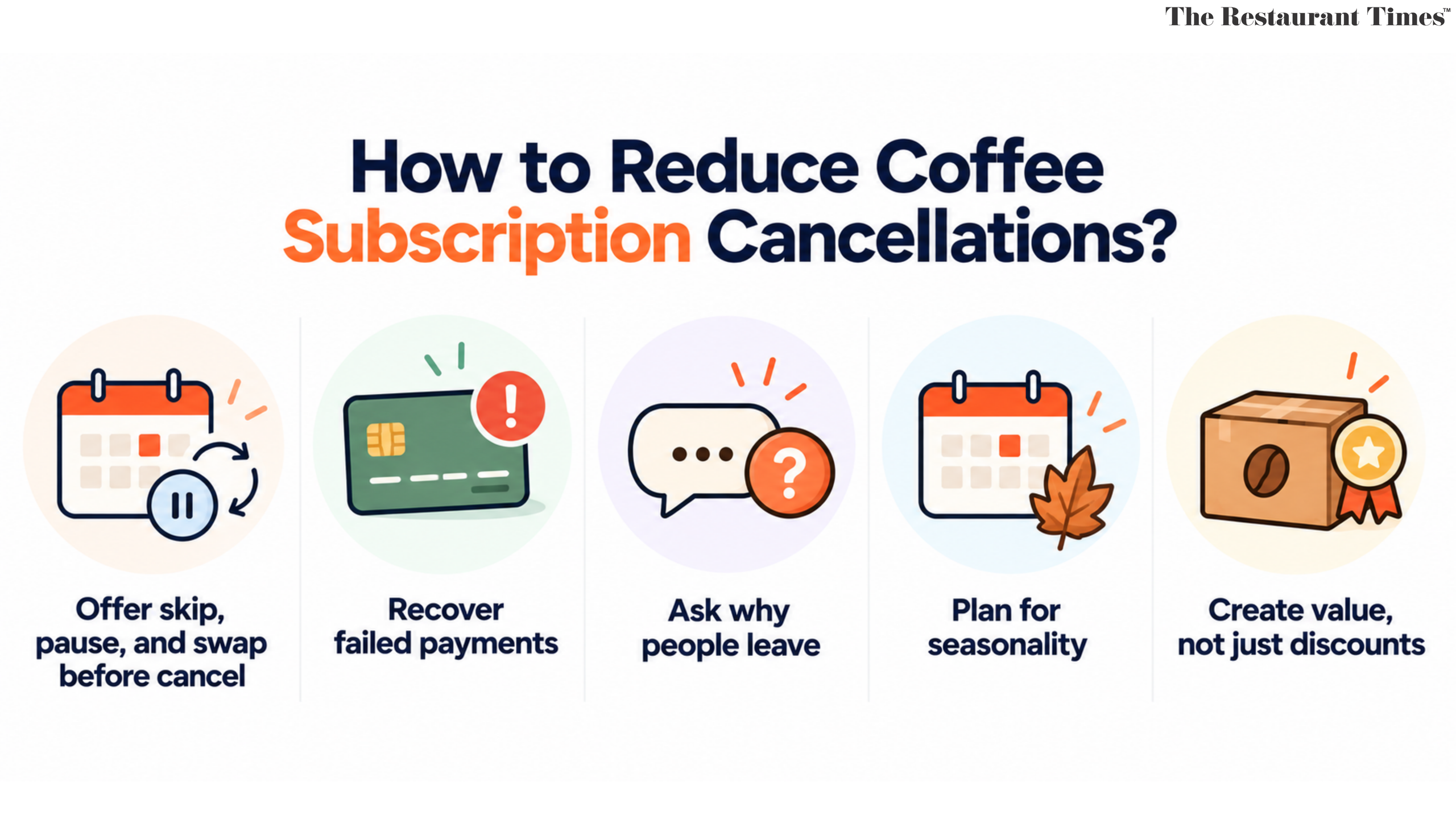
Put these retention tactics in place from day one:
- Offer skip, pause, and swap before cancel. There are times when we bought something last week and expected it to be used up by now, but it is still not finished. The obvious choice then is to skip this week’s order, right? The same should be available in coffee subscriptions, along with the ability to configure the order too.
- Recover failed payments. Some churn is involuntary, caused by expired or declined cards. Recurly found that among its customers who reduced overall churn year over year, lower involuntary churn was the primary reason for 52% of them. Turn on automatic card retries and card-update reminders.
- Ask why people leave. La Colombe tracks the reason behind each cancellation, whether it is price, changing habits, or a discontinued roast, and uses that feedback to improve.
- Plan for seasonality. YES PLZ typically sees a slowdown in January and February and a lift during back-to-school season in September. Time new coffees and sign-up pushes around your own patterns.
- Create value, not just discounts. YES PLZ co-founder Tony Konecny believes discounts alone are not a sustainable retention strategy, so the brand leans on newsletters with coffee education and tasting notes instead. Early access to new coffees, members-only events, and loyalty credits like Bean Box’s 5% back work the same way.
Finally, make cancellation honest and simple. Promise cancel anytime and mean it. The FTC’s 2024 click-to-cancel rule was vacated by a federal appeals court in July 2025, but state laws still apply. In fact, California’s amended Automatic Renewal Law, effective July 1, 2025, sets requirements on disclosures, consent, cancellation, and renewal reminders. These rules are there in every state, although they may vary a bit here and there. You should check the rules properly or ask an attorney for the same.
How Can You Measure Whether Your Coffee Subscription Is Profitable?
You can figure out if your coffee subscription is profitable or not by keeping an eye on your gross profit per delivery, monthly churn rates, and the lifetime value of a subscriber against what it must have cost you to acquire them in the first place.
For starters, make sure to track these numbers every month:
- Monthly recurring revenue (MRR): This is the total subscription billings for the month, and it is, in a way, your income line.
- Active subscribers and net growth: This is calculated by taking new members and subtracting cancellations.
- Monthly churn rate: This is the number of members lost during the month divided by the number of members at the start of the month.
- Gross profit per delivery: This is the price minus the costs of coffee, packaging, shipping, and payment fees.
- Lifetime value (LTV): With a steady churn rate, the average subscriber stays for about 1 divided by the monthly churn rate in months. Multiply that by the monthly gross profit per member.
- Customer acquisition cost (CAC): This is what you spend on free drinks, discounted first bags, ads, and printed materials to attract each member.
- In-store spend by members: For pickup and hybrid plans, track what members buy when they collect their coffee. This can be the hidden profit of a café subscription.
Also, separate subscription profit from café profit in your books. What you can do is: almost every POS provides an option to tag orders so you can simply mark them “subscription orders” and then sort them to see each member’s visit records, whether they made any add-on purchases, and whether referrals are growing or not. This will help you with your overall brand loyalty program as well.
What Are the Most Common Coffee Subscription Mistakes to Avoid?
The most common coffee subscription mistakes are: underpricing, overpromising on value that can’t be maintained, launching with too many choices, and making cancellation a hassle. Most of these can be easily avoided with some careful planning and a limited pilot program.
- One mistake is pricing based on what competitors charge instead of your own costs. A big national brand can offer lower prices because they buy in bulk, but this could be detrimental for a small café. Instead, set your prices based on the calculations from Section 4.
- Offering free shipping on single bags – As the example shows, shipping can consume most of the margin on a 12 oz bag. Use pickup, a shipping fee, or a two-bag minimum.
- Another issue is labeling a plan as “unlimited” without actually having any limits. For example, Panera’s Unlimited Sip Club started in 2022 at $10.99 a month, but by 2026, they had to drop the term “unlimited” and limit members to 30 drinks per billing cycle. This led to a lot of negative feedback on social media, and so it’s better to establish reasonable limits from the start rather than taking value away later.
- Launching with too many choices. Offering five plans, four bag sizes, and six grind types can lead to packing mistakes. It’s smarter to start with just one or two plans and then expand once everything is running smoothly.
- Letting freshness slip. If a member receives stale beans or an undated bag, you have handed them a reason to try other coffee subscriptions.
- Shipping the same thing forever. Even members who want one favorite coffee appreciate an occasional different coffee or seasonal release. Offer swaps and new coffees, but let members opt out if they only want their usual.
- Ignoring failed payments. You can usually fix involuntary churn by using automatic retries and sending out card-update emails.
- Making cancellation difficult. You should rather work on your service and quality than resort to hiding cancel buttons. This one move, while it might seem harmless and even a good way to avoid cancellations, IT’S NOT!!! Hiding cancel buttons damages trust and might even get you into legal trouble with state automatic renewal laws. You’re better off letting your members cancel easily with just a few clicks.
- Forgetting the team. If baristas cannot explain the plan in one sentence or look up a member quickly, sign-ups stall and redemptions slow the line.
Is a Coffee Subscription the Right Next Step for Your Café?
If your café has a solid group of loyal customers, a steady supply of fresh coffee beans, and the ability to handle orders on a regular schedule without slowing down service, then a coffee subscription is the perfect next move. With these three elements in place, a well-priced subscription plan can work wonders and give you a consistent source of income.
Here’s a quick checklist to see if you’re ready:
- Loyal regulars: Do you have at least dozens of customers who come to your cafe a few times a week or might already be buying retail bags from you?
- Reliable supply: Can you or the roaster you buy your coffee from promise to provide the same high-quality whole beans and ground coffee each cycle, with a roast date on the packaging?
- Margin room: Are you profitable even if you’re shipping your beans, or will you need to make pickup your default option?
- Operational capacity: How many people would you need to employ to batch-pack orders?
- Simple tools: Does your tech stack (specifically POS) help you with recurring bills, failed-payment retries, and self-service pause and cancel?
If you can clearly answer all these questions, feel free to kick off a coffee subscription for local pickup. Limit it to a small group of members and track its performance over the next three months.
Remember that customers already have plenty of other subscription services they have to manage on their monthly budget, so they’d need a very, very strong reason to subscribe to you. And it’s not like the business is risky – nearly 195 million American adults drink coffee each week, and 58% had specialty coffee in the past week as of January 2026 – but if your quality is not top-notch and consistent, enrollment will probably not be as expected.
KEY TAKEAWAYS
| – Data shows that at least 82% of Americans drink coffee daily, and most of them have it prepared at home. – Pick one model and pilot it. There are several types of subscription models you can choose from. Among these options, starting with bean replenishment and local pickup is probably the least risky choice, whereas drink memberships might require you to establish clear redemption limits right from the beginning. – Sell more than just coffee. Customers will only be willing to pay you every month if you can offer them freshness, flexibility, tasting notes, early access, and guaranteed café perks that other customers may not be getting otherwise. – On your subscription plan, let customers be able to skip and pause, recover failed payments, and cancel anytime they want. Plus, your staff should be able to see the cancellation reasons. – Measure lifetime value, not just sign-ups. If you really want to know if your plan is profitable or not, you must be checking your gross profit per delivery, monthly churn, and acquisition cost. |
Frequently Asked Questions
1. How profitable is a coffee subscription business?
A coffee subscription service can be very profitable, but only if pricing and fulfillment are built around your real costs. In the worksheet above, a $24 bag of coffee beans earns about 52% gross margin when picked up in-store, but only about 13% when shipped free. At scale, subscriptions can become the core of the business: YES PLZ says subscriptions account for roughly 85% to 90% of its business, and La Colombe says 20% to 30% of its customers are active subscribers. Churn is the biggest swing factor, since consumer replenishment subscriptions like coffee typically lose 4% to 7% of members a month.
2. What platform should I use to sell coffee subscriptions?
Any platform that can connect with the channel you already use to sell your coffee online is the best platform.
However, remember this one thing: whichever platform you choose, you should confirm a few details about it beforehand – whether it supports whole-bean or ground options, clauses for local pickup, skip and pause, what happens when a payment fails, etc.